

Phase 1: Empathy (The K-Travel Cold Open)
Hello! I’m the Lead Editor at Daily Hangul.
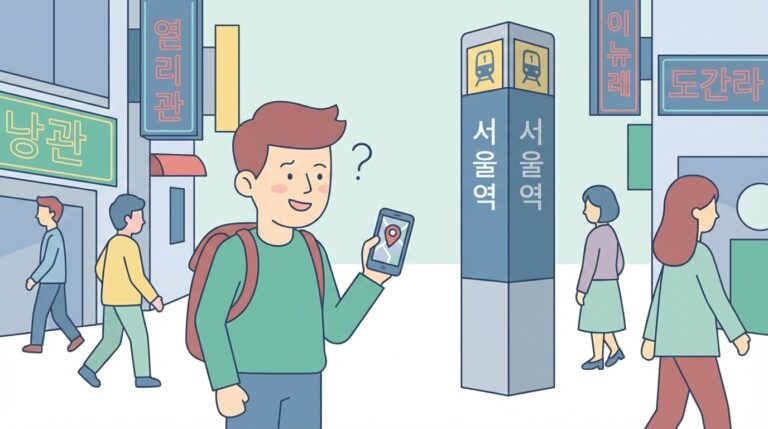
Picture this: You’re standing in the middle of Myeongdong or Hongdae. The map app on your phone flashes a cheerful blue dot with the message, “You have arrived!” You look up, expecting to see that trendy K-Pop pop-up store or that viral cafe you saw on TikTok.
But… there’s nothing. Just a wall of overlapping neon signs, a convenience store, and a chaotic sea of people.
Where is it? Is it underground? Is it on the 4th floor of a building that looks like an office? Is it hidden in an alleyway the width of your shoulders?
If you’ve ever traveled to Korea or watched a K-Drama where the protagonist effortlessly navigates winding hillside neighborhoods (골목길), you know that finding locations on a map in Korea is practically an extreme sport. Korea is a highly dense, vertical country. Addresses and GPS coordinates will only get you so far—eventually, you’ll need to look around, or better yet, ask a local.
Don’t worry! As someone who has lived in Seoul for over a decade (and still gets lost in COEX mall), I’ve guided countless students through this exact frustration. Today, we’re going to learn the authentic, street-smart Korean you need to find your way like a true local.
Phase 2: Deep Dive into Core Expressions
Let’s look at the top three expressions you’ll need when the map app fails you.
1. [장소] 찾고 있는데요.
- Pronunciation: [jangso] chat-go inneundeyo.
(Sound analogy: “chat” sounds like the English word chat, “go” like go, “in-neun-dae-yo” flows smoothly).- Meaning: I am looking for [place]. (Literal) / Excuse me, can you help me find [place]? (Real nuance)
- K-Culture Moment: In K-Dramas, when the protagonist arrives in Seoul from the countryside with a piece of paper in their hand, they stop a busy Seoulite and use this exact phrase.
- Editor’s Insight: This phrase is pure magic. By ending with “~는데요” (which creates a trailing off effect), you aren’t aggressively demanding “Where is this?” Instead, you are stating your situation and politely inviting the other person to help. It’s soft, polite, and very Korean.
- Situation Spectrum:
- Casual (Friends): ✅ (Drop the ‘yo’ -> 찾고 있는데)
- Semi-formal (Strangers on street): ✅
- Formal (Boss/Elders): ⚠️ (Better to ask: [장소]가 어디에 있는지 아시나요?)
- 🤔 Think About It: Why does Korean have so many grammar structures (like ~는데요) that intentionally leave the sentence “open-ended”? How does this reflect the cultural value of not imposing on others?
2. OOO역 N번 출구 근처예요.
- Pronunciation: OOO-yeok N-beon chulgu geuncheoyeyo.
- Meaning: It’s near Exit N of OOO station.
- K-Culture Moment: If you’re going to a K-Pop fan meeting or meeting a friend for Korean BBQ, the location is always described by its nearest subway exit. “Let’s meet at Gangnam Station Exit 10” is a classic.
- Editor’s Insight: In Korea, subway exits are the ultimate compass. We don’t say “It’s on Maple Street.” We say “Come out of Exit 3 and walk straight.” If you know the exit number, you are 90% there.
- Situation Spectrum:
- Casual: ✅
- Semi-formal: ✅
- Formal: ✅
- 🤔 Think About It: Does your hometown rely on street names, cardinal directions (North/South), or landmarks to navigate? How does the reliance on public transit shape the way Koreans map their cities?
3. 이쪽으로 쭈~욱 가세요.
- Pronunciation: i-jjogeuro jju~~uk gaseyo.
(Sound analogy: ‘jjuk’ sounds like a short, tight squeak, but elongate the ‘u’ to emphasize the distance).- Meaning: Go straight this way.
- K-Culture Moment: Ask any local market vendor (아줌마 or 아저씨) where the best hotteok (sweet pancake) stand is, and they will point emphatically and drag out the word “jjuk” to show just how far you have to walk.
- Editor’s Insight: The longer you drag out the “쭈~~욱”, the further the distance! It’s an incredibly fun mimetic word (의태어) that adds flavor to your Korean.
- Situation Spectrum:
- Casual: ✅
- Semi-formal: ✅
- Formal: ✅
Phase 3: Textbook vs. Real Korean
Let’s see how textbooks differ from the lively streets of Seoul!
[Situation 1: Asking where something is]
* 📖 Textbook Korean: 서울역이 어디에 있습니까? (Where is Seoul Station?)
* 🗣️ Real Korean: 저기요, 서울역 가려면 어디로 가야 돼요? (Excuse me, which way should I go to get to Seoul Station?)
* 💡 Why the difference?: Asking “where it exists” sounds overly philosophical or robotic. Locals prefer asking for the action of how to get there.
[Situation 2: Giving directional advice]
* 📖 Textbook Korean: 똑바로 가세요. (Go straight.)
* 🗣️ Real Korean: 이 길로 쭉~ 직진하세요. (Go jju~uk straight down this road.)
* 💡 Why the difference?: “똑바로” can sometimes sound like a scolding (“Sit straight! Do it properly!”). “쭉” or “직진” (go straight ahead) is much more natural for navigation.
Bottom Note: For B1 learners, mastering conversational softeners like “~가려면 어디로 가야 돼요?” elevates your Korean from a translation app to a real human connection!
Phase 4: Cultural Context — K-Culture Deep Dive
4-1. Non-Verbal Cues: The Art of Pointing
When someone gives you directions, pay attention to their hands. In Korea, pointing with one index finger can sometimes be seen as slightly rude or aggressive, especially toward elders.
Instead, Koreans often point with an open hand, palm facing upward or sideways, gesturing toward the direction. Also, use your Nunchi (눈치): Seoulites walk fast! If you need to ask for directions, try to catch someone who isn’t sprinting to catch the subway. Look for shop owners or people waiting at crosswalks.
4-2. The K-Travel Connection: Vertical Cities & Hidden Hotspots
In Korea, space is at a premium. Unlike sprawling suburbs in the West, Korean cities build up. This is why your map app might say “Arrived,” but you can’t see the cafe.
Many viral K-Food spots, aesthetic K-Beauty showrooms, or hip K-Pop pop-up stores are hidden on the 3rd floor, 4th floor, or even underground (지하) of nondescript buildings. Always look up at the signboards, or look for small standing signs (입간판) on the sidewalk. This architectural reality is why “It’s on the 3rd floor” (3층에 있어요) is a survival phrase!
Phase 5: Real-Life Roleplay Scenario
Setting: Friday 6 PM. The vibrant streets of Hongdae. You are meeting your Korean language exchange partner for some legendary Samgyeopsal (Korean BBQ). You’re staring at Kakao Map, totally confused. You decide to stop a friendly-looking local.
Characters:
– YOU: A hungry traveler, trying your best to use Korean.
– Ji-su (28): A local resident, friendly, carrying an iced americano.
Dialogue:
YOU: 저기요, 길을 잃어서요. 혹시 ‘돼지파티 삼겹살’ 식당 어디 있는지 아세요? 🗺️
(jeogiyo, gireul ireoseoyo. hoksi ‘dwaejipati samgyeopsal’ sikdang eodi inneunji aseyo?)
[Excuse me, I’m lost. Do you happen to know where the ‘Pig Party BBQ’ restaurant is?]
Ji-su: 아! 돼지파티요? 거기 진짜 맛있는데!
(a! dwaejipatiyo? geogi jinjja masinneunde!)
[Ah! Pig Party? That place is really delicious!]
(🎭 Stage Direction: Ji-su points down the street with an open palm)
여기서 저쪽으로 쭉 가시면 올리브영이 나와요.
(yeogiseo jeojjogeuro jjuk gasimyeon ollibeuyeongi nawayo.)
[If you go straight that way from here, an Olive Young will appear.]
YOU: 올리브영이요? 그다음엔요?
(ollibeuyeong-iyo? geuda-eumenyo?)
[Olive Young? And then?]
Ji-su: 올리브영 끼고 오른쪽 골목으로 들어가세요.
(ollibeuyeong kkigo oreunjjok golmogeuro deureogaseyo.)
[Turn right at the alley next to Olive Young.]
YOU: 오른쪽 골목이요… 흠, 조금 복잡하네요. 멀어요?
(oreunjjok golmogiyo… heum, jogeum bokjaphaneyo. meoreoyo?)
[Right alley… hmm, it’s a bit complicated. Is it far?]
Ji-su: 아니요, 걸어서 3분? 거기 2층에 있어서 간판 잘 보셔야 돼요!
(aniyo, georeoseo sam-bun? geogi i-cheung-e isseoseo ganpan jal bosyeoya dwaeyo!)
[No, maybe 3 minutes walking? It’s on the 2nd floor, so you have to look carefully for the sign!]
🔀 Your Turn! How do you respond to end the conversation politely?
– A) “아, 알겠습니다. 안녕히 계세요.” (Very textbook, a bit stiff.)
– B) “감사합니다! 덕분에 살았어요! 좋은 하루 보내세요~” (Natural, appreciative, and warm!)
– C) “대박! 고기!” (Too casual for a stranger, though funny!)✅ Best Choice: B — Saying “덕분에 살았어요” (Literally: You saved my life / Thanks to you I survived) is a slightly dramatic, very natural Korean expression that locals love. It shows high fluency and appreciation.
Phase 6: 10-Second Shadowing Drill
Let’s practice! Follow the intonation marks and pausing ( / ).
🥺 저기요, / 길을 잃어서요. / 홍대입구역 9번 출구 / 어떻게 가요?
(jeogiyo, / gireul ireoseoyo. / hongdaeipguyeok gu-beon chulgu / eotteoke gayo?)
Director’s Note: Look slightly helpless but polite. Raise your pitch slightly at the end of “가요?” to make it a soft question.
Phase 7: K-Culture Mini Dictionary
| Korean Word | Romanization | English | Context |
|---|---|---|---|
| 길치 | gilchi | Bad with directions | A funny slang term combining 길 (road) and 치 (incompetence). “I’m a gilchi” is a great icebreaker! |
| 골목 | golmok | Alleyway | The lifeblood of Korean neighborhoods. The best hidden cafes are always in a golmok. |
| 핫플 | hatpeul | Hot place | Short for “Hot Place”. Trendy locations trending on Instagram or map apps. |
| 간판 | ganpan | Signboard | Essential for survival. Because buildings are multi-level, you must read the ganpan on the side of the building. |
| 직진 | jikjin | Go straight | Often used literally, but also in dating slang meaning “to pursue someone straightforwardly without playing games.” |
Phase 8: Traveler’s Survival Kit
🆘 Top 3 Survival Phrases for Navigating Korea
- 🇰🇷 “여기서 멀어요?” (yeogiseo meoreoyo?)
- 🗣️ Meaning: Is it far from here?
- 🇰🇷 “길을 잃었어요.” (gireul ireosseoyo.)
- 🗣️ Meaning: I’m lost.
- 🇰🇷 “혹시 [장소] 아세요?” (hoksi [jangso] aseyo?)
- 🗣️ Meaning: Do you happen to know [place]?
📌 Editor’s Travel Note: The Map App Secret
– Google Maps won’t save you here: Due to national security laws, Google Maps cannot provide accurate walking directions in Korea. You MUST download Naver Map or Kakao Map. (Both have English settings!).
– Address Pro-Tip: While Korea updated to a street-name system (도로명), many older locals still use the old neighborhood system (동). When in doubt, ask for the nearest subway station!
Phase 9: Critical Thinking — “One Step Deeper”
Space and Collective Identity (공간과 공동체 의식)
Have you noticed that Koreans rarely use exact cardinal directions like North, South, East, or West in daily conversation? Instead of saying “Walk two blocks north,” Koreans navigate via relationships and landmarks: “Turn at the Olive Young,” or “It’s next to the pharmacy.”
Furthermore, Koreans often refer to their neighborhood as 우리 동네 (Our neighborhood), not “my neighborhood.” This reflects a deeply ingrained collective mindset. Space is not just a geographical coordinate; it’s a shared community connected by familiar landmarks, subway exits, and local shops.
💬 Your Turn: How do people give directions in your country? Do you use street names, compass directions, or landmarks? Share in the comments below!
Phase 10: FAQ & Avoiding Misunderstandings
Q1: Can I ask an older person for directions using informal language if I’m a foreigner?
No. Even if you are a foreigner, using informal language (반말) to an older person can be seen as disrespectful. Always stick to the ~요 (yo) form we learned today. It’s safe, polite, and universally accepted!
Q2: Someone gave me directions, but they didn’t make eye contact and walked away fast. Were they mad?
Not at all! This is the infamous “busy Seoulite” trait. Many Koreans are shy about speaking English or are genuinely in a massive hurry. If they point and mumble a quick direction while speed-walking, consider it a successful interaction!
❌ Common Mistake: Translating “Where are you?” literally to “당신은 어디에 있습니까?” when meeting a friend.
✅ Do this instead: “지금 어디쯤이야?” (Whereabouts are you?) or “몇 번 출구야?” (Which exit are you at?). “당신” is almost never used in spoken Korean!
Phase 11: Summary & Action Items
One-Liner Summary: To navigate Korea like a local, remember that subway exits are your compass, and politely stating “OOO 찾고 있는데요” is the key to unlocking help!
Action Mission:
– 🥉 Bronze (Solo): Stand in front of your mirror and practice saying: “저기요, 길을 잃어서요” with a polite, slightly lost expression.
– 🥈 Silver (Online): Open Naver Map, find the nearest subway station to your dream K-Pop agency or K-Drama filming spot, and write the exit number in Korean in your notebook.
– 🥇 Gold (Real Life): Next time you are in Korea (or a Korean town), ask a local for directions to a cafe using today’s phrases instead of relying solely on your phone!
K-Culture Mission: Open up Google Street View or Naver Map’s “Street View” around Gangnam Station. Try to “walk” around virtually and spot the Korean words for “Alley” (골목) or “Exit” (출구)!
Did you ever get hilariously lost while traveling? Let me know in the comments! 👇
Frequently Asked Questions (FAQ)
Q: What does "[장소] 찾고 있는데요." mean in Korean and how do you pronounce it?
A: In Korean, "[장소] 찾고 있는데요." is pronounced [jangso] and means: I am looking for [place]. (Literal) / Excuse me, can you help me find [place]? (Real nuance)
Q: What does "OOO역 N번 출구 근처예요." mean in Korean and how do you pronounce it?
A: In Korean, "OOO역 N번 출구 근처예요." is pronounced [OOO-yeok N-beon chulgu geuncheoyeyo.] and means: It's near Exit N of OOO station.
Q: What does "이쪽으로 쭈~욱 가세요." mean in Korean and how do you pronounce it?
A: In Korean, "이쪽으로 쭈~욱 가세요." is pronounced [i-jjogeuro jju~~uk gaseyo.] and means: Go straight this way.







