

Phase 1: Empathy – The “First Month in Korea” Reality Check
Hello there! It’s your Daily Hangul Editor.
Picture this: You’ve just moved into your cozy little Officetel in Seoul. It looks exactly like the ones you’ve seen in your favorite K-Dramas—a neat little loft, giant windows, and a passcode lock that makes you feel like a secret agent. You’re living your best K-Drama life, until the end of the month rolls around.
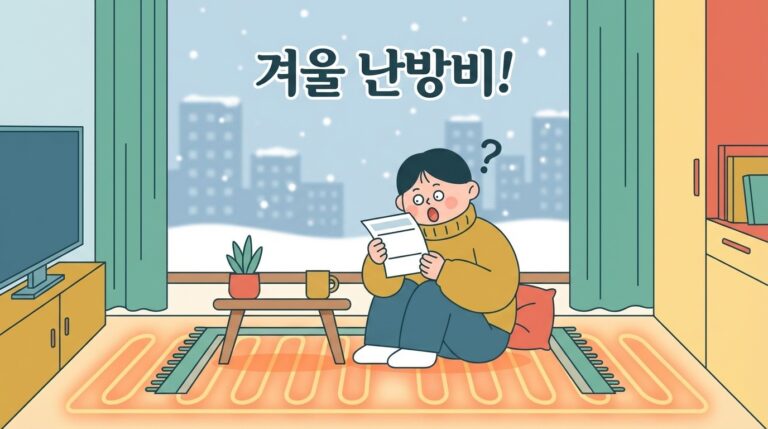
You step out of your door and find a strange, long envelope stuck to your door handle. You open it up, run a translation app over it, and your jaw drops. “Maintenance fee: 200,000 KRW?!”
Suddenly, the romantic K-Drama filter drops, and you’re faced with the harsh reality of Korean adulting: 공과금 (gonggwageum, utility bills) and 관리비 (gwallibi, maintenance fees).
I’ve been teaching expats in Seoul for years, and let me tell you—getting shocked by your first Korean utility bill is practically an initiation rite. But don’t worry! Today, we are going to learn exactly how to talk about these bills, ask the right questions to your landlord, and pay them without breaking a sweat.
Phase 2: Core Expressions Deep Dive
Let’s look at the absolute must-know phrases for dealing with your housing bills.
1. 관리비에 뭐 포함돼요?
- Pronunciation: gwallibie mwo poham-dwaeyo? [gwal-li-bi-e / mwo / po-ham-dwae-yo]
- Meaning:
- Literal: What is included in the maintenance fee?
- Real Nuance: “So, am I paying for my own internet and water, or is that covered in this absurdly high fee?”
- K-Culture Moment: Before signing a housing contract (especially for Villas or Officetels), this is the golden question. In Korea, some gwallibi covers internet, cable TV, and water, while others only cover hallway cleaning and elevator usage.
- Editor’s Insight: The word 포함 (inclusion) combined with 되다 (to become/be done) makes 포함되다 (to be included). It’s a B2-level grammar point that makes you sound incredibly fluent and practical.
- Situation Spectrum:
- Real Estate Agent (Semi-formal): ✅
- Landlord (Formal): ✅
- Friends (Casual): ⚠️ (Use “관리비에 뭐 포함돼?” instead)
- 🤔 Think About It: Why do you think Korean landlords bundle things like internet and cable TV into a “maintenance fee” rather than having tenants set it up themselves? How does this reflect the “pali-pali” (hurry up) convenience culture of Korea?
2. 이번 달 가스비 폭탄 맞았어요.
- Pronunciation: ibeon dal gaseubi poktan majasseoyo. [ee-beon / dal / ga-seu-bi / pok-tan / ma-jas-seo-yo]
- Meaning:
- Literal: I got hit by a gas bill bomb this month.
- Real Nuance: My gas bill is outrageously high this month, and my wallet is crying.
- K-Culture Moment: Winter in Korea means Ondol (underfloor heating). It feels heavenly to walk barefoot on a warm floor when it’s -10°C outside. But if you leave the boiler on all day? You will get a “bill bomb” (요금 폭탄). You’ll often see K-Drama characters wearing thick padded jackets and fuzzy socks indoors—now you know why!
- Editor’s Insight: Koreans love using the word 폭탄 (bomb) for sudden, overwhelmingly bad things. Work bomb (일 폭탄), Message bomb (카톡 폭탄). It’s dramatic, highly expressive, and very native-sounding.
- Situation Spectrum:
- Friends (Casual): ✅
- Close Coworkers (Semi-formal): ✅
- Formal Business settings: 🚫
- 🤔 Think About It: Does your language have a similar dramatic metaphor for an unexpectedly high bill?
3. 이거 자동이체 되나요?
- Pronunciation: igeo jadong-iche doenayo? [ee-geo / ja-dong-ee-che / doe-na-yo]
- Meaning:
- Literal: Does automatic transfer work for this?
- Real Nuance: Can I set up auto-pay for this bill?
- K-Culture Moment: Nobody likes remembering to pay bills every 25th of the month. When you go to a Korean bank to open an account, or when you call the electricity company (KEPCO), this is the magic phrase to automate your life.
- Editor’s Insight: The ending ~되나요? is a soft, polite way of asking “Is this possible?” or “Can I do this?” It sounds much more natural and polite than “할 수 있어요?” (Can I do…?).
- Situation Spectrum:
- Bank Teller / Call Center (Formal): ✅
- Convenience Store Clerk (Semi-formal): ✅
Phase 3: Textbook vs. Real Korean
Let’s upgrade your vocabulary from “textbook robot” to “Seoul local.”
[Situation 1: Talking about how expensive your bills are]
* 📖 Textbook Korean: 이번 달 요금이 아주 비쌉니다. (The fee is very expensive this month.)
* 🗣️ Real Korean: 관리비 장난 아니에요. (The maintenance fee is no joke.)
* 💡 Why the difference?: “장난 아니다” (It’s no joke/It’s crazy) is the ultimate native expression to emphasize that something is extreme, whether good or bad.
[Situation 2: Telling a friend you need to pay bills]
* 📖 Textbook Korean: 저는 은행에 공과금을 납부하러 가야 합니다. (I must go to the bank to pay my utility bills.)
* 🗣️ Real Korean: 아, 오늘 가스비 내야 돼요. (Ah, I have to pay the gas bill today.)
* 💡 Why the difference?: “공과금 납부” is formal administrative language. In daily life, Koreans specify the bill (가스비, 전기세) and use the simple verb 내다 (to pay).
Bottom Note: At the B2 level, focus on replacing overly formal Hanja-based words (like 납부하다) with their native Korean equivalents (like 내다) for casual conversations!
Phase 4: Cultural Context — K-Culture Deep Dive
4-1. Non-Verbal Cues & “Nunchi” (눈치)
When you take a physical bill (Giro/지로용지) to a convenience store to pay, you don’t actually need to say much. A simple “이거 결제해 주세요” (Please ring this up/pay for this) while handing over the paper is enough.
However, if you live in a shared house or an older Villa where the landlord lives upstairs, Nunchi is crucial. If the landlord controls the central heating, you might need to use your nunchi and politely ask, “사장님, 보일러 조금만 더 틀어주실 수 있나요?” (Boss/Landlord, could you turn up the boiler just a little bit?).
4-2. The “Ondol” Trap and K-Drama Realities
K-Dramas often show glamorous apartments. But what they rarely show is the sound of the boiler rumbling in the utility room. Korea uses Ondol (온돌), a floor heating system where hot water runs through pipes under the floor.
It’s deeply embedded in Korean identity. We don’t just sleep in beds; historically, Koreans slept on the warm floor. This is why Koreans take their shoes off indoors—you want to feel that sweet, sweet warmth on your feet!
But beware: turning it on and off constantly actually uses more gas. The local tip? Leave it on “외출” (Going out) mode when you leave the house to maintain a base temperature, preventing a “gas bomb” later!
Phase 5: Real-Life Roleplay Scenario
Setting: It’s a freezing Tuesday night in January. You just got your gas bill. You walk down to the GS25 convenience store in your neighborhood, clutching the paper bill.
Characters:
– YOU: A slightly panicked expat holding a bill for 150,000 KRW.
– Ji-hoon (22): The part-time worker at the convenience store. Friendly but sleepy.
Dialogue:
YOU: 저기요… 이거 여기서 결제 되나요?
(jeogiyo… igeo yeogiseo gyeolje doenayo?)
[Excuse me… can I pay this here?]
(🎭 Stage Direction: You hesitantly slide the Giro bill across the counter.)
Ji-hoon: 네, 됩니다. 바코드 찍어드릴게요.
(ne, doemnida. bakodeu jjigeodeurilgeyo.)
[Yes, you can. I’ll scan the barcode for you.]
YOU: 혹시 카드로 결제할 수 있어요?
(hoksi kadeuro gyeoljehal su isseoyo?)
[By any chance, can I pay with a card?]
Ji-hoon: 아, 공과금은 현금결제만 가능해요. 혹시 현금 있으세요?
(a, gonggwageumeun hyeongeumgyeoljeman ganeunghaeyo. hoksi hyeongeum isseuseyo?)
[Ah, utility bills can only be paid in cash. Do you have cash?]
YOU: 헉, 진짜요? 현금 없는데…
(heok, jinjjayo? hyeongeum eomneunde…)
[Gasp, really? I don’t have cash…]
Ji-hoon: 저기 ATM에서 현금 뽑으실 수 있어요.
(jeogi ATM-eseo hyeongeum ppobeusil su isseoyo.)
[You can withdraw cash from the ATM over there.]
🔀 Your Turn! How do you reply?
– A) “아, 귀찮아요. 안 할래요.” (Ah, that’s annoying. I won’t do it.)
– B) “아, 네! 그럼 잠깐 뽑아올게요. 감사합니다.” (Ah, okay! I’ll go withdraw it quickly. Thank you.)
– C) “왜 카드가 안 돼요?!” (Why can’t I use a card?!)✅ Best Choice: B — In Korea, convenience stores act as a middleman for utility companies, which is why they usually require cash for these specific transactions.
⚠️ Choice C Analysis: Asking “why” aggressively will just confuse the part-timer, who has no control over national billing policies!
Phase 6: 10-Second Shadowing Drill
Let’s practice the most emotional sentence of this unit. Read it aloud in 10 seconds!
😭 이번 달 / 가스비 / 완전 폭탄 맞았어요!
(ee-beon dal / ga-seu-bi / wan-jeon pok-tan ma-jas-seo-yo!)
Emotion: Devastated, looking at your empty wallet.
Rhythm: Pause slightly after “달” and “가스비” to build the dramatic tension before dropping the “bomb” (폭탄).
Phase 7: K-Culture Mini Dictionary
Here are the essential vocabulary words you need to survive housing in Korea:
| 한국어 | Romanization | English | Context |
|---|---|---|---|
| 보일러 | boilleo | Boiler / Floor heating | The heart of a Korean home in winter. Treat it with respect, or face the consequences. |
| 관리비 | gwallibi | Maintenance fee | Usually paid monthly to the building manager. Often includes water and internet in smaller apartments. |
| 지로용지 | jiroyongji | Giro bill / Paper bill | The physical paper bill mailed to your door. You can pay these at banks or convenience stores. |
| 자동이체 | jadong-iche | Automatic transfer | Setting up auto-pay from your Korean bank account. Highly recommended! |
| 풀옵션 | puropseon | Fully furnished | When an apartment comes with a fridge, AC, and washing machine. K-Dramas rarely show the struggle of moving these! |
Phase 8: Traveler’s Survival Kit
Even if you are just visiting Korea for a month and staying in an Airbnb, you might need to deal with the heating or AC!
🆘 Survival Phrases for Short-Term Renters
– 🇰🇷 “보일러 어떻게 켜요?” (boilleo eotteoke kyeoyo?)
– 🗣️ Pronunciation: [bo-il-leo / eo-tteo-ke / kyeo-yo?]
– 📍 Where to use: Texting your Airbnb host in the freezing winter.
– 💡 Pro Tip: Korean boiler control panels are notoriously complex and entirely in Korean. Take a photo of the panel and send it to your host, or use Papago’s image translation feature!📌 Editor’s Travel Note
– Trash Bags (종량제 봉투): In Korea, you cannot throw trash away in normal plastic bags. You MUST buy official district trash bags from the convenience store. Just ask: “종량제 봉투 주세요.”
– Recycling (분리수거): It’s strict! Plastics, vinyl, paper, and food waste must be separated. Your landlord will get angry if you mix them up.
Phase 9: Critical Thinking Corner — “A Step Deeper”
Media vs. Reality: The K-Drama Illusion of Seoul Living
When we watch K-Dramas, we often see young characters working part-time jobs, yet somehow living in gorgeous rooftop apartments (옥탑방) with string lights, drinking soju looking over the city skyline.
In reality, rooftop apartments are infamous for being brutally hot in the summer and freezing cold in the winter. The “romantic” K-Drama housing setup often hides the reality of extremely high heating bills (가스비 폭탄) and thin insulation. Learning the language of utility bills gives you a peek behind the glossy K-Drama curtain into the real, practical lives of everyday Koreans.
💬 Your Turn:
Have you ever moved to a new city or country and realized that the “movie version” of living there was very different from reality? How are utility bills handled in your home country? Share your stories in the comments!
Phase 10: FAQ & Avoiding Common Mistakes
Q: “Can I ask my landlord to lower the maintenance fee (관리비)?”
Usually, no. Maintenance fees are fixed by the building management. However, before signing a lease, you can negotiate the rent (월세) slightly in some cases.
Q: “I lost my paper bill. What do I do?”
Don’t panic! You can call the utility company (like KEPCO for electricity or the city gas company) and give them your address. They will text you a virtual account number (가상계좌) so you can transfer the money directly.
❌ Common Mistake #1: Throwing away the Giro bill thinking it’s junk mail.
✅ Do this instead: Always open mail addressed to your room number! If it has numbers and a barcode on it, it’s money you owe.❌ Common Mistake #2: Turning the boiler completely OFF every time you leave the house in winter.
✅ Do this instead: Put it on ‘외출’ (Going out) mode. If the pipes freeze and burst because you turned it completely off, you will have to pay for the repairs!
Phase 11: Summary & Action Items
One-Liner Summary: To survive Korean housing bills, understand what is included in your gwallibi, and beware of the winter gas bill bomb (gaseubi poktan)!
Take Action! (Your Missions):
– 🥉 Bronze (Solo): Look around your room right now. Point to the AC and say “여름엔 전기세 폭탄!” (Summer means electricity bomb!), then point to the heater and say “겨울엔 가스비 폭탄!” (Winter means gas bomb!).
– 🥈 Silver (Online): Look up a picture of a Korean boiler control panel (보일러 컨트롤러) on Google Images and see if you can find the word ‘외출’ (Going out).
– 🥇 Gold (Real Life): If you are in Korea, take your next utility bill to the convenience store and say “이거 결제해 주세요!” confidently.
🎬 K-Culture Mission:
Next time you watch a K-Drama set in winter, pay attention to the characters’ feet indoors. Are they wearing thick socks or fuzzy slippers? Now you know they are just trying to avoid that gas bill bomb!
Phase 12: Quiz — Interactive Challenge
Let’s test your Seoul survival skills!
1. Fill in the Blank:
A: 이번 달 고지서 봤어?
B: 응… 너무 추워서 매일 틀었더니 완전 가스비 ( _______ ) 맞았어.
Hint: It’s explosive!
2. Situational Judgment:
You want to ask your real estate agent if the internet is included in the monthly maintenance fee. What is the most natural way to ask?
– A) 인터넷 요금을 내야 합니까?
– B) 관리비에 인터넷 포함돼요?
– C) 인터넷이 관리비 안에 있어요?
3. True or False – K-Culture Edition:
You can pay your utility bills with a credit card at any Korean convenience store. ( T / F )
👀 Click here for the answers!
- 폭탄 (Bomb) – “가스비 폭탄 맞았어” is the perfect way to complain about a high heating bill.
- B – “관리비에 뭐뭐 포함돼요?” (What’s included in the maintenance fee?) is the golden phrase for apartment hunting.
- False – Convenience stores generally only accept cash for utility bill payments! If you want to pay by card, you usually have to do it online through the utility company’s website.
Ready to conquer your next Korean utility bill? You’ve got this! Let me know in the comments if you’ve ever experienced a ‘bill bomb’ in your country!
Until next time, keep studying with Daily Hangul!
Frequently Asked Questions (FAQ)
Q: What does "관리비에 뭐 포함돼요?" mean in Korean and how do you pronounce it?
A: In Korean, "관리비에 뭐 포함돼요?" is pronounced [gwallibie mwo poham-dwaeyo? [gwal-li-bi-e / mwo / po-ham-dwae-yo] and means: Literal: What is included in the maintenance fee?
Q: What does "이번 달 가스비 폭탄 맞았어요." mean in Korean and how do you pronounce it?
A: In Korean, "이번 달 가스비 폭탄 맞았어요." is pronounced [ibeon dal gaseubi poktan majasseoyo. [ee-beon / dal / ga-seu-bi / pok-tan / ma-jas-seo-yo] and means: Literal: I got hit by a gas bill bomb this month.
Q: What does "이거 자동이체 되나요?" mean in Korean and how do you pronounce it?
A: In Korean, "이거 자동이체 되나요?" is pronounced [igeo jadong-iche doenayo? [ee-geo / ja-dong-ee-che / doe-na-yo] and means: Literal: Does automatic transfer work for this?







