

Phase 1: Empathy (The Immersive Cold Open)
Hello! It’s your Daily Hangul Editor.
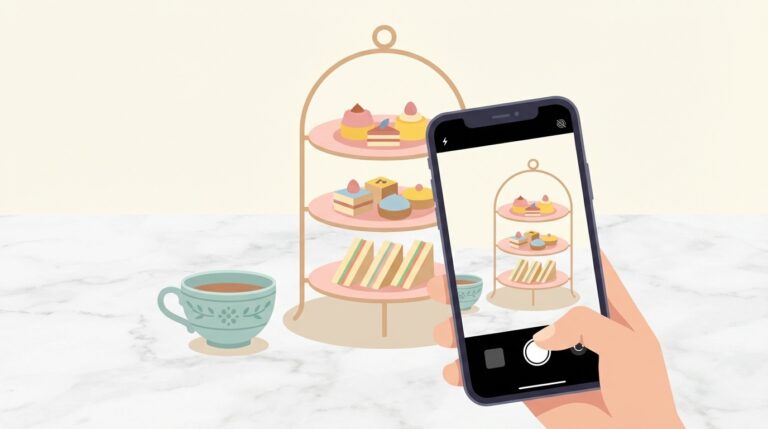
Imagine this: You are sitting in a sleek, sky-high hotel lounge in Yeouido, overlooking the shimmering Han River. The atmosphere feels like a scene straight out of a K-Drama where the Chaebol (conglomerate) heirs meet for a secretive chat. The waiter glides over and places a breathtaking, three-tiered afternoon tea set on your table. It’s adorned with delicate macarons, scones, and a teapot steaming with premium Earl Grey.
You reach out to grab a pastel-pink macaron, but suddenly, your Korean friend gasps and slaps your hand away. “Wait! The lighting!”
If you’ve ever had dessert with a Korean friend in Seoul, you know exactly what I’m talking about. Enjoying an afternoon tea set in Korea isn’t just about eating; it’s a multi-sensory cultural ritual of aesthetics, ‘small luxury,’ and specific praises.
At a C1 level, you already know how to order tea and say “It’s delicious” (맛있어요). But today, we are going to dive into the sophisticated, highly nuanced expressions that will make you sound like a true Seoulite who knows their way around a luxury tea lounge.
Phase 2: Core Expressions Deep Dive
Let’s upgrade your vocabulary from basic textbook Korean to elegant, native-level fluency.
1. 너무 예뻐서 먹기 아까워요.
- Pronunciation: neomu yeppeoseo meokgi akkawoyo. [neo-mu / yep-peo-seo / meok-ggi / ak-ka-wo-yo]
- Meaning: Literal: It’s so pretty that it’s a waste to eat. / Real Nuance: It looks absolutely stunning; it’s almost a sin to ruin it by eating it.
- K-Culture Moment: You will hear this every single time a beautifully plated dessert arrives. In the era of “Insta-vibes” (인스타 감성), acknowledging the visual effort is a crucial polite gesture before you start eating.
- Editor’s Insight: The word ‘아깝다’ (akkawoyo) usually means ‘what a waste’ in a negative sense, but here, it’s the ultimate compliment for aesthetics.
- Situation Spectrum:
- Casual friends: ✅
- Co-workers (Semi-formal): ✅
- Boss/Elders (Formal): ✅ (It shows you appreciate the treat!)
- 🤔 Think About It: Why do Koreans place such a high emphasis on the visual presentation of food, to the point where they delay eating? How does the rise of social media culture intertwine with traditional Korean food aesthetics?
2. 단맛이 과하지 않아서 고급스럽네요.
- Pronunciation: danmasi gwahaji anaseo gogeupseuromneyo. [dan-ma-shi / gwa-ha-ji / a-na-seo / go-geup-sseu-rom-ne-yo]
- Meaning: Literal: The sweetness is not excessive, so it is luxurious. / Real Nuance: It’s not overly sweet, which makes it taste very high-quality and refined.
- K-Culture Moment: You take a bite of the mousse cake. The pastry chef is waiting for your reaction. This phrase is the highest honor you can bestow upon a Korean pastry chef.
- Editor’s Insight: In Korea, if a dessert is too sweet, it’s often considered cheap or childish. A ‘luxurious’ dessert is one where the ingredients’ natural flavors shine without being masked by sugar.
- Situation Spectrum:
- Casual friends: ⚠️ (A bit too formal; just say “많이 안 달고 맛있다!”)
- Co-workers (Semi-formal): ✅
- Boss/Elders (Formal): ✅ (Perfect for impressing an older companion)
- 🤔 Think About It: “It’s not too sweet” is the ultimate praise for desserts in Korea. Does your home country prefer desserts to be unapologetically sweet, or is subtlety also valued?
3. 따뜻한 물 한 번만 더 리필해 주실 수 있나요?
- Pronunciation: ttatteutan mul han beonman deo ripilhae jusil su innayo? [ttat-teu-tan / mul / han-beon-man / deo / ri-pil-hae / ju-shil / su / in-na-yo]
- Meaning: Literal: Could you refill the warm water just one more time? / Real Nuance: Could I get some more hot water for my teapot, please?
- K-Culture Moment: You’ve finished your first steep of tea, but you have three scones left. In high-end lounges, they won’t give you new tea leaves for free, but hot water refills for high-quality loose leaf tea are standard.
- Editor’s Insight: Adding ‘한 번만’ (just once) is a linguistic cushion. It makes the request sound softer and less demanding, a classic Korean politeness strategy.
- Situation Spectrum:
- Casual friends: N/A (You say this to staff)
- Co-workers (Semi-formal): N/A
- Waitstaff (Polite formal): ✅
- 🤔 Think About It: The Korean language relies heavily on ‘cushion words’ (like 좀, 한번, 살짝) to soften requests. Why is directness often avoided when asking for a service?
Phase 3: Textbook vs. Real Korean
Here’s why you might sound a bit robotic if you only stick to your textbook during a fancy tea time.
[Complimenting the Dessert]
* 📖 Textbook Korean: 디저트가 아주 맛있습니다. (The dessert is very delicious.)
* 🗣️ Real Korean: 우와, 많이 안 달아서 끝도 없이 들어가겠는데요? (Wow, it’s not too sweet, I feel like I could eat this endlessly!)
* 💡 Why the difference?: Real conversation uses hyperbole (끝도 없이 – endlessly) and the “not too sweet” standard to express genuine satisfaction.
[Asking for Service/Refill]
* 📖 Textbook Korean: 차를 더 주십시오. (Please give me more tea.)
* 🗣️ Real Korean: 저기요, 혹시 뜨거운 물 좀 더 부어주실 수 있나요? (Excuse me, by any chance, could you pour a little more hot water?)
* 💡 Why the difference?: Using “주십시오” (give me) to service workers sounds like a military command. Using “혹시” (by any chance) and “~주실 수 있나요?” (could you…) shows respect to service staff, which is highly expected in modern Korea.
Bottom Note: At a C1 level, your goal is to master these subtle ‘softeners’. It shows high emotional intelligence and cultural fluency.
Phase 4: Cultural Context — K-Culture Deep Dive
4-1. Non-Verbal Elegance: The Two-Handed Pour
Even in a Western-style afternoon tea setting, Korean etiquette persists. When you are pouring tea from the teapot for someone older than you (or a senior colleague), you shouldn’t just grab the handle with one hand.
* The Gesture: Pour with your dominant hand, and use your free hand to lightly support your pouring arm (near the elbow or wrist), or gently hold the lid of the teapot.
* The Nunchi (눈치): If you are the youngest at the table, it’s unspoken Nunchi that you should proactively pour the tea for others when their cups are empty.
4-2. The “Small Luxury” (스몰 럭셔리) Phenomenon
Why are 20-somethings spending $80-$100 on an afternoon tea set at the Signiel or Shilla Hotel? It’s a massive trend called ‘Small Luxury’ (스몰 럭셔리). Young Koreans might not be able to afford a luxury apartment in Seoul, but they can afford a premium experience for an afternoon. It’s a form of accessible indulgence, deeply tied to the “Insta-aesthetic” culture. The tea set isn’t just food; it’s a ticket to experiencing high society for a few hours.
Phase 5: Real-Life Roleplay Scenario
Setting: Saturday, 2:00 PM. The shimmering glass lounge of a 5-star hotel in Gangnam. A three-tier dessert tray and an elegant silver teapot have just been placed on your table.
Characters:
– YOU: An expat working in Seoul, treating your best Korean friend for their birthday.
– Ji-yeon (30, Female): Your close friend. She’s trendy, loves taking photos, and has an eye for aesthetics.
Dialogue:
Ji-yeon: 와… 진짜 대박이다! 향기로운 차 냄새 좀 맡아봐.
(Wa… jinjja daebagida! Hyanggiroun cha naemsae jom matabwa.)
[Wow… this is seriously amazing! Smell this fragrant tea.]
(🎭 Stage Direction: Ji-yeon claps her hands in delight, then pulls out her smartphone.)
YOU: 내가 특별히 예약했지! 너 생일이잖아.
(Naega teukbyeolhi yeyakaetji! Neo saengirijana.)
[I booked it especially for you! It’s your birthday.]
Ji-yeon: 감동이야ㅠㅠ 앗, 잠깐! 나 인스타에 올릴 사진 한 장만 찍고!
(Gamdongiyaㅠㅠ at, jamkkan! na instae ollil sajin han jangman jjikgo!)
[I’m so touchedㅠㅠ Ah, wait! Let me just take one photo to post on Insta!]
YOU: 그래그래. 너무 예뻐서 먹기 아깝긴 하다.
(Geuraegeurae. Neomu yeppeoseo meokgi akkapgin hada.)
[Yeah, yeah. It really is so pretty it’s a waste to eat.]
Ji-yeon: (Snapping 20 photos rapidly) 오케이, 다 찍었어! 이제 뭐부터 먹을까? 1층 샌드위치부터?
(Okei, da jjigeosseo! Ije mwobuteo meogeulkka? Ilcheung saendeuwichibuteo?)
[Okay, done! What should we eat first? Starting from the sandwiches on the first floor?]
🔀 Your Turn! How do you respond?
– A) “빨리 먹자! 배고파 죽겠어!” (Let’s eat fast! I’m starving to death!)
– B) “응! 근데 샌드위치 먹기 전에 차부터 한 잔 따라줄게.” (Yeah! But before we eat the sandwiches, let me pour you a cup of tea first.)
– C) “저기요! 여기 샌드위치 리필 되나요?” (Excuse me! Can we get a refill on the sandwiches here?)✅ Best Choice: B — It shows excellent manners. Offering to pour the tea first sets a relaxed, elegant pace suitable for the environment.
⚠️ Choice A & C Analysis: ‘A’ ruins the elegant vibe (save that for Korean BBQ!). ‘C’ is a faux pas; luxury afternoon tea sets rarely offer food refills, and shouting “저기요!” in a 5-star hotel lounge is generally avoided (make eye contact with the server instead).
Phase 6: 10-Second Shadowing Drill
Channel your inner elegant drama lead. Speak with a soft, appreciative tone.
🥺 진짜 / 너무 예뻐서 / 먹기 / 아~까워요!
(jinjja / neomu yeppeoseo / meokgi / a~kkawoyo!)
Make sure to stretch the “아~” (a~) slightly to emphasize how “wasteful” it feels to ruin the beautiful dessert!
Phase 7: K-Culture Mini Dictionary
| Korean | Romanization | English | Cultural Context |
|---|---|---|---|
| 스몰 럭셔리 | seulmol reoksyeori | Small luxury | Spending money on small, premium items (like a $100 tea set or high-end hand cream) for psychological satisfaction. |
| 인스타 감성 | inseuta gamseong | Insta-vibe/Aesthetic | Something that looks visually perfect for an Instagram post. Essential for modern cafes. |
| 입가심 | ipgasim | Palate cleanser | Eating something light or drinking tea to refresh the mouth after or between courses. |
| 눈치 | nunchi | Nunchi (Social sense) | Knowing when to pour tea for others without them having to ask. |
Phase 8: Traveler’s Survival Kit
Even if you aren’t living in Seoul long-term, enjoying cafe culture is a must for any traveler. Here are essential phrases for any cafe or tea room.
🆘 Survival Phrases for the Cafe/Tea Lounge
– 🇰🇷 “디카페인으로 변경 가능한가요?” (dikapeineuro byeongyeong ganeunhangayo?)
– 🗣️ Meaning: Is it possible to change this to decaf?
– 📍 Where to use: Any cafe. Koreans drink a massive amount of coffee and tea, so decaf options are widely available now!
- 🇰🇷 “남은 거 포장해 주실 수 있나요?” (nameun geo pojanghae jusil su innayo?)
- 🗣️ Meaning: Could you pack up the leftovers for me?
- 📍 Where to use: Afternoon tea sets are huge. Don’t force yourself to finish; beautifully boxed leftovers are standard!
📌 Editor’s Travel Note
– No Tipping: Even in the most luxurious 5-star hotel lounge in Korea, do not tip. A 10% service charge is already legally included in the menu price. Leaving cash on the table will confuse the staff, and they might chase you down the street thinking you forgot your money!
Phase 9: Critical Thinking Corner — “Think Deeper”
Food & Identity: The “Not Too Sweet” Paradox
In Western cultures, a dessert’s primary job is to be an indulgent explosion of sugar. But in Korea, the highest praise for a pastry is “단맛이 과하지 않다” (The sweetness is not excessive). This isn’t just about dieting; it’s a reflection of traditional Korean culinary philosophy. Traditional Korean sweets (Hangwa) use subtle sweeteners like grain syrup (Jocheong) and focus on the natural flavors of sesame, pine nuts, and red beans. Harmony and balance are valued over intense stimulation. Therefore, a dessert that is overpowering is seen as lacking finesse.
💬 Your Turn: Does your culture have a specific flavor profile that signifies “high quality”? Are desserts in your country meant to be extremely sweet, or subtly balanced? Share your thoughts in the comments!
Phase 10: FAQ & Avoiding Mistakes
Q: Can I ask for infinite tea refills at a hotel lounge?
A: Usually, you can get unlimited hot water refills for your teapot. However, asking for a fresh batch of new tea leaves will almost certainly incur a full extra charge.
Q: Do I say ‘건배’ (Cheers) with teacups?
A: No! ‘건배’ (Geonbae – Empty the glass) is strictly for alcohol. With tea, you simply clink cups gently and say something warm like “맛있게 먹자” (Let’s eat deliciously) or smile.
❌ Common Mistake #1: Calling all hot drinks “차” (Cha).
✅ Do this instead: In English, “Let’s grab tea” can mean going to a cafe. In Korean, if you say “차 마시러 가자” (Let’s go drink tea), it’s a general idiom for going to a cafe, but when ordering, ‘차’ strictly means traditional/herbal tea. Don’t order an Americano and call it ‘차’!
Phase 11: Summary & Action Items
One-Liner Summary: Mastering the Korean afternoon tea requires appreciating the aesthetics first, praising the subtle sweetness, and politely softening your requests to the staff.
Action Mission 3 Steps:
– 🥉 Bronze: Stand in front of a mirror and gracefully practice saying: “너무 예뻐서 먹기 아까워요!”
– 🥈 Silver: Next time you are at a cafe, observe if the desserts are described as “달지 않은” (not sweet) on the menu or reviews.
– 🥇 Gold: Visit a premium cafe or hotel lounge in Korea, wait for your friend to take a photo, and elegantly ask the server: “뜨거운 물 한 번만 더 리필해 주실 수 있나요?”
K-Culture Mission:
Go to Instagram and search the hashtag #애프터눈티세트 (Afternoon tea set). Look at the aesthetic of the photos. Can you spot the ‘Small Luxury’ vibe we talked about?
Did you learn something new today? Which dessert looks too pretty to eat in your hometown? Let me know below! 👇
Phase 12: Interactive Quiz
1. Fill in the Blank (Situational):
You take a bite of an expensive Earl Grey mousse cake. You want to praise the chef for its refined, subtle taste.
“이 케이크는 _____ 않아서 정말 고급스럽네요!”
(A) 너무 예쁘지
(B) 단맛이 과하지
(C) 리필되지
2. True or False – K-Culture Edition:
At a 5-star hotel lounge in Seoul, you received amazing service. You should leave a 10,000 won bill on the table as a tip before leaving. (T / F)
3. Judgment Call:
Your younger colleague is pouring tea for you from a heavy ceramic teapot using only one hand while looking at her phone.
Why might a traditional Korean boss be slightly annoyed by this?
(A) She should be using two hands (or supporting her arm) when pouring for a senior.
(B) She didn’t shout “Geonbae!” first.
(C) She poured the tea instead of the boss.
(Answers: 1. B, 2. False – no tipping in Korea!, 3. A – Two-handed gestures show respect!)
Frequently Asked Questions (FAQ)
Q: What does "너무 예뻐서 먹기 아까워요." mean in Korean and how do you pronounce it?
A: In Korean, "너무 예뻐서 먹기 아까워요." is pronounced [neomu yeppeoseo meokgi akkawoyo. [neo-mu / yep-peo-seo / meok-ggi / ak-ka-wo-yo] and means: Literal: It's so pretty that it's a waste to eat. / Real Nuance: It looks absolutely stunning; it's almost a sin to ruin it by eating it.
Q: What does "단맛이 과하지 않아서 고급스럽네요." mean in Korean and how do you pronounce it?
A: In Korean, "단맛이 과하지 않아서 고급스럽네요." is pronounced [danmasi gwahaji anaseo gogeupseuromneyo. [dan-ma-shi / gwa-ha-ji / a-na-seo / go-geup-sseu-rom-ne-yo] and means: Literal: The sweetness is not excessive, so it is luxurious. / Real Nuance: It's not overly sweet, which makes it taste very high-quality and refined.
Q: What does "따뜻한 물 한 번만 더 리필해 주실 수 있나요?" mean in Korean and how do you pronounce it?
A: In Korean, "따뜻한 물 한 번만 더 리필해 주실 수 있나요?" is pronounced [ttatteutan mul han beonman deo ripilhae jusil su innayo? [ttat-teu-tan / mul / han-beon-man / deo / ri-pil-hae / ju-shil / su / in-na-yo] and means: Literal: Could you refill the warm water just one more time? / Real Nuance: Could I get some more hot water for my teapot, please?







