

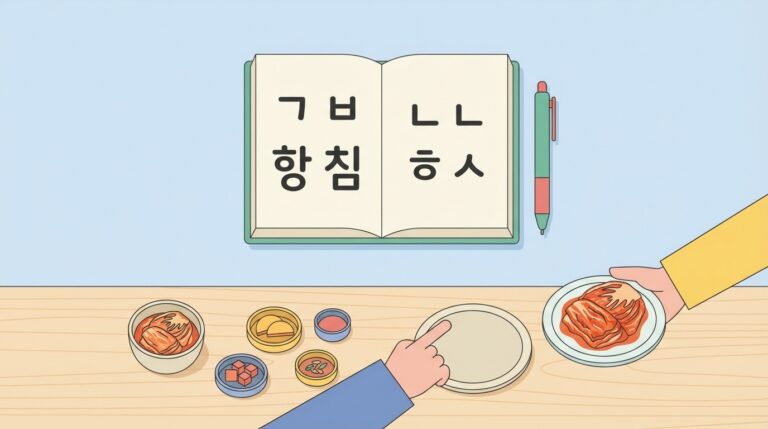
Phase 1: Empathy & Immersion
Hello there! I’m your Daily Hangul Editor.
Picture this: You are watching your favorite K-Drama. The main characters are sitting at a cozy, steam-filled K-BBQ restaurant (포장마차 or 고깃집), the pork belly is sizzling, and the table is covered with tiny, colorful dishes. Suddenly, one of them raises their hand and shouts something, and boom—the restaurant auntie brings them a fresh mountain of Kimchi.
No extra charge. No questions asked.
If you are from a country where every extra dip of sauce costs $1.50, the Korean Banchan (side dish) culture might feel like pure magic. But here is the pain point I hear from my students all the time: “I really want more of those delicious spicy fish cakes, but I don’t know how to ask without sounding rude!”
Don’t worry. This guide is crafted from the real struggles of my tutoring students. Today, we are going to learn exactly how to score those infinite free refills like a true local, without breaking a sweat.
Phase 2: Deep Dive into Core Expressions
Let’s look at the 3 golden phrases you need to master the art of the Banchan refill.
1. 사장님/이모님, 여기 반찬 좀 더 주세요.
- Pronunciation: Sajangnim/Imonim, yeogi banchan jom deo juseyo. [Sa-jang-neem / Ee-mo-neem, yuh-gee bahn-chan johm duh joo-say-yo]
- Meaning: Boss/Auntie, please give us a little more side dishes here. (Literal) -> Excuse me, could we get a refill on the side dishes? (Real nuance)
- K-Culture Moment: You’ll hear this echoing across any K-BBQ joint on a Friday night. “이모님” (Imonim – Auntie) is a term of endearment used for middle-aged female staff, creating a warm, family-like vibe.
- Editor’s Insight: The secret ingredient here is ‘좀’ (a little). Without it, “더 주세요” sounds like a direct command. Adding ‘좀’ softens the request, making it polite and natural.
- Situation Spectrum:
- Casual (Mom-and-pop restaurants): ✅
- Semi-formal (Standard restaurants): ✅
- Formal (High-end fine dining/Hotel restaurants): 🚫 (Use ‘직원분/Jeogiyo’ instead of Imonim)
- 🤔 Think About It: Why do Koreans call restaurant staff “Aunt” (이모) or “Uncle/Boss” (사장님) instead of “Waiter”? How does family-based terminology change the dynamic between a customer and a service worker?
2. 혹시 이거 리필 되나요?
- Pronunciation: Hoksi igeo ripil doenayo? [Hoke-shee ee-guh ree-peel dweh-nah-yo?]
- Meaning: By any chance, is this refillable?
- K-Culture Moment: You are at a slightly fancy traditional Korean restaurant (한정식) and they serve you an incredible soy-marinated crab (게장). You want more, but you are not sure if it’s free. This is the ultimate “safe” question.
- Editor’s Insight: Use this when pointing at a specific, high-value banchan (like meat-based sides, special seafood, or expensive veggies). ‘혹시’ (By any chance) is your best friend in Korean to sound cautious and polite.
- Situation Spectrum:
- Casual: ✅
- Semi-formal: ✅
- Formal: ✅
- 🤔 Think About It: Koreans love incorporating English words like “Refill” (리필) into daily life. Do you have “Konglish” or borrowed words in your language that are used more often than the native word?
3. 깍두기 조금만 더 주실 수 있나요?
- Pronunciation: Kkakdugi jogeumman deo jusil su innayo? [Kkahk-doo-gee jo-geum-mahn duh joo-shil soo een-nah-yo?]
- Meaning: Could you possibly give me just a little bit more cubed radish kimchi?
- K-Culture Moment: Perfect for when the staff looks incredibly busy, and you want to be extra polite. It shows you respect their time and effort.
- Editor’s Insight: Grammatically, “-주실 수 있나요?” (Could you give…?) is softer than “-주세요” (Please give…). It asks for their capability and willingness, which is highly appreciated in Korean culture.
- Situation Spectrum:
- Casual: ⚠️ (A bit too long/formal for a noisy pub)
- Semi-formal: ✅
- Formal: ✅
- 🤔 Think About It: Indirectness is often equated with politeness in Korean. Is it the same in your native language, or is directness preferred?
Phase 3: Textbook vs. Real Korean
Let’s bridge the gap between your Korean textbook and the bustling streets of Seoul.
[Situation 1: Getting the staff’s attention]
* 📖 Textbook Korean: 종업원! (Jongeobwon! – Employee!) -> Never use this!
* 🗣️ Real Korean: 저기요~! (Jeogiyo! – Excuse me!) or 사장님~! (Sajangnim! – Boss!)
* 💡 Why is it different?: Calling someone “employee” highlights a class/service gap, which feels cold. “사장님” (Boss) elevates their status and builds rapport.
[Situation 2: Asking for more Kimchi]
* 📖 Textbook Korean: 김치를 추가해 주시겠습니까? (Gimchireul chugahae jusigesseumnikka? – Would you please add Kimchi?)
* 🗣️ Real Korean: 이모님, 여기 김치 좀 더 주세요~ (Imonim, yeogi gimchi jom deo juseyo~ – Auntie, a little more Kimchi here please~)
* 💡 Why is it different?: The textbook version sounds like a robot or a military officer. Real Korean in food settings relies on warmth, slight vowel-lengthening (주세요~), and the softening word ‘좀’.
Bottom Note: At a
B1 (Intermediate)level, your goal is to transition from mathematically correct sentences to culturally appropriate ones. Ditch the “-습니까?” in casual restaurants!
Phase 4: Cultural Context — K-Culture Deep Dive
4-1. Non-Verbal Cues & The Art of ‘Nunchi’ (눈치)
Before you shout “Jeogiyo!”, you need to use your Nunchi (the Korean superpower of reading the room).
* Look around first: Do you see a sign that says “추가 반찬은 셀프입니다” (Additional side dishes are self-serve)? If there is a “Self-bar” (셀프바) in the corner, asking the staff to bring it to you is a faux pas.
* The Gesture: When asking for a refill, make brief eye contact, raise your hand slightly (not a full classroom arm-raise, just up to your shoulder), and point gently to the empty dish with your whole hand, not just one finger.
4-2. K-Food Connection: The Philosophy of ‘Jeong’ (정)
Why is Banchan free? It all comes down to Jeong (정), a uniquely Korean concept of unspoken affection, generosity, and communal bonding. In Korean culture, serving a bountiful table reflects the host’s warm heart. When you ask for a refill, you aren’t just getting more food; you are participating in this cultural exchange. The restaurant owner feels proud that you enjoy their cooking. It’s not just a transaction; it’s a connection.
Phase 5: Real-Life Roleplay Scenario
Setting: 7:30 PM on a Friday. A packed Samgyeopsal (pork belly) restaurant in Gangnam. The air is thick with the savory smell of roasting meat and the clinking of Soju glasses. You are out with your Korean colleagues.
Characters:
– YOU: An expat working in Seoul, excited for your first team dinner (회식 – Hoesik).
– Minsu (32): Your friendly Korean coworker who is managing the grill.
– Staff (50s): A busy but warm restaurant “Auntie”.
Dialogue:
Minsu: 앗, 마늘이랑 쌈장이 다 떨어졌네요. 더 시킬까요?
(At, maneurirang ssamjangi da tteoreojyeonneyo. Deo sikilkkayo?)
[Ah, we’re out of garlic and ssamjang. Should we order more?]
(🎭 Stage Direction: Minsu looks around, trying to catch the busy staff’s attention)
YOU: 제가 부탁할게요!
(Jega butakalgeyo!)
[I’ll ask for it!]
(🎭 Stage Direction: You see the staff walking by with a tray)
🔀 Your Turn! How do you get her attention and ask?
– A) “아줌마! 마늘 리필!” (Ajumma! Maneul ripil!)
– B) “저기요~ 사장님! 여기 마늘 좀 더 주세요.”
– C) “실례합니다. 마늘을 추가해 주시겠습니까?”✅ Best Choice: B — “Jeogiyo~ Sajangnim!” is the perfect, polite way to get attention in a loud place. Adding ‘좀’ makes the request smooth.
⚠️ Choice A Analysis: NEVER call a worker “Ajumma” (Middle-aged woman). It is considered highly disrespectful and dismissive nowadays.
⚠️ Choice C Analysis: Too formal. You’ll sound like a news anchor ordering pork belly!
(Continuing with Option B)
YOU: 저기요~ 사장님! 여기 마늘이랑 쌈장 좀 더 주세요.
(Jeogiyo~ Sajangnim! Yeogi maneurirang ssamjang jom deo juseyo.)
[Excuse me~ Boss! Could we get a little more garlic and ssamjang here?]
Staff: 네~ 잠시만요! 김치도 더 드릴까요?
(Ne~ Jamsimanyo! Gimchido deo deurilkkayo?)
[Yes~ Just a moment! Shall I give you more Kimchi too?]
YOU: 네, 너무 맛있어요! 감사합니다.
(Ne, neomu masisseoyo! Gamsahamnida.)
[Yes, it’s so delicious! Thank you.]
Minsu: 와, 한국어 진짜 자연스러운데요?
(Wa, hangugeo jinjja jayeonseureoundeyo?)
[Wow, your Korean is really natural!]
🌟 Bonus K-Culture Scenario: The Self-Serve Check
What if you aren’t sure if it’s self-serve?
YOU: 사장님, 혹시 반찬은 셀프인가요?
(Sajangnim, hoksi banchaneun selpeuingayo?)
[Boss, by any chance, are the side dishes self-serve?]
Staff: 아, 저기 뒤쪽 셀프바 이용하시면 돼요~
(A, jeogi dwijjok selpeuba iyonghasimyeon dwaeyo~)
[Ah, you can use the self-bar over there in the back~]
Phase 6: 10-Second Shadowing Drill
Read this aloud. Focus on the pauses (/) and the emotion tags!
😊 밝고 친절하게 (Bright and friendly):
사장님~! / 여기 / 깍두기 좀 / 더 주세요~!
(Sajangnim~! / yeogi / kkakdugi jom / deo juseyo~!)
🥺 조심스럽게 (Cautiously):
혹시 / 이거 / 리필 되나요…?
(Hoksi / igeo / ripil doenayo…?)
Phase 7: K-Culture Mini Dictionary
| 한국어 | Romanization | English | Cultural Context |
|---|---|---|---|
| 리필 | ripil | Refill | Konglish. Used for side dishes, drinks, or coffee (in some cafes). |
| 셀프바 | selpeuba | Self-bar | A designated station where you must get your own banchan. Look for this! |
| 이모님 | imonim | Auntie | Polite, affectionate term for older female staff. Literally means “Mother’s sister”. |
| 정 | jeong | Affection/Connection | The emotional bond and generosity deeply rooted in Korean culture. |
| 회식 | hoesik | Company dinner | A crucial part of Korean corporate life, usually involving K-BBQ and drinks. |
Phase 8: Traveler Survival Kit
If you are traveling in Korea, mastering restaurant dynamics is vital. Here are your Top 3 survival phrases for any dining situation.
🆘 Survival Phrases
– 🇰🇷 “이거 엄청 맵나요?” (Igeo eomcheong maemnayo?)
– 🗣️ Meaning: Is this extremely spicy?
– 📍 Where to use: Before ordering that red-looking stew.
– 🇰🇷 “화장실 비밀번호가 뭐예요?” (Hwajangsil bimilbeonhoga mwoyeyo?)
– 🗣️ Meaning: What is the restroom passcode?
– 📍 Where to use: Many restaurants have external bathrooms with digital locks.
– 🇰🇷 “남은 거 포장되나요?” (Nameun geo pojangdoenayo?)
– 🗣️ Meaning: Can I get the leftovers packed to go?
– 📍 Where to use: When you ordered too much main dish (Note: Banchan is usually NOT packed!).📌 Editor’s Travel Note
– Tipping Culture: There is absolutely NO tipping in Korea. If you leave cash on the table, the staff might run out to the street to return your “forgotten” money! Express your gratitude by saying “잘 먹었습니다!” (I ate well!).
– Translation App: Download Papago—it is vastly superior to Google Translate for Korean honorifics and nuances.
Phase 9: Critical Thinking Corner — “One Step Deeper”
Food & Identity: The Power of the Shared Table
Why are Koreans so obsessed with feeding people and offering free refills? In Korea, eating is rarely an individualistic act; it’s an extension of community. Historically, Korea was an agrarian society where village members shared labor and harvests. The phrase “식구” (Sikgu), meaning “family,” literally translates to “mouths that eat together.” When a restaurant owner gives you a free refill of Kimchi, they are not just handing you food—they are extending a subtle thread of community, treating you as a Sikgu for the hour you are there.
💬 Your Turn: Does your culture have a specific food or dining habit that symbolizes community and sharing? Share it in the comments below!
Phase 10: FAQ & Avoiding Common Mistakes
Q: Can I ask for unlimited meat refills?
A: NO! Unless it is specifically a “무한리필” (All-you-can-eat) restaurant, main dishes (meat, stews) cost money. Only Banchan (veggies, kimchi, small sides) and water are free.
Q: Is it rude to ask for refills multiple times?
A: 1-2 times is perfectly normal. If you ask 5 times for an expensive banchan (like marinated crab), you might get some heavy Nunchi (side-eye).
❌ Common Mistake #1: Calling the female staff “아줌마” (Ajumma).
✅ Do this instead: Always use “사장님” (Boss) or “이모님” (Auntie). “Ajumma” has gained a somewhat negative, dismissive connotation over the years.❌ Common Mistake #2: Asking for refills when there is clearly a “셀프” (Self) sign on the wall.
✅ Do this instead: Take your small plates to the self-bar and load up your own Kimchi!
Phase 11: Summary & Action Items
🎯 One-Liner Summary: Soften your request with “좀” (a little) and call the staff “사장님” to unlock the magic of infinite Korean banchan!
Your Action Missions:
– 🥉 Bronze (Solo): Stand in front of your mirror and practice saying “사장님~ 여기 반찬 좀 더 주세요!” 3 times with a bright smile.
– 🥈 Silver (Online): Next time you watch a K-Drama, spot a restaurant scene. Can you hear them say “Jeogiyo” or “Sajangnim”?
– 🥇 Gold (Real Life): Visit a local Korean restaurant (or a K-town near you) and ask for a Kimchi refill entirely in Korean!
Phase 12: Quiz — Interactive Challenge
1. Situational Judgment: You want more pickled radishes, but the restaurant is packed and the staff is running around. What is the BEST thing to say when they finally pass by?
– A) “아줌마! 깍두기!” (Auntie! Radish!)
– B) “사장님, 바쁘신데 죄송하지만 깍두기 좀 더 주실 수 있나요?” (Boss, sorry you’re busy, but could you give us a bit more radish?)
– C) “종업원, 깍두기 추가요.” (Employee, add radish.)
👉 Click to see the answer
Answer: B. It acknowledges they are busy and uses a soft, polite request. A uses the forbidden “Ajumma” word, and C sounds like a textbook robot.
2. True or False – K-Culture Edition:
“If the banchan is incredibly delicious, it’s polite to leave a $5 tip on the table.”
👉 Click to see the answer
False! No tipping in Korea. Just smile and say “너무 맛있어요!” (It’s so delicious!).
3. Fill in the Blank:
사장님, 여기 김치 ___ 더 주세요. (Boss, please give me a _____ more Kimchi here.)
👉 Click to see the answer
좀 (jom). This tiny word makes your sentence 100x more natural!
Did you score a refill victory using these phrases? Let me know in the comments! Until next time, happy eating! 🥢
Frequently Asked Questions (FAQ)
Q: What does "사장님/이모님, 여기 반찬 좀 더 주세요." mean in Korean and how do you pronounce it?
A: In Korean, "사장님/이모님, 여기 반찬 좀 더 주세요." is pronounced [Sajangnim/Imonim, yeogi banchan jom deo juseyo. [Sa-jang-neem / Ee-mo-neem, yuh-gee bahn-chan johm duh joo-say-yo] and means: Boss/Auntie, please give us a little more side dishes here. (Literal) -> Excuse me, could we get a refill on the side dishes? (Real nuance)
Q: What does "혹시 이거 리필 되나요?" mean in Korean and how do you pronounce it?
A: In Korean, "혹시 이거 리필 되나요?" is pronounced [Hoksi igeo ripil doenayo? [Hoke-shee ee-guh ree-peel dweh-nah-yo?] and means: By any chance, is this refillable?
Q: What does "깍두기 조금만 더 주실 수 있나요?" mean in Korean and how do you pronounce it?
A: In Korean, "깍두기 조금만 더 주실 수 있나요?" is pronounced [Kkakdugi jogeumman deo jusil su innayo? [Kkahk-doo-gee jo-geum-mahn duh joo-shil soo een-nah-yo?] and means: Could you possibly give me just a little bit more cubed radish kimchi?







