

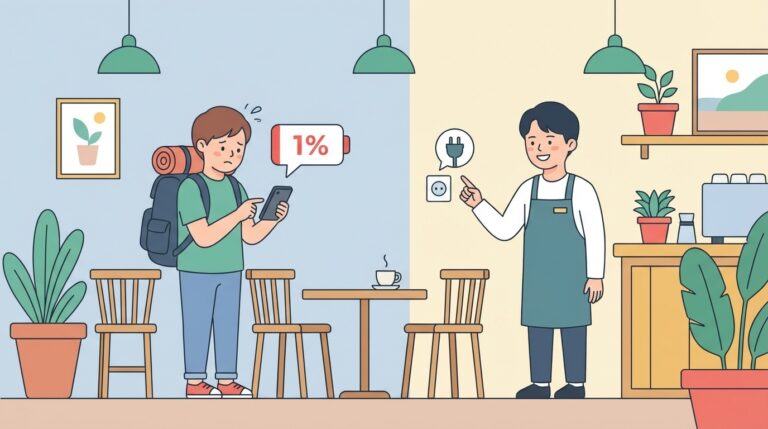
Phase 1: Empathy (Welcome to the 1% Panic)
Hello there! This is your lead editor from Daily Hangul.
Picture this: You are standing in the middle of Myeongdong, Seoul. You’ve just eaten the best K-BBQ of your life, and now you want to find that trendy cafe you saw on a K-Drama. You pull out your phone, Naver Map is loading… and suddenly, the screen goes black.
1%… 0%. Panic! 😱
Your lifeline to the city, your subway pass, your camera—all gone. In dramas, the main character just magically runs into their crush who helps them. But in reality? You need to ask someone for help.
Don’t worry! South Korea is an absolute paradise for smartphone users. From cafes with outlets at every seat to convenience stores where you can rent power banks, you just need to know the right words to unlock these features.
Today, we are going to learn exactly how to save your phone (and your trip!) with basic, A1-level Korean phrases. Let’s power up!
Phase 2: Deep Dive into Core Expressions
Here are the absolute lifesavers you need to know.
1. 충전해 주세요 (Please charge this)
- Pronunciation: chung-jeon-hae ju-se-yo [choong-jun-hae joo-seh-yo]
- Meaning: Literal: Please do charging. / Real nuance: Can you charge this for me?
- K-Culture Moment: You are at a local restaurant (식당). You hand your phone to the owner (사장님 – sajangnim) and say this with a polite smile. In Korea, many restaurants have a multi-charging station right by the cash register just for customers!
- Editor’s Insight: The word 충전 (chung-jeon) means “charge.” The ~해 주세요 (-hae ju-se-yo) part is the magic wand for beginners. It means “Please do [action] for me.” Just put any action word before it, and you sound polite and cute!
- Situation Spectrum:
- Friends (Casual): 🚫 (Too formal, use 충전해 줘! instead)
- Cafe/Restaurant Staff (Semi-formal): ✅
- Strangers/Elders (Formal): ✅
- 🤔 Think About It: Why do Koreans so freely hand their expensive smartphones to restaurant owners without worrying about theft? How does this reflect Korea’s famous “low petty crime” culture?
2. 콘센트 있어요? (Do you have an outlet?)
- Pronunciation: kon-sen-teu i-sseo-yo? [kohn-sen-tuh ee-suh-yo?]
(Sound tip: ‘eu’ sounds like the disgusted sound you make when stepping in gum)- Meaning: Literal & Real: Do you have an electrical outlet?
- K-Culture Moment: You walk into a massive, aesthetic cafe in Seongsu-dong. You have your own charger, but you need the wall plug. This is the phrase you ask the barista.
- Editor’s Insight: Notice how Koreans use the word “콘센트” (concent). This is a Konglish (Korean-English) word derived from “concentric plug.” If you say “outlet” or “socket,” they might not understand you!
- Situation Spectrum:
- Friends (Casual): ⚠️ (Drop the ‘yo’ to say ‘콘센트 있어?’)
- Cafe/Restaurant Staff (Semi-formal): ✅
- Strangers/Elders (Formal): ✅
- 🤔 Think About It: Why are there so many “Konglish” words in technology?
3. 배터리가 없어요 (I have no battery)
- Pronunciation: bae-teo-ri-ga eop-seo-yo [bae-tuh-ree-gah uhp-suh-yo]
- Meaning: Literal: Battery does not exist. / Real nuance: My battery is dead/low.
- K-Culture Moment: Your K-Pop idol is doing a live stream on Weverse, and you type this in the chat before you have to log off. “오빠, 저 배터리가 없어요 ㅠㅠ” (Oppa, my battery is dead!).
- Editor’s Insight: In English, we say the battery is “dead” or “dying.” But in Korean, we simply say it “doesn’t exist” (없어요). It’s a very straightforward and dramatic way to express the emergency!
- Situation Spectrum:
- Friends (Casual): ⚠️ (Say: 나 배터리 없어)
- Cafe/Restaurant Staff (Semi-formal): ✅
- Strangers/Elders (Formal): ✅
Phase 3: Textbook vs. Real Korean
[Situation 1: Explaining your phone is dying]
* 📖 Textbook Korean: 제 휴대전화 배터리가 다 소모되었습니다. (My mobile phone battery has been fully consumed.)
* 🗣️ Real Korean: 아, 배터리 없어! (Ah, bae-teo-ri eop-seo! – Ah, no battery!)
* 💡 Why the difference?: Koreans love efficiency (Ppalli-ppalli culture). Long sentences are naturally shortened in daily conversation.
[Situation 2: Asking someone to charge your phone]
* 📖 Textbook Korean: 실례하지만 휴대전화를 충전해 주실 수 있습니까? (Excuse me, but is it possible for you to charge my mobile phone?)
* 🗣️ Real Korean: 저기요, 이거 충전 좀 해 주세요. (Excuse me, please charge this a bit.)
* 💡 Why the difference?: Adding “좀” (jom – a bit/little) makes the request sound softer and more polite without needing complicated grammar.
Bottom Note: As an A1 beginner, don’t worry about complex honorifics yet. Sticking to phrases ending in ~요 (-yo) is your safest and most polite bet!
Phase 4: Cultural Context — K-Culture Deep Dive
4-1. The Non-Verbal “Nunchi” (눈치)
When asking someone to charge your phone (충전해 주세요), always hand your phone over with both hands. Even if it’s just a quick handoff to a cafe worker, using two hands is a basic sign of respect in Korea.
Also, keep your Nunchi (situational awareness) sharp! If you are at a tiny mom-and-pop restaurant with only three tables, charging your phone is fine, but don’t sit there for two hours just playing on your phone after you finish eating. If it’s a massive Starbucks, take your time!
4-2. The “Charging Paradise” of K-Travel
In Korea, cafes aren’t just for drinking coffee; they are secondary living rooms and offices. You will notice people leaving their laptops and phones unattended on tables to go to the restroom. It’s an unspoken rule: “We are in a cafe, we all need chargers, and we respect each other’s space.”
If you see a plug by your seat, it is 100% free to use. However, out of basic etiquette, you should always order at least one drink per person!
Phase 5: Real-Life Roleplay Scenario
Setting: It’s 2 PM on a hot Saturday in Hongdae. You are sweating, and your phone battery is at 3%. You stumble into a cool, air-conditioned cafe. You see the barista, Minji, organizing the counter.
Characters:
– YOU: A traveler exploring Seoul, trying your best to survive with A1 Korean.
– Minji (20s): A friendly cafe worker who is used to helping tourists.
The Dialogue:
YOU: 안녕하세요! 아이스 아메리카노 하나 주세요. ☕
(an-nyeong-ha-se-yo! a-i-seu a-me-ri-ka-no ha-na ju-se-yo.)
[Hello! One iced americano, please.]
Minji: 네, 매장에서 드시나요?
(ne, mae-jang-e-seo deu-si-na-yo?)
[Yes, is it for here?]
YOU: 네. (You look around anxiously)
(ne.)
[Yes.]
YOU: 저기… 혹시 콘센트 있어요? 🔌
(jeo-gi… hok-si kon-sen-teu i-sseo-yo?)
[Excuse me… by any chance, do you have an outlet?]
Minji: 네, 창가 자리에 있습니다.
(ne, chang-ga ja-ri-e it-seum-ni-da.)
[Yes, there are some by the window seats.]
YOU: 아… 제가 충전기가 없어요. (Show your empty hands) 😢
(a… je-ga chung-jeon-gi-ga eop-seo-yo.)
[Ah… I don’t have a charger.]
Minji: 앗, 저희 매장용 충전기는 지금 다른 분이 쓰고 계세요.
(at, jeo-hui mae-jang-yong chung-jeon-gi-neun ji-geum da-reun bun-i sseu-go gye-se-yo.)
[Oh, our store charger is being used by someone else right now.]
🔀 Your Turn! How should you respond?
– A) “빨리 충전해 주세요!” (Charge it quickly!)
– B) “아, 네… 제 배터리가 없어요. 어떡하죠?” (Ah, I see… I have no battery. What should I do?)
– C) “대박 사건!” (Major incident / No way!)✅ Best Choice: B — Asking “어떡하죠?” (What should I do?) naturally prompts the friendly local to give you a solution.
⚠️ Choice A Analysis: NEVER say “빨리” (quickly) when asking for a favor. It sounds very rude!
⚠️ Choice C Analysis: Too slangy for a cafe worker you just met.
(Assuming you chose B)
YOU: 아, 네… 제 배터리가 없어요. 어떡하죠? 💦
(a, ne… je bae-teo-ri-ga eop-seo-yo. eo-tteok-ha-jo?)
[Ah, I see… I have no battery. What should I do?]
Minji: 아! 근처 편의점에서 ‘보조배터리’ 대여하실 수 있어요! 💡
(a! geun-cheo pyeon-ui-jeom-e-seo ‘bo-jo-bae-teo-ri’ dae-yeo-ha-sil su i-sseo-yo!)
[Ah! You can rent a ‘power bank’ at the convenience store nearby!]
YOU: 감사합니다!! 🏃♂️
(gam-sa-ham-ni-da!!)
[Thank you!!]
Phase 6: 10-Second Shadowing Drill
Practice reading this out loud. Pay attention to the pauses (/) and the emotion!
🥺 Desperately but politely:
저기요, / 제 폰 배터리가 / 없어요. / 충전 좀 / 해 주세요!
(jeo-gi-yo, / je pon bae-teo-ri-ga / eop-seo-yo. / chung-jeon jom / hae ju-se-yo!)
Phase 7: K-Culture Mini Dictionary
| 한국어 (Korean) | Romanization | English | Context |
|---|---|---|---|
| 충전기 | chung-jeon-gi | Charger | The physical charging cable/block. |
| 콘센트 | kon-sen-teu | Wall outlet | Konglish! Very important to know. |
| 보조배터리 | bo-jo-bae-teo-ri | Power bank | Literally “assistant battery.” Koreans always carry these! |
| 돼지코 | dwae-ji-ko | Plug adapter | Literally “pig nose.” Used to describe the 220V round pin adapter used in Korea. |
| 와이파이 | wa-i-pa-i | Wi-Fi | Korea has incredibly fast, free Wi-Fi everywhere. |
Phase 8: Traveler Survival Kit 🆘
🆘 Survival Expression #1: Asking to rent a charger
– 🇰🇷 “보조배터리 대여 돼요?” (bo-jo-bae-teo-ri dae-yeo dwae-yo?)
– 🗣️ English tip: bo-jo-bae-tuh-ree dae-yuh dway-yo?
– 📍 Where to use: Convenience stores (CU, GS25, 7-Eleven).
– 💡 Pro Tip: Look for machines with the brand “완충e” (Wanchung-e) or “보배팡” (Bobae-pang) inside convenience stores or subway stations. You can rent a power bank by scanning a QR code!📌 Editor’s Travel Note
– The Voltage: Korea uses 220V with round pins (Type C or F). If you bring a US plug, you MUST ask for a 돼지코 (pig nose) at your hotel.
– Cafes & Convenience Stores: If your phone dies, look for an Emart24, CU, or a mega-cafe like Ediya or Mega Coffee. They are everywhere and usually have charging ports!
Phase 9: Critical Thinking — “One Step Deeper” 🧠
The “Fast-Fast” (빨리빨리) Culture and Hyper-Connectivity
Have you wondered why it’s so incredibly easy to charge your phone in Korea? It deeply reflects Korea’s famous Ppalli-ppalli (hurry up) culture and its identity as a hyper-connected society. In Korea, being “unreachable” or “offline” makes people highly anxious. Smartphones are used for everything from paying for the bus to ordering food at a table via QR codes. Therefore, cafes and restaurants provide free outlets and charging cables not just as a courtesy, but as an essential survival tool for the society to function smoothly.
💬 Your Turn: In your home country, is it common to find free outlets in cafes, or do people expect you to bring your own fully charged devices? Share in the comments!
Phase 10: FAQ & Avoiding Mistakes
Q: “Can I unplug someone else’s phone at a cafe to charge mine?”
NO! While Koreans are generally relaxed about leaving personal items unattended, unplugging someone else’s device without asking is considered extremely rude. Wait your turn or ask the staff.
Q: “Do I have to buy something to use the outlet in a convenience store?”
Yes. It’s polite to buy at least a bottle of water or a snack if you are going to sit at the convenience store table to charge your phone.
❌ Common Mistake #1: Saying “배터리가 죽었어요” (bae-teo-ri-ga ju-geo-sseo-yo) to mean “My battery died.”
✅ Do This Instead: Koreans don’t say the battery “died” (죽었다 – usually reserved for living things in this context). Say “배터리가 없어요” (bae-teo-ri-ga eop-seo-yo – I have no battery) or “배터리 나갔어요” (bae-teo-ri na-ga-sseo-yo – Battery went out).
Phase 11: Summary & Action Items
💡 One-Liner Summary: To save your dying phone in Korea, just find an outlet (콘센트) or politely say “충전해 주세요” (Please charge this).
Your Action Mission for Today:
– 🥉 Bronze (Solo): Look at your phone’s battery right now. Say “배터리가 없어요” out loud 3 times!
– 🥈 Silver (Online): Comment your current phone battery percentage below in Korean! (e.g., “저 지금 20%예요. 배터리 충전해 주세요!”)
– 🥇 Gold (Real World): Next time you visit a Korean restaurant or cafe in your city, look around to see if you can spot the “콘센트” (outlet) and point it out to your friend!
🎬 K-Culture Mission:
Next time you watch a K-Drama, pay attention to the convenience store scenes. Look closely at the counter—you’ll almost always spot a small tower of charging cables or a power bank rental machine!
Phase 12: Quiz — Interactive Challenge
1. Fill in the Blank:
You are at a cafe and see a plug under the table, but you want to be sure.
“저기요, 이거 ______ 맞아요?” (Excuse me, is this an outlet?)
– A) 충전해
– B) 콘센트
– C) 돼지코
2. True or False — K-Culture Edition:
In Korea, it is considered rude to ask a restaurant owner to charge your phone behind the counter. (T/F)
3. Situational Judgment:
Your phone is at 1%. You run into a GS25 convenience store. What should you ask for to charge your phone on the go?
– A) 아메리카노 하나 주세요.
– B) 보조배터리 대여 돼요?
– C) 와이파이 있어요?
👀 Click here for the answers!
- B (콘센트) – Remember, “concent” is the Konglish word for outlet!
- False – It’s very common! Many restaurants have multiple chargers specifically for customers. Just ask politely: “충전해 주세요.”
- B (보조배터리 대여 돼요?) – Asking to rent a power bank is the perfect solution for charging on the go!
Frequently Asked Questions (FAQ)
Q: What does "충전해 주세요 (Please charge this)" mean in Korean and how do you pronounce it?
A: In Korean, "충전해 주세요 (Please charge this)" is pronounced [chung-jeon-hae ju-se-yo [choong-jun-hae joo-seh-yo] and means: Literal: Please do charging. / Real nuance: Can you charge this for me?
Q: What does "콘센트 있어요? (Do you have an outlet?)" mean in Korean and how do you pronounce it?
A: In Korean, "콘센트 있어요? (Do you have an outlet?)" is pronounced [kon-sen-teu i-sseo-yo? [kohn-sen-tuh ee-suh-yo?] and means: Literal & Real: Do you have an electrical outlet?
Q: What does "배터리가 없어요 (I have no battery)" mean in Korean and how do you pronounce it?
A: In Korean, "배터리가 없어요 (I have no battery)" is pronounced [bae-teo-ri-ga eop-seo-yo [bae-tuh-ree-gah uhp-suh-yo] and means: Literal: Battery does not exist. / Real nuance: My battery is dead/low.







