

Hello! I’m your lead editor at Daily Hangul, your personal guide to not just speaking Korean, but surviving and thriving in Korea.
Imagine this: You’re wandering through the neon-lit streets of Hongdae or navigating the endless underground shopping maze in Gangnam. You spot the perfect K-drama-style oversized blazer. You grab it, you love it, but now… you need to try it on. You look around, make awkward eye contact with the store clerk, and point to the jacket, then point to yourself, then point to a random curtain in the back. Sound familiar?
If you don’t know how to ask for the fitting room, shopping in Korea can turn into an intense game of charades. But don’t worry! Today, we are going to learn the absolute essentials for shopping for clothes in Korea. No more sweating over hand gestures—let’s get you shopping like a true Seoul local. This guide is built from the real, slightly embarrassing, and hilarious shopping experiences of my actual students!
Phase 2: Core Expressions Deep Dive
Let’s learn the exact phrases you need to get into that fitting room smoothly.
1. 입어봐도 돼요?
- Pronunciation: ibeobwado dwaeyo? [ee-buh-bwa-doh dway-yo]
(Tip: ‘돼’ sounds like ‘dway’ as in ‘Dwayne’.)- Meaning: Can I try this on? (Literal: Is it okay if I try wearing it?)
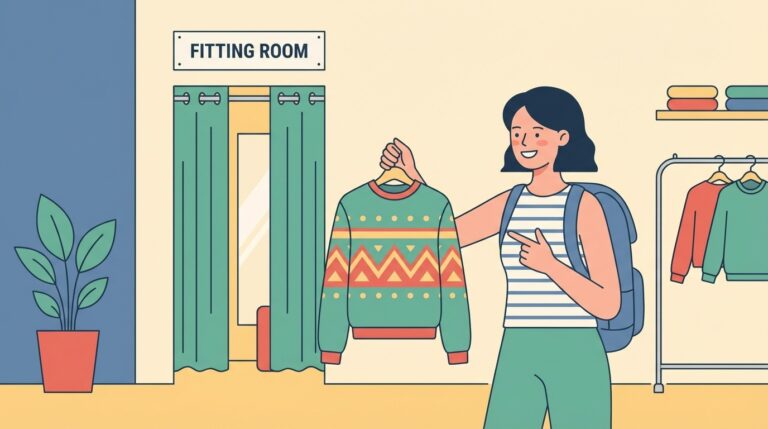
- K-Culture Moment: Picture a bustling boutique in Myeongdong. The clerk is busy arranging clothes. You hold up a cute sweater, catch their eye, and ask, “입어봐도 돼요?” They nod with a smile. This phrase is the magic key. In Korea, you should always ask before trying things on!
- Editor’s Insight: This phrase feels polite but very natural. You aren’t demanding a fitting room; you’re politely asking for permission, which Koreans deeply appreciate.
- Situation Spectrum:
- Casual with friends (Drop the 요): ✅ (입어봐도 돼?)
- To a store clerk (Polite): ✅
- Formal/High-end boutique: ⚠️ (They might use more formal language back to you)
- 🤔 Think About It: Why do Koreans prefer asking “Is it okay if I…” (해도 돼요?) instead of “I want to…”? How does this reflect the Korean value of respecting others’ boundaries?
2. 탈의실이 어디예요?
- Pronunciation: taruisiri eodiyeyo? [tah-ree-sheel-ee uh-dee-yay-yo]
(Tip: ‘탈’ rhymes with ‘pal’. ‘실’ sounds like ‘seal’.)- Meaning: Where is the fitting room?
- K-Culture Moment: You’ve got the green light to try it on, but you have no idea where to go. Underground malls often have hidden fitting rooms disguised as mirrors or curtains. You ask this, and the clerk points you in the right direction.
- Editor’s Insight: ‘탈의실’ (tal-ui-sil) literally means ‘taking off clothes room.’ While some places use ‘피팅룸’ (fitting room), ‘탈의실’ is the standard Korean word you will see on signs.
- Situation Spectrum:
- Casual with friends: ✅ (탈의실 어디야?)
- To a store clerk: ✅
- Formal/High-end boutique: ✅
- 🤔 Think About It: In many languages, “Where is X?” is a direct question. In Korean, adding ‘요’ at the end softens the question. Does your native language have a way to “soften” a direct question?
Phase 3: Textbook vs. Real Korean
Let’s see how real people talk in the boutiques of Seoul compared to what your textbook says.
[Asking to try clothes on]
* 📖 Textbook Korean: 이 옷을 입어보아도 되겠습니까? (May I please try wearing these clothes?)
* 🗣️ Real Korean: 이거 입어봐도 돼요? (Can I try this on?)
* 💡 Why the difference?: The textbook version sounds like a soldier asking a general for permission. Real Korean relies on the simple and polite ‘-아/어/여요’ form for everyday transactions.
[Asking where the fitting room is]
* 📖 Textbook Korean: 탈의실은 어디에 있습니까? (Where is the fitting room located?)
* 🗣️ Real Korean: 피팅룸 어디예요? / 탈의실 어디예요? (Where’s the fitting room?)
* 💡 Why the difference?: Koreans love borrowing English words! ‘피팅룸’ (fitting room) is used just as often as ‘탈의실’, especially in trendy areas like Hongdae or Seongsu-dong.
Bottom Note: At the A2 level, stick to “이거 입어봐도 돼요?” It’s short, polite, and works perfectly 100% of the time!
Phase 4: Cultural Context — K-Culture Deep Dive
4-1. Non-Verbal Cues (The Eye Contact Rule)
When holding up the clothing item, don’t just shout across the store! Make slight eye contact, hold the hanger with both hands (or at least one hand supporting the other arm), and ask “입어봐도 돼요?” Koreans value Nunchi (눈치)—reading the room. If the clerk looks extremely busy dealing with another customer, wait a few seconds before asking.
4-2. K-Beauty Meets K-Fashion: The “Face Cover” (페이스 커버)
If you’ve watched K-dramas, you know Koreans take their makeup (K-Beauty) seriously. But did you know this affects how you shop?
When you go into a fitting room in Korea, you will almost always find a box of sheer, white, tissue-like hoods. This is a 페이스 커버 (Face Cover). Because many Korean women and men wear BB cream or foundation, store owners are terrified of makeup stains on collars.
Survival Rule: If you are trying on tops, you must put the face cover over your head before pulling the shirt on! It feels a bit like wearing a ghost costume, but it’s proper Korean shopping etiquette.
Phase 5: Real-Life Roleplay Scenario
Setting: Saturday afternoon at Goto Mall (Gangnam Underground Shopping Center). It’s crowded, fast-paced, and filled with the latest K-fashion trends. You are holding a beautiful white blouse.
Characters:
* YOU: A traveler looking for a fresh outfit for your trip to a fancy cafe in Seongsu-dong.
* Clerk (직원 – Jigwon): A fast-moving, friendly but busy Korean store owner in her 40s.
Dialogue:
YOU: 저기요, 이거 입어봐도 돼요? 👚
(jeogiyo, igeo ibeobwado dwaeyo?)
(Excuse me, can I try this on?)
(🎭 Stage Direction: You hold up the white blouse carefully)
Clerk: 아, 하얀 옷은 피팅 안 되세요~ 눈으로만 봐주세요.
(a, hayan oseun piting an doeseyo~ nuneuroman bwajuseyo.)
(Ah, white clothes can’t be tried on~ Please just look with your eyes.)
YOU: 아, 정말요? 그럼 이 까만 옷은요?
(a, jeongmalyo? geureom i kkaman oseunyo?)
(Ah, really? Then what about this black one?)
Clerk: 까만 건 괜찮아요. 탈의실 저쪽이에요.
(kkaman geon gwaenchanayo. taruisil jeojjogiyeyo.)
(The black one is fine. The fitting room is over there.)
YOU: 탈의실이요? 아, 감사합니다!
(taruisiriyo? a, gamsahamnida!)
(The fitting room? Ah, thank you!)
(🎭 Stage Direction: You go to the fitting room, but the clerk hands you a white tissue hood)
Clerk: 이거 페이스 커버 쓰시고 입어보세요~
(igeo peiseu keobeo sseusigo ibeoboseyo~)
(Please put on this face cover and try it on~)
🔀 Your Turn! How do you react to the Face Cover?
– A) “이게 뭐예요? 안 쓸래요.” (What is this? I won’t wear it.)
– B) “네, 알겠습니다!” (Yes, understood!) puts it over head.
– C) Put it on your face like a medical mask.✅ Best Choice: B — Accepting and using the face cover shows you respect Korean shopping culture.
⚠️ Choice A & C Analysis: Refusing it (A) might make the clerk ask you to leave the item. Wearing it like a mask (C) will just make the clerk laugh because it goes over your entire head!
Phase 6: 10-Second Shadowing Drill
Let’s practice speaking naturally! Follow the slashes (/) for pausing and pay attention to the emotional tags.
- 🥺 Politely asking: 이거 / 입어봐도 / 돼
요?yo?)
(igeo / ibeobwado / dwae - 🧐 Looking around: 저기요, / 탈의실이 / 어디예요?
(jeogiyo, / taruisiri / eodiyeyo?) - 😊 Thankful: 아, / 감사합니다! / 잘 입어볼게요.
(a, / gamsahamnida! / jal ibeobolgeyo.)
Phase 7: K-Culture Mini Dictionary
| Korean | Romanization | English | Context |
|---|---|---|---|
| 탈의실 | taruisil | Fitting room | The official word for a fitting room. |
| 피팅룸 | pitingrum | Fitting room | The Konglish (Korean-English) version, very common. |
| 페이스 커버 | peiseu keobeo | Face cover | The white hood used to protect clothes from makeup. |
| 프리사이즈 | peurisaijeu | Free size | “One size fits all.” Very common in Korean fashion! |
| 핏이 예쁘다 | pisi yeppeuda | The fit is pretty | A huge compliment in Korea! Meaning the clothes look great on your body shape. |
Phase 8: Traveler Survival Kit
Shopping in Korea is a dream, but you need these survival phrases in your back pocket!
🆘 Survival Phrases for K-Shopping
– 🇰🇷 “다른 사이즈 있어요?” (dareun saijeu isseoyo?)
– 🗣️ English Guide: Do you have another size?
– 📍 Where to use: When the ‘Free size’ isn’t quite right.
- 🇰🇷 “이거 얼마예요?” (igeo eolmayeyo?)
- 🗣️ English Guide: How much is this?
- 📍 Where to use: Street markets and underground malls where there are no price tags.
🇰🇷 “조금 깎아주세요~” (jogeum kkakkajuseyo~)
- 🗣️ English Guide: Please give me a small discount~
- 📍 Where to use: ONLY at traditional markets (like Namdaemun) or underground malls if you buy multiple items and pay in cash.
📌 Editor’s Travel Note
– The White Clothing Rule: In many small boutiques or underground malls (like Goto Mall or Hongdae streets), trying on white shirts or knitwear is strictly prohibited due to makeup and stretching. Don’t be offended if they say no!
– Card vs. Cash: Korea is a cashless society, BUT underground clothing markets often offer a 10% discount if you pay in cash (현금 – hyeongeum) or via bank transfer.
Phase 9: Critical Thinking — “One Step Deeper”
Language & Power: The Politeness of Shopping
In many Western countries, the customer is king, and asking “Where is the fitting room?” is a simple exchange of information. However, in Korea, the phrase “입어봐도 돼요?” (Is it okay if I try this on?) highlights a culture of collective respect. You are acknowledging that the clothing belongs to the store owner until you buy it. Even though you are the paying customer, using polite language (‘요’ form) and asking for permission shows that you respect the owner’s space and goods. This mutual respect makes the shopping experience smoother and more pleasant for everyone.
🧠 Think Deeper:
Have you noticed how language changes the power dynamic between customer and staff?
💬 Your Turn: In your home country, do you usually ask for permission to try on clothes, or do you just walk into the fitting room? Tell us in the comments!
Phase 10: FAQ & Avoiding Mistakes
Q: Can I take 5 items into the fitting room at once?
A: In big global chains (like SPAO, 8Seconds, UNIQLO), yes! But in small street boutiques, it’s best to ask “이거 다 입어봐도 돼요?” (Can I try all of these on?). Usually, they prefer you try 1-2 items at a time.
Q: What if I don’t want to buy it after trying it on?
A: Just smile and say: “생각해 볼게요” (I’ll think about it) or “사이즈가 안 맞아요” (The size doesn’t fit). It’s polite and totally acceptable!
❌ Common Mistake #1: Walking straight into the fitting room without speaking to anyone.
✅ Do this instead: Always make eye contact and ask “입어봐도 돼요?” first. The clerk might need to give you a face cover or point you to a specific room.❌ Common Mistake #2: Wearing your shoes inside the fitting room.
✅ Do this instead: Many Korean fitting rooms have a raised floor. Look down! If there’s a step up or a different flooring material, take off your shoes before stepping in.
Phase 11: Summary & Action Items
One-Liner Summary: To shop smoothly in Korea, remember to ask for permission with “입어봐도 돼요?” and respect the face cover rule!
Your Action Mission:
* 🥉 Bronze (Solo): Stand in front of your mirror with your favorite jacket and practice asking, “저기요, 이거 입어봐도 돼요?” 3 times.
* 🥈 Silver (Online): Comment below with the K-fashion item you want to buy the most in Korea!
* 🥇 Gold (Real World): Next time you visit a Korean store (or even your local mall), try whispering the Korean phrase to yourself as you head to the fitting room.
K-Culture Mission: Watch a K-drama where the characters go shopping (like a makeover montage scene!) and see if you can hear them ask about sizes or the fitting room.
Phase 12: Interactive Quiz
Test your K-Shopping knowledge!
1. You find a beautiful white knit sweater in a small Hongdae boutique. What is the most likely scenario?
A) The clerk will let you try it on immediately.
B) The clerk will ask you not to try it on because it’s white.
C) You can try it on, but only if you buy it first.
2. Fill in the blank:
“Excuse me, where is the fitting room?”
“저기요, ___________ 어디예요?”
A) 화장실 (hwajangsil)
B) 계산대 (gyesandae)
C) 탈의실 (taruisil)
3. True or False:
If you see a white tissue-hood inside the fitting room, you should use it to wipe the mirror.
(Answers: 1. B – White clothes are usually a no-go for trying on in small boutiques! 2. C – 탈의실! 화장실 means restroom. 3. False – That’s a face cover to protect the clothes from your makeup!)
Frequently Asked Questions (FAQ)
Q: What does "입어봐도 돼요?" mean in Korean and how do you pronounce it?
A: In Korean, "입어봐도 돼요?" is pronounced [ibeobwado dwaeyo? [ee-buh-bwa-doh dway-yo] and means: Can I try this on? (Literal: Is it okay if I try wearing it?)
Q: What does "탈의실이 어디예요?" mean in Korean and how do you pronounce it?
A: In Korean, "탈의실이 어디예요?" is pronounced [taruisiri eodiyeyo? [tah-ree-sheel-ee uh-dee-yay-yo] and means: Where is the fitting room?







