

Phase 1: Empathy & K-Culture Cold Open
Hello! I’m the Lead Editor at Daily Hangul.
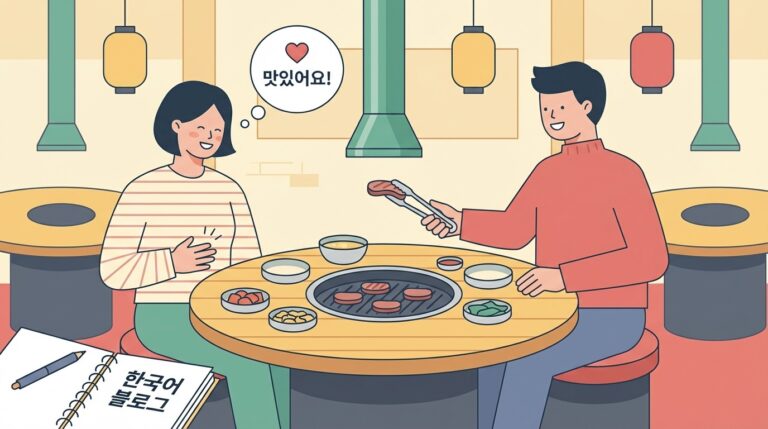
Imagine this: You are sitting at a bustling Korean BBQ restaurant in the heart of Seoul. It looks exactly like that scene from your favorite K-Drama—the sizzle of the pork belly, the clinking of Soju glasses, and the lively chatter around you. Your Korean host or friend keeps placing perfectly grilled meat onto your plate. You’ve already eaten three servings, and your stomach is screaming for mercy. You want to say, “I’m full, I can’t eat anymore, let’s pay!” But how do you say it politely without breaking the warm, welcoming mood?
In Korean dining culture, offering food is a primary way of showing affection. If you don’t know how to gracefully say “I’m full” and transition to paying the bill, you might end up eating until you literally can’t walk!
This guide is built from the real, slightly panicked questions of my beginner (A1) students. Today, we’ll learn exactly how to pause the meat-train and smoothly ask for the bill like a true local.
Phase 2: Core Expressions Deep Dive
Here are the top 3 lifesaver phrases you need at the end of a Korean meal.
1. 배불러요 (I’m full)
- Pronunciation: [bae-bul-leo-yo] (The ‘eo’ sounds like the ‘u’ in ‘run’)
- Meaning: Literal: “My stomach is calling/full” | Real nuance: “I am comfortably full.”
- K-Culture Moment: You’ll often hear K-Pop idols rubbing their stomachs on V-Live after a “Mukbang” (eating broadcast) and letting out a satisfied “Ah~ baebulleoyo!”
- Editor’s Insight: This is the most natural, polite way to announce your stomach is at capacity. Add “너무” (neo-mu / too much) to make it stronger: “너무 배불러요!”
- Situation Spectrum:
- Close Friends (Casual): ✅ (Drop the ‘yo’ -> 배불러)
- Coworkers (Semi-formal): ✅
- Boss/Elders (Formal): ⚠️ (Use ‘배가 부릅니다’ if extremely formal, but ‘배불러요’ is usually fine with a polite tone)
- 🤔 Think About It: Why is “배불러요” (I am full) used as a compliment in Korea? In many cultures, talking about your stomach size might be rude, but in Korea, it proves the host did a great job feeding you!
2. 더 이상 못 먹어요 (I can’t eat anymore)
- Pronunciation: [deo i-sang mot meo-geo-yo]
- Meaning: Literal: “More than this, I cannot eat” | Real nuance: “I’m so stuffed, not one more bite!”
- K-Culture Moment: Picture a Korean grandmother piling a mountain of rice into your bowl. This is the phrase you desperately need!
- Editor’s Insight: ‘못’ (mot) means ‘cannot’. It implies you want to eat more of their delicious food, but your physical limits prevent you. It’s a very polite refusal.
- Situation Spectrum:
- Close Friends (Casual): ✅
- Coworkers (Semi-formal): ✅
- Boss/Elders (Formal): ✅
3. 계산해 주세요 (Please give me the bill / Please ring me up)
- Pronunciation: [gye-san-hae ju-se-yo]
- Meaning: Literal: “Please calculate” | Real nuance: “Check, please!”
- K-Culture Moment: Unlike Western restaurants where you wait at the table, in K-Dramas, you always see the main character grab the bill from the table and march up to the front counter to pay.
- Editor’s Insight: This is essential! Use it at the front counter, or to ask a passing waiter to process your card.
- Situation Spectrum:
- Friends (Casual): 🚫 (You don’t say this to friends, you say it to staff)
- Restaurant Staff: ✅
Phase 3: Textbook vs. Real Korean
[When turning down more food]
* 📖 Textbook Korean: 아니요, 괜찮습니다. 배가 부릅니다. (No, I am fine. My stomach is full.)
* 🗣️ Real Korean: 아유~ 너무 배불러요! 진짜 잘 먹었어요. (Oh my~ I’m so full! I really ate well.)
* 💡 Why the difference?: Koreans value expressing gratitude alongside refusal. Saying “I ate well” softens the rejection and praises the food.
[When offering to pay the bill]
* 📖 Textbook Korean: 제가 계산하겠습니다. (I will calculate the bill.)
* 🗣️ Real Korean: 제가 살게요! (I’ll buy/treat!)
* 💡 Why the difference?: “제가 살게요” is the ultimate “Insider” phrase. It shows generosity, which is a huge part of Korean group dining culture.
Bottom Note: For A1 beginners, sticking to “제가 살게요” (I’ll treat) or simply taking the bill to the counter is perfectly polite and natural!
Phase 4: Cultural Context — K-Culture Deep Dive
4-1. Non-Verbal Cues: The Polite Refusal
When you say “배불러요” (I’m full) to an elder offering you more food, don’t just sit still. Gently wave your hands in front of you (like a “no” gesture) while smiling warmly. You can also lightly pat your stomach. It shows you physically cannot take more, rather than just disliking the food.
4-2. K-Food Connection: The “K-Dessert” Trap
You are at a Dakgalbi (Spicy Stir-fried Chicken) restaurant. You say “배불러요!” (I’m full!). The waiter nods, clears the pan, and asks, “볶음밥 하나 해 드릴까요?” (Shall I make one fried rice for you?).
Wait, what?
In Korea, fried rice (Bokkeumbap) cooked in the leftover meat juices is considered “dessert.” Even if Koreans are 100% full, they will magically find room for the Bokkeumbap. If you truly want to stop eating and pay, you must survive the Bokkeumbap offer first!
Phase 5: Real-Life Roleplay Scenario
Setting: Friday night, 8 PM. A noisy, smoke-filled K-BBQ spot in Gangnam. You’ve just finished your third plate of pork belly.
Characters:
– YOU: A foreigner on your first business trip to Korea.
– Minsu (32): Your friendly Korean coworker who is obsessed with feeding you.
Minsu: 더 시킬까요? 고기 더 먹어요! 🥩
(deo si-kil-kka-yo? go-gi deo meo-geo-yo!)
[Should we order more? Eat more meat!]
(🎭 Stage Direction: Minsu lifts his tongs, ready to hail the waiter.)
YOU: 아, 아니요! 저 진짜 너무 배불러요.
(a, a-ni-yo! jeo jin-jja neo-mu bae-bul-leo-yo.)
[Ah, no! I’m really, really full.]
Minsu: 에이, 하나도 안 먹었잖아요. 냉면은요?
(e-i, ha-na-do an meo-geot-ja-na-yo. naeng-myeon-eun-yo?)
[Hey, you barely ate anything. How about cold noodles?]
YOU: 더 이상 못 먹어요. 정말 잘 먹었습니다!
(deo i-sang mot meo-geo-yo. jeong-mal jal meo-geot-seum-ni-da!)
[I can’t eat anymore. I really ate well!]
🔀 YOUR TURN! How should you transition to paying?
– A) “빨리 가요.” (Let’s go fast.)
– B) “계산은 어떻게 해요? 제가 살게요!” (How do we pay? I’ll treat!)
– C) “돈 내세요.” (You pay money.)✅ Best Choice: B — Offering to treat (제가 살게요) is incredibly polite. Minsu will likely fight you to pay the bill anyway (a classic Korean polite battle), but making the offer makes you look like a K-Culture pro!
⚠️ Choice C Analysis: “돈 내세요” is very aggressive and rude. Never command someone to pay!
Phase 6: 10-Second Shadowing Drill
Practice these lines out loud! Follow the slashes for natural pauses.
- 🥺 (Politely refusing)
아유, / 너무 배불러요. (a-yu, / neo-mu bae-bul-leo-yo.)
Oh my, I am so full. -
😊 (Expressing gratitude)
진~~~짜 / 잘 먹었습니다! (jin~~~jja / jal meo-geot-seum-ni-da!)
I reeeally ate well! -
💳 (At the counter, to the staff)
여기 / 계산해 주세요. (yeo-gi / gye-san-hae ju-se-yo.)
Please give me the bill here.
Phase 7: K-Culture Mini Dictionary
| Korean | Romanization | English | Cultural Context |
|---|---|---|---|
| 정 | jeong | Affection/Bond | The deep emotional bond in Korean culture, often expressed by feeding someone until they are stuffed. |
| 볶음밥 | bok-keum-bap | Fried Rice | The legendary “K-Dessert.” Fried rice made in the same pan after eating the main meat dish. |
| 쏘다 | sso-da | To treat/buy | Slang meaning “to shoot.” Used when you are proudly paying for everyone’s meal. (내가 쏠게요! = I’m treating!) |
| 영수증 | yeong-su-jeung | Receipt | Always requested at the end of payment if you need it for business trips. |
Phase 8: Traveler’s Survival Kit
If you are traveling in Seoul, paying at a restaurant is slightly different from the West. Here are your top survival phrases!
🆘 Survival Phrases for the Cashier
– 🇰🇷 “카드로 할게요.” (ka-deu-ro hal-ge-yo)
– 🗣️ Guide: [I will pay with card]
– 📍 Where to use: At any cafe or restaurant counter.
- 🇰🇷 “영수증 버려 주세요.” (yeong-su-jeung beo-ryeo ju-se-yo)
- 🗣️ Guide: [Please throw away the receipt]
- 📍 Where to use: When the cashier asks if you need the receipt and you don’t.
📌 Editor’s Travel Note
– No Tipping: South Korea has a strict NO TIP culture. If you leave money on the table, the waiter might chase you down the street thinking you forgot your change!
– The Counter: Do not wait at the table for the check. Grab the small paper bill usually left on your table (or simply remember your table number) and walk to the front door counter to pay.
Phase 9: Critical Thinking — “One Step Deeper”
Food & Identity (Food as Jeong)
Why do Koreans insist you eat more, even when you say “I’m full”? In Korea, food is deeply tied to the concept of Jeong (정)—a sense of collective warmth and bonding. Historically, during harder times, sharing precious food was the ultimate sign of love. Today, a Korean friend or restaurant owner piling side dishes (banchan) onto your table is their way of saying, “I care about you.” Understanding this turns a potentially overwhelming meal into a beautiful cultural experience.
🧠 Think Deeper:
Because of this culture, rejecting food bluntly can seem like rejecting their affection. That is why we always pair “I’m full” with “I ate so well!” (잘 먹었습니다).💬 Your Turn: How do people in your culture show affection through food? Do you have to clear your plate to be polite? Let me know in the comments!
Phase 10: FAQ & Avoiding Mistakes
Q: Can I say “배불러 (Bae-bul-leo)” without the ‘yo’ to the restaurant staff?
No! Dropping the ‘yo’ makes it “Banmal” (informal language). Only say “배불러” to your close friends or younger siblings. Always use “배불러요” to staff or elders.
Q: Do I have to pay for the extra side dishes (Banchan) they gave me?
No! Banchan (like kimchi, bean sprouts, etc.) are almost always free and infinitely refillable in Korea. Enjoy!
❌ Common Mistake #1: Leaving cash on the table and walking out.
✅ Do this instead: Always hand your card or cash directly to the cashier at the front counter. Leaving cash on the table might confuse the staff or look like you forgot it.
Phase 11: Summary & Action Items
One-Liner Summary: Gently stop the food-train with “배불러요” (I’m full) and confidently head to the counter with “계산해 주세요” (Bill, please).
Action Mission:
– 🥉 Bronze: Stand in front of your mirror and practice patting your stomach while saying “아유~ 너무 배불러요!” 3 times.
– 🥈 Silver: Next time you watch a K-Drama eating scene, try to spot the moment they walk to the front counter to pay.
– 🥇 Gold (For travelers): Go to a Korean restaurant, finish your meal, and successfully say “계산해 주세요” at the counter!
K-Culture Mission:
Search “Korean Mukbang” on YouTube. Watch the end of the video—chances are, the creator will lean back and sigh, “진짜 배불러요!” (I’m really full!).
Phase 12: Quiz — Interactive Challenge
Q1. You are having dinner with your boss. You are completely stuffed. What is the BEST thing to say?
A) 배불러. (Bae-bul-leo)
B) 너무 배불러요. 잘 먹었습니다! (Neo-mu bae-bul-leo-yo. Jal meo-geot-seum-ni-da!)
C) 계산해 주세요. (Gye-san-hae ju-se-yo.)
Q2. True or False: If the service was excellent, you should leave a 10% tip on the table.
Q3. Fill in the blank:
You want to treat your friend to coffee after dinner.
“아메리카노 내가 _______!” (I’ll buy/treat the Americano!)
(Answers)
Click to reveal answers!
Q1: B (Always use ‘yo’ for politeness, and thanking them for the food is crucial!).
Q2: False! (There is no tipping culture in Korea. Just a warm “Jal meogeotseumnida!” is enough).
Q3: 살게요 (sal-ge-yo) or 쏠게요 (ssol-ge-yo).
Frequently Asked Questions (FAQ)
Q: What does "배불러요 (I'm full)" mean in Korean and how do you pronounce it?
A: In Korean, "배불러요 (I'm full)" is pronounced [bae-bul-leo-yo] and means: Literal: "My stomach is calling/full" | Real nuance: "I am comfortably full."
Q: What does "더 이상 못 먹어요 (I can't eat anymore)" mean in Korean and how do you pronounce it?
A: In Korean, "더 이상 못 먹어요 (I can't eat anymore)" is pronounced [deo i-sang mot meo-geo-yo] and means: Literal: "More than this, I cannot eat" | Real nuance: "I'm so stuffed, not one more bite!"
Q: What does "계산해 주세요 (Please give me the bill / Please ring me up)" mean in Korean and how do you pronounce it?
A: In Korean, "계산해 주세요 (Please give me the bill / Please ring me up)" is pronounced [gye-san-hae ju-se-yo] and means: Literal: "Please calculate" | Real nuance: "Check, please!"







