

Phase 1: Empathy (The Cold Open)
Hello there! I’m your Daily Hangul Editor.
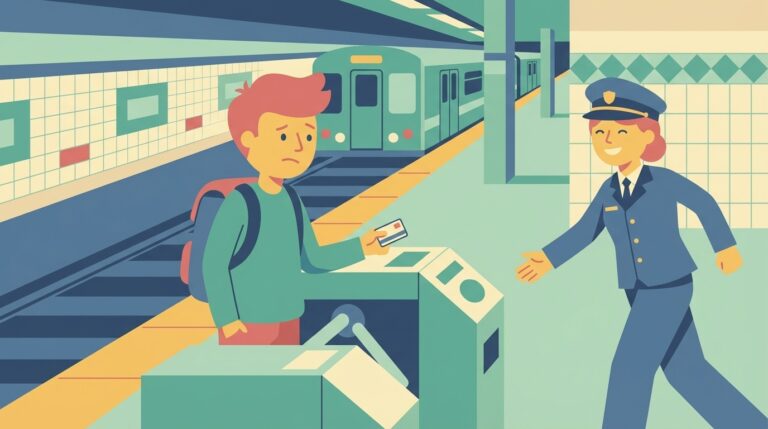
Imagine this: You’re in Seoul. It’s rush hour. You confidently step onto the iconic blue bus, feeling like the main character in a K-Drama. You gracefully tap your T-money card against the terminal, expecting that cheerful little “Beep!”
Instead, a loud, robotic voice announces to the entire bus: “잔액이 부족합니다 (Janaegi bujokhamnida).”
The bus driver pauses. The passengers behind you sigh. Your mind goes blank.
If you’ve ever felt the cold sweat of the “Insufficient Balance” moment, you are not alone! In fact, it’s a rite of passage for anyone visiting or living in Korea. Today, we’re going to learn exactly how to handle this situation with grace, so you can smoothly step out of panic mode and look like an absolute local.
(Note: This guide is built from the real, sweaty-palmed experiences of my students!)
Phase 2: Core Expressions Deep Dive
Here are the lifesavers you need when your card betrays you.
1. 잔액이 부족합니다
- Pronunciation: [janaegi bujokhamnida] (“ja-naeg-ee boo-jok-ham-nee-da”)
- Meaning: Literal: The balance is insufficient. / Real Nuance: “You’re broke (on this card).”
- K-Culture Moment: This isn’t something you say; it’s something the machine says! In K-Dramas, this sound effect is often used for comedic timing when a character is completely down on their luck.
- Editor’s Insight: You just need to recognize this phrase. The moment you hear “janaegi…”, you should already be reaching for your wallet.
- Situation Spectrum:
- Casual: 🚫 (It’s a machine’s voice!)
- 🤔 Think About It: Korean public transit machines use highly formal language (합쇼체/Habsho-che) to address passengers. Why do you think automated systems in Korea are programmed to be so strictly polite?
2. (만 원) 충전해 주세요
- Pronunciation: [(man won) choong-jeon-hae joo-se-yo] (“choong-jeon” sounds like “choong” + “john” but with a soft j)
- Meaning: Literal: Please charge (10,000 won). / Real Nuance: “Top up my card with 10k won, please!”
- K-Culture Moment: You’re at a GS25 or CU convenience store. The cashier is scanning items at lightning speed. You hand over your card and cash, saying this phrase, and the transaction is done in 3 seconds.
- Editor’s Insight: “충전 (choong-jeon)” means “recharge.” We use it for transit cards, phone batteries, and even resting on the weekend (“I need to recharge my energy”).
- Situation Spectrum:
- Convenience store staff (Semi-formal): ✅
- Subway station staff (Formal): ✅
3. 현금으로 낼게요
- Pronunciation: [hyeon-geumeuro naelgeyo] (“hyeon-geum” – ‘eu’ sounds like the disgusted sound you make when stepping in gum)
- Meaning: Literal: I will pay with cash. / Real Nuance: “Let me just pay cash right now!”
- K-Culture Moment: The bus is already moving. You got the “insufficient balance” error. Instead of getting off in shame, you confidently pull out some coins or a 1,000 won bill and say this to the driver.
- Editor’s Insight: This is your ultimate backup plan on a bus. Just remember, subways don’t accept direct cash at the turnstile!
- Situation Spectrum:
- Bus driver (Respectful): ✅
Phase 3: Textbook vs. Real Korean
Let’s see how the language evolves from the classroom to the bustling streets of Seoul.
[At the Convenience Store]
* 📖 Textbook Korean: 제 교통카드에 만 원을 충전하고 싶습니다. (I would like to recharge 10,000 won to my transit card.)
* 🗣️ Real Korean: 만 원 충전해 주세요. (Or simply: 이거 만 원이요! + Handing over the card and cash together)
* 💡 Why the difference?: Korea’s “빨리빨리 (Ppalli-ppalli / Hurry up)” culture! In a busy convenience store, efficiency is politeness. Keep it short and sweet.
[Explaining the Error]
* 📖 Textbook Korean: 제 카드에 잔액이 부족한 것 같습니다. (It seems my card lacks balance.)
* 🗣️ Real Korean: 아, 돈이 없네요. / 안 찍히네요. (Ah, there’s no money. / It’s not tapping.)
* 💡 Why the difference?: Koreans rarely use the formal word “잔액 (balance)” in spoken conversation. “돈 (money)” is much more direct and natural.
Phase 4: Cultural Context — K-Culture Deep Dive
4-1. Non-Verbal Cues: The Art of the Two-Handed Handover
When asking a convenience store worker to recharge your card, never slide or toss the card onto the counter. Hand it to them using both hands, or with your right hand while your left hand lightly supports your right elbow. This non-verbal “Nunchi” shows respect.
4-2. K-Travel Connection: The “Cash Only” Paradox
Here is a massive culture shock for travelers: Korea is famously a cashless society. You can buy a 1,000 won pack of gum with a credit card. BUT, reloading a physical T-money card requires CASH.
Whether you are at a subway ticket machine or a convenience store, you cannot use your Visa or Mastercard to top up your transit card. If you hear “잔액이 부족합니다,” you must find an ATM, withdraw cash, and then recharge. Always keep a crisp 10,000 won bill in your passport case for transit emergencies!
Phase 5: Real-Life Roleplay Scenario
Setting: It’s 6:30 PM on a Friday. You are getting on Bus #741 near Gangnam Station. The bus is packed. You tap your T-money card.
Characters:
– YOU: A traveler who just spent a bit too much at a K-Beauty store and forgot to check your T-money balance.
– Bus Driver (기사님 / Gisa-nim): A Korean Ahjussi. He seems rushed but is actually very helpful.
(You step onto the bus and tap your card on the terminal.)
Terminal: 삑! 잔액이 부족합니다. (Bbeep! Janaegi bujokhamnida.)
(You freeze. The driver looks at you through the mirror.)
기사님 (Driver): 학생, 잔액이 없네.
[hak-saeng, janaegi eom-ne.]
(Student, you have no balance.)
YOU: 헉, 진짜요? 어떡하지…
[heok, jinjja-yo? eotteok-haji…]
(Gasp, really? What should I do…)
기사님 (Driver): 현금 있어?
[hyeon-geum isseo?]
(Do you have cash?)
🔀 Your Turn! How should you respond?
– A) “아니요, 신용카드 낼게요.” (No, I’ll pay with a credit card.)
– B) “네! 잠시만요, 현금으로 낼게요.” (Yes! Just a moment, I’ll pay in cash.)
– C) “저 그냥 내릴게요!” (I’ll just get off!)✅ Best Choice: B — If you have cash, just ask for a moment and pay. Korean bus drivers will wait for you to find your coins.
⚠️ Choice A Analysis: You cannot use a regular foreign credit card directly on the bus terminal unless it has a specific Korean post-paid transit chip.
⚠️ Choice C Analysis: Getting off is an option if you have zero cash, but it’s much better to prepare some coins in advance!
(Assuming you chose B)
YOU: 네! 잠시만요, 현금으로 낼게요.
[ne! jamshiman-yo, hyeon-geumeuro naelgeyo.]
(Yes! Just a moment, I’ll pay in cash.)
기사님 (Driver): 천오백 원이에요. 저기 통에 넣어요.
[cheon-o-baek won-ieyo. jeogi tong-e neoeoyo.]
(It’s 1,500 won. Put it in the box over there.)
YOU: 네, 여기 있습니다. 감사합니다!
[ne, yeogi itseumnida. gamsahamnida!]
(Yes, here it is. Thank you!)
(You successfully sit down, feeling like a true Seoulite.)
Phase 6: 10-Second Shadowing Drill
Practice this out loud. Pay attention to the pauses (/) and the emotion tags!
- 🥺 A bit panicked: 아! / 카드가 / 안 찍혀요.
(Ah! / kadeu-ga / an jjikhyeo-yo.)
“Ah! My card isn’t tapping/working.” -
😤 Determined & Ready: 기사님, / 저 / 현금으로 / 낼게요!
(Gisa-nim, / jeo / hyeon-geumeuro / naelgeyo!)
“Driver, / I / will pay / with cash!” -
😊 Polite & Quick: 만 원 / 충전해 주세요.
(Man won / choong-jeon-hae joo-se-yo.)
“Please top up / 10,000 won.”
Phase 7: K-Culture Mini Dictionary
| 한국어 (Korean) | Romanization | English | Context |
|---|---|---|---|
| 기사님 | gisa-nim | Driver (Respectful) | Essential title for bus or taxi drivers. Never use “Ahjussi” if you can avoid it! |
| 단말기 | dan-mal-gi | Terminal / Card Reader | The machine you tap your card on. |
| 환승 | hwan-seung | Transfer | Tapping your card when getting off the bus gets you a free transfer! |
| 눈치 | nunchi | Social awareness | Having the nunchi to step aside if your card fails, so others can board. |
Phase 8: Traveler Survival Kit
🆘 Top 3 Survival Phrases for Transit Crises
– 🇰🇷 “제일 가까운 편의점이 어디예요?” (je-il gakka-un pyeon-ui-jeomi eodi-yeyo?)
– 🗣️ Meaning: Where is the nearest convenience store? (To reload your card!)
– 🇰🇷 “교통카드 충전 되나요?” (gyo-tong-kadeu choong-jeon doe-nayo?)
– 🗣️ Meaning: Can I recharge my transit card here?
– 🇰🇷 “ATM기 어디에 있어요?” (에이티엠기 어딨어요? – ATM-gi eodisseoyo?)
– 🗣️ Meaning: Where is the ATM? (Because you need cash!)📌 Editor’s Travel Note
– The Free Transfer Rule: Always tap your card when you get OFF the bus or out of the subway. If you transfer to another bus or subway within 30 minutes, it’s free!
– Subway vs. Bus Recharges: You can recharge your card at automated machines inside any subway station, but you cannot recharge it on a bus.
– Climate Card (기후동행카드): If you’re staying in Seoul for a few days, look into the new unlimited transit passes. They save you the stress of “insufficient balance” entirely!
Phase 9: Critical Thinking Corner — “One Step Deeper”
🧠 Think Deeper: Media vs. Reality
In K-Dramas, public transportation in Seoul looks flawless. Characters effortlessly glide through subway turnstiles, gazing romantically out the window. But the reality is that the Korean transit system, while world-class, has hidden “local rules.” The biggest shock for tourists is discovering that a hyper-modern, tech-savvy country still demands physical cash to reload a transit card. This highlights a fascinating gap between the glossy media image of a fully digitized Korea and the practical, everyday infrastructure that still relies on old-school systems.
💬 Your Turn: Have you ever experienced a “cash-only” surprise in a country you thought was completely cashless? Let me know in the comments!
Phase 10: FAQ & Avoiding Common Mistakes
Q: Can I just give my credit card to the convenience store worker to recharge my T-money?
No! This is the #1 mistake. You must use Korean Won in cash.
Q: What if I have no cash on the bus?
You will politely have to say “죄송합니다, 내릴게요” (Sorry, I’ll get off) and find an ATM.
Q: Can I pay for two people with one transit card?
Yes! Before tapping on the bus, tell the driver “두 명이요 (Du myeong-iyo – Two people, please).” The driver will press a button. Wait for them to nod, then tap your card.
❌ Common Mistake #1: Tapping the card violently when it says “error.”
✅ Do this instead: Look at the screen; it usually shows an error code. Just step aside gracefully and check your balance on your phone (using apps like BucaCheck) or ask the driver.
Phase 11: Summary & Action Items
One-Liner Summary: When the machine yells “Insufficient Balance,” don’t panic—just grab your cash and say “충전해 주세요” (Please recharge) or “현금으로 낼게요” (I’ll pay with cash).
Action Mission 3 Steps:
– 🥉 Bronze (Solo): Stand in front of your mirror and practice looking slightly surprised while saying, “아, 현금으로 낼게요.”
– 🥈 Silver (Online): Comment below with your favorite transit station in Korea, or the one you want to visit most!
– 🥇 Gold (Real Life): Go to a Korean convenience store and successfully recharge your T-money card using the phrase “만 원 충전해 주세요!”
🎟️ K-Culture Mission: Next time you watch a K-Drama, look closely at the bus or subway scenes. Can you spot the exact moment they tap their card? What color is the terminal?
Phase 12: Interactive Quiz
1. You are on the bus. Your card has no money. You have a 1,000 won bill. What do you say?
A) 만 원 충전해 주세요.
B) 현금으로 낼게요.
C) 안녕히 계세요.
2. True or False — K-Culture Edition:
You can easily use your foreign Apple Pay or Visa card to tap into the Seoul subway.
3. Fill in the Blank:
To show politeness to the convenience store staff when asking for a recharge, use ________ (nunchi/two hands/cash only) when handing over your card.
(Answers: 1. B, 2. False! You need a T-money card or a specific local card. 3. two hands)
Frequently Asked Questions (FAQ)
Q: What does "잔액이 부족합니다" mean in Korean and how do you pronounce it?
A: In Korean, "잔액이 부족합니다" is pronounced [janaegi bujokhamnida] and means: Literal: The balance is insufficient. / Real Nuance: "You're broke (on this card)."
Q: What does "(만 원) 충전해 주세요" mean in Korean and how do you pronounce it?
A: In Korean, "(만 원) 충전해 주세요" is pronounced [man won] and means: Literal: Please charge (10,000 won). / Real Nuance: "Top up my card with 10k won, please!"
Q: What does "현금으로 낼게요" mean in Korean and how do you pronounce it?
A: In Korean, "현금으로 낼게요" is pronounced [hyeon-geumeuro naelgeyo] and means: Literal: I will pay with cash. / Real Nuance: "Let me just pay cash right now!"







