

Phase 1: Empathy
Greeting: Hello! This is your Lead Editor at Daily Hangul.
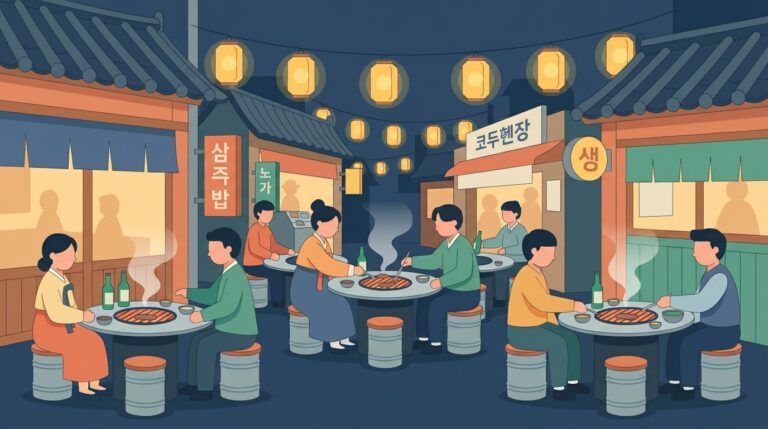
Picture this: A rainy night in Seoul. You step into a tiny, slightly faded Nopo (노포, a decades-old traditional Korean eatery). The air is thick with the savory smell of grilled pork belly and bubbling stews. In the corner, just like a classic K-Drama scene, a group of office workers clink their green Soju glasses, and someone confidently shouts across the noisy room, “Auntie! Two more bottles of Soju here!”
You sit at your table, menu in hand, stomach growling. The owner is incredibly busy, darting between tables. You try making eye contact—the polite Western way—but she rushes right past you. You freeze. How do you get her attention without feeling incredibly rude?
Don’t worry. This is a rite of passage for every expat and traveler in Korea! Today, we’re going to master the Nopo Vibe. Knowing these expressions won’t just get you fed; it will earn you that approving nod from the local owner, making you an absolute ‘Insider’ in the K-Food scene. This guide is built straight from the real-life struggles and triumphs of our Daily Hangul students. Let’s dive in!
Phase 2: Deep Dive into Core Expressions
1. 이모님! (Auntie! / Excuse me!)
- Pronunciation: [i-mo-nim] – Sounds like the letter ‘E’, ‘mo’ (as in motion), and ‘neem’ (like the tree).
- Meaning: Literal = Aunt (mother’s sister) | Real nuance = An affectionate, respectful way to call a middle-aged female Nopo owner or staff.
- K-Culture Moment: In almost every Korean thriller or slice-of-life drama, the detective sits at a Nopo and warmly calls out, “이모님, 국밥 한 그릇 주소!” (Auntie, a bowl of rice soup!). It instantly breaks the ice and establishes a bond of ‘Jeong’ (정, deep connection/affection).
- Editor’s Insight: This word feels warm and slightly informal but still respectful because of the ‘-님’ suffix. However, do NOT use this in a fancy, modern Italian restaurant or a fine-dining spot. It belongs purely to the Nopo, casual BBQ spots, and traditional markets.
- Situation Spectrum:
- Casual Nopo / Traditional Market: ✅
- Modern Cafe / Fine Dining: 🚫
- To a young female staff member in her 20s: 🚫 (Big mistake!)
- 🤔 Think About It: Why does the Korean language use familial terms (Aunt, Older Brother, Older Sister) for complete strangers? Does your native culture have a similar way of turning public spaces into ‘family’ spaces?
2. 앞접시 좀 주실 수 있나요? (Could we get some small sharing plates?)
- Pronunciation: [ap-jeop-si jom ju-sil su in-na-yo?] – ‘ap’ sounds like ‘up’, ‘jeop’ rhymes with ‘yup’, ‘si’ like ‘she’.
- Meaning: Literal = Front plate, please give. | Real nuance = Could I please have a small individual plate to eat from the shared main dish?
- K-Culture Moment: When a giant, bubbling pot of Kimchi Jjigae arrives at the center of the table, everyone grabs their spoon. But if it’s too hot, or you want to eat neatly, you ask for an ‘ap-jeop-si’.
- Editor’s Insight: The word ‘앞’ means ‘front’. So it literally means “the plate in front of me.” Since B1 learners already know “주세요” (give me), upgrading to “주실 수 있나요?” (Could you give me?) sounds much softer and more sophisticated.
- Situation Spectrum:
- Casual friends eating together: ✅ (Just say: 앞접시 좀 줘)
- Eating with coworkers/seniors: ✅
- Formal dining: ✅
- 🤔 Think About It: Korean food heavily revolves around sharing one main pot or grill. What does this communal eating style say about the Korean value of community?
3. 밥 하나 비벼주세요! (Please mix/fry one portion of rice for us!)
- Pronunciation: [bap ha-na bi-byeo-ju-se-yo!]
- Meaning: Literal = Mix one rice please. | Real nuance = We are ready for the ‘K-Dessert’ (Fried rice cooked on the leftover BBQ grill/stew pot)!
- K-Culture Moment: You’ve finished 90% of your spicy Dak-galbi (spicy stir-fried chicken). The climax of the Nopo experience is calling the owner to fry rice with the savory leftovers. This is famously known on Korean social media as ‘K-Dessert’ because Koreans finish a heavy meal with… more carbs!
- Editor’s Insight: ‘비비다’ means to rub or mix (like Bibimbap). When you say this, the owner will bring rice, seaweed, and sesame oil to perform magic on your grill.
- Situation Spectrum:
- K-BBQ / Spicy Stir-fry Nopo: ✅
- Soup-only restaurants: 🚫 (They won’t know what to fry!)
- 🤔 Think About It: Every culinary culture has a ‘finale’. In Western culture, it’s sweet desserts. In Nopo culture, it’s fried rice. Why do you think savory finishes are so beloved here?
Phase 3: Textbook vs. Real Korean
[Calling the Waiter in a Crowded Restaurant]
* 📖 Textbook Korean: 종업원, 메뉴판 좀 주시겠습니까? (Waiter, could you please give me the menu?)
* 🗣️ Real Korean: 사장님~! / 이모님~! 여기요! (Boss~! / Auntie~! Over here!)
* 💡 Why the difference?: Calling someone ‘종업원’ (employee/waiter) sounds very clinical and slightly condescending in Nopo culture. Elevating them to ‘Boss’ or ‘Auntie’ shows street-smarts and respect.
[Expressing that the food is amazing]
* 📖 Textbook Korean: 이 음식은 정말 맛있습니다. (This food is very delicious.)
* 🗣️ Real Korean: 와, 대박. / 진짜 미쳤다. (Wow, jackpot. / This is literally crazy.)
* 💡 Why the difference?: Young Koreans use exaggerated expressions like ‘미쳤다’ (crazy) to express that food hits the spot perfectly. (Note: Only use this with close friends, not to the Nopo owner directly!)
Bottom Note: At a B1 level, you want to sound natural but polite. If “이모님” feels too risky because you can’t guess their age, “사장님” (Sa-jang-nim / Boss) is your 100% safe, universally respected alternative!
Phase 4: Cultural Context — K-Culture Deep Dive
4-1. Non-Verbal Nunchi (눈치) at the Nopo
Don’t wait to be seated like in a Western diner! In a true Nopo, you use your Nunchi (the subtle art of reading the room). If you see an empty table that hasn’t been cleaned yet, hover near it. When making your order, do not rely on eye contact. Nopo owners are moving at the speed of light. Raise your hand slightly, project your voice clearly from your chest, and confidently call out “사장님!” If you whisper, you’ll be hungry all night.
4-2. The K-Drama Trope: Soju and Secrets
Why do Nopo restaurants feature so heavily in K-Dramas like Itaewon Class or Hospital Playlist? The Nopo is the great equalizer in Korean society. Regardless of your corporate rank, everyone sits on the same plastic stools, cooks their own meat, and pours drinks for each other using two hands. It represents the stripping away of formal office hierarchy. However, there’s a catch: Media vs. Reality. While K-Drama characters might get drunk and yell at the Nopo owner, in reality, Koreans treat the ‘Imo-nim’ with immense respect. She is the queen of that space.
Phase 5: Real-Life Roleplay Scenario
Setting: Friday, 7:30 PM. An old, smoky Nopo alley near Jongno-3-ga. The smell of charcoal and pork belly is intoxicating. You are sitting on a round tin chair with your Korean coworker, Minsu.
Characters:
– YOU: An expat working in Seoul, excited to try authentic Nopo BBQ.
– Minsu (32): Your friendly Korean coworker who knows all the best local spots.
– Imo-nim (50s): The fast-walking, charismatic Nopo owner.
Dialogue:
Minsu: 여기가 진짜 노포 맛집이에요! 이모님! 저희 삼겹살 2인분 주세요!
(yeo-gi-ga jin-jja no-po mat-ji-bi-e-yo! i-mo-nim! jeo-hui sam-gyeop-sal i-in-bun ju-se-yo!)
[English] This is a true Nopo hotspot! Auntie! Two portions of pork belly for us, please!
Imo-nim: 네~ 불 먼저 넣어줄게요. 반찬은 저기 셀프예요!
(ne~ bul neon-jeo neo-eo-jul-ge-yo. ban-cha-neun jeo-gi sel-peu-ye-yo!)
[English] Yes~ I’ll put the fire (charcoal) in first. Side dishes are self-serve over there!
YOU: 민수 씨, 제가 반찬 가져올게요. 뭐 좋아해요?
(min-su ssi, je-ga ban-chan ga-jyeo-ol-ge-yo. mwo jo-a-hae-yo?)
[English] Minsu, I’ll bring the side dishes. What do you like?
Minsu: 마늘이랑 김치 듬뿍 가져다주세요. 아, 참! 우리 앞접시도 필요해요.
(ma-neu-ri-rang gim-chi deum-ppuk ga-jyeo-da-ju-se-yo. a, cham! u-ri ap-jeop-si-do pi-ryo-hae-yo.)
[English] Please bring plenty of garlic and kimchi. Oh, right! We need small plates too.
(🎭 Stage Direction: The Imo-nim is rushing past your table with a tray of drinks)
🔀 Your Turn! How do you ask the Imo-nim for the plates?
– A) “저기요! 앞접시 주세요!” (Excuse me! Give plates!)
– B) “이모님~ 바쁘신데 죄송하지만 앞접시 두 개만 주실 수 있나요?”
– C) “사장님! 여기 앞접시 좀 주세요!”✅ Best Choice: C is the most natural for a bustling Nopo. It’s confident, polite, and quick.
⚠️ Choice B Analysis: While grammatically beautiful and very polite, Nopo owners are too busy for long, flowery sentences. Keep it short and snappy!
⚠️ Choice A Analysis: “저기요” (Excuse me) is okay, but “주세요” without “좀” (a little/please) can sound a bit demanding.
YOU: (Confidently) 사장님! 여기 앞접시 두 개만 주세요!
(sa-jang-nim! yeo-gi ap-jeop-si du gae-man ju-se-yo!)
[English] Boss! Two small plates over here, please!
Imo-nim: 아이고, 우리 외국인 손님 한국말 잘하네! 서비스로 계란찜 하나 줄게!
(a-i-go, u-ri oe-gu-gin son-nim han-gung-mal jal-ha-ne! seo-bi-seu-ro gye-ran-jjim ha-na jul-ge!)
[English] Oh my, our foreign guest speaks Korean so well! I’ll give you a steamed egg as service (on the house)!
YOU: 와, 대박! 감사합니다, 이모님!
(wa, dae-bak! gam-sa-ham-ni-da, i-mo-nim!)
[English] Wow, jackpot! Thank you, Auntie!
Phase 6: 10-Second Shadowing Drill
Let’s practice the rhythm! Pay attention to the pauses (/) and the emotion tags.
🗣️ 😤 (Confidently and loud) 사장님~! / 여기 / 앞접시 두 개만 / 주시겠어요?
(sa-jang-nim~! / yeo-gi / ap-jeop-si du gae-man / ju-si-ge-sseo-yo?)🗣️ 😊 (Excitedly) 이모님! / 저희 / 밥 하나 / 비벼주세요!
(i-mo-nim! / jeo-hui / bap ha-na / bi-byeo-ju-se-yo!)
Phase 7: K-Culture Mini Dictionary
| Korean | Romanization | English | Context & Meaning |
|---|---|---|---|
| 노포 | no-po | Old-school eatery | Literally “old shop.” Beloved for authentic taste, cheap prices, and vintage vibes. |
| 서비스 | seo-bi-seu | “On the house” | Free food given by the owner as a sign of affection (Jeong). Never demand it; let it be a surprise! |
| 단골 | dan-gol | Regular customer | Nopo owners treat their ‘dan-gol’ like family, often giving them secret menu items or extra portions. |
| 볶음밥 | bo-kkeum-bap | Fried rice | The mandatory “K-Dessert” cooked on your meat grill or stew pot at the end of the meal. |
Phase 8: Traveler Survival Kit
If you are visiting a Nopo or traditional market, keep these survival phrases in your back pocket!
🆘 Survival Phrases for the Nopo
– 🇰🇷 “화장실 비밀번호가 뭐예요?” (hwa-jang-sil bi-mil-beon-ho-ga mwo-ye-yo?)
– 🗣️ Meaning: What is the bathroom passcode?
– 📍 Context: Many old Nopos share an external bathroom in the alleyway that requires a 4-digit pin.
- 🇰🇷 “앞치마 하나만 주세요.” (ap-chi-ma ha-na-man ju-se-yo.)
- 🗣️ Meaning: Please give me one apron.
- 📍 Context: Red Nopo stews splatter everywhere. Ask for a Nopo’s signature colorful apron to protect your clothes!
📌 Editor’s Travel Note
– Cash vs Card: Korea is a cashless society, but in highly traditional markets or very old Nopos, paying with physical cash or account transfer (계좌이체) might get you a slightly larger portion or a warmer smile!
– Tipping: DO NOT LEAVE A TIP. Nopo owners might chase you down the street thinking you forgot your change. Tipping is not part of Korean culture.
Phase 9: Critical Thinking — “One Step Deeper”
Food & Identity: The Concept of Jeong (정) and One Pot
🧠 Think Deeper:
In a Nopo, you rarely order individual dishes. Pork belly, Kimchi stew, and Dak-galbi are all served in one giant pan in the center of the table. Everyone uses their own spoons to eat from the same bubbling pot (though younger generations increasingly prefer using the ‘ap-jeop-si’ front plates). This culinary setup is a direct reflection of Jeong (정)—the invisible Korean cultural fabric of collective bonding, affection, and shared destiny. When Koreans say “Let’s eat a meal together” (밥 한 번 먹자), they are literally inviting you into their communal circle. By sharing the same pot, you are no longer just an acquaintance; you are “sik-gu” (식구 – those who share a mouth/food).💬 Your Turn: Does your culture have a concept similar to ‘Jeong’ or a tradition of sharing food from a single source? Let us know in the comments!
Phase 10: FAQ & Avoiding Common Mistakes
Q: Can I call a young male waiter ‘Samchon’ (Uncle) just like I call the older ladies Imo-nim?
A: No. While you might hear older Korean men call young waiters “Samchon,” for foreign learners, it can sound awkward or slightly rude. Stick to “사장님” (Boss) or “저기요” (Excuse me) for anyone who isn’t a middle-aged female.
Q: Is it okay to ask for more side dishes?
A: Yes! Nopos are famous for unlimited side dishes (Banchan). You can say “김치 좀 더 주실 수 있나요?” (Could I have more Kimchi?). However, many places are now “Self-serve” (셀프), so look around for a side-dish station first!
❌ Common Mistake #1: Waiting at the door to be seated.
✅ Do this instead: In a Nopo, if you see an empty, clean table, just walk up and sit down! If it’s messy, hover near it and say, “사장님, 여기 상 좀 치워주세요~” (Boss, please clear this table~).
Phase 11: Summary & Action Items
One-Liner Summary: To conquer the authentic Nopo vibe, project your voice, confidently call out “Imo-nim” or “Sajang-nim,” and don’t forget your K-Dessert fried rice!
Action Mission 3 Steps:
– 🥉 Bronze (Solo): Stand in front of your mirror and practice shouting “사장님!” confidently without feeling shy.
– 🥈 Silver (Online): Find a Nopo review on Google Maps or Instagram and leave a comment: “여기 볶음밥 꼭 비벼주세요!” (You must mix the fried rice here!).
– 🥇 Gold (Real Life): Visit a Nopo, order meat, and successfully ask for an “ap-jeop-si” (front plate) using today’s expressions.
🎬 K-Culture Mission:
Watch an episode of Reply 1988 or Hospital Playlist. Count how many times the characters yell “이모님!” at a restaurant, and notice the lack of eye contact they use when ordering!
Phase 12: Interactive Quiz Challenge
Q1. Situational Judgment: You are at a bustling old Nopo. The owner (a lady in her 50s) is flying across the room carrying hot stews. You need a menu. What is the BEST way to get her attention?
– A) Make intense eye contact and smile until she comes over.
– B) Wait patiently with your hand raised in silence.
– C) Shout confidently: “이모님! 여기 메뉴판 좀 주세요!”
Reveal Answer: C! In a Nopo, silence means you get skipped. A confident, respectful shout is the way to go.
Q2. Fill in the Blank: After finishing your Dak-galbi, you want the famous ‘K-Dessert’.
“사장님! 저희 밥 하나만 _________!” (Boss! Please mix one portion of rice for us!)
Reveal Answer: 비벼주세요 (bi-byeo-ju-se-yo)
Q3. True or False – K-Culture Edition:
If the Nopo owner gives you an extra bottle of soda for free, you should leave a 15% tip on the table as a thank you.
Reveal Answer: FALSE! That free soda is ‘Service’ (서비스) given out of affection (Jeong). Tipping is not practiced in Korea and will cause confusion. Just say a massive “감사합니다!” (Thank you!)
Frequently Asked Questions (FAQ)
Q: What does "이모님! (Auntie! / Excuse me!)" mean in Korean and how do you pronounce it?
A: In Korean, "이모님! (Auntie! / Excuse me!)" is pronounced [i-mo-nim] and means: Literal = Aunt (mother's sister) | Real nuance = An affectionate, respectful way to call a middle-aged female Nopo owner or staff.
Q: What does "앞접시 좀 주실 수 있나요? (Could we get some small sharing plates?)" mean in Korean and how do you pronounce it?
A: In Korean, "앞접시 좀 주실 수 있나요? (Could we get some small sharing plates?)" is pronounced [ap-jeop-si jom ju-sil su in-na-yo?] and means: Literal = Front plate, please give. | Real nuance = Could I please have a small individual plate to eat from the shared main dish?
Q: What does "밥 하나 비벼주세요! (Please mix/fry one portion of rice for us!)" mean in Korean and how do you pronounce it?
A: In Korean, "밥 하나 비벼주세요! (Please mix/fry one portion of rice for us!)" is pronounced [bap ha-na bi-byeo-ju-se-yo!] and means: Literal = Mix one rice please. | Real nuance = We are ready for the 'K-Dessert' (Fried rice cooked on the leftover BBQ grill/stew pot)!







