

Phase 1: Empathy & The Noraebang Panic
Hello there! This is your Daily Hangul Editor.
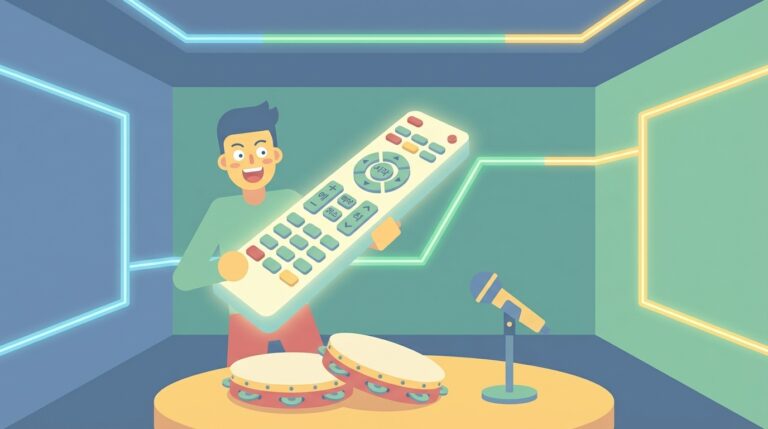
Picture this: You are in Seoul. You’ve just survived your first Hoesik (Korean company dinner) at a bustling K-BBQ restaurant. The team is in high spirits, and someone shouts, “Let’s go to the 2nd round!” Naturally, you end up at a Noraebang (Korean karaoke room). The neon lights are flashing, the tambourines are shaking, and suddenly, the massive, spaceship-like remote control is passed to you.
You stare at it. There are dozens of buttons, all in Korean. Your favorite K-Pop song is playing in your head, but the screen is just waiting for your command. The subtitle in a K-Drama might just say [Sings a song], but in reality, the person holding that remote holds the power of the party!
If you don’t know how to navigate this remote, you might accidentally cancel someone else’s song (a huge Noraebang faux pas!) or sit in silence while others sing. But don’t worry. This guide is based on real SOS messages from my B2-level students who found themselves paralyzed by the Noraebang remote. Today, I’ll teach you not just the words, but the Nunchi (social cues) to become the ultimate Noraebang Insider.
Phase 2: Core Expressions Deep Dive
Let’s break down the most essential phrases you need when that massive remote is handed to you.
1. 제목으로 검색할게요 (I’ll search by title)
- Pronunciation: [jemogeuro geomsaekalgeyo]
- Sound-alike guide: ‘je’ like jet, ‘mok’ like mock, ‘eu’ (sounds like the disgusted sound you make when stepping in gum!), ‘geom’ like gum, ‘saek’ like sack, ‘al-ge-yo’ like I’ll-get-yo.
- Meaning: I will search (for the song) by its title.
- K-Culture Moment: The remote usually defaults to searching by song title. When your Korean friend asks, “What are you looking for?”, saying this confidently shows you know your way around the machine.
- Editor’s Insight: The verb 검색하다 means “to search” (used for Google, Naver, and Noraebang!). Saying ~할게요 implies a soft, polite intention.
- Situation Spectrum:
- Casual (친구 사이): ✅ (Change to: 제목으로 검색할게)
- Semi-formal (직장 동료): ✅
- Formal (직장 상사·어른): ✅
- 🤔 Think About It: Why do Koreans often announce what they are doing (like “I will search now”) instead of just doing it in silence? How does this reflect the communal vibe of a Korean gathering?
2. 예약 버튼 눌러주세요 (Please press the reserve button)
- Pronunciation: [yeyak beoteun nulleojuseyo]
- Sound-alike guide: ‘ye’ like yeah, ‘yak’ like the animal but cut short, ‘beo-teun’ (Koreanized ‘button’), ‘nul-leo’ like null-o, ‘ju-se-yo’ like juice-eh-yo.
- Meaning: Please press the reservation button.
- K-Culture Moment: In Noraebang, you don’t just “play” a song immediately; you build a playlist. You queue it up so the music never stops. Pressing ‘시작’ (Start) right away will cut off whatever is currently playing! Always press ‘예약’ (Reserve).
- Editor’s Insight: This phrase is a lifesaver when you are far from the remote. You can type the numbers on the remote, but if someone else is holding it, you politely ask them to hit “Reserve” for you.
- Situation Spectrum:
- Casual (친구 사이): ✅ (Change to: 예약 좀 눌러줘)
- Semi-formal (직장 동료): ✅
- Formal (직장 상사·어른): ⚠️ (Better to ask a peer to do it, not the boss!)
- 🤔 Think About It: The word 예약 means reservation (like for a hotel or restaurant). Why do you think Noraebang culture treats queuing a song as “making a reservation”?
3. 이거 취소하지 마세요! (Please don’t cancel this!)
- Pronunciation: [igeo chwisohaji maseyo!]
- Sound-alike guide: ‘i-geo’ like ego, ‘chwi’ like tree with a ‘ch’, ‘so’ like sew, ‘ha-ji ma-se-yo’ (the classic K-Drama “please don’t” phrase).
- Meaning: Please don’t cancel this (song)!
- K-Culture Moment: When a song starts and nobody claims it, someone usually reaches for the ‘취소’ (Cancel) button. If it’s your song, you need to shout this playfully!
- Editor’s Insight: It carries a sense of urgency. In K-Dramas, you often see characters fighting over the remote to cancel a cheesy ballad.
- Situation Spectrum:
- Casual (친구 사이): ✅ (Change to: 이거 취소하지 마!)
- Semi-formal (직장 동료): ✅ (Say it with a bright, apologetic smile)
- Formal (직장 상사·어른): 🚫
- 🤔 Think About It: The suffix ~지 마세요 is a negative command. How does the tone of voice change this from a strict order to a playful plea?
Phase 3: Textbook vs. Real Korean
Let’s look at how Noraebang navigation changes from the classroom to the neon-lit room.
[When asking someone to find a song]
* 📖 Textbook: 제 노래를 검색해 주시겠습니까? (Would you please search for my song?)
* 🗣️ Real Korean: 이거 예약 좀 해줄래요? (Can you reserve this for me?) / 나 이거 하나만 찾아줘. (Just find this one for me.)
* 💡 Why the difference?: Noraebangs are loud! Long, formal sentences get drowned out by the music. Efficiency and short, clear requests work best.
[When offering the remote to someone else]
* 📖 Textbook: 리모컨을 사용하시겠습니까? (Would you like to use the remote control?)
* 🗣️ Real Korean: 다음 노래 뭐 할래요? (What song do you want to do next?) / 리모컨 드릴까요? (Shall I give you the remote?)
* 💡 Why the difference?: Passing the remote is less about the object and more about inviting them into the spotlight.
Bottom Note: At a B2 level, focus on using ~해 줄래요? (Can you… for me?). It strikes the perfect balance between polite and natural, making you sound like a culturally aware friend rather than a textbook.
Phase 4: Cultural Context — K-Culture Deep Dive
4-1. Non-Verbal Cues: The Art of Passing the Remote
In Korean culture, handling objects with two hands is a sign of respect. Even in a chaotic Noraebang, if you are passing the massive remote or the microphone to a senior colleague or older friend, use both hands (or place your left hand under your right elbow). Also, pay attention to the room’s Nunchi. If everyone is hyped up and dancing, don’t queue a tragic 5-minute ballad. Read the room!
4-2. The K-Drama & Hoesik Connection
If you’ve watched K-Dramas like Hospital Playlist or Misaeng, you’ve seen the classic Noraebang scenes. The remote holder acts as the DJ.
Here is a crucial tip: Never, under any circumstances, press ‘우선예약’ (Priority Reservation) unless you are among your closest best friends. This button skips the queue and forces your song to play next. In a corporate Hoesik setting, using this button is an absolute taboo and a one-way ticket to ruining the vibe!
Phase 5: Real-life Roleplay Scenario
Setting: Friday night, 10 PM. You’ve just finished a team dinner in Gangnam, and the team moved to a Coin Noraebang (a smaller, self-service karaoke room). The room is tight, the lights are dazzling, and the music is blaring. You are sitting next to Minsu.
Characters:
– YOU: A foreign professional working in Seoul, decent at Korean but terrible at typing on the Korean remote.
– Minsu (32): Your friendly Korean co-worker who has taken it upon himself to be the “Noraebang DJ.”
Dialogue:
Minsu: 자, 다음 노래 누구 차례예요? 저 리모컨 잡고 있어요! 🎤
(Ja, da-eum no-rae nu-gu cha-rye-ye-yo? Jeo ri-mo-keon jap-go isseo-yo!)
[Okay, whose turn is it for the next song? I’m holding the remote!]
(🎭 Stage Direction: Minsu waves the massive remote in the air, looking at you expectantly.)
YOU: 아, 저 노래 하나 부르고 싶은데, 타이핑이 너무 느려서요.
(Ah, jeo no-rae ha-na bu-reu-go si-peun-de, ta-i-ping-i neo-mu neu-ryeo-seo-yo.)
[Ah, I want to sing a song, but my typing is too slow.]
Minsu: 오! 무슨 노래요? 가수 이름이 뭐예요?
(Oh! Mu-seun no-rae-yo? Ga-su i-reum-i mwo-ye-yo?)
[Oh! What song? What’s the singer’s name?]
🔀 Your Turn! How do you reply?
– A) “방탄소년단 노래를 부르고 싶습니다.” (Textbook, a bit too stiff for a party)
– B) “방탄소년단 노래요! 혹시 ‘다이너마이트’ 검색해 줄래요?”
– C) “우선예약 눌러주세요!” (Yikes!)✅ Best Choice: B — Reason: It gives the singer’s name, the song title, and uses the natural ~해 줄래요? (Can you search…?).
⚠️ Choice C Analysis: Asking to press ‘Priority Reservation’ (우선예약) means you want to cut off everyone else’s queued songs to sing yours immediately. Highly inappropriate for a work setting!
Minsu (Assuming you chose B): 아, 다이너마이트! 오케이, 예약 버튼 눌렀어요. 곧 나와요!
(Ah, Da-i-neo-ma-i-teu! Okay, ye-yak beo-teun nul-leo-sseo-yo. Got na-wa-yo!)
[Ah, Dynamite! Okay, I pressed the reserve button. It’s coming up soon!]
(🎭 Stage Direction: Minsu shakes a tambourine as the intro starts.)
YOU: 와, 고마워요! 이거 취소하지 마세요, 여러분! 😆
(Wa, go-ma-wo-yo! I-geo chwi-so-ha-ji ma-se-yo, yeo-reo-bun!)
[Wow, thanks! Please don’t cancel this, everyone!]
Phase 6: 10-Second Shadowing Drill
Let’s practice the rhythm of Korean. Pay attention to the pauses (/) and the emotion tags!
😊 저 / 방탄소년단 노래 / 부를게요! 혹시 / 검색 좀 / 해줄래요?
(jeo / bang-tan-so-nyeon-dan no-rae / bu-reul-ge-yo! hok-si / geom-saek jom / hae-jul-lae-yo?)
[I will sing a BTS song! By any chance, could you search it for me?]
Pro-Tip: Make your voice bounce slightly on 해줄래요? to sound friendly and polite, not demanding.
Phase 7: K-Culture Mini Dictionary
Master these Noraebang control keywords, and you’ll navigate the remote like a pro.
| 한국어 (Korean) | Romanization | English | Cultural Context |
|---|---|---|---|
| 예약 | ye-yak | Reserve/Queue | The golden rule. Always queue a song, never just “start” it. |
| 시작 | si-jak | Start/Play | Pressing this immediately plays the song, cutting off the current one. |
| 취소 | chwi-so | Cancel/Stop | Used to stop a song mid-way if it’s too high or nobody wants to sing it. |
| 우선예약 | u-seon-ye-yak | Priority Reserve | The taboo button! Puts your song at the very front of the queue. |
| 간주점프 | gan-ju-jeom-peu | Skip Interlude | Skips the long instrumental breaks so you don’t awkwardly stand there. |
| 떼창 | tte-chang | Sing-along | When the whole room sings the chorus together (very K-Pop!). |
Phase 8: Traveler Survival Kit
Even if you aren’t at a corporate dinner, you might visit a Coin Noraebang (코인노래방) with friends. Here is your survival kit.
🆘 Survival Phrases Top 3
– 🇰🇷 “영어 검색 어떻게 해요?” (yeong-eo geom-saek eo-tteo-ke hae-yo?)
– 🗣️ Sound guide: young-uh geom-sack uh-tuh-keh heh-yo?
– 📍 Where to use: When you want to sing an English pop song but the remote is in Korean.
– 💡 Pro Tip: Look for the button that says ‘영/한’ (Eng/Kor) on the remote to switch the keyboard language!
- 🇰🇷 “여기 카드 돼요?” (yeo-gi ka-deu dwae-yo?)
- 🗣️ Sound guide: yuh-gi ka-deu dweh-yo?
- 📍 Where to use: Asking if they accept credit cards (Coin Noraebangs used to be cash only, now most take cards).
🇰🇷 “시간 다 됐어요.” (si-gan da dwae-sseo-yo)
- 🗣️ Sound guide: shee-gan da dweh-suh-yo.
- 📍 Where to use: Letting your friends know the karaoke time is up.
📌 Editor’s Travel Note
– Service (서비스): In traditional Noraebangs (not coin ones), if you are energetic and having fun, the owner will often magically add 15-30 minutes of free time to your screen. This is called “Service”! Don’t be alarmed if your timer suddenly goes up.
Phase 9: Critical Thinking Corner — “A Step Deeper”
🧠 Think Deeper: Language & Power in the Noraebang
Korean society is famously structured around hierarchy (age, job titles). However, the Noraebang acts as a fascinating cultural loophole. When you step into a karaoke room during a Hoesik, the rigid power structures temporarily flatten. The intern might hold the remote and dictate the playlist, while the strict boss enthusiastically shakes a tambourine.
Yet, the language still maintains respect. You might sing wildly together, but you still use polite forms like “검색해 주시겠어요?” to your boss. It’s a delicate dance of letting loose while maintaining boundaries—a true test of Nunchi.💬 Your Turn: Does your culture have a specific place or activity where workplace hierarchies are temporarily forgotten? Share it in the comments!
Phase 10: FAQ & Avoiding Misunderstandings
Q: Is it okay to sing an English song at a Korean Noraebang?
Yes! Korean remotes have a vast library of pop songs. Just press the ‘POP’ category button. However, at a company dinner, try to throw in at least one Korean song to impress the crowd!
Q: What if I don’t want to sing?
It’s perfectly fine. You can be the “Remote DJ” (helping others search for songs) or the “Tambourine Master.” Just enthusiastically cheering for others is 100% acceptable.
❌ Common Mistake #1: Pressing ‘시작’ (Start) instead of ‘예약’ (Reserve).
✅ Do this instead: Always ensure you hit ‘예약’. Pressing ‘시작’ while someone is singing will immediately cut their song off, leading to a very awkward silence.❌ Common Mistake #2: Monopolizing the remote.
✅ Do this instead: After queuing 1 or 2 of your songs, pass the remote to someone else saying, “다음 노래 뭐 부를래요?” (What song do you want to sing next?).
Phase 11: Summary & Action Items
- One-Liner Summary: Survive the Noraebang by mastering the remote: always press 예약 (Reserve), never 취소 (Cancel) someone else’s song, and use “검색해 줄래요?” to politely ask for help.
-
Action Mission 3 Steps:
- 🥉 Bronze (Solo): Say “제목으로 검색할게요” out loud 3 times while pretending to hold a remote.
- 🥈 Silver (Online): Comment below with the name of the K-Pop song you would queue first at a Noraebang!
- 🥇 Gold (Real Life): Next time you go to a Coin Noraebang (or even your local karaoke), try switching the remote to the Korean interface and queueing a song using the Hangul keyboard.
- K-Culture Mission: Watch a clip of Hospital Playlist or any K-Drama Noraebang scene on YouTube. Watch closely—who is holding the remote? Who is shaking the tambourine? Can you spot the hierarchy?
Phase 12: Quiz — Interactive Challenge
1. Situational Judgment:
You are at a Noraebang with your Korean boss. They ask you what you want to sing. You want them to search for a song for you. What is the most appropriate response?
– A) “아저씨, 이거 취소해!” (Mister, cancel this!)
– B) “제 노래 좀 예약해 주시겠어요?” (Would you please reserve my song?)
– C) “우선예약 누를게요!” (I’ll press priority reserve!)
2. True or False — K-Culture Edition:
In a Korean Noraebang, it is considered polite to press ‘시작’ (Start) while someone else’s song is currently playing to save time. (T/F)
(Answers: 1: B – It is polite and uses the correct term ‘예약’. / 2: False! Pressing start will cut off the current singer!)
Frequently Asked Questions (FAQ)
Q: What does "제목으로 검색할게요 (I'll search by title)" mean in Korean and how do you pronounce it?
A: In Korean, "제목으로 검색할게요 (I'll search by title)" is pronounced [jemogeuro geomsaekalgeyo] and means: a key conversational Korean expression covered in this lesson.
Q: What does "예약 버튼 눌러주세요 (Please press the reserve button)" mean in Korean and how do you pronounce it?
A: In Korean, "예약 버튼 눌러주세요 (Please press the reserve button)" is pronounced [yeyak beoteun nulleojuseyo] and means: a key conversational Korean expression covered in this lesson.
Q: What does "이거 취소하지 마세요! (Please don't cancel this!)" mean in Korean and how do you pronounce it?
A: In Korean, "이거 취소하지 마세요! (Please don't cancel this!)" is pronounced [igeo chwisohaji maseyo!] and means: a key conversational Korean expression covered in this lesson.







