

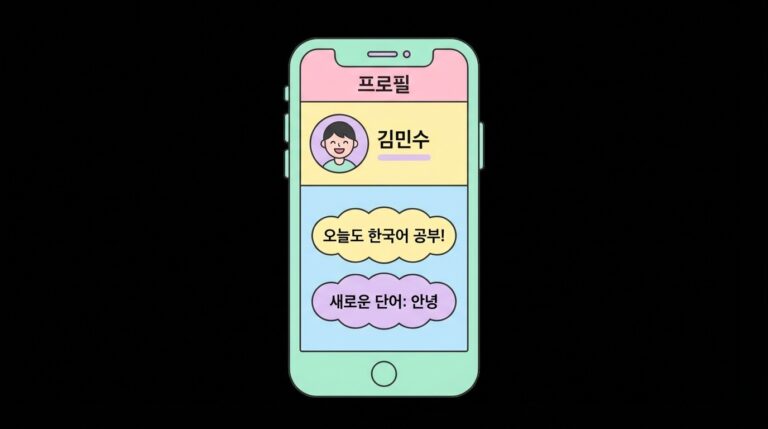
Phase 1: Empathy (Cold Open)
Hello there! I’m your lead editor and tutor at Daily Hangul.
Have you ever looked at your Korean friend’s KakaoTalk profile (Korea’s #1 messenger app) and felt completely lost? In Korean textbooks, you learn to write long, polite sentences like, “I am busy right now.” But when you check your friend’s profile, it just says one word: “바쁨” (Bappeum) with a tiny turtle emoji.
Or maybe you’ve watched a K-Drama where the main character goes through a bad breakup. Suddenly, they delete their profile picture, and their status message changes to a single dot: “.”
What is going on here? Welcome to the subtle, unwritten world of Korean Smartphone Nunchi (눈치)! Your status message (상태 메시지) in Korea is more than just text—it’s a signal, a mood board, and a polite boundary all rolled into one. If you want to use your smartphone like a true local and get those “Wow, your Korean is so natural!” compliments, you’ve come to the right place. Let’s decode this together!
Phase 2: Core Expressions Deep Dive
When setting a status message, Koreans rarely use full sentences. Instead, we use a special “noun-ending” trick or short keywords to save space and sound cool. Let’s look at the top 3 expressions you need.
1. 바쁨 (Busy)
- Pronunciation: [bappeum] Sounds like you’re saying “ba-ppoom” very quickly.
- Meaning: Literal: Busyness. / Real nuance: “I am busy, please don’t expect a fast reply.”
- K-Culture Moment: You’ll see this everywhere on KakaoTalk during university exam weeks or at the end of the month in corporate offices. It’s a polite warning shield!
- Editor’s Insight: By taking the adjective 바쁘다 (busy) and attaching an ‘ㅁ’ at the end, you turn it into a noun. It feels objective and neutral—not too formal, but not rude either.
- Situation Spectrum:
- Casual Friends: ✅
- Coworkers (Semi-formal): ✅
- Boss/Elders (Formal): ⚠️ (Better to use “업무 중” – At work)
- 🤔 Think About It: Why do Koreans prefer not to use full polite sentences like “바쁩니다” in their status? Could it be that status messages are meant for everyone (friends and bosses alike), so finding a “neutral” tone is important?
2. 00 중 (In the middle of ~)
- Pronunciation: [~ jung] The ‘중’ sounds like “joong” but with a slightly softer ‘j’.
- Meaning: In the middle of doing something.
- K-Culture Moment: “회의 중” (In a meeting) or “수업 중” (In class). If a K-Pop idol is practicing, they might post a story saying “연습 중!” (Practicing!).
- Editor’s Insight: Just add “중” after a noun. It’s incredibly useful! Driving? “운전 중”. Sleeping? “수면 중”. Resting? “휴식 중”. It clearly explains your situation without needing a long apology.
- Situation Spectrum:
- Casual Friends: ✅
- Coworkers (Semi-formal): ✅
- Boss/Elders (Formal): ✅
- 🤔 Think About It: Notice how we don’t say “I am…” (저는…)? Korean is a pro-drop language. We love skipping the subject when the context is obvious!
3. 급한 일은 전화주세요 (Call me if it’s urgent)
- Pronunciation: [geuphan ireun jeonhwajuseyo]
- Meaning: Literal: For urgent matters, please give me a call.
- K-Culture Moment: You will see this a lot on the profiles of Korean freelancers, sales reps, or office workers when they go on vacation (휴가 중).
- Editor’s Insight: Koreans value quick responses (빨리빨리 culture). If you can’t check messages, telling people how to reach you in an emergency shows you are responsible and considerate.
- Situation Spectrum:
- Casual Friends: ⚠️ (A bit too formal for besties)
- Coworkers (Semi-formal): ✅
- Boss/Elders (Formal): ✅
- 🤔 Think About It: How does your culture handle being away from the phone? Do you let people know, or do you just reply when you can?
Phase 3: Textbook vs. Real Korean
Let’s see how the language evolves from the classroom to the streets of Seoul.
[Situation 1: You are busy with work]
* 📖 Textbook Korean: 저는 지금 일을 하고 있어서 아주 바쁩니다. (I am working right now so I am very busy.)
* 🗣️ Real Korean: 업무 중 💻 / 바쁨 ㅠㅠ
* 💡 Why so different?: Status messages are all about visual efficiency. A quick icon and a noun-ending save time and look much cleaner on a small phone screen.
[Situation 2: Your phone is broken]
* 📖 Textbook Korean: 제 휴대폰이 고장 났습니다. 메시지를 보낼 수 없습니다. (My mobile phone is broken. I cannot send messages.)
* 🗣️ Real Korean: 폰 고장 📱 카톡 안됨 (Phone broken. Kakao doesn’t work.)
* 💡 Why so different?: Dropping particles (이/가, 을/를) and using abbreviations like “카톡” (KakaoTalk instead of Kakaotalk messenger) is standard digital survival skills in Korea.
Bottom Note: For A2 learners, using noun-endings (-음/ㅁ) or (-중) is the perfect sweet spot. It’s not heavy slang, but it makes you look like you truly understand the culture!
Phase 4: Cultural Context — K-Culture Deep Dive
4-1. Non-Verbal Cues: The Art of “Profile Nunchi”
In Korea, reading the room is called Nunchi (눈치). This applies heavily to smartphones! Before calling a coworker, a Korean person will almost always check their KakaoTalk profile first. If the status says “회의 중” (In a meeting) or has a 🌙 (moon) emoji, it’s an unspoken rule: Do not call. Send a text and wait. Your status message does the talking so you don’t have to.
4-2. K-Drama Connection: The Emotional Barometer
If you’ve watched any modern K-Drama, you know the classic KakaoTalk scenes. The camera zooms in on the smartphone screen.
– When falling in love: The character changes their status to a cute song lyric or a subtle heart emoji.
– When going through a breakup: They delete everything. The profile picture goes back to the default gray silhouette (기본 이미지), the background is empty, and the status becomes a single dot (“.”) or “…”.
This “blanking out” is a dramatic way of telling the world, “I am going through a hard time, leave me alone,” without actually saying it.
Phase 5: Real-life Roleplay Scenario
Setting: Monday morning at a trendy cafe near Gangnam Station. You are grabbing a quick Americano with your Korean friend, Minji (28, friendly, loves gossiping). You are scrolling through your phone together.
Characters:
– YOU: An international student who just started learning how to use KakaoTalk properly.
– Minji: Your Korean friend who is an expert at digital Nunchi.
Dialogue:
Minji: 너 카톡 프사(프로필 사진) 바꿨네? 예쁘다!
(Neo katok peusa bakkwotne? Yeppeuda!)
[You changed your Kakao profile pic? It’s pretty!]
(🎭 Stage Direction: Minji points at your phone screen with a smile)
YOU: 고마워! 근데 상태 메시지는 뭐라고 쓸지 모르겠어.
(Gomawo! Geunde sangtae mesijineun mworago sseulji moreugesseo.)
[Thanks! But I don’t know what to write for my status message.]
Minji: 음… 요즘 한국 사람들은 길게 안 써. 짧게 써야 해.
(Eum… yojeum hanguk saramdeureun gilge an sseo. Jjalge sseoya hae.)
[Hmm… Koreans don’t write long things these days. You have to keep it short.]
YOU: 진짜? ‘저는 아주 행복합니다’ 어때?
(Jinjja? ‘Jeoneun aju haengbokhamnida’ eottae?)
[Really? How about ‘I am very happy’?]
Minji: 으악, 너무 교과서 같아! 하하.
(Uak, neomu gyogwaseo gata! Haha.)
[Ugh, that sounds too much like a textbook! Haha.]
YOU: 그럼 뭐라고 써야 자연스러워?
(Geureom mworago sseoya jayeonseureowo?)
[Then what should I write to sound natural?]
Minji: 그냥 ‘행복함 😊’이나 ‘기분 좋음’이 나아.
(Geunyang ‘haengbokham 😊’이나 ‘gibun joeum’i naa.)
[Just ‘Happy 😊’ or ‘Feeling good’ is better.]
YOU: 아하, 명사처럼 끝나는구나!
(Aha, myeongsacheoreom kkeutnaneunguna!)
[Aha, it ends like a noun!]
Minji: 맞아. 어? 잠깐만. 우리 조별 과제 리더 오빠 상태 메시지 좀 봐.
(Maja. Eo? Jamkkanman. Uri jobyeol gwaje rideo oppa sangtae mesiji jom bwa.)
[Right. Oh? Wait a minute. Look at our group project leader’s status message.]
(🎭 Stage Direction: Minji’s eyes go wide as she shows you his profile)
YOU: 상태 메시지가 점(.) 하나밖에 없는데?
(Sangtae mesijiga jeom(.) hanabakke omneunde?)
[His status message is just a single dot(.)?]
🔀 Your Turn! How should you react?
– A) “아, 핸드폰이 고장 났나 봐요!” (Oh, his phone must be broken!)
– B) “무슨 안 좋은 일 있나? 연락하지 말자.” (Is something wrong? Let’s not contact him.)
– C) “저한테 점(.)을 보낸 건가요?” (Did he send a dot to me?)✅ Best Choice: B — Reason: In K-Culture digital Nunchi, a single dot (.) usually means the person is stressed, sad, or going through a breakup. It’s a signal to give them some space!
⚠️ Choice A & C Analysis: The dot is not a glitch or a direct message to you. It’s an emotional broadcast to everyone on his list.
Phase 6: 10-Second Shadowing Drill
Let’s practice saying you are busy out loud, just in case you need to explain your status message in real life! Pay attention to the pauses (/) and the emotion tags.
- 😤 (Firmly but politely) 죄송하지만 / 저 지금 / 업무 중이에요.
(joesonghajiman / jeo jigeum / eommu jung-ieyo.)
[I’m sorry but / I am / working right now.] -
🥺 (Apologetically) 아… / 제가 요즘 / 좀 바쁨 모드예요.
(Ah… / jega yojeum / jom bappeum modeu-yeyo.)
[Ah… / these days I am / in a bit of a “busy mode”.]
Phase 7: K-Culture Mini Dictionary
Master these 4 words, and your Korean friends will think you’ve lived in Seoul for years!
| 한국어 | Romanization | English | Cultural Context |
|---|---|---|---|
| 카톡 | Katok | KakaoTalk | The universal abbreviation for Korea’s top messenger app. |
| 프사 | Peusa | Profile Picture | Short for 프로필 사진. Changing your ‘peusa’ is a big deal in Korea! |
| 상메 | Sangme | Status Message | Short for 상태 메시지. |
| 단톡방 | Dantokbang | Group Chat Room | 단체 (Group) + 카톡 (Kakao) + 방 (Room). Where all the team/friend drama happens. |
Phase 8: Traveler Survival Kit
Even if you are just visiting Korea for a week, understanding phone statuses and digital communication is crucial. You might need to message an Airbnb host, a local tour guide, or a beauty salon on KakaoTalk.
🆘 Survival Phrases for Adding/Messaging on Kakao
– 🇰🇷 “카톡 하세요?” (katok haseyo?)
– 🗣️ Meaning: Do you use KakaoTalk?
– 📍 Where to use: When asking a host or local friend for their contact info.
- 🇰🇷 “제 아이디 추가해 주세요.” (je aidi chugahae juseyo.)
- 🗣️ Meaning: Please add my ID.
- 📍 Where to use: Exchanging contacts.
📌 Editor’s Travel Note
– Business Status: If you look up a restaurant or hair salon on KakaoTalk or Naver Maps, look for “영업 중” (Open/In business) or “영업 종료” (Closed). If it says “휴무” (Day off), don’t go there!
– Wi-Fi: Korea has free Wi-Fi almost everywhere (cafes, subways, buses). You’ll rarely be without a connection to check your messages!
Phase 9: Critical Thinking — “One Step Deeper”
Language & Power: The “Neutral Zone” of the Internet
🧠 Think Deeper:
Korean has strict hierarchy built into the language. You must choose between polite/formal language (존댓말) for elders and casual language (반말) for friends. But what happens on a public status message where both your boss and your best friend can see it?This is why the “Noun-ending” (-음/ㅁ) evolved! By ending words as nouns (e.g., 바쁨 instead of 바빠요 or 바빠), you completely bypass the hierarchy system. It is a brilliant, socially acceptable “neutral zone” created by Korean internet culture to survive the stress of hierarchy.
💬 Your Turn: Does your native language have a way to sound completely neutral when you don’t know who is reading your message? Share it in the comments!
Phase 10: FAQ & Avoiding Mistakes
Q: Can I put slang or funny emojis in my work messenger status?
A: ⚠️ Maybe, but be careful! On a personal KakaoTalk, yes. But on an internal company messenger (like Slack or Teams in Korea), keep it strictly professional: “회의 중” (In a meeting) or “재택근무 중” (Working from home).
Q: If someone’s status is “휴식 중” (Resting), can I still message them?
A: Yes, sending a message is usually fine (they can read it later). Just don’t call them directly.
❌ Common Mistake #1: Writing a full diary entry in your status.
✅ How to fix it: Keep it to 1-3 words. The mystery makes it cool!
Phase 11: Summary & Action Items
One-Liner Summary: To set a natural Korean status message, ditch the long textbook sentences and use noun-endings (-음/ㅁ) or (-중) for short, polite, and neutral updates!
Action Mission:
– 🥉 Bronze (Solo): Look at your own messenger app and translate your current mood into a short Korean noun-ending.
– 🥈 Silver (Online): Leave a comment below with what your Korean status message would be today! (e.g., 커피 필요함 – Need coffee)
– 🥇 Gold (Real World): Change your actual KakaoTalk or WhatsApp status to a Korean expression like “공부 중 📚” (Studying) for 24 hours!
K-Culture Mission:
Next time you watch a K-Drama, pay close attention to the scenes where characters look at their phones. See if you can spot the word “중” on their screens or notice when their profile picture suddenly disappears!
Phase 12: Quiz — Interactive Challenge
1. Fill in the Blank:
You are currently driving and cannot answer the phone. What should your status say?
“[ ] 중 🚗”
(Hint: The Korean word for driving)
Click for the answer
운전 (unjeon). The full status is “운전 중” (Driving).
2. Situational Judgment:
You open KakaoTalk and see your Korean coworker’s status is “휴가 중 ✈️” (On vacation). You need a file from them. What is the most Nunchi-appropriate action?
– A) Call them immediately. It’s just a quick question.
– B) Send an email and wait until they return.
– C) Send a message saying “I know you are on vacation but please read this right now.”
Click for the answer
Best Answer: B. Unless the office is literally burning down, respect the “휴가 중” status. Koreans take the boundary between work and vacation very seriously these days!
3. True or False — K-Culture Edition:
“In Korean digital culture, changing your profile picture to a blank default image and setting your status to a dot (.) usually means you are incredibly happy.”
Click for the answer
False! It usually means the exact opposite—the person is stressed, sad, or going through a breakup.
Frequently Asked Questions (FAQ)
Q: What does "바쁨 (Busy)" mean in Korean and how do you pronounce it?
A: In Korean, "바쁨 (Busy)" is pronounced [bappeum] and means: Literal: Busyness. / Real nuance: "I am busy, please don't expect a fast reply."
Q: What does "00 중 (In the middle of ~)" mean in Korean and how do you pronounce it?
A: In Korean, "00 중 (In the middle of ~)" is pronounced [~ jung] and means: In the middle of doing something.
Q: What does "급한 일은 전화주세요 (Call me if it's urgent)" mean in Korean and how do you pronounce it?
A: In Korean, "급한 일은 전화주세요 (Call me if it's urgent)" is pronounced [geuphan ireun jeonhwajuseyo] and means: Literal: For urgent matters, please give me a call.







