

Phase 1: The Weekend Drama Bombshell
Hello there! It’s your Daily Hangul editor.
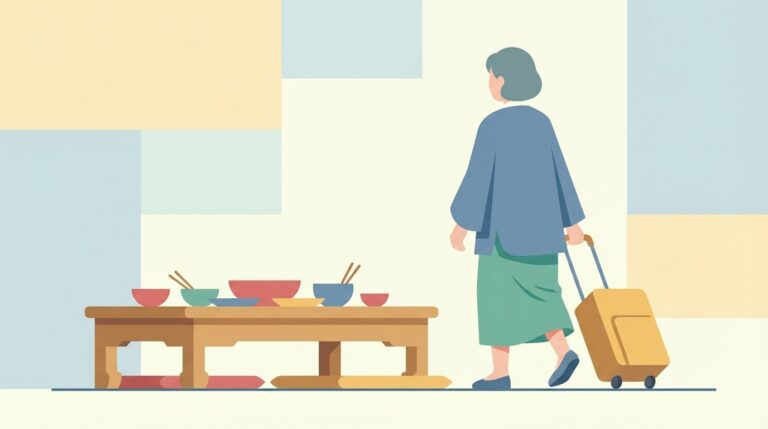
Picture this classic K-Drama scene: It’s a Sunday evening. The whole extended family is gathered around the dinner table, eating the lavish meal the matriarch has spent two days preparing. Suddenly, she sets down her spoon. The room goes dead silent. She looks at her husband of 40 years and says, “여보, 우리 졸혼해요.” (Honey, let’s do Jolhon.)
The subtitles might translate this to “I want a divorce” or “Let’s separate,” but neither of those captures the seismic cultural shift behind the word. The husband drops his chopsticks. The adult children gasp. Chaos ensues.
Welcome to one of the most fascinating social phenomena in modern South Korea: 졸혼 (Jolhon), or “Graduating from Marriage.” As a C2-level learner, you already know the grammar. Now, it’s time to understand the profound societal shifts happening in Korean living rooms. If you can discuss Jolhon over a cup of coffee with your Korean friends, you won’t just sound fluent—you’ll sound like a true insider who deeply understands modern Korean society.
Let’s dive into the vocabulary of twilight independence, shall we?
Phase 2: Core Expressions Deep Dive
1. 졸혼 (Jolhon)
- Pronunciation: [jol-hon] Sounds like ‘jole-hohn’
- Meaning: (Literal) Graduating from marriage / (Real Nuance) An arrangement where an older married couple lives separately to pursue their own lives, without legally divorcing.
- K-Culture Moment: This is the ultimate plot twist in weekend family dramas (주말 드라마). It usually involves the mother moving to a quiet countryside home, while the patriarchal father is left behind, miserably trying to figure out how to boil instant ramen.
- Editor’s Insight: The genius of this word lies in the hanja ‘졸 (卒)’, meaning ‘to graduate or finish’ (like in 졸업 – graduation). It shifts the narrative from “failure” (divorce) to “successful completion of a long, hard duty.” It’s actually quite an empowering concept for the older generation!
- Situation Spectrum:
- Close friends (Casual discussion): ✅
- Colleagues (Societal discussion): ✅
- Asking an elder directly if they are doing it: 🚫 (Highly intrusive!)
- 🤔 Think About It: Why use the word “graduate”? How does this reflect the traditional Korean view of marriage as an unavoidable “duty” (의무) rather than purely a romantic partnership?
2. 황혼 이혼 (Hwanghon Ihon)
- Pronunciation: [hwang-hon i-hon] ‘Hwang-hon’ sounds like a poetic, sighing breath.
- Meaning: (Literal) Twilight divorce / (Real Nuance) Divorcing in one’s later years, usually after the children are fully grown and married.
- K-Culture Moment: While Jolhon is a lifestyle choice, Hwanghon Ihon is the legal end. In the news, you’ll often hear sociologists discussing the spike in 황혼 이혼 as a reflection of women refusing to endure a patriarchal marriage until death.
- Editor’s Insight: At the C2 level, you need to distinguish between 졸혼 (living apart, staying legally married, often amicable) and 황혼 이혼 (the legal severing of ties, often due to long-standing resentment).
- Situation Spectrum:
- Academic/Social debates: ✅
- Gossip with friends: ⚠️ (Be sensitive)
- Small talk: 🚫
- 🤔 Think About It: Does your language have a specific poetic term for getting divorced in old age, or is it just “divorce”?
3. 자아를 찾다 (Ja-a-reul chat-da)
- Pronunciation: [ja-a-reul chat-da] Say ‘ja-a’ with a slight elongation, emphasizing the ‘self’.
- Meaning: (Literal) To find one’s ego/self / (Real Nuance) To discover one’s true identity, often after years of living for others.
- K-Culture Moment: This is the emotional core of the Jolhon trend. You’ll hear indie K-Pop artists or veteran actors on talk shows tearfully explaining that they finally want to “자아를 찾고 싶어요” after decades of being known only as “someone’s mom” (누구 엄마) or “someone’s wife” (누구 아내).
- Editor’s Insight: It sounds a bit philosophical, but it’s used quite colloquially when someone is making a major life change to prioritize their own happiness.
- Situation Spectrum:
- Deep conversations with friends: ✅
- Expressing your own life goals: ✅
- Casual workplace banter: 🚫 (A bit too deep for the water cooler)
- 🤔 Think About It: In Korea, women are often referred to by their child’s name (e.g., Min-su’s mom). How does “finding oneself” rebel against this linguistic tradition?
Phase 3: Textbook vs. Real Korean
Let’s upgrade your vocabulary from “foreigner who studies hard” to “fluent resident.”
[Describing Older Couples Living Apart]
* 📖 Textbook Korean: 두 분은 이혼하지 않았지만 따로 갑니다. (They are not divorced but live separately. – Too rigid and literal)
* 🗣️ Real Korean: 두 분 최근에 졸혼 선언하셨어. (They recently declared their Jolhon.)
* 💡 Why the difference?: Using the word “선언” (declaration) gives it the dramatic, empowering weight it carries in modern society.
[Describing the Desire for Independence]
* 📖 Textbook Korean: 이제 혼자 살고 싶습니다. (I want to live alone now.)
* 🗣️ Real Korean: 이제 내 이름 석 자로 살고 싶어. (Now I want to live by the three syllables of my own name.)
* 💡 Why the difference?: “My three-syllable name” is a powerful idiomatic way to say “I want to reclaim my identity,” deeply resonating with older Korean women who sacrificed their individual identity for their family.
[When Parents Focus on Themselves]
* 📖 Textbook Korean: 부모님이 각자의 취미를 가집니다. (My parents have their own hobbies.)
* 🗣️ Real Korean: 우리 부모님 요즘 제2의 전성기를 누리셔. (My parents are enjoying their second prime/golden age these days.)
* 💡 Why the difference?: “제2의 전성기” is a highly natural, positive way to describe active, independent seniors in Korea.
Phase 4: Cultural Context — K-Culture Deep Dive
4-1. Non-verbal Context: The Weight of the Subject
When discussing Jolhon or the shifting dynamics of elderly couples, notice the Nunchi (눈치) involved. If a Korean friend brings up their parents’ Jolhon, they might laugh it off, but watch their eyes. It’s still a sensitive transition. Your role isn’t to judge, but to listen with empathetic nods (고개 끄덕임) and soft verbal affirmations like “아, 정말요?” (Oh, really?) or “많이 놀라셨겠네요.” (You must have been very surprised.)
4-2. K-Drama & Societal Tropes
The Jolhon narrative has completely revolutionized K-Dramas. Twenty years ago, a mother leaving the house was a tragedy that would end in her tearful return. Today? It’s a comedy of liberation.
The Patriarch’s Kitchen Crisis: A classic trope tied to Jolhon is the older, traditional husband who suddenly realizes he doesn’t even know where the rice cooker is. The drama will inevitably show him miserably eating cold side dishes (반찬) or burning a fried egg. This directly critiques the extreme gender roles of the past. When you watch a drama and see an older man struggling to use a microwave, you are watching the cultural ripple effects of the Jolhon era.
Phase 5: Interactive Role-play Scenario
Setting: Friday evening at a trendy wine bar in Yeonnam-dong. You are catching up with your close Korean friend, Ji-eun (34). She recently visited her parents’ house and looks a bit overwhelmed.
Characters:
– YOU: A long-term resident in Korea, culturally attuned and fluent.
– Ji-eun: Your friend. Independent, but currently dealing with family drama.
Dialogue:
지은: 하아… 나 오늘 진짜 와인 한 병 다 마실 거야.
(Ha-a… na oneul jinjja wain han byeong da masil geoya.)
[Sigh… I’m really going to drink a whole bottle of wine today.]
(🎭 Stage Direction: Ji-eun takes a huge gulp of her red wine and rubs her temples)
YOU: 무슨 일 있어? 본가 다녀온다더니, 분위기 안 좋았어?
(Museun il isseo? Bonga danyeoon-dadeoni, bunwigi an jo-asseo?)
[What happened? You said you were visiting your parents’ house, was the vibe bad?]
지은: 야, 우리 엄마 폭탄 선언 하셨잖아. 아빠한테 졸혼하자고.
(Ya, uri eomma poktan seoneon hasyeot-jana. Appa-hante jolhon-hajago.)
[Hey, my mom dropped a bombshell. She told my dad she wants to do Jolhon.]
🔀 Your Turn! How do you respond?
– A) “헐, 이혼하시는 거야? 어떡해!” (Omg, are they getting divorced? What are you going to do!)
– B) “진짜? 아버님 충격 많이 받으셨겠다. 넌 괜찮아?” (Really? Your dad must have been so shocked. Are you okay?)
– C) “오, 어머니 멋지시다! 제2의 전성기 시작이네!” (Oh, your mom is so cool! It’s the start of her second prime!)✅ Best Choice: B — Reason: At the C2 level, you know that while Jolhon is empowering for the mother, it is highly disruptive for the family. Showing empathy for all parties (the shocked dad, the stressed friend) is the most emotionally intelligent (눈치 있는) response.
⚠️ Choice A Analysis: You confused Jolhon with legal divorce. Plus, overreacting might make Ji-eun feel worse.
⚠️ Choice C Analysis: While progressively true, it might be too insensitive to your friend who is currently stressed out by the family conflict.
지은: (If you chose B) 내 말이! 아빠 완전 충격받아서 아무 말씀도 못 하시더라. 엄마는 이미 시골에 작은 집까지 다 알아놓으셨대.
(Nae mari! Appa wanjeon chunggyeok-badaseo amu malsseumdo mot hasideora. Eommaneun imi sigore jageun jipkkaji da a-ra-no-eu-syeot-dae.)
[That’s what I’m saying! My dad was so shocked he couldn’t even speak. Mom apparently already looked up a small house in the countryside.]
YOU: 와, 어머니 진짜 계획 다 세워두셨구나. 그동안 많이 답답하셨나 봐.
(Wa, eomeoni jinjja gyehoek da se-wo-du-syeot-guna. Geudong-an mani dapdap-hasyeon-na bwa.)
[Wow, your mom really had it all planned out. She must have felt really suffocated all this time.]
Phase 6: 10-Second Shadowing Drill
Channel your inner K-Drama matriarch making her grand declaration of independence. Focus on the pauses!
😤 여보, / 나 이제 / 밥 안 해. (Yeo-bo, / na i-je / bap an hae.)
😊 내 이름 석 자로 / 내 인생 / 살 거야! (Nae ireum seok ja-ro / nae insaeng / sal geo-ya!)
(Honey, I’m not cooking rice anymore. I’m going to live my life under my own three-syllable name!)
Phase 7: K-Culture Mini Dictionary
| 한국어 | Romanization | English | Cultural Context |
|---|---|---|---|
| 가부장제 | gabujangje | Patriarchy | The traditional Korean family system, heavily influenced by Confucianism, which the Jolhon trend is directly responding to. |
| 효도 | hyodo | Filial Piety | The duty to care for one’s parents. The Jolhon of parents often shifts the burden of hyodo for the adult children. |
| 시월드 | si-wol-deu | “In-law World” | A slang combining ‘시’ (husband’s family) and ‘World’. Refers to the stress and demands placed on a wife by her husband’s family. Leaving ‘Si-world’ is a major motivation for Jolhon. |
| 주말 부부 | jumal bubu | Weekend Couple | Married couples who live apart due to work and only meet on weekends. (Different from Jolhon, as this is out of necessity, not a desire for independence). |
Phase 8: Traveler’s Survival Kit (Senior Independence Edition)
With the rise of Jolhon and independent seniors, solo travel among the older generation in Korea has skyrocketed. Whether you are traveling in your golden years, or navigating Korea with older family members, you need these phrases.
🆘 Survival Phrases for the Senior/Independent Traveler
– 🇰🇷 “여기 경로 우대 되나요?” (Yeogi gyeongno udae doenayo?)
– 🗣️ Meaning: Is there a senior citizen discount here?
– 📍 Where to use: Palaces, museums, KTX train stations.
- 🇰🇷 “1인분도 주문 가능한가요?” (Irin-bundo jumun ganeung-hangayo?)
- 🗣️ Meaning: Can I order just one portion?
- 📍 Where to use: Korean BBQ or stew restaurants (historically designed for communal eating, but solo dining is rising!).
- 💡 Pro Tip: Look for signs that say “혼밥 환영” (Solo diners welcome)!
📌 Editor’s Travel Note
– Transportation: Seniors (65+) ride the subway for free in Korea, but foreigners usually do not qualify. However, KTX and domestic flights often have minor senior discounts—always ask!
– Temple Stays: One of the most popular solo travel activities for women seeking “자아실현” (self-actualization) post-Jolhon is booking a quiet Temple Stay in the mountains.
Phase 9: Critical Thinking Corner — “One Step Deeper”
🧠 Think Deeper: Language & Power (From “Mom” back to “Me”)
In Korean society, language violently strips away a woman’s individual identity after marriage and childbirth. She ceases to be called by her name and becomes “누구 엄마” (Someone’s Mom), “며느리” (Daughter-in-law), or “여보” (Honey). The linguistic structure itself reinforces her position purely relative to her family members. The rise of Jolhon isn’t just about changing an address; it’s a linguistic rebellion. When a 60-year-old woman says, “내 이름 석 자로 살겠다” (I will live by my three-syllable name), she is using language to reclaim the power and individuality that the patriarchal lexicon took from her. It is the ultimate reclamation of self.
💬 Your Turn: Does your native language shift a person’s identity or title so drastically after marriage or parenthood? How do older generations in your culture assert their independence? Share in the comments!
Phase 10: FAQ & Avoiding Mistakes
Q: “My Korean host mother told me she and her husband are living apart. Can I ask if they are doing Jolhon?”
Editor: MAYBE, but tread lightly! Jolhon is a trendy media word, but in real life, older folks might feel embarrassed talking about family separation to a foreigner. Instead of using the blunt word Jolhon, say: “두 분 다 각자의 시간을 즐기시는 거네요! 멋지세요.” (You are both enjoying your own time! That’s cool.)
❌ Common Mistake #1: Asking an elder, “이혼하셨어요?” (Did you get divorced?)
✅ Do This Instead: NEVER ask this directly. In older Korean generations, divorce carries a massive social stigma. If they want you to know, they will tell you.❌ Common Mistake #2: Treating Jolhon like a tragedy.
✅ Do This Instead: Remember the nuance! Jolhon is often a proactive, positive choice for the person initiating it (usually the wife). Congratulate their new chapter of life!
Phase 11: Summary & Action Items
- One-Liner Summary: Jolhon (졸혼) isn’t just “graduating from marriage”; it’s a profound cultural shift where the older Korean generation is choosing self-actualization over patriarchal duty.
Action Mission:
– 🥉 Bronze (Solo): Practice saying the shadowing drill with maximum K-Drama flair in the mirror.
– 🥈 Silver (Online): Go to a K-Drama forum or YouTube clip of a family drama, and leave a comment in Korean using the word “제2의 전성기” (Second prime).
– 🥇 Gold (Field Mission): The next time you are discussing social trends with a Korean friend, ask for their opinion: “한국의 졸혼 문화에 대해 어떻게 생각해?” (What do you think about Korea’s Jolhon culture?)
🎬 K-Culture Mission: Watch an episode of a Korean weekend family drama (주말 드라마) on Netflix or Viki. Count how many times the parents’ relationship is shown to be purely about duty versus romance. Spot the “patriarch struggling to cook” trope!
Phase 12: Interactive Quiz
1. Fill in the Blank:
“우리 엄마는 이제 가족을 위해 희생하지 않고, ______를 찾고 싶어 하셔.”
(My mom no longer wants to sacrifice for the family; she wants to find her _______.)
A) 눈치 (Nunchi)
B) 자아 (Ego/Self)
C) 효도 (Filial piety)
2. True or False — K-Culture Edition:
“Jolhon (졸혼) means legally ending a marriage with a divorce paper.”
3. Situational Judgment:
You are at a cafe, and a 65-year-old Korean woman tells you she recently moved to Jeju Island by herself, leaving her husband in Seoul because she “wanted to live her own life.”
What is the most culturally appropriate (눈치 있는) C2-level response?
A) 남편분이 너무 불쌍해요. (Your husband is so pitiful.)
B) 와, 제2의 전성기를 즐기고 계시네요! 응원합니다. (Wow, you are enjoying your second prime! I support you.)
C) 왜 황혼 이혼을 안 하셨어요? (Why didn’t you get a twilight divorce?)
(Answers: 1: B, 2: False – they stay legally married, 3: B – Praise her new independent chapter!)
Frequently Asked Questions (FAQ)
Q: What does "졸혼 (Jolhon)" mean in Korean and how do you pronounce it?
A: In Korean, "졸혼 (Jolhon)" is pronounced [jol-hon] and means: (Literal) Graduating from marriage / (Real Nuance) An arrangement where an older married couple lives separately to pursue their own lives, without legally divorcing.
Q: What does "황혼 이혼 (Hwanghon Ihon)" mean in Korean and how do you pronounce it?
A: In Korean, "황혼 이혼 (Hwanghon Ihon)" is pronounced [hwang-hon i-hon] and means: (Literal) Twilight divorce / (Real Nuance) Divorcing in one's later years, usually after the children are fully grown and married.
Q: What does "자아를 찾다 (Ja-a-reul chat-da)" mean in Korean and how do you pronounce it?
A: In Korean, "자아를 찾다 (Ja-a-reul chat-da)" is pronounced [ja-a-reul chat-da] and means: (Literal) To find one's ego/self / (Real Nuance) To discover one's true identity, often after years of living for others.







