

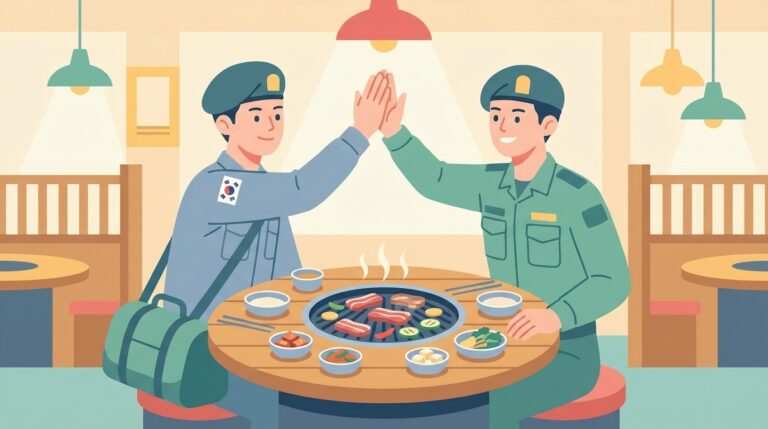
Phase 1: Empathy (The K-Culture Cold Open)
Hello! I’m the Lead Editor of Daily Hangul.
Picture this: You are watching a K-Drama. The handsome male lead suddenly appears at a bustling local pub, wearing a crisp military uniform and a beret. He drops a heavy duffel bag, salutes his friends with a massive grin, and says one short phrase. Immediately, the whole table goes wild, pouring him a shot of Soju. Or perhaps your favorite K-Pop idol unexpectedly posts a selfie on Weverse with short hair, writing: “ARMY/EXO-L/Blink! I missed you!”
If you love K-Culture, you can’t escape the topic of Military Service (군대 – gundae). In South Korea, all able-bodied men must serve in the military for about 18 to 21 months. It’s a huge, emotional milestone! And the absolute best part of those 18 months? Leave (휴가 – hyuga).
But how do you react when your Korean friend (or bias) says they are on vacation from the military? If you just say a textbook “Congratulations,” it might sound a bit robotic. Today, I’ll teach you the real survival phrases to celebrate this golden moment like a true local!
(Note: This guide is based on real questions from our Daily Hangul students who wanted to leave sweet comments for their favorite idols on military leave!)
Phase 2: Core Expressions Deep Dive
1. 저 휴가 나왔어요!
- Pronunciation: jeo hyu-ga na-wa-sseo-yo! (hyu-ga sounds like “hue-gah”, na-wa-sseo-yo flows like “nah-wah-so-yo”)
- Meaning: (Literal) I came out on leave! / (Real nuance) I’m on military vacation! I’m free!
- K-Culture Moment: This is the announcement phrase. When a soldier steps out of the military base, they immediately pull out their phone and text this to their friends, family, and girlfriend.
- Editor’s Insight: Notice the verb “나왔어요” (came out). Koreans don’t just say “I have a vacation.” Because soldiers are literally confined to a base, they say they came out to the civilian world. It feels like a breath of fresh air!
- Situation Spectrum:
- Close friends (Casual): ✅ (나 휴가 나왔어! – na hyu-ga na-wa-sseo!)
- Coworkers/Acquaintances (Semi-formal): ✅ (저 휴가 나왔어요!)
- Boss/Elders (Formal): ✅ (저 휴가 나왔습니다!)
- 🤔 Think About It: Why do you think spatial words like “coming out” (나오다) or “going in” (들어가다) are used so often for institutions in Korea (like the military, hospital, or even school)? Does your language use spatial verbs for taking time off?
2. 맛있는 거 사 줄게요!
- Pronunciation: ma-sin-neun geo sa jul-ge-yo! (ma-sin-neun: ma-sheen-neun. The ‘s’ softens into an ‘sh’ sound)
- Meaning: (Literal) I will buy you a delicious thing! / (Real nuance) Let me treat you to some good food!
- K-Culture Moment: This is the most heartwarming response you can give to a soldier on leave. Military food is okay, but it’s not Mom’s cooking or K-BBQ!
- Editor’s Insight: In Korea, feeding someone is the ultimate expression of love and care. When someone comes back from a hard time (like the army), buying them a hearty meal is a cultural rule.
- Situation Spectrum:
- Close friends (Casual): ✅ (맛있는 거 사 줄게!)
- Older/Respectful (Semi-formal): ⚠️ (맛있는 거 사 드릴게요! – use the humble verb 드리다)
- Boss/Elders (Formal): 🚫 (Elders usually buy you food, not the other way around!)
- 🤔 Think About It: In your culture, what is the first thing people offer someone who has been away for a long time? Is it food, a hug, or a party?
3. 언제 복귀해요?
- Pronunciation: eon-je bok-gwi-hae-yo? (bok-gwi: boke-gwee)
- Meaning: (Literal/Real nuance) When do you return to base?
- K-Culture Moment: The dreaded reality check! In a K-Drama, friends will ask this around 10 PM over drinks, and the soldier’s face will instantly drop from a smile to a sigh.
- Editor’s Insight: “복귀 (bok-gwi)” means “returning to one’s post/base.” It’s a slightly military/formal word, but everyone uses it for soldiers. Warning: Don’t ask this on their very first day of leave! Let them enjoy their freedom first.
- Situation Spectrum:
- Close friends (Casual): ✅ (언제 복귀해?)
- Semi-formal: ✅ (언제 복귀해요?)
Phase 3: Textbook vs. Real Korean
[Situation 1: Saying you got a vacation from the army]
* 📖 Textbook Korean: 저는 군대에서 휴가를 받았습니다. (I received a vacation from the military.)
* 🗣️ Real Korean: 나 첫 휴가 나왔어! (I came out for my first leave!)
* 💡 Why the difference?: Koreans love efficiency. “첫 휴가” (first leave) is a huge milestone, and “나왔어” implies the military context automatically!
[Situation 2: Asking when they have to go back]
* 📖 Textbook Korean: 언제 군대로 돌아갑니까? (When do you return to the military?)
* 🗣️ Real Korean: 언제 들어가? (When do you go in?)
* 💡 Why the difference?: Again, spatial words! The military base is seen as a closed space. “Going in” (들어가다) is the casual, everyday way to say “going back to base.”
Bottom Note: For A2 learners, sticking to the
-아/어요form is your safest bet. It’s polite, natural, and works in 90% of daily situations.
Phase 4: Cultural Context — K-Culture Deep Dive
4-1. Non-Verbal Cues (The “Short Hair” & The “Salute”)
When a Korean man is in the military, his hair is shaved very short (the classic buzzcut). Even when they wear civilian clothes on leave, their hair gives them away! If you see a guy with a buzzcut nervously looking at his phone while wearing a baseball cap… high chance he’s a soldier on leave. Also, when soldiers greet older friends or family, they often jokingly give a military salute and loudly say “충성! (Chungseong! – Loyalty!)”.
4-2. K-Food Connection: The “Leave Meal” (휴가 첫 끼)
The very first meal a soldier eats after stepping off the train is sacred. It’s called “첫 끼” (first meal). What do they eat?
1. Samgyeopsal (Pork Belly) & Soju: The ultimate taste of society.
2. Mom’s Home-cooked Meal (집밥): Nothing beats Doenjang-jjigae made by mom.
3. Spicy Food (Tteokbokki, Malatang): Military food isn’t usually extremely spicy, so young soldiers often crave something that burns their tongue!
Critical View: Why does food matter so much? Because the military is about collective eating with strict schedules. Choosing what, when, and where to eat on leave is the ultimate taste of personal freedom.
Phase 5: Interactive Roleplay Scenario
Scenario A: The K-BBQ Celebration
Setting: Friday night, 7:30 PM. A noisy Samgyeopsal (Pork Belly) restaurant in Gangnam. Meat is sizzling on the grill.
Characters:
– YOU: An exchange student who just learned some Korean.
– Min-su: Your Korean language exchange partner who is currently serving in the military. He just got his first 100-day leave (백일휴가).
Min-su: 우와! 오랜만이에요! 저 오늘 첫 휴가 나왔어요! 🫡
(uwa! oraenmanieyo! jeo oneul cheot hyuga nawasseoyo!)
[Wow! It’s been a while! I came out on my first leave today!]
YOU: 축하해요! 군대 생활은 어때요?
(chukahaeyo! gundae saenghwareun eottaeyo?)
[Congratulations! How is military life?]
Min-su: ㅠㅠ 너무 힘들어요. 매일 이 삼겹살이 생각났어요.
(ㅠㅠ neomu himdeureoyo. maeil i samgyeopsari saenggangnasseoyo.)
[It’s so hard. I thought about this pork belly every single day.]
(🎭 Stage Direction: Min-su looks at the sizzling meat with tears of joy in his eyes)
Min-su: 오늘 고기 진짜 많이 먹을 거예요!
(oneul gogi jinjja mani meogeul geoyeyo!)
[I’m going to eat so much meat today!]
🔀 Your Turn! How do you reply?
– A) “언제 복귀해요?” (When do you go back?)
– B) “많이 드세요! 제가 맛있는 거 사 줄게요!” (Eat a lot! I’ll treat you!)
– C) “저는 배불러요.” (I’m full.)✅ Best Choice: B — Korean culture is all about treating friends who have had a hard time. Buying a meal for a soldier on leave will make you an instant best friend.
⚠️ Choice A Analysis: NEVER ask this while the meat is still cooking on the first day! It will instantly ruin his appetite! 😂
Scenario B: K-Pop Fan Bonus 🎤
Setting: Your favorite idol group’s member is serving in the military. He just opened a surprise live stream in his civilian clothes.
Idol: 여러분, 저 휴가 나왔어요! 잘 지냈어요?
(yeoreobun, jeo hyuga nawasseoyo! jal jinaesseoyo?)
[Everyone, I’m on leave! Have you been well?]
YOU (Typing fast in the chat):
오빠! 휴가 축하해요! 맛있는 거 많이 먹고 푹 쉬어요! 💜
(oppa! hyuga chukahaeyo! masinneun geo mani meokgo puk swieoyo!)
[Oppa! Congrats on your leave! Eat lots of delicious food and rest well!]
Phase 6: 10-Second Shadowing Drill
Read out loud and focus on the flow. The slashes (/) show you where to pause naturally.
- 🎉 Brightly: 저 오늘 / 휴가 나왔어요!
(jeo oneul / hyu-ga na-wa-sseo-yo!) - 🥺 Warmly: 많이 드세요! / 제가 / 맛있는 거 / 사 줄게요.
(ma-ni deu-se-yo! / je-ga / ma-sin-neun geo / sa jul-ge-yo.) - 😢 Sadly (but playfully): 아쉽다… / 언제 / 복귀해요?
(a-swip-da… / eon-je / bok-gwi-hae-yo?)
Phase 7: K-Culture Mini Dictionary
| Korean | Romanization | English | Context |
|---|---|---|---|
| 군대 | gundae | Military | The mandatory service. Often just called “going to the army” (군대 가다). |
| 휴가 | hyuga | Leave/Vacation | The most precious time for a soldier. Also used for regular work vacations! |
| 복귀 | bokgwi | Return to base | The sad journey back to the military camp. |
| 백일휴가 | baegil hyuga | 100-day leave | The very first vacation a soldier gets after enlisting (usually around the 100-day mark). It’s highly celebrated. |
| 고무신 | gomusin | Rubber shoes | Slang for a girlfriend who is waiting for her boyfriend to finish his military service. |
Phase 8: Traveler Survival Kit
If you travel to Korea, especially on a Friday evening or Sunday afternoon, you will see hundreds of young men in uniform with big backpacks at Seoul Station, Yongsan Station, or bus terminals. They are heading out for leave or returning to base!
🆘 Survival Phrases at the Train Station
– 🇰🇷 “서울역 가는 표 있어요?” (seoul-yeok ganeun pyo isseoyo?)
– 🗣️ English Guide: [seoul-yuck gah-neun pyo ee-so-yo?]
– 📍 Where to use: KTX/Train ticket counter.
– 💡 Pro Tip: If the train is sold out (which happens often when soldiers go on leave), ask for “입석” (ibseok – standing ticket)!📌 Editor’s Travel Note
– Apps to use: KORAIL Talk (for train tickets). Book early on weekends!
– Etiquette: Soldiers in uniform usually sit quietly and sleep on the train. Give them a warm smile if you make eye contact, they are exhausted!
Phase 9: Critical Thinking Corner — “Think Deeper”
Food & Identity (음식과 정체성)
In Korea, asking “What do you want to eat?” (뭐 먹고 싶어?) is practically a synonym for “I care about you.” For a soldier who has been eating institutional meals off a metal tray for months, choosing their own food is a reclamation of their personal identity. Eating together from the same grill (like K-BBQ) or sharing a stew isn’t just about nutrition; it’s a social ritual of welcoming them back into the “tribe” of society.
💬 Your Turn:
In your culture, how do you make someone feel “welcomed back home” after a long time away? Is there a specific food or ritual you do? Share in the comments!
Phase 10: FAQ & Common Mistakes
Q: Can I use “휴가 (hyuga)” if I’m just taking time off from my office job?
Yes! Absolutely. “휴가” is the universal word for vacation or leave. “저 내일 휴가예요!” (I’m on vacation tomorrow!) will make your coworkers very jealous.
Q: Should I salute my Korean friend when he says he’s on leave?
It’s a fun joke! If you salute and say “충성! (Chungseong!)”, he will definitely laugh and appreciate your knowledge of Korean culture.
❌ Common Mistake #1:
Asking “언제 복귀해요?” (When do you return?) the moment you see them.
✅ Do this instead:
Let them enjoy the present. Ask “뭐 먹고 싶어요?” (What do you want to eat?) first.❌ Common Mistake #2:
Using “방학 (bang-hak)” for a soldier’s leave.
✅ Do this instead:
“방학” is strictly for school/university vacations (winter break, summer break). For work or military, always use “휴가 (hyuga)”!
Phase 11: Summary & Action Items
One-Liner Summary: When a Korean soldier comes out on leave, celebrate their “휴가 (hyuga)” by offering to buy them delicious food (맛있는 거 사 줄게요) and avoiding the dreaded “return to base” (복귀) question too early!
Your Action Missions:
– 🥉 Bronze: Stand in front of a mirror, pretend you are a K-Drama lead, and proudly say: “저 오늘 휴가 나왔어요!”
– 🥈 Silver: Leave a comment on your favorite idol’s social media who is currently serving: “오빠, 휴가 때 맛있는 거 많이 먹어요!”
– 🥇 Gold: Next time you go to a Korean restaurant, use the word “맛있는 거” (delicious thing) when talking to your friends!
K-Culture Mission:
Watch the K-Drama “Crash Landing on You” or “D.P.” Keep your ears open for the word “휴가 (hyu-ga)”. You’ll be surprised how often you hear it now!
Phase 12: Quiz — Interactive Challenge
1. Situational Judgment: Your friend Min-woo just texted you: “나 오늘 첫 휴가 나왔어!!! (I came out on my first leave today!!!)” What is the BEST reply?
A) 수고하셨습니다. (Thank you for your hard work – polite/formal)
B) 방학 축하해! (Happy school vacation!)
C) 대박! 오늘 고기 먹으러 가자! 내가 살게. (Awesome! Let’s go eat meat today! I’ll pay.)
2. Fill in the Blank:
Korean soldiers hate the word _________ because it means they have to go back to the military base.
A) 휴가 (hyuga)
B) 복귀 (bokgwi)
C) 삼겹살 (samgyeopsal)
3. True or False – K-Culture Edition:
In Korea, it is culturally natural for the friend who is not in the military to pay for the meal when a soldier comes out on leave. (T / F)
(Answers: 1: C – Use casual form with a friend and offer food! / 2: B / 3: True – It’s a way of showing appreciation and care!)
How did you do on the quiz? Let me know in the comments below! And if you have any questions about Korean military culture, ask away! Until tomorrow, keep your Hangul Daily! 😊
Frequently Asked Questions (FAQ)
Q: What does "저 휴가 나왔어요!" mean in Korean and how do you pronounce it?
A: In Korean, "저 휴가 나왔어요!" is pronounced [jeo hyu-ga na-wa-sseo-yo! (hyu-ga sounds like "hue-gah", na-wa-sseo-yo flows like "nah-wah-so-yo"] and means: (Literal) I came out on leave! / (Real nuance) I'm on military vacation! I'm free!
Q: What does "맛있는 거 사 줄게요!" mean in Korean and how do you pronounce it?
A: In Korean, "맛있는 거 사 줄게요!" is pronounced [ma-sin-neun geo sa jul-ge-yo! (ma-sin-neun: ma-sheen-neun. The 's' softens into an 'sh' sound] and means: (Literal) I will buy you a delicious thing! / (Real nuance) Let me treat you to some good food!
Q: What does "언제 복귀해요?" mean in Korean and how do you pronounce it?
A: In Korean, "언제 복귀해요?" is pronounced [eon-je bok-gwi-hae-yo? (bok-gwi: boke-gwee] and means: (Literal/Real nuance) When do you return to base?







