

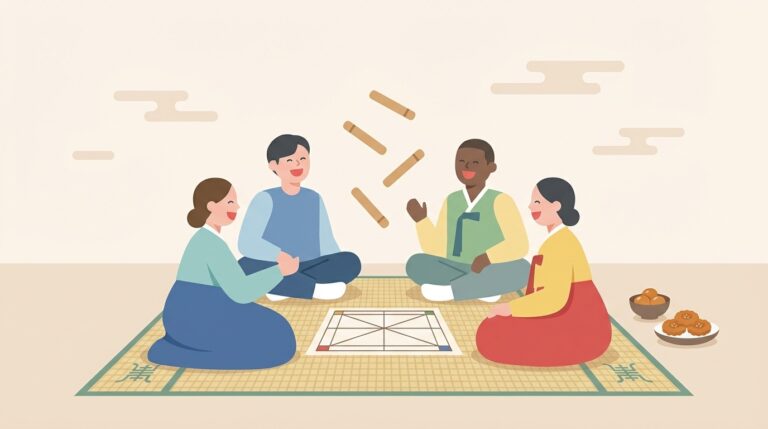
Don’t Just Watch! How to Dominate Yutnori Like a Korean Insider
Phase 1: Empathy & K-Culture Cold Open
Hello! I’m the Lead Editor of Daily Hangul.
Imagine this: You are watching a Chuseok or Seollal (Lunar New Year) special episode of your favorite K-Pop idol variety show (like Run BTS or Going Seventeen). The members are gathered around a traditional mat, throwing four wooden sticks into the air. Suddenly, one member screams, slams his hand on the floor, and the whole room erupts in chaos. The subtitles just say, “Oh no!” or “Caught!”
What just happened? Are they fighting? No, they are playing Yutnori (윷놀이), Korea’s most competitive traditional holiday game.
If you ever spend a traditional holiday in Korea, your host family or friends will inevitably bring out the Yut sticks. Knowing the rules is one thing, but knowing what to shout in the heat of the moment? That turns you from an awkward foreign guest into an absolute insider (인싸).
This guide is based on real experiences of my intermediate (B2) students who survived the glorious chaos of Korean holiday family gatherings. Let’s dive in!
Phase 2: Core Expressions Deep Dive
1. 한 번 더! (One more time!)
- Pronunciation: Han beon deo! [Han bun duh! – sounds like ‘Han’ + a short ‘bun’ + ‘duh’]
- Meaning: One more time (Literal) / Let me roll again! (Real nuance)
- K-Culture Moment: In Yutnori, if you roll a Yut (4 sticks flat) or Mo (4 sticks round), you get an extra turn. People chant this exactly like an encore chant at a K-Pop concert.
- Editor’s Insight: This isn’t just a request; it’s a victory cry. You say it while confidently picking up the sticks again to assert dominance.
- Situation Spectrum:
- Casual (Friends): ✅
- Semi-formal (Co-workers): ✅
- Formal (Boss/Elders): ⚠️ (Add 요: “한 번 더 던질게요!”)
- 🤔 Think About It: Why does Korean culture love the concept of “one more” (like service at restaurants, or encores)? How does this reflect the generous, lively spirit of Jeong (정)?
2. 잡았다! (Caught it!)
- Pronunciation: Jabatda! [Jah-baht-dah! – ‘jab’ like in boxing, ‘at’, ‘dah’]
- Meaning: I caught it! (Literal) / I captured your piece! (Real nuance)
- K-Culture Moment: The most dramatic K-Drama plot twist in Yutnori is when your token lands on the exact same spot as the opponent’s. You “catch” them, sending them back to the start, and you get an extra turn!
- Editor’s Insight: It carries a feeling of mischievous triumph. Say it while literally slapping your token onto the board.
- Situation Spectrum:
- Casual (Friends): ✅
- Semi-formal (Co-workers): ✅
- Formal (Boss/Elders): 🚫 (Say “잡았습니다!”)
- 🤔 Think About It: How does vocabulary used in games reflect a culture’s attitude toward competition and reversal of fortune?
3. 낙입니다 / 낙이네! (It’s a fall! / Out of bounds!)
- Pronunciation: Nagimnida / Nagine! [Nah-gheem-nee-dah / Nah-ghee-neh!]
- Meaning: It’s a fall (Literal) / Invalid roll, you’re out! (Real nuance)
- K-Culture Moment: If even one Yut stick rolls off the designated mat (멍석, meongseok), your turn is forfeited. Everyone from the opposing team points at the stick and screams “낙!” (Nak!).
- Editor’s Insight: ‘Nak’ comes from the Hanja (Chinese character) 落, meaning ‘to fall’. It’s the ultimate buzzkill for the thrower and pure joy for the opponents.
- Situation Spectrum:
- Casual (Friends): ✅ (낙이다! / 낙이네!)
- Semi-formal (Co-workers): ✅ (낙이네요!)
- Formal (Boss/Elders): ✅ (낙입니다!)
- 🤔 Think About It: Traditional games often have strict physical boundaries but flexible social rules. Does your culture have a game with an “out of bounds” rule that causes family arguments?
Phase 3: Textbook vs. Real Korean
[Situation 1: Cheering for an amazing roll]
* 📖 Textbook Korean: 정말 잘 던지셨습니다. (You threw that very well.)
* 🗣️ Real Korean: 대박! 모 나왔다! (Jackpot! Mo came out!)
* 💡 Why the difference?: Fast-paced games require short, punchy exclamations. Koreans drop subjects and use exclamation words like ‘대박’ to convey instant hype.
[Situation 2: Teasing an opponent who just got caught]
* 📖 Textbook Korean: 당신의 팀이 지고 있습니다. (Your team is losing.)
* 🗣️ Real Korean: 어떡해~ 다 잡혔네? (What to do~ You got completely caught, huh?)
* 💡 Why the difference?: The phrase “어떡해” (Oh no / What should we do) is ironically used here for playful mockery, showcasing the Korean art of Tiki-taka (banter).
Phase 4: Cultural Context — K-Culture Deep Dive
4-1. Non-verbal Elements: The Drama of the Throw
Language isn’t just spoken; it’s physical. In Yutnori, you don’t just gently drop the sticks. You gather them in two hands, shake them loudly, and toss them high up in the air. If the result is bad, slapping the floor (방바닥) in frustration is a classic non-verbal reaction. Reading the room (Nunchi) is crucial: if grandma rolls a bad hand, jokingly complaining is fine, but let her have her moment!
4-2. K-Culture Connections: Idol Variety Shows
If you watch K-Pop idols on their custom variety shows, Yutnori is a staple. Why? Because it tests friendships! The rules of Yutnori allow you to “piggyback” (업기) your own pieces to move faster, but if caught, all piggybacked pieces die together. The betrayal, the alliances, and the dramatic zooming of the camera when a piece is “caught” mimic a real-life soap opera. Fans even use the term “낙” (Nak) in daily life now to describe a failed attempt at something (e.g., failing to get concert tickets).
Phase 5: Real-Life Roleplay Scenario
Scenario A: The Seollal Battlefield
- Setting: Friday night during Seollal (Lunar New Year). You are in the cozy living room of your Korean friend, Minji. There is a huge plate of Jeon (Korean pancakes) on the table. You are playing Yutnori.
- Characters:
- YOU: An exchange student experiencing your first Korean holiday.
- Minji (25): Your friend, highly competitive.
- Minji’s Uncle (50s): The reigning Yutnori champion of the family.
Dialogue:
Uncle: 자, 내 차례지? 이번엔 무조건 ‘모’다! 😎
(Ja, nae charyeji? Ibeonen mujogeon ‘mo’da!)
[Translation] Alright, my turn right? This time it’s definitely a ‘Mo’!
(🎭 Stage Direction: Uncle shakes the sticks dramatically and throws them high)
Minji: 아, 삼촌 제발 살살 해요!
(A, samchon jebal salsal haeyo!)
[Translation] Ah, Uncle, please go easy on us!
(🎭 Stage Direction: The sticks land. One stick bounces and rolls off the mat.)
YOU: 엇? 막대기 하나가 밖으로 나갔어요!
(Eot? Makdaegi hanaga bakkeuro nagasseoyo!)
[Translation] Uh? One stick went outside!
Minji: 꺄아악! 삼촌, 방금 그거 낙이에요, 낙!
(Kkyaaak! Samchon, banggeum geugeo nagieyo, nak!)
[Translation] Kyaaak! Uncle, that was a ‘Nak’ just now, Nak!
Uncle: 에이, 이 정도면 걸친 거지. 그냥 넘어가자, 응?
(Ei, i jeongdomyeon geolchin geoji. Geunyang neomeogaja, eung?)
[Translation] Hey, it’s touching the line. Let’s just let it slide, huh?
🔀 Your Turn! How do you respond?
– A) “네, 알겠습니다. 계속 하세요.” (Yes, understood. Please continue.)
– B) “안 돼요! 삼촌 얄짤없어요! 낙입니다!” (No way! No mercy Uncle! It’s Nak!)
– C) “제가 대신 던져드릴까요?” (Shall I throw it for you instead?)✅ Best Choice: B — Why? In Yutnori, the age hierarchy temporarily vanishes. Playfully shouting “얄짤없어요” (no mercy/exceptions) shows you understand the game’s competitive vibe and will earn you big laughs from the family!
⚠️ Choice A Analysis: Too textbook. It kills the fun vibe of the game.
Scenario B: Bonus — Buying Snacks for the Game
- Setting: Gwangjang Market before heading to the family gathering.
YOU: 사장님, 약과 세 팩 주세요.
(Sajangnim, yakgwa se paek juseyo.)
[Translation] Boss, three packs of Yakgwa, please.
Vendor: 아이고, 학생 명절이라고 선물 사가네? 하나 더 줄게!
(Aigo, haksaeng myeongjeorirago seonmul sagane? Hana deo julge!)
[Translation] Oh my, buying gifts for the holiday? I’ll give you one more!
YOU: 우와, 감사합니다! 새해 복 많이 받으세요!
(Uwa, gamsahamnida! Saehae bok mani badeuseyo!)
[Translation] Wow, thank you! Happy New Year!
Phase 6: 10-Second Shadowing Drill
Read aloud, matching the rhythm and emotion!
- 😆 Triumph: 아싸! / 모 나왔다! / 한 번 더 / 던질게요!
(assa! / mo nawatda! / han beon deo / deonjilgeyo!)
[Yes! ‘Mo’ came out! I’ll throw one more time!] -
😭 Frustration: 아 진짜… / 낙이잖아요! / 무효예요, 무효!
(a jinjja… / nagijanayo! / muhyoyeyo, muhyo!)
[Ah seriously… it’s ‘Nak’! Invalid, it’s invalid!]
Phase 7: K-Culture Mini Dictionary
| Korean | Romanization | English | Context |
|---|---|---|---|
| 윷놀이 | yutnori | Yut game | The traditional board game played during Seollal and Chuseok. |
| 도, 개, 걸, 윷, 모 | do, gae, geol, yut, mo | Pig, Dog, Sheep, Cow, Horse | The 5 outcomes of throwing the sticks, determining how many spaces you move (1 to 5). |
| 멍석 | meongseok | Straw mat | The traditional mat. Sticks must land on it, or it’s a ‘Nak’. |
| 업기 | eopgi | Piggybacking | Stacking your pieces to move together. High risk, high reward! |
| 새해 복 많이 받으세요 | saehae bok mani badeuseyo | Happy New Year | Literal translation: “Please receive a lot of New Year’s luck.” |
Phase 8: Traveler Survival Kit
During traditional holidays, a lot of stores and restaurants in Korea close. If you are traveling during Seollal or Chuseok, you must know how to navigate this!
🆘 Survival Expression #1: Asking about holiday hours
– 🇰🇷 “명절 연휴에 문 여나요?” (myeongjeol yeonhyue mun yeonayo?)
– 🗣️ English Pronunciation: Myeong-jeol yeon-hyu-eh moon yeo-na-yo?
– 📍 Where to use: Restaurants, cafes, local shops before the holiday.
– 💡 Pro Tip: Look for signs that say “정상영업” (Open as usual) or “명절 휴무” (Closed for the holiday).📌 Editor’s Travel Note
– Useful Apps: KakaoMap and Naver Map update their business hours in real-time during holidays. Always check the app before walking 20 minutes to a restaurant!
– Buying a Yut set: You can buy a cheap Yutnori set at any Daiso or large supermarket (E-mart, Homeplus) during the holiday season for around 3,000 KRW. Take it to a cafe and play with friends!
– Empty Seoul: Seoul actually becomes wonderfully quiet during major holidays because everyone goes to their hometowns. It’s the best time to visit palaces like Gyeongbokgung, which often host free traditional game events!
Phase 9: Critical Thinking Corner — “One Step Deeper”
Language & Power: The Temporary Collapse of Hierarchy
Korean society is famous for its strict age and status hierarchy, which is deeply embedded in the language (honorifics vs. casual speech). However, during Yutnori, this hierarchy softens significantly. While you still shouldn’t use absolute casual language (반말) to an elder, the intensity of the game allows for playful shouting, demanding “no mercy,” and teasing older relatives when they lose. Traditional games act as a social release valve, a brief period where the joy of community (Jeong) overrides strict Confucian rules, allowing families to bond on a deeply human level.
💬 Your Turn: Does your culture have a specific game, holiday, or event where social rules and hierarchies are temporarily ignored for the sake of fun? Share it in the comments!
Phase 10: FAQ & Avoiding Misunderstandings
- “Can I really yell at my Korean boss or elders while playing Yutnori?”
- Maybe. You can be loud and enthusiastic, but keep the “요” (yo) at the end of your sentences. Scream “낙이에요!” (It’s Nak!), not “낙이야!” (which is only for close friends).
- “What if I don’t know how to count the score?”
- Don’t worry! Usually, there is a designated “말 잡이” (Token Mover) in the family who calculates everything. Just focus on throwing the sticks nicely.
❌ Common Mistake #1: Throwing the sticks directly at someone.
✅ Do this instead: Throw them straight up in the air above the mat. Throwing them aggressively across the room can hit the jeon (pancakes) or break a glass!❌ Common Mistake #2: Assuming places are open on the day of Seollal/Chuseok.
✅ Do this instead: The actual day of the holiday is when 80% of local shops close. Stick to hotel restaurants, convenience stores, or major tourist hubs.
Phase 11: Summary & Action Items
- One-Liner Summary: Mastering exclamations like “한 번 더” and “낙입니다” will make you the star of any Korean traditional holiday game.
-
Action Mission 3 Steps:
- 🥉 Bronze (Solo): Stand up and practice throwing invisible sticks while shouting “잡았다!”
- 🥈 Silver (Online): Find a YouTube video of idols playing Yutnori and leave a comment pointing out when someone gets a “Nak.”
- 🥇 Gold (Real-Life): Buy a Yutnori set from Daiso and teach the game to your friends using the Korean phrases you learned today!
- K-Culture Mission: Search “Idol Yutnori” on YouTube. Watch just 5 minutes and count how many times they scream “대박” or “한 번 더”!
Phase 12: Quiz — Interactive Challenge
1. Situational Judgment: Your host family’s grandfather throws the sticks, and one slides completely off the mat. What is the most culturally appropriate yet fun thing to say?
– A) 할아버지, 바보예요. (Grandpa, you are a fool.)
– B) 아싸! 할아버지 낙이에요! (Yes! Grandpa, it’s a Nak!)
– C) 안녕히 계세요. (Goodbye.)
2. Fill in the Blank: When you capture your friend’s piece on the board, you slap your piece down and shout: “________!”
– A) 한 번 더 (One more time)
– B) 잡았다 (Caught it)
– C) 배고파 (I’m hungry)
3. True or False – K-Culture Edition: During Chuseok and Seollal, all restaurants in Seoul are open for 24 hours because it’s a festive season. (T/F)
(Answers below)
.
.
.
Answers:
1. B – It’s playful but keeps the polite “요” ending. Option A is highly disrespectful.
2. B – “잡았다!” is the perfect dramatic phrase for capturing a piece.
3. False – Many family-owned restaurants close so the owners can visit their hometowns. Always check map apps for holiday hours!
Frequently Asked Questions (FAQ)
Q: What does "한 번 더! (One more time!)" mean in Korean and how do you pronounce it?
A: In Korean, "한 번 더! (One more time!)" is pronounced [Han beon deo! [Han bun duh! - sounds like 'Han' + a short 'bun' + 'duh'] and means: One more time (Literal) / Let me roll again! (Real nuance)
Q: What does "잡았다! (Caught it!)" mean in Korean and how do you pronounce it?
A: In Korean, "잡았다! (Caught it!)" is pronounced [Jabatda! [Jah-baht-dah! - 'jab' like in boxing, 'at', 'dah'] and means: I caught it! (Literal) / I captured your piece! (Real nuance)
Q: What does "낙입니다 / 낙이네! (It's a fall! / Out of bounds!)" mean in Korean and how do you pronounce it?
A: In Korean, "낙입니다 / 낙이네! (It's a fall! / Out of bounds!)" is pronounced [Nagimnida / Nagine! [Nah-gheem-nee-dah / Nah-ghee-neh!] and means: It's a fall (Literal) / Invalid roll, you're out! (Real nuance)







