

Phase 1: Empathy & Immersion (The ‘Oh No’ Moment)
Hello there! I’m your Senior Editor from Daily Hangul.
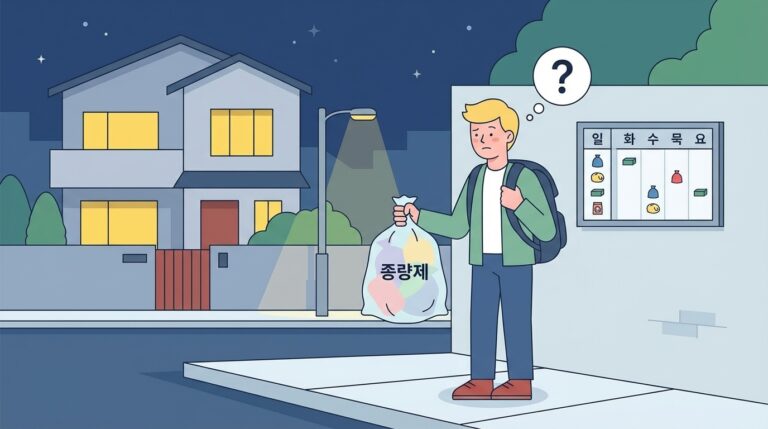
Imagine this: You’ve finally arrived at your cute Airbnb in Seoul. It looks just like the apartment from your favorite K-Drama. You unpack, eat some delicious delivery Tteokbokki, and clean up. You’ve even bought the special Korean garbage bags. You confidently walk outside to throw it away, but suddenly… an angry-looking note on the wall catches your eye, and your neighbor gives you a serious side-eye.
What went wrong?
In K-Dramas, you rarely see the glamorous lead characters dealing with the strict reality of Korean garbage disposal. But in real life? Taking out the trash (쓰레기, sseuregi) in Korea is a serious business. It’s not just about how you separate it, but crucially, when (배출 시간, baechul sigan) you take it out.
Throwing out trash at the wrong time in Korea isn’t just a minor faux pas; it can result in a hefty fine and some very unhappy neighbors.
Don’t worry! I’ve seen countless students and travelers panic over this. Today, as your local navigator, I’m going to teach you the absolute essential, beginner-friendly survival phrases so you can handle your trash like a true local.
Phase 2: Deep Dive into Core Expressions
Let’s master the 3 most critical phrases you need for this situation.
1. 쓰레기 언제 버려요?
- Pronunciation: sseuregi eonje beoryeoyo? [ssuh-reh-gee un-jeh buh-ryuh-yo?]
- Sound-alike guide: ‘쓰레기 (sseuregi)’ sounds a bit like saying “Sue Reggie”. ‘언제 (eonje)’ sounds like “on J”. ‘버려요 (beoryeoyo)’ sounds like “bore yo-yo”.
- Meaning: When do I throw away the trash?
- K-Culture Moment: You’re at your new officetel (studio apartment). You ask the building manager (아저씨, ajeossi) this question. It’s the first step to becoming a respected resident.
- Editor’s Insight: This is the most practical, natural way to ask. It’s not overly formal, but the ‘요 (yo)’ at the end makes it perfectly polite for managers, landlords, or convenience store workers.
- Situation Spectrum:
- Friends (Casual): ⚠️ (Drop the ‘요’ -> 쓰레기 언제 버려?)
- Building Manager/Strangers (Semi-formal): ✅
- Highly Formal Situations: 🚫
- 🤔 Think About It: Why does a simple chore require scheduling? What does this tell you about living in a densely populated city like Seoul?
2. 밤에 버리세요.
- Pronunciation: bame beoriseyo. [bahm-eh buh-ree-seh-yo.]
- Meaning: Please throw it away at night.
- K-Culture Moment: This is the answer you will hear 90% of the time. In most Korean neighborhoods, trash is collected at dawn, so residents are required to put it out after sunset (usually between 8 PM and midnight).
- Editor’s Insight: Listen for the word ‘밤 (bam)’, which means night. If you hear this, do not take your trash out in the morning!
- Situation Spectrum:
- This is what you will hear from others giving you instructions: ✅
- 🤔 Think About It: In many Western countries, people take out the trash in the morning. Why do you think Korea prefers the night shift?
3. 오늘 버려도 돼요?
- Pronunciation: oneul beoryeodo dwaeyo? [oh-neul buh-ryuh-doh dway-yo?]
- Meaning: Can I throw it away today?
- K-Culture Moment: Different types of trash (plastics, paper, food) have specific days assigned to them in many neighborhoods. If you have a huge box from your K-Pop merch delivery, you need to check if today is the right day to toss it!
- Editor’s Insight: ‘오늘 (oneul)’ means today. This is a great “safe check” phrase. If they cross their arms and say “안 돼요 (an dwaeyo)” (No), you know you need to hold onto it.
- Situation Spectrum:
- Asking a neighbor/landlord: ✅
- 🤔 Think About It: Asking for permission to do basic chores shows a high level of respect for community rules. Does your culture have similar communal checks?
Phase 3: Textbook vs. Real Korean
[Asking about the schedule]
* 📖 Textbook Korean: 쓰레기 배출 시간이 언제입니까? (sseuregi baechul sigani eonjeimnikka? – Very stiff, sounds like a police officer or a government brochure.)
* 🗣️ Real Korean: 쓰레기 언제 내놔요? (sseuregi eonje naenwayo?) or 언제 버려요? (eonje beoryeoyo?)
* 💡 Why the difference?: Koreans prefer efficient, action-oriented verbs in daily life. ‘버리다’ (to throw away) or ‘내놓다’ (to put out) is much more natural than the bureaucratic word ‘배출’ (emission/discharge).
[Being told you can’t do it now]
* 📖 Textbook Korean: 지정된 시간에 버려 주십시오. (jijeongdoen sigane beoryeo jusipsio. – Please throw it away at the designated time.)
* 🗣️ Real Korean: 지금 버리면 안 돼요. (jigeum beorimyeon an dwaeyo. – You shouldn’t throw it away right now.)
* 💡 Why the difference?: Everyday speech relies on direct conditions (“If you do it now, it’s a no”) rather than formal administrative vocabulary.
Bottom Note: For A1 beginners, don’t worry about the complex grammar of why “안 돼요” means “no”. Just memorize it as a chunk: “Action + 안 돼요” = “You can’t do that.”
Phase 4: Cultural Context — K-Culture Deep Dive
4-1. Non-Verbal Cues & The Art of ‘Nunchi’
When asking “쓰레기 언제 버려요?”, point to the trash bag. If your Korean isn’t perfect, the gesture will do 90% of the work.
Also, this is a prime situation to use 눈치 (Nunchi)—the Korean art of reading the room. If it’s Tuesday morning and you look at the designated trash pole on your street and see absolutely zero bags… use your nunchi. It’s probably not the time to take yours out. Wait and see when the locals start bringing theirs out!
4-2. The “I Live Alone” Reality (K-Variety Show Connection)
If you watch the popular Korean reality show I Live Alone (나 혼자 산다), you’ll often see celebrities sorting their recycling on their living room floors. It’s a highly relatable trope. In dramas, rich CEOs live in penthouses where magical staff handle the trash. But in reality, everyone—from K-Pop idols to office workers—has to memorize their neighborhood’s disposal time. It’s the ultimate equalizer in Korean society!
Phase 5: Practical Roleplay Scenario
Setting: It’s 10:00 AM on your second day in Seoul. You are staying in a cozy villa in Yeonnam-dong. You have a full bag of trash. You carry it downstairs and bump into the building’s friendly but strict owner.
Characters:
– YOU: A traveler trying to be a good guest.
– Ahjumma (60s): The building owner. She likes keeping her building spotless.
Dialogue:
YOU: 안녕하세요! (Hello!)
(annyeonghaseyo!)
Ahjumma: 어머, 쓰레기 버리게요? 🗑️
(eomeo, sseuregi beorigeyo?)
[Oh, are you going to throw away the trash?]
YOU: 네. 쓰레기 언제 버려요?
(ne. sseuregi eonje beoryeoyo?)
[Yes. When do I throw away the trash?]
Ahjumma: 아유, 아침에는 안 돼요. 밤에 버리세요.
(ayu, achimeneun an dwaeyo. bame beoriseyo.)
[Oh my, not in the morning. Please throw it away at night.]
YOU: 아, 밤에요?
(a, bameyo?)
[Ah, at night?]
Ahjumma: 네, 저녁 8시 넘어서요.
(ne, jeonyeok yeodeolsi neomeoseoyo.)
[Yes, after 8 PM.]
YOU: 그럼… 오늘 버려도 돼요?
(geureom… oneul beoryeodo dwaeyo?)
[Then… can I throw it away today?]
Ahjumma: 네, 오늘은 일반 쓰레기 날이에요. 밤에 내놔요.
(ne, oneureun ilban sseuregi narieyo. bame naenwayo.)
[Yes, today is general trash day. Put it out at night.]
🔀 Your Turn! How should you reply?
– A) “오케이, 바이!” (Okay, bye!)
– B) “아, 알겠습니다. 감사합니다!” (Ah, understood. Thank you!)
– C) Just nod and walk away silently.✅ Best Choice: B — It shows you understood the rule and are grateful for the guidance. Koreans appreciate it when foreigners respect community rules.
⚠️ Choice A Analysis: Too casual for an older building owner. It sounds a bit rude!
Phase 6: 10-Second Shadowing Drill
Let’s practice! Speak out loud. Pay attention to the pauses (/) and the emotion tags.
- 🥺 (Confused, seeking help): 저기요… / 쓰레기 / 언제 버려요?
(jeogiyo… / sseuregi / eonje beoryeoyo?) - 😤 (Like a strict but kind Ahjumma): 아침엔 안 돼요! / 밤에 / 버리세요.
(achim-en an dwaeyo! / bame / beoriseyo.) - 😊 (Double checking): 아~ / 그럼 / 오늘 버려도 돼요?
(ah~ / geureom / oneul beoryeodo dwaeyo?)
Phase 7: K-Culture Mini Dictionary
| Korean | Romanization | English | Context |
|---|---|---|---|
| 눈치 | nunchi | Social sense | The ability to read the room. E.g., checking if neighbors put their trash out first. |
| 쓰레기 | sseuregi | Trash / Garbage | Can be general, food, or recycling. |
| 종량제 봉투 | jongnyangje bongtu | Volume-based garbage bag | You must buy these at convenience stores or supermarkets to throw away general trash. |
| 아저씨 / 아줌마 | ajeossi / ajumma | Middle-aged man / woman | Often used respectfully for building managers or store owners. |
| 과태료 | gwataeryo | Fine | What you get if you ignore the disposal times or don’t use the right bags! |
Phase 8: Traveler’s Survival Kit
Since taking out trash is a daily reality for anyone staying in an Airbnb or residence hotel, here are your absolute must-know survival phrases for the convenience store.
🆘 Survival Expression #1: Buying the Bags
– 🇰🇷 “쓰레기 봉투 있어요?” (sseuregi bongtu isseoyo?)
– 🗣️ Pronunciation: [ssuh-reh-gee bong-too ee-ssuh-yo?]
– 📍 Where to use: Convenience stores (CU, GS25, 7-Eleven).
– 💡 Pro Tip: The cashier will ask what size you want (usually in Liters, ‘리터’). Hold up your fingers for 10 (sip) or 20 (isip) liters!📌 Editor’s Travel Note
– The Apps: Use Papago to translate any angry-looking signs taped near the trash area. It has an image translation feature!
– CCTV is everywhere: Don’t think you can sneak your trash out at 2 PM. Korean alleys are heavily monitored by CCTVs to catch illegal dumping.
Phase 9: Critical Thinking — “One Step Deeper”
Space, Rules, and the Korean Community (Food & Identity / Space)
🧠 Think Deeper:
Why is Korea so strict about when you take out the trash? It comes down to geography and community. Seoul is incredibly dense, with millions of people living in close quarters. If everyone put their trash out whenever they wanted, the narrow alleys would constantly smell, especially during the hot, humid summers. The strict “night-time only” rule ensures the garbage trucks can sweep through at dawn, leaving the streets clean for the morning commute. It’s a reflection of putting the community’s comfort over individual convenience.💬 Your Turn: Does your neighborhood back home have strict rules about trash, or is it more relaxed? Share in the comments!
Phase 10: FAQ & Avoiding Misunderstandings
Q: “Can I use ‘쓰레기 언제 버려요?’ to anyone?”
Yes! As long as you keep the ‘요 (yo)’ at the end, it is perfectly fine to use with building managers, convenience store staff, or neighbors you’ve just met.
Q: “What if I’m leaving for the airport in the morning and HAVE to throw it away?”
If you are checking out of an Airbnb, message your host in advance. They will usually make an exception or tell you exactly where to hide it so the neighbors don’t complain.
❌ Common Mistake #1: Throwing household trash into public bins on the street (like near a bus stop).
✅ How to fix it: Never do this! It is considered illegal dumping. Always use the designated spot for your specific building.
Phase 11: Summary & Action Items
- One-Liner Summary: To avoid fines and angry neighbors, always ask “쓰레기 언제 버려요?” and remember that the answer is almost always “밤 (night)”!
-
Action Mission 3 Steps:
- 🥉 Bronze (Solo): Say “쓰레기 언제 버려요?” 3 times while tying up your trash bag at home.
- 🥈 Silver (Online): Comment below with the time you usually take out the trash in your country!
- 🥇 Gold (Real-world): If you are in Korea, go to a convenience store, buy a ‘쓰레기 봉투’ (trash bag), and ask the clerk when you should throw it out.
- K-Culture Mission: Watch an episode of I Live Alone (나 혼자 산다) on YouTube. Look closely at the background when they are cleaning their houses—you’ll spot the colored Jongnyangje bags!
Phase 12: Quiz — Interactive Challenge
1. Situational Judgment: It’s 2:00 PM (afternoon). Your trash bag is full. What should you do?
– A) Take it outside immediately so your room doesn’t smell.
– B) Ask “언제 버려요?” and wait until the designated time (usually night).
– C) Throw it in the public trash can at the subway station.
(Answer: B. Taking it out in the afternoon will anger neighbors, and C is illegal!)
2. Fill in the Blank:
You want to ask if it’s okay to throw out the trash today.
“______ 버려도 돼요?”
(Answer: 오늘 / oneul / today)
3. True or False — K-Culture Edition:
You can put your trash in any normal plastic bag from a supermarket to throw it away outside. (T/F)
(Answer: False. You must buy and use the official, color-coded ‘종량제 봉투’ (volume-based bags) sold at convenience stores.)
Frequently Asked Questions (FAQ)
Q: What does "쓰레기 언제 버려요?" mean in Korean and how do you pronounce it?
A: In Korean, "쓰레기 언제 버려요?" is pronounced [sseuregi eonje beoryeoyo? [ssuh-reh-gee un-jeh buh-ryuh-yo?] and means: a key conversational Korean expression covered in this lesson.
Q: What does "밤에 버리세요." mean in Korean and how do you pronounce it?
A: In Korean, "밤에 버리세요." is pronounced [bame beoriseyo. [bahm-eh buh-ree-seh-yo.] and means: Please throw it away at night.
Q: What does "오늘 버려도 돼요?" mean in Korean and how do you pronounce it?
A: In Korean, "오늘 버려도 돼요?" is pronounced [oneul beoryeodo dwaeyo? [oh-neul buh-ryuh-doh dway-yo?] and means: Can I throw it away today?







