

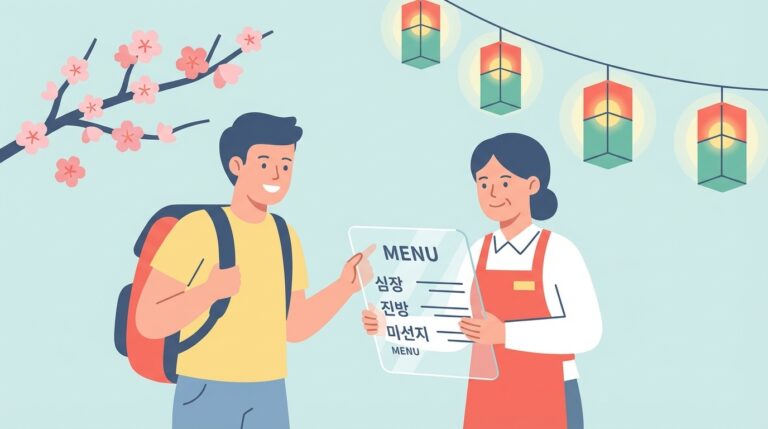
1. Welcome to the Real Korea! 🇰🇷
안녕하세요! 매일한글 에디터입니다.
Imagine this: You are at a breathtaking regional festival in Korea. Perhaps it’s the Jinhae Cherry Blossom Festival or the Boryeong Mud Festival. The atmosphere is electric, the K-Pop covers are blasting, and you sit down at a cozy tent stall (Pojangmacha, 포장마차) to order a simple plate of Pajeon (scallion pancake) and some Makgeolli. But when the bill arrives, it’s 50,000 KRW! Your heart drops. Was the textbook ‘Thank you’ (Kamsahamnida) really enough here?
Welcome to the dark side of local tourism: 바가지 요금 (Bagaji Yogeum), or rip-off pricing.
For a long time, this was a massive pain point for both foreign tourists and domestic travelers. But recently, Korean local governments have declared war on this practice. To survive, they are introducing strict 차별화 전략 (Differentiation Strategies) and aggressive campaigns to eradicate scams. As a C2-level learner or MICE professional, understanding this shift isn’t just about saving your wallet—it’s about reading the socio-economic pulse of modern Korea.
Let’s dive into the words and cultural nuances that will make you sound like an absolute local expert at your next Korean festival!
2. 핵심 표현 심층 분석 (Core Expressions Deep Dive)
1. 바가지(를) 씌우다 / 바가지를 쓰다
- Pronunciation: bagaji(reul) ssiuda / bagajireul sseuda (Sounds like: bah-gah-jee… think of ‘baggie’ with an ‘ah’ sound)
- Meaning: (Literal) To put a gourd over someone’s head / (Real) To overcharge someone / To be ripped off.
- K-Culture Moment: You will see this everywhere in Korean news headlines during festival seasons, or in K-Dramas where a protagonist angrily argues with a market vendor. ‘바가지 요금’ (Rip-off pricing) is the noun form.
- Editor’s Insight: This isn’t just about something being ‘expensive’ (비싸다). It carries a deep sense of being scammed or tricked. If you buy a luxury bag, it’s expensive, but it’s not ‘bagaji’. If you pay $50 for a street-food pancake, that is bagaji.
- Situation Spectrum:
- 친구 사이(Casual): ✅ (“나 완전 바가지 썼어!”)
- 직장 동료(Semi-formal): ⚠️ (Use cautiously in professional settings)
- 공식 비즈니스(Formal): ✅ (Only when used formally as a noun: “바가지 요금 논란”)
- 🤔 Think About It: Why a ‘gourd’ (바가지)? In traditional Korean gambling games, a gourd was used to cover and hide the winning items, leading to the nuance of being deceived. Does your language have an object-based idiom for being scammed?
2. 근절하다
- Pronunciation: geunjeolhada (geun-jeol-ha-da)
- Meaning: (Literal) To cut off the root / (Real) To eradicate, root out, or completely eliminate.
- K-Culture Moment: When a local mayor apologizes on TV for a festival’s overpriced food controversy, they will inevitably bow and say, “바가지 요금을 강력히 근절하겠습니다!” (We will strongly eradicate rip-off pricing!).
- Editor’s Insight: This is a high-level Hanja word used in policy-making, MICE planning, and public campaigns. Using this shows you deeply understand Korean administrative phrasing.
- Situation Spectrum:
- 친구 사이(Casual): 🚫 (Too serious!)
- 공식 발표·비즈니스(Formal): ✅
3. 정찰제
- Pronunciation: jeongchalje (jeong-chal-jeh)
- Meaning: Fixed-price system.
- K-Culture Moment: To differentiate their festivals, local governments now mandate Jeongchalje. You will see huge banners saying “전 품목 정찰제 시행” (All items are strictly fixed-price).
- Editor’s Insight: Haggling was once considered part of Korean ‘Jeong’ (정, warmth). But nowadays, transparency is king. Jeongchalje brings peace of mind to modern consumers.
3. 교과서 vs 진짜 한국어
[상황 1: 축제에서 음식이 터무니없이 비쌀 때 (Overpriced Food)]
* 📖 교과서 한국어: 가격이 너무 비싸서 불만입니다. (I am dissatisfied because the price is too high.)
* 🗣️ 진짜 한국어: 와, 여기 완전 바가지 썼네. 가성비 똥망이야. (Wow, totally got ripped off here. The cost-to-performance ratio is trash.)
* 💡 왜 다를까?: ‘가성비 (가게 대비 성능, Cost-Performance)’ is a religion in modern Korea. The slang ‘똥망’ (totally ruined/crap) adds emotional weight to the frustration.
[상황 2: 친구가 유명한 관광지에 간다고 할 때 (Warning a Friend)]
* 📖 교과서 한국어: 관광지에서는 상인들을 조심하십시오. (Please be careful of merchants in tourist areas.)
* 🗣️ 진짜 한국어: 거기 호구 잡히기 딱 좋아. 무조건 리뷰 보고 가. (That’s the perfect place to get played like a pushover. You must check reviews before going.)
* 💡 왜 다를까?: ‘호구’ (Pushover) reflects the Korean cultural fear of being taken advantage of. Relying on digital reviews is the ultimate defense mechanism.
Bottom Note: For C2 professionals, instead of harsh slang, use: “이 축제는 차별화 전략이 부족해서 아쉽네요.” (It’s a pity this festival lacks a differentiation strategy.)
4. 문화적 맥락 — K-Culture 딥다이브
4-1. 비언어적 요소: The ‘Scanning’ Nunchi
At modern Korean festivals, you shouldn’t just sit down anywhere. Use your Nunchi (눈치). Watch the locals: they will stand in front of the stall and actively scan for a laminated, officially stamped menu board provided by the local government. If a stall has no visible prices, Koreans will swiftly walk away.
4-2. K-Food & K-Travel: The Baek Jong-won Effect
Why is ‘Eradicating Bagaji’ such a hot topic right now? Enter Baek Jong-won, Korea’s most famous culinary entrepreneur. He recently collaborated with struggling local markets (like Yesan Market) to revitalize them. His core strategy? 차별화 (Differentiation) through unique local ingredients, and absolute 가격 투명성 (Price Transparency).
Before this, YouTube vloggers went viral by exposing traditional markets charging $70 for a handful of snacks. The public outrage was so intense that it forced a nationwide MICE and tourism reform. Now, local festivals are terrified of bad Naver reviews. The power has shifted entirely to the consumer!
5. 실전 롤플레이 시나리오
메인 롤플레이: 강릉 커피 축제 현장
- Setting: 10월의 맑은 가을날, 강릉 커피 축제 현장. 당신은 글로벌 MICE 컨설턴트 자격으로 한국인 파트너 민수와 함께 부스들을 시찰 중입니다. 곳곳에 ‘바가지 요금 신고 센터’라는 현수막이 걸려 있습니다.
- Characters:
- YOU (독자): 날카로운 안목을 가진 글로벌 MICE 전문가.
- 민수 (35세): 한국인 프로젝트 매니저. 트렌드에 민감함.
민수: 이번 축제는 지자체에서 신경을 정말 많이 썼네요. 저기 현수막 보이시죠?
(Min-su: The local government really put a lot of effort into this festival. Do you see that banner over there?)
YOU: 아, ‘바가지 요금 근절! 전 매장 정찰제’?
(Ah, ‘Eradicate rip-off pricing! Fixed prices for all stores’?)
민수: 네, 작년에 지역 축제들이 가격 논란 때문에 뉴스에 크게 났었거든요. 그래서 이번엔 입점 업체들 메뉴랑 가격을 아예 통일시켰대요.
(Min-su: Yes, local festivals made national news last year because of pricing controversies. So this time, they unified the menus and prices for all participating vendors.)
YOU: 훌륭한 대처네요. 관광객 입장에서는 가격이 투명해야 지갑을 열게 되니까요.
(Excellent response. From a tourist’s perspective, prices need to be transparent to open our wallets.)
민수: 맞아요. 그런데 저쪽 푸드트럭 꼬치는 하나에 8천 원이네요. 약간 비싼 감이 있는데… 어떻게 생각하세요?
(Min-su: Right. But that food truck skewer over there is 8,000 won each. Feels a bit pricey… What do you think?)
🔀 당신의 차례! 어떻게 대답할까요?
– A) “와, 진짜 바가지네요! 경찰에 신고합시다!”
– B) “단순히 비싸다고 바가지는 아니죠. 지역 특산물인 흑돼지를 썼다거나 하는 차별화 전략이 있는지 확인해 봐야 해요.”
– C) “저기요! 꼬치 너무 비싸요! 깎아주세요!”✅ Best Choice: B — 이유: C2 레벨의 비즈니스/전문가적 접근입니다. High prices aren’t always ‘Bagaji’ if the value (differentiation) justifies it.
⚠️ Choice A & C 분석: A is an overreaction. C is a cultural faux pas; haggling is strongly discouraged at modern structured festivals.
6. 10초 섀도잉 드릴
Practice your tone! Slant lines (/) indicate natural pauses.
- 😤 단호하게: 예전에는 / 관광지 바가지가 / 정말 심했어요.
(yejeon-eneun / gwangwangji bagaji-ga / jeongmal simhaesseoyo.) - 😊 만족스럽게: 이 축제는 / 정찰제라서 / 참 다행이네요!
(i chukje-neun / jeongchalje-raseo / cham dahaeng-ineyo!) - 🧐 분석적으로: 지역 축제가 성공하려면 / 명확한 차별화 전략이 / 필수입니다.
(jiyeok chukje-ga seonggong-haryeomeyon / myeonghwakhan chabyeolhwa jeollyak-i / pilsu-imnida.)
7. K-Culture 미니 사전
| 한국어 | Romanization | Meaning | 맥락 설명 |
|---|---|---|---|
| 호구 | hogu | Pushover / Sucker | Someone easily scammed. “호구 잡히다” means to be treated like a fool. |
| 가성비 | gaseongbi | Cost-effectiveness | The holy grail of Korean consumer culture. Price vs. Performance. |
| 현수막 | hyeonsumak | Banner | Used aggressively in Korea for public campaigns, protests, and festival announcements. |
| 정찰제 | jeongchalje | Fixed-price system | The modern antidote to traditional market haggling. |
8. 여행자 서바이벌 키트
Even as an advanced speaker, when you travel to the Korean countryside, things can get confusing. Keep these phrases handy:
🆘 서바이벌 표현 TOP 3
– 🇰🇷 “여기 지자체에서 인증한 메뉴판인가요?”
– (Is this menu board certified by the local government?)
– 📍 쓰는 곳: Unmarked festival stalls.
– 🇰🇷 “혹시 정찰제 매장인가요?”
– (Is this a fixed-price store?)
– 📍 쓰는 곳: Traditional markets near festival grounds.
– 🇰🇷 “영수증 꼭 챙겨주세요.”
– (Please make sure to give me the receipt.)
– 📍 쓰는 곳: Everywhere. You need receipts to report ‘Bagaji’ to the festival complaint center!📌 Editor’s Travel Note
– The ‘Good Price Store’ (착한가격업소): Look for this blue sticker! It’s a government-certified badge for stores that maintain affordable prices.
– Cash vs. Card: Even small festival stalls now accept credit cards. If a vendor insists on cash or an account transfer (계좌이체) and refuses cards, it’s a red flag.
9. 비판적 사고 코너 — “한 발 더 깊이”
🧠 Think Deeper: 언어와 권력 (Language & Power in the Digital Age)
Traditionally, Korean traditional markets were defined by ‘정(Jeong)’—the ambiguous but warm cultural affection where a vendor might give you an extra apple (덤) just because they liked you. However, as local festivals commercialized, this ambiguity became a weapon for exploitation (Bagaji).
Today, the demand for absolute transparency—fixed prices, published menus, and digital reporting QR codes—shows a fascinating shift. Modern Korean society now values systematic ‘fairness’ over traditional ‘warmth’. The power has shifted from the merchant to the smartphone-wielding consumer, who can destroy a festival’s reputation overnight with a single YouTube vlog. Is ‘Jeong’ disappearing, or is it just evolving into a demand for mutual respect?
💬 Your Turn: How is traditional marketplace culture changing in your country due to the internet? Do people still haggle, or is fixed pricing the absolute norm? Let us know in the comments!
10. FAQ & 오해 방지
- Q: Can I haggle at traditional markets or festivals if I speak Korean well?
- A: Generally, NO. Due to the recent “Eradicate Bagaji” campaigns, fixed pricing is heavily enforced. Trying to haggle at an officially sanctioned festival booth might actually offend the vendor or cause confusion.
- Q: If food is expensive, is it always ‘Bagaji’?
- A: Not always. Some regional specialties (like Hanwoo beef or specific seafood) are genuinely expensive. It’s only Bagaji if the price drastically exceeds the standard market rate or if the quality is deceptively poor.
❌ 흔한 실수 (Common Mistake): Threatening to “report” a vendor just because the price is slightly higher than Seoul.
✅ 이렇게 하세요: Check Kakao Maps or Naver reviews first to understand the baseline price of the region’s specialty!
11. 요약 및 액션 아이템
- One-Liner Summary: To navigate modern Korean festivals like a pro, you must understand the cultural shift towards 정찰제 (fixed pricing) and the war against 바가지 요금 (rip-off pricing).
-
Action Mission 3단계:
- 🥉 Bronze (혼자서): Shadow the phrase “여기 완전 바가지 썼네!” in front of the mirror with an appropriately frustrated expression.
- 🥈 Silver (온라인): Go to Naver Maps, search for a famous market (e.g., 광장시장 or 예산시장), and read the Korean reviews. Try to spot the word ‘가성비’ or ‘바가지’.
- 🥇 Gold (실전): The next time you visit a Korean event or market, confidently ask: “여기 정찰제인가요?”
12. 퀴즈 — 인터랙티브 챌린지
Q1. You are advising a Korean local government on a new MICE event. Which phrase would you use in your official presentation?
1) 우리 축제는 호구를 잡아야 합니다.
2) 관광객을 위한 바가지 요금 근절과 차별화 전략이 필요합니다.
3) 가성비 똥망 축제를 기획합시다.
(정답: 2번. 1 and 3 are slang/negative and highly inappropriate for business.)
Q2. True or False: To show you are culturally integrated, you should actively haggle with vendors at modern Korean local festivals.
(정답: False. Modern festivals enforce ‘정찰제’ (fixed prices) to prevent scams and ensure fairness for everyone.)
Q3. Fill in the blank: “아까 그 포장마차 파전이 5만 원이라고? 우리 완전 (_______) 썼어!”
(정답: 바가지)
수고하셨습니다! Now you’re ready to enjoy Korea’s beautiful festivals without getting scammed. See you in the next lesson!
Frequently Asked Questions (FAQ)
Q: What does "근절하다" mean in Korean and how do you pronounce it?
A: In Korean, "근절하다" is pronounced [geunjeolhada (geun-jeol-ha-da] and means: (Literal) To cut off the root / (Real) To eradicate, root out, or completely eliminate.
Q: What does "정찰제" mean in Korean and how do you pronounce it?
A: In Korean, "정찰제" is pronounced [jeongchalje (jeong-chal-jeh] and means: Fixed-price system.






