

Phase 1: Empathy (Immersive Open)
Hello! I’m the Lead Editor of Daily Hangul.
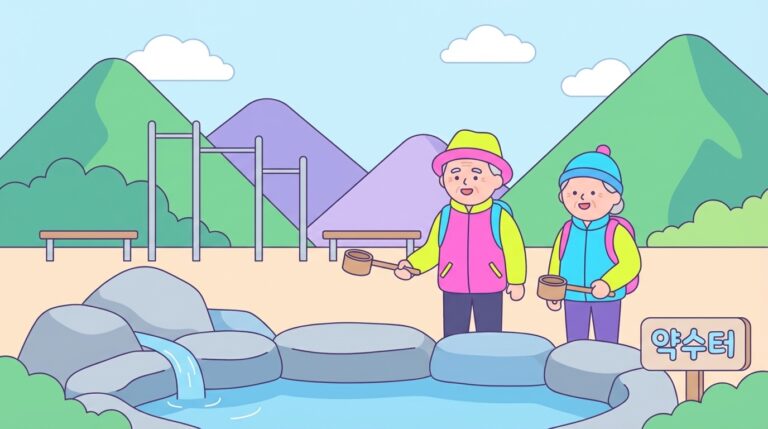
Imagine this: You’re hiking up a beautiful mountain in Seoul, maybe Bukhansan or Inwangsan. You’re sweating, tired, and definitely need a break. Suddenly, you reach a small clearing. You hear the refreshing sound of trickling water, and you see groups of older Koreans—dressed head-to-toe in neon, professional-grade hiking gear—drinking from a small natural spring. This is the legendary ‘약수터’ (Yaksuteo – Mineral Spring).
Then, a friendly Ahjumma (middle-aged woman) hands you a plastic dipper of water or a piece of cucumber. You freeze. In K-Dramas, mountains are where characters go to clear their heads or share deep secrets. But right now, in real life, you just need to know how to politely accept (or decline!) the water and say hello without making things awkward.
I’ve lived in Seoul for over a decade, and I can tell you that Korean hiking culture is a unique, heartwarming world of its own. It’s a place where strangers become instant friends over a cherry tomato. Today, we are going to learn the essential survival Korean for the mountain trails and the Yaksuteo. Trust me, knowing these simple phrases will turn you from a lost tourist into an “Insider” on the trails!
Phase 2: Core Expressions Deep Dive
Let’s look at the absolute must-know phrases for A1 beginners at a Yaksuteo.
1. 안녕하세요 (Hello)
- Pronunciation: [an-nyeong-ha-se-yo] + Sounds like ‘on-nyong-ha-say-yo’
- Meaning: Hello / Good morning (Literal: Are you at peace?)
- K-Culture Moment: You know how in K-Dramas, people bow when they greet? On a mountain, it’s slightly different. As you pass fellow hikers, especially near the resting spots like Yaksuteo, it is polite to give a slight head nod and say this cheerfully.
- Editor’s Insight: Think of it as a friendly trail greeting. You don’t need to stop and chat; just a passing, slightly prolonged “안녕하세~요” (An-nyeong-ha-se~yo) makes you look incredibly polite.
- Situation Spectrum:
- Casual (Friends): ✅ (Say “안녕” An-nyeong)
- Semi-formal (Strangers on trail): ✅
- Formal (Elders at Yaksuteo): ✅
- 🤔 Think About It: Why do Koreans greet strangers on a mountain but rarely on a busy city street? How does nature change social boundaries in your country?
2. 이거 마셔도 돼요? (Can I drink this?)
- Pronunciation: [i-geo ma-syeo-do dwae-yo?] + ‘i-geo’ sounds like ‘ee-go’, ‘ma-syeo’ sounds like ‘ma-show’
- Meaning: Can I drink this? (Literal: This drink-also okay?)
- K-Culture Moment: You see water trickling from a rock into a stone basin. There are communal cups, but you aren’t sure if the water is safe or if you’re allowed to use it. You can ask a nearby local this question.
- Editor’s Insight: The word “이거” (this) is your best friend as a beginner! Just point at anything and add “해도 돼요?” (can I do…?). It’s the ultimate survival structure.
- Situation Spectrum:
- Casual: ⚠️ (Add “요” to be safe with strangers)
- Semi-formal: ✅
- Formal: ✅
- 🤔 Think About It: Koreans love asking for “permission” or “reassurance” (돼요? Is it okay?) before doing something in a shared space. Does your culture value individualism or shared consensus more?
3. 감사합니다 / 잘 먹겠습니다 (Thank you / I will eat well)
- Pronunciation: [gam-sa-ham-ni-da / jal meok-get-sseum-ni-da]
- Meaning: Thank you / I will enjoy the food (Literal: I will eat well).
- K-Culture Moment: Korean hikers love to pack snacks—cucumbers, kimbap, cherry tomatoes, and Makgeolli (rice wine). They love sharing them with foreigners! If an elder hands you food at the Yaksuteo, say “잘 먹겠습니다” to instantly win their hearts.
- Editor’s Insight: “잘 먹겠습니다” is the Korean “Bon Appétit,” but it’s specifically used to thank the person who provided the food. It shows immense respect.
- Situation Spectrum:
- Casual: ✅
- Semi-formal: ✅
- Formal: ✅
- 🤔 Think About It: Why is food sharing so central to Korean hospitality? Have you noticed this in K-Dramas where mothers constantly put food on their children’s rice bowls?
Phase 3: Textbook vs Real Korean
[Greeting hikers on the trail]
* 📖 Textbook Korean: 안녕하십니까? (An-nyeong-ha-sim-ni-kka? – Very formal, military-like)
* 🗣️ Real Korean: 안녕하세요~ (An-nyeong-ha-se-yo~ – with a soft, extended ‘yo’)
* 💡 Why the difference?: The textbook version is too stiff for the relaxing nature of a mountain. A soft, friendly tone builds instant rapport.
[When offered a snack you don’t want to eat]
* 📖 Textbook Korean: 아니요, 저는 오이를 싫어합니다. (No, I hate cucumbers.)
* 🗣️ Real Korean: 아~ 괜찮습니다. 감사합니다! (Ah~ gwaen-chan-seum-ni-da. Gam-sa-ham-ni-da! – Ah, I’m okay. Thank you!)
* 💡 Why the difference?: Direct refusal can hurt the feeling of “Jeong” (affection/sharing). Saying “I am okay/fine” is the polite way to say “No, thank you” in Korea.
Phase 4: Cultural Context — K-Culture Deep Dive
4-1. Non-verbal Elements at the Yaksuteo
When accepting water or a snack from an older hiker, always use two hands. You can either hold the cup with both hands, or accept it with your right hand while lightly touching your right elbow with your left hand. This is the ultimate sign of respect. Also, read the Nunchi (the room’s atmosphere)—if the locals are taking turns using a specific water dipper, wait for your turn patiently.
4-2. K-Culture Connection: Mountain Gyms & Makgeolli
Have you ever watched a Korean variety show or drama and seen people vigorously using outdoor exercise machines in the middle of a park or mountain? We call this 산스장 (San-seujang), a mix of 산 (San – Mountain) and 헬스장 (Health-jang – Gym). Yaksuteos are almost always located next to a San-seujang.
After hitting the Yaksuteo and finishing the hike, the real K-Culture begins: 파전 (Pajeon – Green onion pancake) and 막걸리 (Makgeolli – Rice wine) at the restaurants at the base of the mountain. Korean hiking is 30% exercise and 70% eating and socializing!
Phase 5: Real-life Roleplay Scenario
Setting: Saturday morning, 9 AM. You are halfway up a popular trail in Seoul. You’re out of breath and sweating. You spot a Yaksuteo. Next to it, an older Korean woman (Ahjumma) in a bright pink windbreaker is handing out slices of cucumber to her friends.
Characters:
– YOU: A beginner Korean learner, very thirsty and tired.
– Ahjumma (60s): Friendly, energetic, loves feeding people.
Dialogue:
YOU: (Approaching the water spring)
안녕하세요.
(An-nyeong-ha-se-yo.)
[Hello.]
Ahjumma: 어머, 외국인이네! 안녕하세요~ 혼자 왔어요?
(Eo-meo, oe-gug-in-i-ne! An-nyeong-ha-se-yo~ hon-ja wat-seo-yo?)
[Oh my, a foreigner! Hello~ Did you come alone?]
YOU: 네, 혼자 왔어요.
(Ne, hon-ja wat-seo-yo.)
[Yes, I came alone.]
Ahjumma: 아이고~ 힘들겠다. (Points to the water) 물 마셔요.
(A-i-go~ him-deul-get-da. Mul ma-syeo-yo.)
[Oh my~ you must be tired. Drink some water.]
YOU: 이거 마셔도 돼요?
(i-geo ma-syeo-do dwae-yo?)
[Can I drink this?]
Ahjumma: 그럼요! 엄청 시원해요.
(Geu-reom-yo! Eom-cheong si-won-hae-yo.)
[Of course! It’s very refreshing.]
YOU: (Drinking water) 아~ 시원해요. 감사합니다.
(Ah~ si-won-hae-yo. Gam-sa-ham-ni-da.)
[Ah~ it’s refreshing. Thank you.]
Ahjumma: (Pulls out a plastic container) 자, 오이도 하나 먹어요.
(Ja, o-i-do ha-na meok-eo-yo.)
[Here, have a cucumber too.]
(🎭 Stage Direction: The Ahjumma holds out a bright green slice of cucumber directly toward you)
🔀 Your Turn! How should you respond?
– A) “아니요, 싫어요.” (No, I hate it.)
– B) “우와! 잘 먹겠습니다!” (Wow! I will eat well!)
– C) “얼마예요?” (How much is it?)✅ Best Choice: B — Accepting graciously with two hands and saying “잘 먹겠습니다” will make her day.
⚠️ Choice A & C Analysis: ‘싫어요’ is way too direct and rude. Asking for the price (C) breaks the mood, as sharing food is an act of affection (Jeong), not a transaction!
YOU: 우와! 잘 먹겠습니다!
(U-wa! Jal meok-get-sseum-ni-da!)
[Wow! I will eat well! (Thank you for the food!)]
Ahjumma: 그래그래, 맛있게 먹고 조심해서 가요!
(Geu-rae-geu-rae, ma-sit-ge meok-go jo-sim-hae-seo ga-yo!)
[Yes yes, enjoy it and go safely!]
Bonus K-Culture Scenario: Finding the Restroom
YOU: 저기요… 화장실이 어디예요?
(Jeo-gi-yo… hwa-jang-sil-i eo-di-ye-yo?) [Excuse me… where is the restroom?]
Hiker: 쭉~ 올라가면 있어요.
(Jjuk~ ol-la-ga-myeon it-seo-yo.) [If you go straight up, it’s there.]
Phase 6: 10-Second Shadowing Drill
Practice out loud with the right intonation!
- 😊 안/녕/하/세/요~
(an / nyeong / ha / se / yo~)
[Smile and drag the ‘yo’ slightly!] -
🥺 이/거 / 마/셔/도 / 돼/요?
(i-geo / ma-syeo-do / dwae-yo?)
[Point at the water and slightly raise your pitch at the end.] -
🥰 잘 / 먹/겠/습/니/다!
(jal / meok-get-sseum-ni-da!)
[Say it energetically while holding the cucumber with two hands!]
Phase 7: K-Culture Mini Dictionary
| Korean | Romanization | English | Context |
|---|---|---|---|
| 약수터 | yaksuteo | Mineral Spring | A natural water spring in mountains where hikers rest and socialize. |
| 등산 | deungsan | Hiking / Mountain climbing | A beloved national pastime for Koreans of all ages. |
| 산스장 | sanseujang | Mountain Gym | Outdoor exercise equipment found along mountain trails. |
| 오이 | oi | Cucumber | The ultimate Korean hiking snack. Hydrating and refreshing! |
| 정 | jeong | Affection / Bond | The invisible social glue of Korea; why strangers share food. |
Phase 8: Traveler Survival Kit
If you are planning to hike in Korea, these phrases will save you!
🆘 Survival Phrases Top 3
1. 🇰🇷 “약수터가 어디예요?” (Yaksuteo-ga eo-di-ye-yo?)
– 🗣️ Sound-alike: Yak-soo-teo-gah oh-dee-yay-yo?
– 📍 Meaning: Where is the mineral spring?
2. 🇰🇷 “화장실이 어디예요?” (Hwa-jang-sil-i eo-di-ye-yo?)
– 🗣️ Sound-alike: Hwa-jang-sheel-ee oh-dee-yay-yo?
– 📍 Meaning: Where is the restroom?
3. 🇰🇷 “아~ 괜찮습니다.” (Ah~ gwaen-chan-seum-ni-da)
– 🗣️ Sound-alike: Ah~ gwen-chan-seum-nee-da
– 📍 Meaning: Ah~ I’m okay (Polite way to decline food/help).📌 Editor’s Travel Note
– Water Safety: While many locals drink directly from the Yaksuteo, check if there is a sign that says “음용 불가” (Not for drinking). If you have a sensitive stomach, it’s better to just wash your hands and face to cool down!
– Bring your own bottle: Due to hygiene, communal dippers are disappearing. Bring a small tumbler!
Phase 9: Critical Thinking Corner — “A Step Deeper”
🧠 Think Deeper: Food & Identity (음식과 정체성)
Why do Korean hikers carry extra cucumbers, cherry tomatoes, and kimbap just to give them away to strangers at the Yaksuteo? In Korea, eating alone was traditionally seen as sad. Sharing food is the most direct expression of ‘정’ (Jeong – human affection). When the Ahjumma hands you a cucumber, she isn’t just giving you calories; she is acknowledging you as part of the community, welcoming you to her mountain.💬 Your Turn: In your culture, how do strangers show hospitality to travelers or visitors? Do you share food with people you just met? Share your thoughts in the comments!
Phase 10: FAQ & Avoiding Mistakes
Q: Do I have to bow 90 degrees to older hikers?
A: No! On a mountain, a slight 15-degree head nod while passing is perfect.
Q: An older man offered me a cup of Makgeolli at the top. Can I take it?
A: Yes, if you want to! Just remember to accept the cup with two hands. (But drink responsibly so you can safely hike down!)
❌ Common Mistake #1: Saying “싫어요” (I hate it / No) when declining food.
✅ Do this instead: Always use “괜찮습니다” (I am okay) with a smile. It saves face for the person offering.
Phase 11: Summary & Action Items
One-Liner Summary: A simple “안녕하세요” and “잘 먹겠습니다” will turn any Korean mountain trail into a welcoming community!
Action Mission:
– 🥉 Bronze (Solo): Stand in front of your mirror and practice saying “이거 마셔도 돼요?” while pointing at a glass of water.
– 🥈 Silver (Online): Comment below with your favorite hiking snack in your country!
– 🥇 Gold (Real-life): Next time you visit Korea, hike an easy trail (like Namsan or Inwangsan) and gently say “안녕하세요” to an older hiker passing by.
K-Culture Mission:
Search “Korean mountain gym” (산스장) on YouTube today and watch how vigorously Korean grandpas exercise!
Phase 12: Quiz — Interactive Challenge
1. You are at a Yaksuteo and want to know if you can drink the water. What should you say?
A) 물 싫어요 (Mul sil-eo-yo)
B) 이거 마셔도 돼요? (i-geo ma-syeo-do dwae-yo?)
C) 얼마예요? (Eol-ma-ye-yo?)
Click for the answer
Answer is B! A means “I hate water” and C means “How much is it?”.
2. True or False: If an older hiker offers you a cucumber, you should grab it quickly with one hand.
Click for the answer
False! Always accept items from older people with TWO hands as a sign of respect.
3. Fill in the blank: The Korean concept of shared human affection, often expressed by sharing food, is called _____.
Click for the answer
Jeong (정).
Frequently Asked Questions (FAQ)
Q: What does "안녕하세요 (Hello)" mean in Korean and how do you pronounce it?
A: In Korean, "안녕하세요 (Hello)" is pronounced [an-nyeong-ha-se-yo] and means: Hello / Good morning (Literal: Are you at peace?)
Q: What does "이거 마셔도 돼요? (Can I drink this?)" mean in Korean and how do you pronounce it?
A: In Korean, "이거 마셔도 돼요? (Can I drink this?)" is pronounced [i-geo ma-syeo-do dwae-yo?] and means: Can I drink this? (Literal: This drink-also okay?)
Q: What does "감사합니다 / 잘 먹겠습니다 (Thank you / I will eat well)" mean in Korean and how do you pronounce it?
A: In Korean, "감사합니다 / 잘 먹겠습니다 (Thank you / I will eat well)" is pronounced [gam-sa-ham-ni-da / jal meok-get-sseum-ni-da] and means: Thank you / I will enjoy the food (Literal: I will eat well).







