

Phase 1: Empathy – The K-Culture Cold Open
Hello! I’m the lead editor of Daily Hangul, your veteran tutor and local cultural navigator.
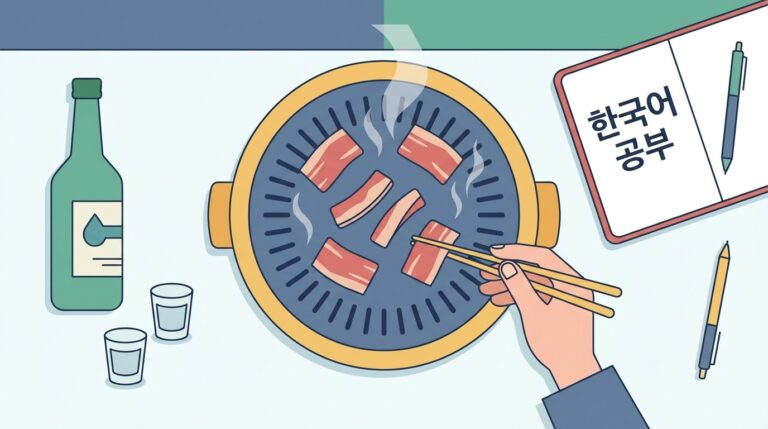
Picture this K-Drama moment: It’s a Friday night. The neon signs of Seoul are glowing, and a group of coworkers is sitting around a round metal table at a Korean BBQ restaurant. The green Soju bottles are clinking, and the pork belly is sizzling. Everyone is chanting ‘Cheers!’ but there’s one person who isn’t drinking. Instead, their chopsticks are moving at the speed of light, devouring all the expensive meat. Suddenly, a friend jokingly hits their shoulder and says, ‘Ya! Stop doing THAT!’
Wait, what is ‘THAT’?
In Korean drinking culture, there is a very specific, slightly funny slang word for this exact behavior. If you only know textbook Korean, you might just say ‘You eat a lot.’ But if you know today’s phrase, you will instantly become an insider at any Korean gathering. This lesson is based on real questions my students ask after their first Korean company dinner (Hoesik). Let’s dive in!
Phase 2: Core Expressions Deep Dive
1. 안주발 세우다
- Pronunciation: [an-ju-bal se-u-da]
- ‘an-ju’ sounds like ‘on-joo’.
- ‘bal’ sounds like the ‘bal’ in ‘ball’, but cut short.
- Meaning:
- Literal: To establish the power of bar snacks.
- Real Nuance: Eating all the good food (snacks/side dishes) while barely drinking any alcohol.
- K-Culture Moment: You are a college student with no money. You order one plate of expensive spicy fried chicken and three bottles of cheap beer. One friend keeps eating the chicken but isn’t drinking. The others will definitely yell, ‘Stop doing anjubal!’
- Editor’s Insight: This phrase is 90% used as a playful joke between friends. It’s not usually a serious fight, but it shows how much Koreans value the balance between alcohol and food.
- Situation Spectrum:
- Casual (Friends): ✅
- Semi-formal (Coworkers): ⚠️ (Only if you are very close!)
- Formal (Boss/Elders): 🚫 (Never say this to your boss!)
- 🤔 Think About It: In many Western countries, people go to a bar just to drink. But in Korea, alcohol always comes with food. Why do you think Korean culture links drinking and eating so tightly together?
2. 안주
- Pronunciation: [an-ju]
- Meaning: Food specifically meant to be eaten with alcohol (bar snacks/side dishes).
- K-Culture Moment: When ordering at a Hof (Korean style pub), the menu is divided into ‘Drinks’ and ‘Anju’. Chimaek (Chicken + Maekju/Beer) is the most famous Anju combination!
Phase 3: Textbook vs. Real Korean
[Scenario 1: Telling a friend they are eating too much food at the bar]
* 📖 Textbook Korean: 안주를 너무 많이 먹네요. (You are eating too many snacks.)
* 🗣️ Real Korean: 야, 안주발 좀 그만 세워! (Hey, stop focusing only on the food!)
* 💡 Why?: Koreans love using short, punchy slang to show intimacy. Adding the suffix ‘-bal’ (which means effect or power) makes the sentence much more playful and expressive.
[Scenario 2: Asking what food to order at a pub]
* 📖 Textbook Korean: 술과 함께 먹을 음식을 주문합시다. (Let’s order food to eat with alcohol.)
* 🗣️ Real Korean: 여기 안주 뭐 맛있어? (What anju is good here?)
* 💡 Why?: In a drinking setting, Koreans rarely use the general word ‘eumsik’ (food). They almost exclusively use the word ‘anju’.
Bottom Note: At the A2 level, you don’t need to use deep street slang. Just knowing and smiling when someone says ‘Anjubal’ is enough to show you understand the culture!
Phase 4: Cultural Context — K-Culture Deep Dive
4-1. Non-Verbal Elements (Nunchi at the Table)
Korean drinking culture is all about Nunchi (the ability to read the room). If you are eating the ‘Anju’, you should also be pouring drinks for others!
* Pro Tip: When pouring a drink for someone older, always use two hands. If someone pours for you, hold your glass with two hands. And remember, never fill your own glass!
4-2. K-Food Connection
Why is ‘Anju’ so important? Historically, drinking alcohol on an empty stomach was considered very bad for your health and somewhat rude. In a traditional Korean pub (Pojangmacha), the food is often the main star. From spicy rice cakes (Tteokbokki) to savory pancakes (Jeon) on rainy days, the alcohol is just an excuse to eat great food together.
Phase 5: Interactive Roleplay Scenario
Setting: Friday 7 PM. A busy BBQ restaurant near Gangnam Station. The room is filled with smoke, chatter, and the smell of roasting garlic. You are sitting with your Korean coworker, Minsu.
Characters:
– YOU: An expat who loves Korean BBQ but isn’t a heavy drinker.
– Minsu (32): Your friendly Korean coworker who loves Soju.
Dialogue:
Minsu: 짠! (Jjan! / Cheers!)
YOU: 짠! (Jjan!)
(🎭 Stage Direction: Minsu takes a shot of Soju. You take a tiny sip and immediately start eating the premium beef on the grill.)
Minsu: 야, 고기 진짜 맛있다. 그치?
(Ya, gogi jinjja masitda. geuchi? / Hey, the meat is really good, right?)
YOU: 네! 최고예요!
(Ne! choegoyeyo! / Yes! It’s the best!)
Minsu: 근데 너 술은 안 마시고 안주발만 세우냐?
(Geunde neo sureun an masigo anjubalman se-u-nya? / But are you just eating the food and not drinking?)
🔀 Your Turn! How will you reply?
– A) 죄송합니다. 술 마실게요. (Sorry. I will drink.)
– B) 아, 고기가 너무 맛있어서 그래요! (Ah, the meat is just so good, that’s why!)
– C) 조용히 하세요. (Be quiet.)✅ Best Choice: B — This is the perfect, polite but playful way to respond! It praises the food and keeps the mood light.
⚠️ Choice A Analysis: Too serious! Minsu is just joking.
🚫 Choice C Analysis: ‘Be quiet’ in Korean is considered very aggressive unless you are extremely close friends.
Phase 6: 10-Second Shadowing Drill
Let’s practice the best response from our roleplay! Focus on the pauses (/) and the emotion.
😊 아, / 고기가 너무 맛있어서 / 그래요!
(Ah, / gogiga neomu masisseoseo / geuraeyo!)
[Emotion: Bright and slightly defensive in a cute way!]
Phase 7: K-Culture Mini Dictionary
| Korean | Romanization | English | Cultural Context |
|---|---|---|---|
| 눈치 | nunchi | Social sense | The ability to read the atmosphere. Crucial at dinners. |
| 회식 | hoesik | Company dinner | A team bonding event, usually involving a lot of Soju and Anju. |
| 짠 | jjan | Cheers | The sound of glasses clinking. |
| 원샷 | wonsyat | Bottoms up | From the English ‘One shot’. Drinking it all at once. |
Phase 8: Traveler Survival Kit
If you visit a Korean pub, these phrases will save you!
🆘 Survival Phrases
– 🇰🇷 ‘이거 매워요?’ (igeo maewoyo?)
– 🗣️ English guide: [ee-geo mae-wo-yo?]
– 📍 Where to use: Ordering Anju. (Korean bar food can be super spicy!)
- 🇰🇷 ‘소주 한 병 주세요.’ (soju han byeong juseyo.)
- 🗣️ English guide: [so-joo han byung joo-se-yo]
- 📍 Where to use: Asking for another bottle.
📌 Editor’s Travel Note
– Call Buttons: Most Korean pubs have a call button on the table (Ding-dong!). Don’t wave your hands; just press the button!
– No Tipping: Remember, there is NO tipping culture in Korea. Just pay the bill at the front counter when you leave.
Phase 9: Critical Thinking Corner — ‘One Step Deeper’
Food & Identity: The Concept of ‘Jeong’ (정)
In Korea, eating out of the same pot or sharing a large plate of food is more than just a meal. It’s a way of building ‘Jeong’ (affection and emotional connection). That’s why drinking alcohol without sharing food feels very cold and distant to Koreans. When a friend teases you about ‘Anjubal’, they are actually acknowledging that you are part of their circle, sharing the communal food.
💬 Your Turn: Does your culture have a specific food that is ONLY eaten when drinking? Tell me in the comments!
Phase 10: FAQ & Avoiding Mistakes
Q: Can I tell my boss ‘Anjubal se-u-ji maseyo’ (Don’t eat all the snacks)?
Absolutely NOT. Even if you add polite endings, this is slang meant for peers. If you say this to a boss, the whole table will freeze!
Q: Is it okay if I really don’t drink alcohol?
Yes! Modern Korean culture respects personal choices. You can ask for soda (Cola/Cider) and still enjoy the ‘Anju’. Just say: ‘저는 술을 못 마셔요’ (I can’t drink alcohol).
❌ Common Mistake: Leaving your friend’s glass empty.
✅ Do This Instead: In Korea, if you see an empty glass, it’s polite to refill it. Keep an eye on your friends’ glasses!
Phase 11: Summary & Action Items
One-Liner Summary: ‘Anjubal’ is a fun slang term for eating all the bar snacks without drinking, and knowing it makes you a true K-Culture insider!
Action Mission 3 Steps:
– 🥉 Bronze: Practice saying ‘Anjubal’ 3 times in front of the mirror with a playful face.
– 🥈 Silver: Leave a comment below telling us what your favorite ‘Anju’ is!
– 🥇 Gold: Use the shadowing sentence (‘아, 고기가 너무 맛있어서 그래요!’) next time you eat K-BBQ with friends.
K-Culture Mission:
The next time you watch a K-Drama with a drinking scene, look closely at the table. Can you spot the ‘Anju’? Try to guess what they are eating!
Phase 12: Quiz — Interactive Challenge
1. Situational Judgment: You are at a pub with close friends. Your friend is just eating all the spicy chicken and not touching their beer. What can you playfully say?
A) 안주발 좀 그만 세워! (Stop doing anjubal!)
B) 안녕히 계세요. (Goodbye.)
C) 조용히 하세요. (Be quiet.)
2. True or False:
If the service is good at a Korean BBQ restaurant, you should leave a 15% tip on the table. (T/F)
(Answers: 1: A, 2: False – No tipping in Korea!)
Frequently Asked Questions (FAQ)
Q: What does "안주발 세우다" mean in Korean and how do you pronounce it?
A: In Korean, "안주발 세우다" is pronounced [an-ju-bal se-u-da] and means: a key conversational Korean expression covered in this lesson.
Q: What does "안주" mean in Korean and how do you pronounce it?
A: In Korean, "안주" is pronounced [an-ju] and means: Food specifically meant to be eaten with alcohol (bar snacks/side dishes).







