

Phase 1: Empathy & The Scene
Hello! This is your Daily Hangul Editor. 😊
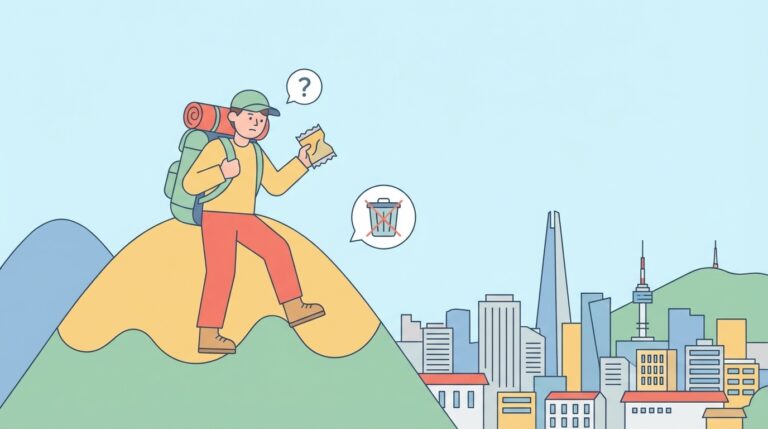
Picture this: It’s a brisk Saturday morning. You step onto a Seoul subway car, and suddenly, a wave of neon-colored windbreakers floods the train. You’ve just encountered the legendary Korean hiking squad! Inspired, you hike up Bukhansan, reach the breathtaking peak, and enjoy a rewarding roll of kimbap (김밥). But as you finish your meal and look around for a place to toss the wrapper…
“Wait, where on earth are the trash cans?” 🗑️👀
If you don’t know the golden rule of Korean mountains—쓰레기 되가져오기 (Packing out your own trash)—you might end up wandering aimlessly or, worse, getting some intense side-eyes from the local ajusshis (아저씨) and ajummas (아줌마).
This guide is based on real panic moments experienced by our learners. Today, we’ll learn how to handle your trash like a seasoned local, avoid the awkward stares, and flex your Korean Nunchi (눈치) at 800 meters above sea level!
Phase 2: Core Expressions Deep Dive
1. 쓰레기는 꼭 챙겨가세요.
- Pronunciation: sseuregineun kkok chaenggyeogaseyo. (sounds like: sseu-re-gi-neun kkok chaeng-gyeo-ga-se-yo — the ‘으’ sounds like the disgusted sound you make when stepping in gum!)
- Meaning: Literal: Make sure to take your trash. / Real Nuance: Please be responsible and pack out your trash.
- K-Culture Moment: You’ll often hear this over the National Park broadcast speakers, or a friendly older hiker might gently tell you this if they see you looking confused with a wrapper in your hand.
- Editor’s Insight: Notice we use 챙기다 (to pack/take care of) instead of just 가져가다 (to take). 챙기다 implies a sense of responsibility and mindfulness. It feels much warmer and more personal than a robotic command.
- Situation Spectrum:
- Casual with friends: ✅ (쓰레기 꼭 챙겨가!)
- Semi-formal with coworkers: ✅
- Formal with elders/strangers: ✅
- 🤔 Think About It: Why does Korean use 챙기다 (to care for/pack) for trash? What does this say about how Koreans view personal responsibility in public spaces?
2. 여기 버리면 안 돼요.
- Pronunciation: yeogi beorimyeon an dwaeyo. (sounds like: yeo-gi beo-ri-myeon ahn dwae-yo)
- Meaning: Literal: If you throw it here, it doesn’t work. / Real Nuance: You shouldn’t/can’t throw that away here.
- K-Culture Moment: Imagine you are about to leave an empty water bottle near a resting bench. Your Korean friend grabs your arm in a panic and whispers this phrase!
- Editor’s Insight: Koreans rarely say a direct “Don’t do it” (하지 마세요) to acquaintances or strangers unless they are angry. Instead, the grammar -(으)면 안 되다 (If you do X, it is not okay) softens the blow while still setting a clear rule.
- Situation Spectrum:
- Casual with friends: ✅ (여기 버리면 안 돼!)
- Semi-formal with coworkers: ✅
- Formal with elders/strangers: ⚠️ (Better to say: 쓰레기통이 없어서 가져가셔야 해요 – Because there’s no bin, you have to take it.)
- 🤔 Think About It: Does your native language rely on direct commands (like “Do not litter”) or conditional warnings (like “If you litter, it is bad”) for public rules?
3. 제 가방에 넣을게요.
- Pronunciation: je gabange noeulgeyo. (sounds like: jeh ga-bang-eh neo-eul-ge-yo)
- Meaning: Literal & Real: I will put it in my bag.
- K-Culture Moment: You’re sharing snacks with your hiking group. You finish the cookies, roll up the wrapper, and say this confidently. Instant respect from everyone!
- Editor’s Insight: The -(으)ㄹ게요 ending is a B1 grammar gem. It doesn’t just mean “I will”—it implies “I will do this for the sake of our situation/relationship.” It’s an active promise to the listener.
- Situation Spectrum:
- Casual with friends: ✅ (내 가방에 넣을게.)
- Semi-formal with coworkers: ✅
- Formal with elders/strangers: ✅
Phase 3: Textbook vs. Real Korean
[Situation 1: Reminding a friend not to litter]
* 📖 Textbook Korean: 쓰레기를 바닥에 버리지 마십시오. (Do not throw trash on the floor – highly formal/stiff)
* 🗣️ Real Korean: 쓰레기 다 챙겼지? (You packed all your trash, right?)
* 💡 Why the difference?: Real conversations rely on confirming the other person’s action rather than giving strict commands. Using “챙기다” implies you trust them to be responsible.
[Situation 2: Realizing there are no trash bins]
* 📖 Textbook Korean: 이곳에는 쓰레기통이 없습니다. (There are no trash bins in this place.)
* 🗣️ Real Korean: 헐, 여기 쓰레기통 없나 봐. (Heol, guess there are no bins here.)
* 💡 Why the difference?: Adding “헐” (Heol – Oh my god/Whoa) expresses genuine surprise, which perfectly matches the feeling of a foreigner expecting a bin where there is none!
Bottom Note: For B1 (Intermediate) learners, transitioning from direct textbook commands to softer, suggestive grammar like -(으)면 안 돼요 and -나 봐요 is the key to sounding like a natural Korean speaker.
Phase 4: Cultural Context — K-Culture Deep Dive
4-1. The Non-verbal “Nunchi” of Trash 🚮
Language isn’t just spoken! In Korea, Nunchi (눈치) is everything. When you finish eating on the mountain, don’t just sit there waiting for someone else to clean up.
* Action Tip: Start gathering your own wrappers, visibly fold them small, and open your backpack. This non-verbal cue says, “I respect the mountain and our group!”
* Eye Contact: When someone offers to take your trash into their larger bag, make eye contact, smile, and say “아, 감사합니다!” (Ah, thank you!). Don’t just toss it to them without looking.
4-2. K-Food Connection: The Mountain Feast 🥒🍅
Why does trash even happen on a mountain? Because in Korea, hiking is basically an excuse to eat!
Koreans love sharing food at the summit. You will see people passing around cherry tomatoes, sliced cucumbers, boiled eggs, and of course, cup ramyeon.
* The Golden Rule of Ramyeon: If you eat cup noodles at the peak, you must drink all the soup. Pouring leftover spicy broth into the soil is a huge offense to the environment and the hiking community. Drink up, and pack the empty, dry cup in your bag!
Phase 5: Interactive Roleplay Scenario
Scenario A: The Bukhansan Kimbap Incident
- Setting: Saturday, 12:30 PM. The rocky peak of Bukhansan. The wind is cool, and the view of Seoul is stunning. You just finished a delicious tuna kimbap.
- Characters:
- YOU: An intermediate Korean learner who loves nature.
- Min-su (32): Your Korean coworker, a hiking enthusiast wearing head-to-toe North Face.
Min-su: 와, 정상에서 먹는 김밥이 최고죠? 🍙
(Wa, jeongsangeseo meongneun gimbabi choegojyo?)
[Translation: Wow, kimbap eaten at the peak is the best, right?]
(🎭 Stage Direction: Min-su wipes his mouth and starts folding his aluminum foil)
YOU: 네! 진짜 맛있었어요. 배불러요.
(Ne! jinjja masisseosseoyo. Baebulleoyo.)
[Translation: Yes! It was really delicious. I’m full.]
Min-su: 다행이네요. 자, 이제 슬슬 내려갈까요?
(Dahaengineyo. Ja, ije seulseul naeryeogalkkayo?)
[Translation: That’s a relief. Well, shall we slowly head down now?]
YOU: 좋아요! 근데 민수 씨, 쓰레기통이 어디 있어요?
(Joayo! Geunde Minsu ssi, sseuregitongi eodi isseoyo?)
[Translation: Sounds good! But Min-su, where is the trash can?]
Min-su: 아! 한국 산에는 쓰레기통이 없어요. ‘쓰레기 되가져오기’가 규칙이거든요.
(A! hanguk saneneun sseuregitongi eopseoyo. ‘sseuregi doegajyeoogi’ga gyuchigigeodeunyo.)
[Translation: Ah! There are no trash cans on Korean mountains. ‘Bringing trash back’ is the rule.]
(🎭 Stage Direction: Min-su pulls out a small plastic bag from his pocket)
🔀 Your Turn! How should you respond?
– A) 아, 몰랐어요. 그냥 바위 뒤에 둘게요. (Ah, I didn’t know. I’ll just leave it behind the rock.)
– B) 정말요? 그럼 제 가방에 다시 넣을게요. (Really? I’ll put it back in my bag then.)
– C) 쓰레기통을 왜 안 만들어요? 이상해요. (Why don’t they make trash cans? It’s weird.)✅ Best Choice: B — You show immediate understanding and take responsibility. This makes you look incredibly polite and culturally aware!
⚠️ Choice A & C Analysis: A is illegal and will shock Min-su. C might be a valid question in your head, but complaining to Min-su kills the good vibe.
Min-su: (If you chose B) 오~ 센스 있네요! 제 쓰레기봉투에 같이 버려도 돼요. 이리 주세요.
(O~ senseu inneyo! Je sseuregibongtue gachi beoryeodo dwaeyo. Iri juseyo.)
[Translation: Oh~ you have great sense! You can throw it in my trash bag. Hand it here.]
YOU: 아, 정말요? 감사합니다!
(A, jeongmallyo? Gamsahamnida!)
[Translation: Ah, really? Thank you!]
Scenario B: The Post-Hike Reward (K-Food Bonus!)
(At the bottom of the mountain, inside a bustling Makgeolli tavern)
– Min-su: 등산 끝나고는 무조건 파전이죠! 사장님, 여기 해물파전 하나 주세요!
(Deungsan kkeunnagoneun mujogeon pajeonijyo! Sajangnim, yeogi haemulpajeon hana juseyo!)
[After hiking, pajeon is a must! Boss, one seafood green onion pancake here!]
– YOU: 막걸리도 마시면 안 돼요? 저 막걸리 좋아해요!
(Makgeollido masimyeon an dwaeyo? Jeo makgeolli joahaeyo!)
[Can’t we drink Makgeolli too? I like Makgeolli!]
– Min-su: (Laughs) 당연하죠! 오늘 쓰레기 잘 챙겨왔으니까 제가 쏩니다!
(Dangyeonhajyo! Oneul sseuregi jal chaenggyeowasseunikka jaega ssomnida!)
[Of course! Since you packed your trash so well today, it’s my treat!]
Phase 6: 10-Second Shadowing Drill
Practice speaking like a local! Pay attention to the pauses (/) and the emotion tags.
- 😊 Lightbulb moment: 아! / 한국 산에는 / 쓰레기통이 / 없구나!
(Ah! / hanguk saneneun / sseuregitongi / eopguna!) -
🥺 Polite offer: 혹시 / 쓰레기 담을 봉투 / 있어요?
(Hoksi / sseuregi dameul bongtu / isseoyo?) -
😤 Firm but polite: 쓰레기는 / 가방에 / 꼭 / 챙겨가세요!
(Sseuregineun / gabange / kkok / chaenggyeogaseyo!)
Phase 7: K-Culture Mini Dictionary
| Korean | Romanization | English | Cultural Context |
|---|---|---|---|
| 등산 | deungsan | Hiking | Not just a sport, but a major social activity in Korea, especially for those over 40. |
| 쓰레기 되가져오기 | sseuregi doegajyeoogi | Packing out trash | The national campaign to keep nature clean by bringing all your waste back home. |
| 종량제 봉투 | jongnyangje bongtu | Standardized garbage bag | Korea’s mandatory paid trash bags used at home. You bring your mountain trash home to put in here! |
| 막걸리 | makgeolli | Milky rice wine | The traditional reward drink after a long hike, usually paired with savory pancakes (Pajeon). |
| 눈치 | nunchi | Social awareness | Reading the room. e.g., Noticing everyone is packing their trash and doing the same. |
Phase 8: Traveler Survival Kit 🎒
Are you planning to hike Namsan, Bukhansan, or Seoraksan during your trip? Keep these phrases handy!
🆘 Survival Phrases for Hikers
1. 🇰🇷 “쓰레기봉투 하나 주세요.” (sseuregibongtu hana juseyo.)
– 🗣️ Meaning: “One trash bag, please.”
– 📍 Where to use: At a convenience store before starting the hike.
2. 🇰🇷 “화장실이 어디예요?” (hwajangsiri eodiyeyo?)
– 🗣️ Meaning: “Where is the restroom?”
– 📍 Where to use: Restrooms are usually only at the entrance or specific shelters. Ask before you climb!
3. 🇰🇷 “정상까지 얼마나 걸려요?” (jeongsangkkaji eolmana geollyeoyo?)
– 🗣️ Meaning: “How long does it take to the peak?”
– 📍 Where to use: Asking hikers coming down the trail.📌 Editor’s Travel Note
– Navigation: Google Maps doesn’t work well for hiking trails in Korea. Download Naver Map or KakaoMap; they show detailed mountain trail routes!
– Restrooms ≠ Trash Cans: Sometimes there are restrooms at mountain shelters. DO NOT throw your food wrappers in the restroom bins. Those are strictly for toilet paper/hygiene products.
Phase 9: Critical Thinking — “Think Deeper”
Food, Community, and Public Identity 🍲
In Korea, eating together is the ultimate form of bonding. Even halfway up a treacherous mountain, Koreans will set out a small mat and share a feast of kimbap, fruit, and ramyeon with friends (and sometimes strangers!). This reflects Korea’s deep-rooted 정 (Jeong – collective affection) culture.
However, this collective mindset extends to public spaces too. The “Pack out your trash” rule works so well in Korea because leaving trash behind isn’t just seen as hurting nature—it’s viewed as disrespecting the collective community who shares the mountain. Taking your trash home is an act of communal respect.
💬 Your Turn: Does your culture have a strong tradition of sharing food outdoors? How are public spaces maintained in your country? Let us know in the comments!
Phase 10: FAQ & Avoiding Mistakes
Q: “Can I just leave my apple core or banana peel for the animals? It’s biodegradable!”
A: NO! This is a huge misconception. Human food alters the wildlife ecosystem and takes months to decompose. Pack out everything, even fruit peels!
Q: “Is it okay to hand my trash to a park ranger if I see one?”
A: NO. Rangers are there to protect the park, not to act as walking garbage cans. Keep it in your bag.
❌ Common Mistake #1: Leaving a neat little pile of trash next to a bench, thinking “someone will clean it up.” There are no sweepers on the mountain peaks. Your trash will blow away into the forest.
✅ Do This Instead: Always bring a small ziplock bag or plastic bag in your backpack specifically for waste.
Phase 11: Summary & Action Items
- One-Liner Summary: Korean mountains don’t have trash cans, so always remember: 쓰레기는 제 가방에 넣을게요! (I’ll put the trash in my bag!)
🔥 Action Missions:
– 🥉 Bronze (Solo): Stand in front of a mirror with a backpack and say, “쓰레기는 꼭 챙겨가세요!” three times.
– 🥈 Silver (Online): Leave a comment in Korean on a Korean hiking YouTube Vlog (e.g., “풍경이 예뻐요! 저도 쓰레기 잘 챙겨서 등산하고 싶어요.”).
– 🥇 Gold (Real Life): Next time you are in Korea (or hiking anywhere!), pack out your trash and say “다 챙겼다!” (Got it all!) to yourself like a proud local.
🎬 K-Culture Mission: Search for “Korean mountain Kimbap” (등산 김밥) on Instagram or TikTok and see how creatively people pack their hiking meals!
Phase 12: Interactive Challenge Quiz
1. You just finished a delicious Cup Ramyeon at the peak of Hallasan. You have leftover soup. What should you do?
– A) Pour it into the dirt; it’s good for the plants.
– B) Drink it all, or carry the cup down carefully without spilling.
– C) Give the soup to a local bird.
(Answer: B. Pouring salty soup destroys the soil!)
2. Fill in the Blank:
“여기 ( ______ ) 안 돼요.”
(You shouldn’t throw it away here.)
– A) 버리면 (beorimyeon)
– B) 먹으면 (meogeumyeon)
– C) 사면 (samyeon)
(Answer: A. 버리다 means to throw away.)
3. True or False – K-Culture Edition:
“Koreans usually drink Makgeolli (rice wine) before they start hiking to get energy.”
(Answer: False! Drinking before hiking is dangerous. Makgeolli and Pajeon are the ultimate rewards AFTER safely coming down the mountain!)
Great job today! You are now officially ready to conquer Korean mountains without leaving a trace. See you in the next Daily Hangul lesson! 🏔️🥾
Frequently Asked Questions (FAQ)
Q: What does "쓰레기는 꼭 챙겨가세요." mean in Korean and how do you pronounce it?
A: In Korean, "쓰레기는 꼭 챙겨가세요." is pronounced [sseuregineun kkok chaenggyeogaseyo. (sounds like: sseu-re-gi-neun kkok chaeng-gyeo-ga-se-yo — the '으' sounds like the disgusted sound you make when stepping in gum!] and means: Literal: Make sure to take your trash. / Real Nuance: Please be responsible and pack out your trash.
Q: What does "여기 버리면 안 돼요." mean in Korean and how do you pronounce it?
A: In Korean, "여기 버리면 안 돼요." is pronounced [yeogi beorimyeon an dwaeyo. (sounds like: yeo-gi beo-ri-myeon ahn dwae-yo] and means: Literal: If you throw it here, it doesn't work. / Real Nuance: You shouldn't/can't throw that away here.
Q: What does "제 가방에 넣을게요." mean in Korean and how do you pronounce it?
A: In Korean, "제 가방에 넣을게요." is pronounced [je gabange noeulgeyo. (sounds like: jeh ga-bang-eh neo-eul-ge-yo] and means: Literal & Real: I will put it in my bag.







