

Phase 1: Empathy & K-Culture Cold Open
Hello! I am the Lead Editor of Daily Hangul.
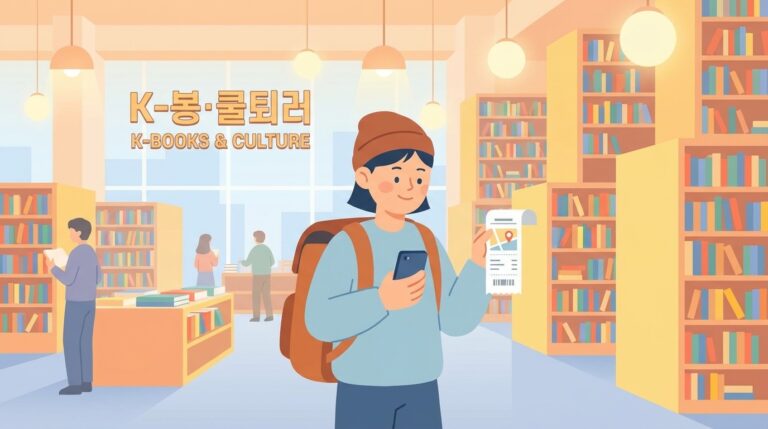
Imagine this: You are standing inside the massive Kyobo Bookstore in Gwanghwamun, Seoul. It feels less like a store and more like a grand library from a K-Drama like Romance is a Bonus Book. You want to buy that one Korean poetry book that RM from BTS recommended on his social media. But there’s a problem—the signs are everywhere, the search computers have Korean keyboards, and the sheer number of bookshelves is overwhelming.
You see a staff member organizing bestsellers. You want to ask for help, but your mind goes blank. Do you just point at your phone? Do you say “Book… where?”
Don’t worry! This is a very common struggle for Korean learners. Knowing exactly how to ask for a book not only saves you 30 minutes of wandering around but also makes you feel like a true insider in Korea. This guide is based on real questions from my students who successfully navigated Korean bookstores to buy their favorite K-Pop idol’s photo essays and K-Drama script books!
Phase 2: Core Expressions Deep Dive
1. [책 이름] 있어요?
- Pronunciation: [chaek ireum] isseoyo? (‘isseoyo’ sounds like “ee-so-yo”)
- Meaning: Do you have [Book Name]? (Literal: Does [Book Name] exist?)
- K-Culture Moment: You will hear this everywhere in Korea—not just in bookstores! In a K-Drama, when the female lead runs into a convenience store looking for hangover pills for her boss, she breathlessly asks the cashier, “숙취해소제 있어요?” (Do you have hangover medicine?).
- Editor’s Insight: This is the ultimate survival phrase. You don’t need complicated grammar. Just say the noun + 있어요?. It’s polite, natural, and instantly understood.
- Situation Spectrum:
- Casual with friends: ✅ (Drop the ‘요’ -> 있어?)
- Store staff (Semi-formal): ✅
- Formal/Boss: ⚠️ (Better to use “있으십니까?”)
- 🤔 Think About It: Why do Koreans use “exist” (있다) instead of “have” (가지다) when asking a store if they sell something? How does this reflect the Korean focus on the situation/space rather than personal ownership?
2. 이거 어디 있어요?
- Pronunciation: igeo eodi isseoyo? (‘eo-di’ sounds like the ‘uh’ in ‘uh-oh’ + ‘dee’)
- Meaning: Where is this?
- K-Culture Moment: Picture a fan at a K-Pop pop-up store. They have a picture of an exclusive photocard on their phone. They show it to the staff and ask, “이거 어디 있어요?”
- Editor’s Insight: When you don’t know how to pronounce the Korean book title, your smartphone is your best friend. Show the picture and say “이거” (this). It’s incredibly practical.
- Situation Spectrum:
- Casual with friends: ✅
- Store staff (Semi-formal): ✅
- Formal/Boss: 🚫 (Too blunt)
- 🤔 Think About It: “이거” (this) implies physical closeness. In your native language, how much does physical distance dictate the words you choose?
3. 찾아주실 수 있나요?
- Pronunciation: chajajusil su innayo? (‘cha-ja’ sounds like ‘cha-ja’, ‘ju’ like juice without ‘ice’)
- Meaning: Could you please find this for me? (Literal: Can you give me the favor of finding it?)
- K-Culture Moment: This is a very soft, polite way to ask for help. It’s the kind of phrase a polite character in a K-Drama would use when talking to an older bookstore owner in a quiet neighborhood.
- Editor’s Insight: The magical part here is “주다” (to give). In Korean, when you ask someone to do something for you, you format it as “giving the action as a favor.” It shows great respect for the other person’s effort.
- Situation Spectrum:
- Casual with friends: 🚫 (Too formal)
- Store staff (Semi-formal): ✅ (They will love your politeness!)
- Formal/Boss: ✅
- 🤔 Think About It: Why does the Korean language have so many ways to express “doing a favor”? What does this say about the culture of mutual help and politeness?
Phase 3: Textbook vs. Real Korean
[Situation 1: Trying to get the staff’s attention]
* 📖 Textbook Korean: 실례합니다. (Excuse me.)
* 🗣️ Real Korean: 저기요! (Excuse me / Over there!)
* 💡 Why the difference?: While “실례합니다” is correct, “저기요” is the absolute standard for calling staff in Korea, whether in a bookstore, restaurant, or cafe. It literally means “Hey, over there!”
[Situation 2: Asking for a specific book location]
* 📖 Textbook Korean: 이 책은 어느 서가에 위치해 있습니까? (On which bookshelf is this book located?)
* 🗣️ Real Korean: (Showing phone) 이거 어디 있어요? (Where is this?)
* 💡 Why the difference?: Efficiency! Koreans love “Palli-palli” (빨리빨리 – hurry). Pointing at a screen and asking “where is it” is the fastest way to communicate.
Bottom Note: At the A2 level, focus on being understood quickly rather than using overly complex grammar. Smiling and showing your screen with “이거 어디 있어요?” is a flawless strategy!
Phase 4: Cultural Context — K-Culture Deep Dive
4-1. Non-verbal Elements: The “Two-Hand” Rule and Nunchi
When showing your phone to the bookstore staff, use both hands to hold out your phone, or lightly touch your right elbow with your left hand while extending your right arm. This is a fundamental non-verbal sign of respect in Korea.
Also, use a little Nunchi (눈치 – reading the room). If the staff member is carrying a heavy stack of books or dealing with a complaining customer, wait a moment before saying “저기요!”
4-2. K-Travel Connection: The “Print Receipt” Culture
If you visit large bookstores like Kyobo (교보문고) or YP Books (영풍문고), you will see rows of computers. These are the 도서 검색대 (Book Search Kiosks). You can search for the book (even in English sometimes!) and press the “Print” (출력) button. A tiny receipt will print out showing a map of the exact bookshelf (e.g., [B-14-2]).
However, if the computer keyboard is only in Korean and you can’t type it, showing the picture to the staff is your best bet!
Phase 5: Real-life Roleplay Scenario
Setting: Saturday afternoon at Kyobo Bookstore in Gangnam. The place is packed with people. You are looking for a specific Korean learning workbook, but the language section is huge. You spot a staff member in a vest organizing shelves.
Characters:
* YOU: A foreign student eager to improve their Korean.
* Staff (Jimin): 20s, a part-time bookstore employee. Friendly but very busy.
Dialogue:
YOU: 저기요!
(jeogiyo!)
[Excuse me!]
(🎭 Stage Direction: You wave slightly to get her attention)
Staff: 네, 손님. 찾으시는 책 있으세요?
(ne, sonnim. chajeusineun chaek isseuseyo?)
[Yes, customer. Is there a book you are looking for?]
YOU: 네, 혹시 이 책 있어요?
(ne, hoksi i chaek isseoyo?)
[Yes, by any chance, do you have this book?]
(🎭 Stage Direction: You hand your phone to her using both hands)
Staff: 아, 잠시만요. 검색해 볼게요.
(a, jamsimanyo. geomsaekhae bolgeyo.)
[Ah, just a moment. I’ll search for it.]
(🎭 Stage Direction: She types rapidly on her tablet)
Staff: 이 책은 지금 제고가 없네요. 다 팔렸어요.
(i chaegeun jigeum jaegoga eomneyo. da pallyeosseoyo.)
[This book is out of stock right now. It’s all sold out.]
🔀 Your Turn! How should you respond?
* A) “당신 참 나빠요!” (You are so bad!)
* B) “아, 진짜요? 아쉽네요. 감사합니다.” (Ah, really? That’s a shame. Thank you.)
* C) “책 내놔!” (Hand over the book!)✅ Best Choice: B — Acknowledging the situation politely and thanking them is the best approach.
⚠️ Choice Analysis: A is grammatically weird and rude. C is what a villain in a historical K-Drama says!
YOU: 아, 진짜요? 아쉽네요. 감사합니다.
(a, jinjjayo? aswimneyo. gamsahamnida.)
[Ah, really? That’s a shame. Thank you.]
Staff: 대신에 비슷한 다른 책은 저기 D구역에 있어요!
(daesine biseutan dareun chaegeun jeogi D-guyeoge isseoyo!)
[Instead, similar books are over there in Section D!]
YOU: 네, 한번 볼게요. 수고하세요!
(ne, hanbeon bolgeyo. sugohaseyo!)
[Okay, I’ll take a look. Keep up the good work!]
Bonus Roleplay: The K-Pop Section
(At the Hottracks section inside the bookstore)
YOU: 저기요, 이거 새 앨범 나왔어요?
(jeogiyo, igeo sae aelbeom nawasseoyo?)
[Excuse me, did this new album come out?]
Staff: 네! 포스터랑 포토카드 포함되어 있어요.
(ne! poseuteorang potokadeu pohamdoeeo isseoyo.)
[Yes! It includes a poster and photocard.]
YOU: 대박! 이거 하나 주세요.
(daebak! igeo hana juseyo.)
[Awesome! Please give me one.]
Phase 6: 10-Second Shadowing Drill
Practice this sentence to sound incredibly natural when asking for help.
😊 저기요, / 이거 / 어디 있어요?
(jeogiyo, / igeo / eodi isseoyo?)
Intonation Guide:
* 저기요 -> Call out brightly.
* / -> Pause slightly while showing your phone screen.
* 어디 있어요? -> Raise the pitch at the end like a question.
Phase 7: K-Culture Mini Dictionary
| Korean | Romanization | English | Context |
|---|---|---|---|
| 눈치 | nunchi | Social sense | The ability to read the room. Crucial when deciding exactly when to approach busy staff. |
| 베스트셀러 | beseuteuselleo | Bestseller | Found right at the entrance of Korean bookstores. A great place to see what’s trending in Korea. |
| 재고 | jaego | Stock/Inventory | What you hope the bookstore has! “재고 있어요?” (Do you have it in stock?) |
| 검색대 | geomsaekdae | Search Kiosk | The computers in the bookstore where you can search for book locations. |
| 핫트랙스 | hatteuraekseu | Hottracks | The music/stationery section usually found inside Kyobo Bookstores. A heaven for K-Pop fans! |
Phase 8: Traveler Survival Kit
Here are the top survival phrases when you are book-hunting in Seoul:
🆘 Survival Phrase #1
* 🇰🇷 “이거 품절이에요?” (igeo pumjeorieyo?)
* 🗣️ English Guide: Is this sold out?
* 📍 Where to use: Bookstores, clothing stores, K-Pop merchandise lines.🆘 Survival Phrase #2
* 🇰🇷 “결제할게요.” (gyeoljehalgeyo.)
* 🗣️ English Guide: I would like to pay.
* 📍 Where to use: At the cashier.🆘 Survival Phrase #3
* 🇰🇷 “영수증 주세요.” (yeongsujeung juseyo.)
* 🗣️ English Guide: Please give me the receipt.
* 📍 Where to use: Everywhere. Often, cashiers will ask “영수증 드릴까요?” (Shall I give you the receipt?). Reply with “네” (Yes) or “아니요 괜찮아요” (No, it’s fine).📌 Editor’s Travel Note
* The Map Receipt: If you use the book search kiosk (검색대), press the button that says “위치 프린트” (Print Location). It prints a tiny map so you don’t even need to ask the staff!
* Cash vs. Card: Korean bookstores are predominantly card-based. Apple Pay and foreign credit cards work well at major chains like Kyobo and YP Books.
Phase 9: Critical Thinking Corner — “One Step Deeper”
Space and Identity: Why do Koreans hang out in bookstores?
🧠 Think Deeper:
If you visit a large bookstore in Korea on a weekend, you will see people reading on large wooden tables, couples having dates, and families spending the whole afternoon there. Bookstores in Korea have evolved into “complex cultural spaces” (복합문화공간). This reflects modern Korean society’s desire for indoor spaces that offer comfort, air conditioning, aesthetic pleasure, and intellectual stimulation, especially given the crowded, fast-paced urban environment outside. It’s not just a place to buy goods; it’s a place to be.💬 Your Turn: Do people in your culture hang out in bookstores just to relax? Or is it strictly a “buy and leave” environment? Share your thoughts in the comments!
Phase 10: FAQ & Avoiding Mistakes
Q: Can I just say the book’s name with a question mark? Like “해리포터?”
It works, and the staff will understand you, but it sounds a bit impolite and abrupt. Always add “있어요?” at the end!
Q: Should I use “너” (you) when talking to the staff?
Absolutely not! Never use “너” with strangers or staff. It is very rude. Just skip the word “you” entirely. The Korean language naturally drops the subject when it’s obvious.
❌ Common Mistake #1: Calling the female staff member “아줌마” (Ajumma – middle-aged woman) or male staff “아저씨” (Ajeossi – middle-aged man).
✅ Do This Instead: Always use “저기요!” (Excuse me!). It’s safe, polite, and doesn’t assume anything about their age or status.
Phase 11: Summary & Action Items
- One-Liner Summary: To find a book effortlessly, grab your phone, show the picture, and say, “저기요, 이거 어디 있어요?”
Action Mission 3 Steps:
* 🥉 Bronze (Solo): Stand in front of a mirror, pretend you are holding a phone, and say “저기요, 이거 어디 있어요?” three times.
* 🥈 Silver (Online): Go to a Korean online bookstore (like Kyobo online) and try to find the Korean title of your favorite book. Write it down!
* 🥇 Gold (Real-world): If you are in Korea, go to a bookstore today and ask a staff member where a specific section is using today’s phrase!
K-Culture Mission:
Next time you watch a K-Drama, look closely at the background when characters are walking down the street. Try to spot the word 서점 (Bookstore) or 문고 (Bookstore chain) on the signs!
What book are you dying to buy in Korea? Let us know in the comments below! 👇
Phase 12: Quiz — Interactive Challenge
1. Situational Judgment: You are at a bookstore looking for a Korean cookbook. You see a busy staff member. How should you get their attention?
* A) 너, 이거 어디 있어?
* B) 아저씨! 책 주세요!
* C) 저기요, 이거 있어요?
2. Fill in the Blank:
Staff: “찾으시는 책 있으세요?” (Are you looking for a book?)
You: “네, 해리포터 책 _________?” (Yes, do you have the Harry Potter book?)
* A) 없어요
* B) 있어요
* C) 가세요
3. True or False – K-Culture Edition:
If you buy a book in a Korean bookstore, it is mandatory to leave a tip for the cashier.
* True or False?
(Answers: 1. C | 2. B | 3. False – There is no tipping culture in Korea!)
Frequently Asked Questions (FAQ)
Q: What does "[책 이름] 있어요?" mean in Korean and how do you pronounce it?
A: In Korean, "[책 이름] 있어요?" is pronounced [chaek ireum] and means: Do you have [Book Name]? (Literal: Does [Book Name] exist?)
Q: What does "이거 어디 있어요?" mean in Korean and how do you pronounce it?
A: In Korean, "이거 어디 있어요?" is pronounced [igeo eodi isseoyo? ('eo-di' sounds like the 'uh' in 'uh-oh' + 'dee'] and means: Where is this?
Q: What does "찾아주실 수 있나요?" mean in Korean and how do you pronounce it?
A: In Korean, "찾아주실 수 있나요?" is pronounced [chajajusil su innayo? ('cha-ja' sounds like 'cha-ja', 'ju' like juice without 'ice'] and means: Could you please find this for me? (Literal: Can you give me the favor of finding it?)







