

Phase 1: Empathy (Immersive Open)
Hello! I’m your Daily Hangul editor.
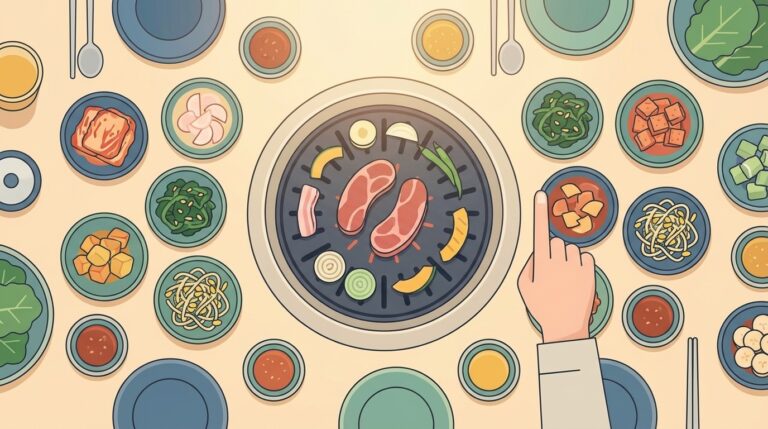
Picture this: You are sitting inside a bustling K-BBQ restaurant in Seoul. The pork belly is sizzling on the grill, K-Pop hits are blasting through the speakers, and you’ve just made the perfect lettuce wrap. But wait… you reach out and realize the tiny plate of spicy, garlicky kimchi is completely empty.
In a K-Drama, you’d see the main character confidently raise their hand, make eye contact with the friendly owner, and yell, “Imo! (Auntie!)” Next thing you know, a mountain of fresh kimchi appears. But when you try to do it, your heart beats faster. Do you have to pay for this? Is it rude to ask for more? What if you don’t know the name of the dish?
Don’t worry! Getting endless free side dishes (banchan) is one of the best parts of Korean food culture. If you don’t know how to ask, you’re missing out on a huge slice of the authentic K-Food experience. Today, I’ll teach you exactly how to ask for refills like a local, so you can eat to your heart’s content without breaking a sweat.
(Note: This guide is built directly from the real-life struggles of my intermediate students who used to sit in silence with empty kimchi bowls!)
Phase 2: Core Expressions Deep Dive
Here are the absolute lifesaver phrases you need to know.
1. 사장님, 반찬 좀 더 주시겠어요?
- Pronunciation: Sajangnim, banchan jom deo jusigesseoyo? [Sah-jahng-neem, bahn-chahn johm duh joo-she-gess-uh-yo?]
- Meaning: (Literal) Boss, would you give more side dishes? / (Real nuance) Excuse me, could we get some more side dishes, please?
- K-Culture Moment: You’ll hear this polite, standard phrase everywhere, from a quiet traditional dining room to a busy franchise restaurant. It’s the safest and most polite way to get a waiter’s attention.
- Editor’s Insight: The word Sajangnim means ‘CEO’ or ‘Boss’, but in Korea, we use it to respectfully address restaurant owners or staff. Notice we use jom (a little)—even if you want a massive plate, saying “a little” makes the request sound softer and more polite!
- Situation Spectrum:
- Casual / Local diners: ✅
- Semi-formal / Nice restaurants: ✅
- Very formal dining: ✅
- 🤔 Think About It: Why do Koreans call restaurant staff “Boss” even if they are just part-time workers? How does this reflect the Korean value of giving respect to strangers?
2. 여기 [음식 이름] 리필해 주세요!
- Pronunciation: Yeogi [Food name] ri-pil-hae juseyo! [Yuh-gee … ree-peel-hae joo-seh-yo!]
- Meaning: (Literal) Here, please refill [Food name]! / (Real nuance) Could we get a refill of [Food name] over here!
- K-Culture Moment: Picture a lively university district like Hongdae. A group of friends eating spicy Tteokbokki needs more pickled radishes to cool their tongues. One of them cheerfully waves at the staff and says this.
- Editor’s Insight: Ripil (Refill) is a widely loved Konglish word. It feels modern, casual, and energetic. When using this, point to your table and say “Yeogi” (here) so the staff knows where to bring the food!
- Situation Spectrum:
- Casual / Friends / Pubs: ✅
- Semi-formal / Coworkers: ⚠️ (Okay, but slightly casual)
- Very formal dining: 🚫 (Stick to expression #1)
- 🤔 Think About It: “Refill” is an English word, but it’s used natively in Korea. Does your language borrow English words for specific dining concepts?
3. 이것 좀 더 주실 수 있나요?
- Pronunciation: Igeot jom deo jusil su innayo? [Ee-guht johm duh joo-sheel soo een-nah-yo?]
- Meaning: (Literal) Can you give more of this? / (Real nuance) Could I get a little more of this one, please?
- K-Culture Moment: You’re eating a traditional meal with 12 different side dishes. You taste something magical. Is it lotus root? Pickled garlic stems? You have no idea, but you want more! You politely hold up the small plate and ask this.
- Editor’s Insight: This is the ultimate “cheat code” for foreigners. You don’t need to memorize the dictionary of Korean side dishes. Just point at the empty dish or hand it to the server and say this.
- Situation Spectrum:
- Casual / Friends: ✅
- Semi-formal: ✅
- Formal: ✅
Phase 3: Textbook vs. Real Korean
[When asking for more Kimchi]
* 📖 Textbook Korean: 저는 김치를 더 원합니다. (I want more Kimchi.)
* 🗣️ Real Korean: 사장님~ 여기 김치 좀 더 주세요! (Boss~ a little more Kimchi here please!)
* 💡 Why is it different?: Direct translation of “I want” sounds very demanding in Korean. We prefer asking the other person to “give” (주세요) as a favor, which builds a softer, communal vibe.
[When asking if side dishes are free]
* 📖 Textbook Korean: 이 반찬은 무료입니까? (Is this side dish free of charge?)
* 🗣️ Real Korean: 이거 리필 되나요? (Can this be refilled?)
* 💡 Why is it different?: Asking “Is it free?” can sometimes sound a bit stingy or awkward. Asking “Can it be refilled?” is the natural, culturally accepted way to check if an extra portion is included.
Bottom Note: At a B1 level, you want to sound polite but natural. Stop saying “저는 (I)” in restaurants. Dropping the subject makes you sound instantly fluent!
Phase 4: Cultural Context — K-Culture Deep Dive
4-1. Non-verbal Nunchi (눈치)
Language isn’t just words; it’s timing! When asking for a refill, don’t scream across the room while the waiter is carrying a massive pot of boiling soup. Wait for them to walk by, make slight eye contact, raise your hand about halfway up, and speak with a friendly tone.
4-2. K-Food Connection: The Magic of Free Banchan
If you go to a restaurant in Europe or the US, extra bread or olives often cost money. But in Korea? Banchan (side dishes) are a symbol of Jeong (정 – warmth, affection, generosity).
Restaurants pride themselves on making you feel full and well-fed, much like a Korean mother would. However, this relies on a beautiful honor system. Pro Tip: Only ask for what you can finish! Leaving a mountain of refilled side dishes is considered rude and wasteful. Also, remember that main dishes (meat, fish, special pancakes) usually cannot be refilled for free—only the small side dishes can!
Phase 5: Real-Life Roleplay Scenario
Setting: Friday night, 7 PM. A smoky, lively Samgyeopsal (pork belly) restaurant near Gangnam Station. Clinking Soju glasses echo around you. You are sitting with your friendly Korean coworker, Minsu.
Characters:
– YOU: A foreigner working in Korea, determined to use your Korean skills tonight.
– Minsu (32): Your supportive, humorous Korean coworker who loves to eat.
Dialogue:
Minsu: 야, 오늘 고기 냄새 진짜 좋다! 🥩
(Ya, oneul gogi naemsae jinjja jota!)
[Wow, the meat smells amazing today!]
(🎭 Stage Direction: Minsu flips the sizzling pork belly with tongs)
YOU: 네, 너무 맛있어 보여요! 배고파요.
(Ne, neomu masisseo boyeoyo! Baegopayo.)
[Yes, it looks so delicious! I’m hungry.]
Minsu: 상추에 쌈 싸서 먹어봐요. 어? 근데 쌈장이 다 떨어졌네.
(Sangchue ssam ssaseo meogeobwayo. Eo? Geunde ssamjangi da tteoreojyeonne.)
[Try wrapping it in lettuce. Oh? But we are all out of ssamjang (dipping sauce).]
YOU: 아, 제가 직원분께 부탁할까요?
(A, jega jigwonbunkke butakalkkayo?)
[Ah, should I ask the staff?]
Minsu: 좋아요! 한 번 한국어로 해봐요.
(Joayo! Han beon hangugeoro haebwayo.)
[Good idea! Try doing it in Korean.]
(🎭 Stage Direction: A waiter is walking past your table)
🔀 Your Turn! How do you ask for more Ssamjang?
– A) “저기요! 나는 쌈장을 원해요!” (Excuse me! I want Ssamjang!)
– B) “사장님~ 여기 쌈장 좀 더 주시겠어요?” (Boss~ could we get a little more Ssamjang here?)
– C) “야! 쌈장 리필!” (Hey! Ssamjang refill!)✅ Best Choice: B — It is polite, natural, and uses the magic word ‘jom’ (a little).
⚠️ Choice A Analysis: Sounds like a robot translated it. Using “I want” is too direct.
🚫 Choice C Analysis: Absolutely rude! You only say “Ya!” to close friends, never to service staff.
(Assuming you chose B)
YOU: 사장님~ 여기 쌈장 좀 더 주시겠어요?
(Sajangnim~ yeogi ssamjang jom deo jusigesseoyo?)
[Boss~ could we get a little more Ssamjang here?]
Waiter: 네~ 바로 가져다 드릴게요!
(Ne~ baro gajyeoda deurilgeyo!)
[Yes~ I’ll bring it right away!]
Minsu: 와, 한국어 진짜 자연스러운데요? 대박!
(Wa, hangugeo jinjja jayeonseureoundeyo? Daebak!)
[Wow, your Korean is so natural! Awesome!]
YOU: 하하, 칭찬 감사합니다. 매일 연습하고 있어요.
(Haha, chingchan gamsahamnida. Maeil yeonseuphago isseoyo.)
[Haha, thanks for the compliment. I practice every day.]
Minsu: 자, 고기 다 익었다! 많이 먹어요!
(Ja, gogi da igeotda! Mani meogeoyo!)
[Alright, the meat is fully cooked! Eat up!]
Phase 6: 10-Second Shadowing Drill
Repeat this out loud to master the natural rhythm. Pay attention to the pauses (/)!
😊 사장님~ / 여기 반찬 좀 / 더 주시겠어요?
(Sajangnim~ / yeogi banchan jom / deo jusigesseoyo?)
Emotion Tag: Say it with a polite, bright smile (😊). Don’t trail off at the end; keep the tone slightly raised to form a gentle question.
Phase 7: K-Culture Mini Dictionary
| 한국어 (Korean) | Romanization | English | Cultural Context |
|---|---|---|---|
| 반찬 | banchan | Side dishes | Small dishes served with rice in Korean cuisine. Essential to any meal! |
| 무한리필 | muhan-ripil | Infinite refill | All-you-can-eat style. Often seen in K-BBQ or Tteokbokki buffets. |
| 정(情) | jeong | Warmth/Affection | The invisible Korean emotional bond that powers the culture of sharing and giving free food. |
| 이모님 | imo-nim | Auntie | Used to warmly call middle-aged female restaurant staff. (Use only in casual, local spots!) |
| 셀프 | sel-peu | Self-service | If you see ‘물은 셀프입니다’, it means you must fetch your own water. |
Phase 8: Traveler Survival Kit
Asking for refills is great, but here are the top survival phrases you need for a smooth restaurant experience in Korea.
🆘 Survival Phrases TOP 3
– 🇰🇷 “물은 셀프인가요?” (Mureun selpeuingayo?)
– 🗣️ Meaning: Is water self-service?
– 📍 Where to use: Mom-and-pop diners, food courts.
- 🇰🇷 “앞접시 좀 주시겠어요?” (Apjeopsi jom jusigesseoyo?)
- 🗣️ Meaning: Could you give me some small sharing plates?
- 📍 Where to use: Any time you share a big dish (like stew or chicken) with friends.
🇰🇷 “메뉴판 좀 다시 주시겠어요?” (Menyupan jom dasi jusigesseoyo?)
- 🗣️ Meaning: Could I have the menu back, please?
- 📍 Where to use: When you want to order round two!
📌 Editor’s Travel Note
– The Magic Table Bell: Many Korean restaurants have a small bell (딩동/ding-dong) on the table. If you see it, just press it once! The staff will come over. You don’t even need to shout “Sajangnim!”
– Tipping Culture: Korea is strictly a No-Tip culture. The excellent service and infinite banchan are all included in the price. Trying to tip might actually confuse the staff!
Phase 9: Critical Thinking — “One Step Deeper”
Food & Identity: The Culture of Sharing
In many Western cultures, dining is often individualized—you order your plate, and you eat your food. However, Korean food culture is built around communal sharing. The huge pot of stew in the center, the shared meat on the grill, and the array of free banchan that everyone picks from all reflect the Korean identity of “We” (우리) over “I” (나). When you ask for a refill of side dishes, you aren’t just getting more food; you are participating in a communal bond where the restaurant host takes care of the guests, and guests share the table’s bounty together.
💬 Your Turn: Do restaurants in your home country offer any complimentary food items (like bread, chips and salsa, or peanuts)? Does it feel different from the Korean banchan culture? Let me know in the comments!
Phase 10: FAQ & Avoiding Misunderstandings
Q: Can I call the waiter “Imo” (Auntie) everywhere?
A: No! “Imo” or “Imo-nim” gives off a very cozy, local vibe. It’s great for traditional markets, casual soup restaurants, or local K-BBQ joints. However, if you are at a modern cafe, an Italian restaurant, or a fine dining establishment, use “저기요 (Excuse me)” or “직원분 (Staff)” instead.
Q: Are all side dishes really free?
A: Generally, yes! Kimchi, pickled radishes, bean sprouts, and seasoned spinach are free to refill. However, some places might charge a small fee for premium sides like marinated crabs (게장) or rolled omelets (계란말이). If you’re unsure, ask: “이거 리필 되나요?” (Can this be refilled?)
❌ Common Mistake #1: Pointing with one finger aggressively.
✅ Do this instead: Gesture toward the empty plate with an open palm or use two hands to politely hand the plate to the server while asking.
Phase 11: Summary & Action Items
One-Liner Summary: Remember, to get infinite K-Food happiness, just smile and say: “사장님, 여기 [음식 이름] 좀 더 주시겠어요?”
Your Action Missions for Today:
– 🥉 Bronze (Solo): Stand in front of your mirror and practice the 10-second shadowing drill three times with a bright smile.
– 🥈 Silver (Online): Watch a K-Drama or a K-Food vlog on YouTube. See if you can spot a scene where someone asks for more food or water.
– 🥇 Gold (Real Life): Next time you visit a Korean restaurant (even in your home country!), confidently ask for a Kimchi refill using today’s phrase.
K-Culture Special Mission: Go onto Google Maps or KakaoMap, search for a “Gogi-jib” (K-BBQ restaurant) in Seoul, look at their photo reviews of the banchan spread, and imagine pointing out which one you would ask to refill!
Phase 12: Quiz — Interactive Challenge
1. Situational Judgment: You are eating at a very fancy, modern Korean fusion restaurant in a luxury hotel. You want more pickled radishes. What is the BEST way to ask?
– A) 이모! 단무지 리필!
– B) 사장님, 이것 좀 더 주시겠어요?
– C) 저기요, 이거 무료인가요?
2. True or False – K-Culture Edition:
“If a Korean restaurant brings you 5 small side dishes, you are expected to pay a tip for the excellent service and extra food.”
3. Fill in the Blank:
사장님~ 여기 김치 (____) 더 주시겠어요?
(Hint: The magical word meaning ‘a little’ that makes everything sound polite)
(Answers: 1. B – Avoid ‘Imo’ in fancy places. / 2. False – Korea has no tipping culture! / 3. 좀 (jom))
Frequently Asked Questions (FAQ)
Q: What does "사장님, 반찬 좀 더 주시겠어요?" mean in Korean and how do you pronounce it?
A: In Korean, "사장님, 반찬 좀 더 주시겠어요?" is pronounced [Sajangnim, banchan jom deo jusigesseoyo? [Sah-jahng-neem, bahn-chahn johm duh joo-she-gess-uh-yo?] and means: (Literal) Boss, would you give more side dishes? / (Real nuance) Excuse me, could we get some more side dishes, please?
Q: What does "여기 [음식 이름] 리필해 주세요!" mean in Korean and how do you pronounce it?
A: In Korean, "여기 [음식 이름] 리필해 주세요!" is pronounced [Yeogi [Food name] and means: (Literal) Here, please refill [Food name]! / (Real nuance) Could we get a refill of [Food name] over here!
Q: What does "이것 좀 더 주실 수 있나요?" mean in Korean and how do you pronounce it?
A: In Korean, "이것 좀 더 주실 수 있나요?" is pronounced [Igeot jom deo jusil su innayo? [Ee-guht johm duh joo-sheel soo een-nah-yo?] and means: (Literal) Can you give more of this? / (Real nuance) Could I get a little more of this one, please?







