

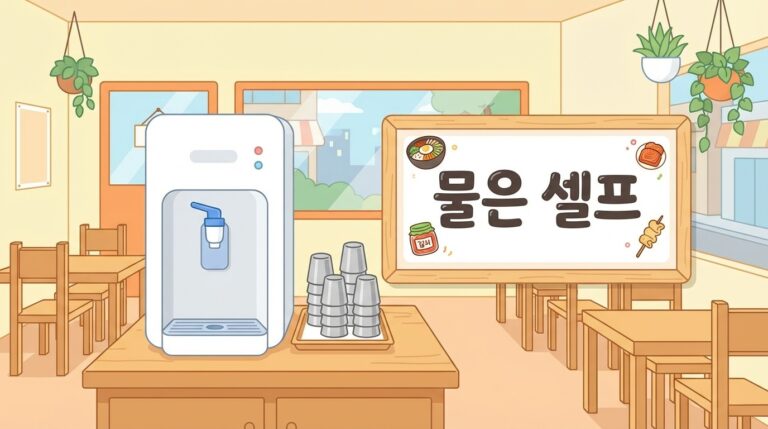
Phase 1: Empathy (Welcome to the Real Korea!)
Hello there! I’m the Lead Editor at Daily Hangul. I’ve spent years living in Seoul, exploring every hidden alleyway, and teaching students just like you.
Picture this: You just sat down at a bustling, delicious-smelling Gukbap (hot soup with rice) restaurant in Myeongdong. You’re super thirsty after walking all day. You wait patiently for the waiter to pour you a glass of water. Ten minutes pass. Twenty minutes pass. Everyone else around you has water! Are they ignoring you?
Then, you spot a tiny sign on the wall next to a machine… “물은 셀프”.
Don’t worry, they aren’t ignoring you! Knowing this one simple phrase will save you from sitting thirsty for 20 minutes, and it will immediately make you look like a total local insider. This guide is built from real moments when my students thought Korean waiters were mad at them! Let’s dive in.
Phase 2: Core Expressions Deep Dive
Here are the most important phrases you need when you are thirsty in a Korean restaurant!
1. 물은 셀프입니다
- Pronunciation: Mu-reun / sel-peu-im-ni-da (The ‘eu’ sounds like the disgusted sound you make when stepping in gum!)
- Meaning: Literal: “Water is self.” vs. Real Nuance: “Please get your own water (self-service).”
- K-Culture Moment: This is the most common sign in casual Korean restaurants. If you walk into a K-BBQ joint or a noodle shop, look at the walls or the refrigerator. You’ll definitely see this sign!
- Editor’s Insight: “Self” (셀프) is a Konglish (Korean-English) word that means “Self-service.” It’s not just for water; sometimes side dishes are “self” too!
- Situation Spectrum:
- Casual (with friends): ✅ (You can just say “물은 셀프야”)
- Semi-formal (coworkers): ✅
- Formal (fancy restaurant): 🚫 (Fancy places will pour water for you)
- 🤔 Think About It: Why do you think so many Korean restaurants use self-service for water instead of having waiters pour it? Does your country have a similar system?
2. 정수기 어디 있어요?
- Pronunciation: Jeong-su-gi / eo-di / is-seo-yo?
- Meaning: Literal: “Water purifier where is?” vs. Real Nuance: “Where is the water dispenser?”
- K-Culture Moment: You know it’s self-service, but the restaurant is so crowded you can’t find the machine!
- Editor’s Insight: Jeongsugi is the magic machine in every Korean home and restaurant that dispenses both icy cold and boiling hot water.
- Situation Spectrum:
- Casual: ✅
- Semi-formal: ✅
- Formal: ✅
- 🤔 Think About It: In Korea, asking direct questions like “Where is this?” is very normal and not considered rude. Are direct questions okay in your mother tongue?
Phase 3: Textbook vs. Real Korean
Let’s see how real life differs from your textbook when you are at a restaurant that is not self-service.
[Asking for Water]
* 📖 Textbook Korean: 물을 주시겠습니까? (Would you please give me water?)
* 🗣️ Real Korean: 사장님~ 여기 물 좀 주세요! (Boss~ Please give us some water here!)
* 💡 Why is it different?: Korean restaurants are fast-paced! Using titles like “Sajang-nim” (Owner) and short, direct requests gets you faster service.
[Taking the cups]
* 📖 Textbook Korean: 제가 컵을 가져오겠습니다. (I will bring the cups.)
* 🗣️ Real Korean: 내가 물 가져올게! (I’ll go grab the water!)
* 💡 Why is it different?: Between friends, taking initiative to serve others is a sign of affection. It’s quick and casual!
Bottom Note: At an A2 level, you don’t need overly complex grammar. Just saying “물 좀 주세요” (Water, please) with a smile is perfect!
Phase 4: Cultural Context — K-Culture Deep Dive
4-1. Non-Verbal Clues: The Power of “Nunchi”
In Korea, don’t just silently raise your hand and wait for eye contact. Waiters are busy! You have to use your voice loudly (“Sajang-nim!”) or press the magical Call Bell (콜벨) on your table. Also, if you see the “물은 셀프” sign, use your Nunchi (눈치 – the Korean ability to read the room) and walk straight to the water purifier without asking the waiter!
4-2. K-Food Connection: The “Self” Culture
Water isn’t the only thing that is “self-service.” Have you ever watched a K-Drama where friends are eating spicy Tteokbokki, and one friend naturally stands up to bring yellow radishes and water for the whole table?
In Korean food culture, 반찬은 셀프 (Side dishes are self-service) is also very common. This culture helps restaurants keep food prices affordable and service lightning-fast. The beautiful part? It’s usually the youngest person, or the one trying to show care, who volunteers to fetch the water and utensils for everyone. It’s a small act of love!
Phase 5: Real-Life Roleplay Scenarios
Scenario A: The K-BBQ Dinner
- Setting: Friday night, 7 PM. A smoky K-BBQ restaurant near Gangnam Station. Soju bottles are on the table.
- Characters:
- YOU: A foreign student, 3 months into your Korean life.
- Min-su: Your friendly 25-year-old Korean language exchange partner.
Min-su: 야, 오늘 고기는 내가 쏜다! 🥩
(Ya, oneul gogineun naega ssonda!)
(English) Hey, meat is on me today!
(🎭 Stage Direction: Min-su picks up the tongs and starts grilling the pork belly)
YOU: 우와, 진짜요? 고마워요!
(Uwa, jinjjayo? Gomawoyo!)
(English) Wow, really? Thank you!
(🎭 Stage Direction: You suddenly feel very thirsty. You look around, but there’s no water pitcher on the table. You see a sign far away that says “물은 셀프”.)
🔀 Your Turn! How do you react?
– A) Sit quietly and wait until Min-su notices you are thirsty.
– B) “민수 씨, 저기 가서 물 좀 가져오세요.” (Minsu, go over there and get water.)
– C) “아, 물은 셀프네요! 제가 물 가져올게요.” (Ah, water is self-service! I’ll go get the water.)✅ Best Choice: C — Because Min-su is grilling the meat (and paying!), volunteering to get the water shows great Nunchi and manners!
⚠️ Choice B Analysis: Min-su is busy grilling. Telling him to fetch water sounds a bit bossy!
Scenario B: The Call Bell Moment
- Setting: A busy Kimchi Stew restaurant.
- You: You want more Kimchi.
YOU: (Presses the Call Bell on the table – “Ding-dong!”)
Waiter: 네~ 무엇을 도와드릴까요?
(Ne~ Mueoseul dowadeurilkkayo? / Yes, how can I help you?)
YOU: 사장님, 여기 김치 좀 더 주세요!
(Sajang-nim, yeogi gimchi jom deo juseyo! / Owner, more Kimchi here please!)
Waiter: 아, 손님! 반찬은 저기 셀프바 이용해주세요~
(Ah, sonnim! Banchaneun jeogi selpeuba iyonghaejuseyo~ / Ah customer! Please use the self-bar over there for side dishes~)
YOU: 아! 네, 알겠습니다!
Phase 6: 10-Second Shadowing Drill
Practice these lines out loud with the right emotion and pauses!
- 😊 Brightly: 아! / 물은 / 셀프네요! (Ah! / mu-reun / sel-peu-ne-yo!)
- 😤 Loudly (in a busy place): 사장님! / 여기 / 물 좀 / 주세요~ (Sa-jang-nim! / yeo-gi / mul jom / ju-se-yo~)
- 🏃♂️ Energetically: 제가 / 물 / 가져올게요! (Je-ga / mul / ga-jyeo-ol-ge-yo!)
Phase 7: K-Culture Mini Dictionary
| Korean | Romanization | English Meaning | Context |
|---|---|---|---|
| 셀프 | sel-peu | Self-service | Konglish. Used everywhere in food and retail! |
| 정수기 | jeong-su-gi | Water dispenser | Found in homes, offices, and restaurants. |
| 눈치 | nun-chi | Reading the room | The essential Korean social skill of sensing what others need. |
| 사장님 | sa-jang-nim | Boss / Owner | The safest, most polite way to call a restaurant worker. |
Phase 8: Traveler Survival Kit
If you are traveling to Korea soon, save these phrases on your phone!
🆘 Survival Phrases for K-Restaurants
– 🇰🇷 “물 좀 주세요.” (Mul jom juseyo) = Please give me water. (Use if there is NO self-service sign).
– 🇰🇷 “반찬 더 주세요.” (Banchan deo juseyo) = Please give me more side dishes.
– 🇰🇷 “화장실 어디 있어요?” (Hwajangsil eodi isseoyo?) = Where is the restroom?📌 Editor’s Travel Note
– Free Water: In Korea, tap water is safe, but restaurants always serve purified or boiled water (like barley tea) for FREE. You never pay for water!
– No Tipping: Never tip the waiter for bringing you water. Korea has absolutely NO tipping culture. It might actually confuse them!
Phase 9: Critical Thinking — “One Step Deeper”
🧠 Think Deeper: Food & Identity (The Culture of “Jeong”)
In Western cultures, fetching your own water might just feel like a restaurant saving money on labor. But in Korea, it ties deeply into the communal dining culture. When a Korean person stands up to go to the Jeongsugi (water dispenser), they never bring just one cup for themselves. They bring a stack of cups and pour water for everyone at the table. This is a reflection of Jeong (정)—a deep sense of connection, care, and collective identity. Serving water to your friends is a silent way of saying, “I am taking care of you.”
💬 Your Turn:
In your culture, who usually pours the drinks or serves the food when eating out with friends? Share your thoughts in the comments!
Phase 10: FAQ & Avoiding Misunderstandings
Q: Can I bring my own outside drink into a Korean restaurant?
A: Generally, no! Unless it’s a cafe where you are studying for hours, it’s polite to only drink what the restaurant provides (or buy their soda/beer).
Q: What if the “Self” water machine is empty?
A: Just say, “사장님, 정수기에 물이 없어요” (Sajang-nim, the water dispenser is out of water!).
❌ Common Mistake #1: Waiting at the table angrily because no one brought water.
✅ Do This Instead: Look around for the “물은 셀프” sign. If you see it, proudly walk up and get your water!❌ Common Mistake #2: Taking the whole giant water pitcher from the purifier to your table if it belongs on top of the machine.
✅ Do This Instead: Fill up individual stainless steel cups at the machine, OR grab an empty pitcher provided specifically for tables and fill that up.
Phase 11: Summary & Action Items
One-Liner Summary:
If you see “물은 셀프” (Water is self-service), show off your Korean skills by finding the Jeongsugi and bringing water for your friends!
Action Mission:
– 🥉 Bronze (Solo): Stand in front of your kitchen sink and practice saying “물은 셀프네요!” out loud 3 times.
– 🥈 Silver (Online): Comment on this blog post: What is your favorite Korean food to eat with a cold glass of water?
– 🥇 Gold (Real Life): Next time you visit a Korean restaurant, find the water dispenser yourself and grab cups for your table!
🎬 K-Culture Mission:
Next time you watch a K-Drama eating scene, pay close attention! Can you spot the water dispenser in the background, or notice who is pouring the water for the group?
Phase 12: Interactive Quiz!
1. Situational Judgment:
You are eating spicy Ramen. Your mouth is burning! You yell, “사장님, 물 좀 주세요!” The owner points to the wall. What does the sign probably say?
– A) 화장실 (Restroom)
– B) 물은 셀프 (Water is self-service)
– C) 계산은 카운터 (Pay at the counter)
2. True or False:
“In Korean restaurants, you have to pay a $1 fee to use the self-service water dispenser.”
3. Fill in the Blank:
You want to ask your friend to go get water.
“야, 여기 물은 ( _____ )야!”
(Answers: 1. B, 2. False! Water is always free in Korea, 3. 셀프)
Frequently Asked Questions (FAQ)
Q: What does "물은 셀프입니다" mean in Korean and how do you pronounce it?
A: In Korean, "물은 셀프입니다" is pronounced [Mu-reun / sel-peu-im-ni-da (The 'eu' sounds like the disgusted sound you make when stepping in gum!] and means: Literal: "Water is self." vs. Real Nuance: "Please get your own water (self-service)."
Q: What does "정수기 어디 있어요?" mean in Korean and how do you pronounce it?
A: In Korean, "정수기 어디 있어요?" is pronounced [Jeong-su-gi / eo-di / is-seo-yo?] and means: Literal: "Water purifier where is?" vs. Real Nuance: "Where is the water dispenser?"







