

Phase 1: Empathy
Hello, language enthusiasts! It’s your Editor from Daily Hangul.
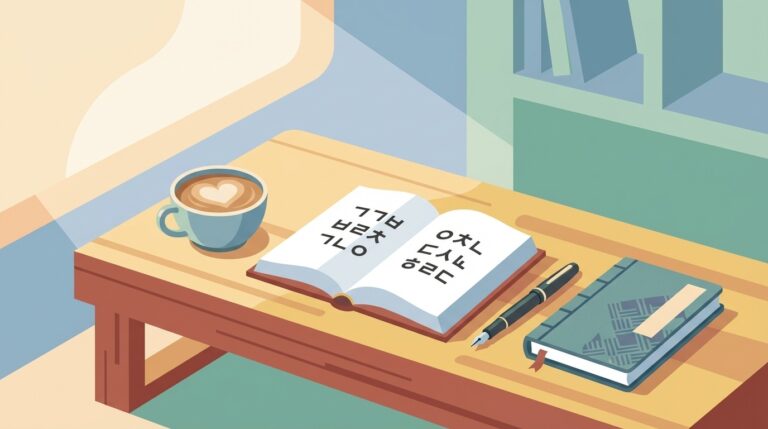
Picture this: You walk into a trendy, minimalist cafe in Seongsu-dong on a rainy Saturday afternoon. The scent of roasted coffee beans fills the air. While half the patrons are fiercely typing away on their sleek laptops—this is the land of hyper-connectivity, after all—you notice someone sitting quietly by the window. They have a beautiful leather-bound notebook open, a fountain pen in hand, and they are meticulously, slowly writing down sentences from a novel.
In a country famous for its ‘Pali-pali’ (hurry up) culture and lightning-fast internet, why are so many Koreans obsessed with writing by hand?
Welcome to the world of ‘Pilsa’ (필사)—the art of transcription.
For Korean learners, especially at the C1 level, simply ‘reading’ isn’t enough anymore. You need to absorb the nuance, the rhythm, and the soul of the language. Today, we aren’t just going to talk about reading a book; we are going to explore how Koreans internalize literature, drama scripts, and even K-Pop lyrics through the meditative practice of Pilsa. If you want to talk about books like a true Korean intellectual or a passionate ‘Studygram’ (Study + Instagram) user, you need these expressions in your arsenal.
This guide is inspired by my advanced students who wanted to express that a book didn’t just entertain them, but actually changed their perspective. Let’s dive in!
Phase 2: Core Expressions Deep Dive
To talk about reading and transcribing at an advanced level, forget simple words like 읽다 (to read) and 쓰다 (to write). It’s time to upgrade.
1. 문장을 곱씹다
- Pronunciation: [munjangeul gopssipta] -> ‘gop-ssip-tta’ (Think of the ‘ss’ as a sharp, hissing sound, and the ‘tta’ like a crisp tap on a snare drum.)
- Meaning: Literal: To chew a sentence over and over. / Real nuance: To deeply ponder, savor, or ruminate on the meaning of a sentence.
- K-Culture Moment: Imagine a character in a K-Drama staring blankly at a text message from an ex, reading it 100 times to figure out the hidden meaning. Or, reading a profound line in a Han Kang novel and closing your eyes to fully absorb it. That’s gopssipta.
- Editor’s Insight: This word has a very tactile, sensory feel to it. Just like chewing a tough but flavorful piece of Korean BBQ to get all the juices out, you are extracting every drop of meaning from the words.
- Situation Spectrum:
- Casual friends: ✅
- Coworkers (Semi-formal): ✅
- Boss/Elders (Formal): ✅ (Often used in formal book reviews or essays)
- 🤔 Think About It: Why does Korean use a food-related verb (‘chewing’) for a cognitive process like ‘pondering’? What does this tell us about the connection between physical sensation and intellectual understanding in Korean culture?
2. 마음에 새기다
- Pronunciation: [maeume saegida] -> ‘ma-eu-me sae-gi-da’ (‘으/eu’ sounds like the disgusted sound you make when stepping in gum—keep your teeth together and pull your lips back.)
- Meaning: Literal: To engrave/carve into one’s mind/heart. / Real nuance: To take something deeply to heart; to internalize a lesson or a beautiful quote so you never forget it.
- K-Culture Moment: You are at a fan meeting, and your favorite K-Pop idol gives a touching, tearful speech about never giving up. You write it down in your diary because you want to 마음에 새기다.
- Editor’s Insight: This isn’t just memorizing. Memorizing is for tests (외우다). Sae-gi-da is for life philosophies. It implies a permanent, emotional impression.
- Situation Spectrum:
- Casual friends: ✅
- Coworkers (Semi-formal): ✅
- Boss/Elders (Formal): ✅
- 🤔 Think About It: “Engraving” implies effort and permanence, much like writing on stone. Does your native language have a physical metaphor for remembering something important?
3. 긴 여운이 남다
- Pronunciation: [gin yeouni namda] -> ‘gin yeo-u-ni nam-da’
- Meaning: Literal: A long lingering resonance remains. / Real nuance: The lasting emotional impact or afterglow you feel after finishing a great book, movie, or song.
- K-Culture Moment: You just finished watching the final episode of My Mister or Reply 1988. The screen goes black, but you just sit there, staring at the wall, unable to move on with your life. That heavy, beautiful feeling in your chest? That is yeoun.
- Editor’s Insight: This is the ultimate compliment you can give to a piece of art or literature in Korean. If a book has no yeoun, it was just a quick read. If you are doing Pilsa, it’s usually because the text left a 긴 여운.
- Situation Spectrum:
- Casual friends: ✅
- Coworkers (Semi-formal): ✅
- Boss/Elders (Formal): ✅
Phase 3: Textbook vs. Real Korean
Let’s see how native speakers actually talk about their reading and writing habits on social media or with friends.
[Describing the act of copying a good quote]
* 📖 Textbook Korean: 좋은 문장을 공책에 씁니다. (I write good sentences in a notebook.)
* 🗣️ Real Korean: 인생 글귀를 다이어리에 박제했어요. (I ‘taxidermied/permanently fixed’ the quote of a lifetime in my diary.)
* 💡 Why the difference?: ‘박제하다’ (to stuff/taxidermy) is popular C1-level internet slang used when you want to preserve something permanently, highlighting the digital generation’s desire to capture fleeting moments.
[Describing the feeling of focusing on handwriting]
* 📖 Textbook Korean: 글씨를 쓰면 마음이 편해집니다. (Writing makes my mind comfortable.)
* 🗣️ Real Korean: 필사하면서 글멍 때리기 딱 좋아요. (It’s perfect for zoning out into the text while transcribing.)
* 💡 Why the difference?: ‘멍 때리다’ means to space out. Koreans love creating compounds for mindfulness activities: ‘불멍’ (staring at fire), ‘물멍’ (staring at water), and now ‘글멍’ (staring at text/writing).
Bottom Note: At the C1 level, integrating words like 인생 글귀 (quote of a lifetime) or 글멍 shows you understand modern Korean cultural trends, not just dictionary definitions.
Phase 4: Cultural Context — K-Culture Deep Dive
4-1. The Non-verbal Nuance: 꾹꾹 눌러 쓰다
When Koreans talk about Pilsa, they often use the adverb 꾹꾹 (pressing down firmly). It’s not just about the ink on the page; it’s about the physical effort. When you say “글씨를 꾹꾹 눌러 썼어요” (I pressed down firmly while writing), it conveys sincerity, mindfulness, and deep emotion. It’s a non-verbal attitude of respect toward the text.
4-2. K-Culture Connection: The “Studygram” & Stationery Obsession (문구 덕후)
If you search #필사 or #공스타그램 (Studygram) on Instagram, you will see thousands of aesthetically pleasing posts from Koreans.
Korea has a massive stationery culture. Places like Kyobo Hottracks or Artbox aren’t just stores; they are playgrounds for Mungu Deoku (stationery nerds). Pilsa isn’t just an educational activity; it’s a sensory hobby. The right fountain pen, the thickness of the paper, the color of the ink—these are all crucial elements. People do Pilsa to curate an aesthetic and mindful lifestyle, fighting back against the fatigue of staring at screens all day.
Critical View: Is this genuine mindfulness, or just another performative aesthetic for social media? In a society that constantly evaluates performance, even ‘relaxing’ hobbies like Pilsa can sometimes feel like a competition for the prettiest handwriting or the most expensive pen.
Phase 5: Practical Roleplay Scenario
Setting: Saturday afternoon at Kyobo Bookstore in Gwanghwamun, inside the premium stationery section. You are looking for the perfect pen to start your Pilsa journey. You are with your Korean friend, Ji-eun, who is a massive stationery enthusiast.
Characters:
– YOU: An advanced Korean learner who just bought a poetry book and wants to start transcribing it.
– Ji-eun (28): Your Korean friend. She owns 15 fountain pens and takes her paper quality very seriously.
Dialogue:
Ji-eun: 필사 시작한다고? 와, 드디어 너도 문구 덕후의 길로 들어서는구나! 🖋️
(Pilsa sijakhandago? Wa, deudieo neodo mungu deokuui gillo deureoseoneunguna!)
[You’re starting transcription? Wow, you’re finally entering the path of a stationery nerd!]
YOU: 응, 한강 작가님 책을 읽었는데 여운이 너무 길게 남아서, 그냥 눈으로만 읽기엔 아쉽더라고.
(Eung, Han Kang jakganim chaegeul ilgeonneunde yeouni neomu gilge namaseo, geunyang nuneuroman ilgigien aswipdeorago.)
[Yeah, I read a book by author Han Kang and the lingering resonance was so long, it felt like a shame to just read it with my eyes.]
Ji-eun: 맞아! 좋은 문장은 직접 손으로 꾹꾹 눌러 써야 마음에 확 새겨지지. 노트는 골랐어?
(Maja! Joeun munjangeun jikjeop soneuro kkukkkuk nulleo sseoya maeume hwak saegyeojiji. Noteuneun gollasseo?)
[Exactly! Good sentences need to be written down firmly by hand to be truly engraved in your mind. Did you pick a notebook?]
YOU: 노트는 샀는데, 펜을 못 고르겠어. 그냥 볼펜으로 쓰면 그 느낌이 안 날 것 같아서.
(Noteneun sanneunde, peneul mot goreugesseo. Geunyang bolpeneuro sseumyeon geu neukkimi an nal geot gataseo.)
[I bought a notebook, but I can’t choose a pen. I feel like an ordinary ballpoint pen won’t give me that ‘feel’.]
Ji-eun: 그럼 만년필이지! 저기 직원분한테 가서 한 번 써봐도 되냐고 물어봐.
(Geureom mannyeonpiriji! Jeogi jigwonbunhante gaseo han beon sseobwado doenyago mureobwa.)
[Then it has to be a fountain pen! Go ask the staff over there if you can try writing with it.]
(🎭 Stage Direction: Ji-eun points to a glass display case with elegant fountain pens.)
🔀 Your Turn! How should you ask the staff to test the pen?
– A) “이 펜 좀 써도 돼요?” (Basic, but a bit too blunt for a premium store)
– B) “혹시 이거 시필해 볼 수 있을까요? 필기감을 좀 확인하고 싶어서요.” (Advanced, natural, uses exact terminology)
– C) “저기요, 이거 잉크 나와요?” (Too casual, slightly rude)✅ Best Choice: B — Reason: 시필(하다) means ‘to test write’, and 필기감 means ‘the feeling of writing/smoothness’. Using these specific C1-level terms instantly shows the staff you are a serious customer, and it’s the polite way to ask in a high-end stationery shop.
Phase 6: 10-Second Shadowing Drill
Let’s practice reading this sentence with the right emotion and pausing. Imagine you are explaining your new hobby to a friend over coffee.
😌 좋은 문장을 / 손으로 꾹꾹 눌러 쓰다 보면, / 그 의미를 / 온전히 곱씹게 돼요.
(joeun munjangeul / soneuro kkukkkuk nulleo sseuda bomyeon, / geu uimireul / onjeonhi gopssipge dwaeyo.)
“If you firmly write down good sentences by hand, you get to wholly savor their meaning.”
Pro-tip for Intonation: Emphasize 꾹꾹 (with a heavy, firm voice) and 온전히 (with a smooth, drawn-out tone to show completeness).
Phase 7: K-Culture Mini Dictionary
Here are some essential keywords for navigating the Korean reading and writing aesthetic:
| Korean | Romanization | English Meaning | Contextual Explanation |
|---|---|---|---|
| 필사 | pilsa | Transcription / Copying text | The act of copying books or scripts by hand to improve writing, vocabulary, or mindfulness. |
| 필기감 | pilgigam | The feel of a pen | Crucial vocabulary for stationery lovers. Refers to how smooth or scratchy a pen feels on paper. |
| 글귀 | geulgwi | Phrase / Quote | Usually preceded by words like ‘인생’ (life) or ‘명’ (famous) to describe a deeply moving sentence. |
| 다꾸 | dakku | Diary decoration | Short for 다이어리 꾸미기. The massive trend of aesthetically decorating one’s diary with stickers, tapes, and calligraphy. |
| 문구 덕후 | mungu deoku | Stationery nerd | Someone who is deeply passionate about collecting pens, notebooks, and writing accessories. |
Phase 8: Traveler’s Survival Kit (Bookstore Edition)
Even if you are just visiting Korea for a week, you must visit Kyobo Bookstore (교보문고) or an independent indie bookstore (독립서점). Here is how to survive and shop like a pro.
🆘 Survival Phrases for Book/Stationery Shopping
– 🇰🇷 “만년필용 노트 있나요? 종이가 안 번지는 걸로요.”
(mannyeonpiryong noteu innayo? jong-iga an beonjineun geolloyo.)
“Do you have notebooks for fountain pens? One where the paper doesn’t bleed through.”
– 🇰🇷 “베스트셀러 말고, 작가님 추천 도서가 있을까요?”
(beseuteuselleo malgo, jakganim chucheon doseoga isseulkkayo?)
“Aside from the bestsellers, do you have any books recommended by the author/owner?” (Great for indie bookstores!)
– 🇰🇷 “이거 포장해 주실 수 있나요? 선물할 거라서요.”
(igeo pojanghae jusil su innayo? seonmulhal georaseoyo.)
“Could you gift-wrap this? It’s for a present.”📌 Editor’s Travel Note
– Hotspots: Kyobo Bookstore in Gwanghwamun isn’t just a bookstore; it’s a cultural complex. Make sure to check out the ‘Hottracks’ section for stationery.
– Indie Bookstores: Search for ‘독립서점’ on Naver Maps in areas like Mangwon-dong or Haebangchon. They often have rare, beautifully bound books perfect for Pilsa.
– Etiquette: Don’t take photos of the inside pages of books. It’s considered extremely rude and a copyright violation in Korean bookstores!
Phase 9: Critical Thinking Corner — “One Step Deeper”
Language & Mindset: The Rebellion of ‘Pali-pali’
🧠 Think Deeper:
Korea is the epitome of the Pali-pali (hurry up) culture, where efficiency and speed are paramount. We read news in 3-line summaries and watch YouTube on 1.5x speed. So why is Pilsa—an incredibly slow, inefficient, and analog process—so beloved by modern Koreans?Perhaps Pilsa is a quiet rebellion against hyper-digitalization. By deliberately slowing down to ‘chew over’ (곱씹다) a sentence, Koreans are reclaiming their mental space. The physical act of pressing a pen to paper (꾹꾹 눌러 쓰다) forces the mind to stay in the present moment, offering a rare sanctuary of ‘slowness’ in one of the fastest cities on earth.
💬 Your Turn: Do you have a hobby in your culture that forces you to intentionally slow down? Have you ever tried transcribing something by hand? Share your thoughts in the comments!
Phase 10: FAQ & Avoiding Misunderstandings
Q: Can I use ‘베끼다’ instead of ‘필사하다’?
❌ ABSOLUTELY NOT. This is the biggest mistake learners make!
* 필사하다 (Pilsa-hada): To transcribe for study, appreciation, or mindfulness. (Positive)
* 베끼다 (Bekki-da): To plagiarize, copy someone’s homework, or cheat. (Highly Negative)
If you say “저는 유명한 작가의 글을 베껴요” (I copy famous authors’ writings), people will think you are a plagiarist! Say “필사해요” instead.
Q: Is it weird to transcribe K-Pop lyrics?
Not at all! In fact, translating and transcribing deep, poetic lyrics (like those by IU, RM of BTS, or AKMU) is a fantastic C1-level exercise. It helps you grasp poetic metaphors (은유) and rhythm (운율) in Korean.
Q: I want to leave a book review on a Korean blog. Can I say “이 책은 재미있어요”?
You can, but for a C1 speaker, it’s too basic. Use the expressions we learned:
“이 책은 다 읽고 나서도 긴 여운이 남습니다. 좋은 문장이 많아 필사하며 곱씹어 읽기 좋은 책입니다.”
(This book leaves a long lingering resonance even after finishing it. With many good sentences, it’s a great book to savor by transcribing.) -> Sounds like a native literary critic!
Phase 11: Summary & Action Items
One-Liner Summary: Pilsa (필사) isn’t just about copying words; it’s the beautiful Korean practice of savoring (곱씹다) and internalizing (마음에 새기다) sentences until they leave a lasting impact (여운이 남다).
Your Action Missions:
– 🥉 Bronze (Solo): Find your favorite quote in your native language and try translating it into Korean. Write it down by hand.
– 🥈 Silver (Online): Find a Korean quote on Instagram (search #글귀). Copy it by hand, post it on your story, and tag it with #필사 and #한국어공부!
– 🥇 Gold (Real World): Go to a bookstore or a Muji store, try out a pen, and ask the staff: “이거 시필해 봐도 될까요?” (Can I test write with this?)
🎬 K-Culture Mission:
Watch an episode of a slice-of-life K-Drama (like Run On or Romance is a Bonus Book where characters work with words) and see if you can spot them using beautiful stationery or writing in a diary.
Which Korean book, drama, or song has left the longest ‘여운’ (lingering resonance) on you? Let me know below! 👇
Phase 12: Quiz — Interactive Challenge
1. Situational Judgment: You want to tell your Korean professor that you loved a specific sentence in the textbook so much that you wrote it down to remember it deeply. Which is the best phrasing?
A) 교수님, 그 문장을 제 노트에 베꼈어요.
B) 교수님, 그 문장이 너무 좋아서 마음에 새기려고 필사했습니다.
C) 교수님, 그 문장을 곱씹어서 박제했어요.
2. Fill in the Blank:
“영화가 끝났는데도 감동이 사라지지 않고 깊은 ( )이/가 남았다.”
A) 필기감
B) 다꾸
C) 여운
3. True or False – K-Culture Edition:
“If you buy a nice fountain pen at a Korean stationery shop, it’s customary to tip the staff for helping you choose.” (T / F)
👀 Click here for the answers!
- Answer: B.
Explanation: A uses ‘베꼈어요’ which implies plagiarism or mindless copying. C uses ‘박제했어요’, which is internet slang and highly inappropriate for a professor. B uses formal, respectful, and advanced vocabulary (마음에 새기다, 필사하다). - Answer: C (여운).
Explanation: ‘여운이 남다’ means a lingering emotional impact remains. - Answer: False.
Explanation: Korea does NOT have a tipping culture. Tipping the staff at a bookstore or anywhere else will only cause confusion and awkwardness!
Frequently Asked Questions (FAQ)
Q: What does "문장을 곱씹다" mean in Korean and how do you pronounce it?
A: In Korean, "문장을 곱씹다" is pronounced [munjangeul gopssipta] and means: Literal: To chew a sentence over and over. / Real nuance: To deeply ponder, savor, or ruminate on the meaning of a sentence.
Q: What does "마음에 새기다" mean in Korean and how do you pronounce it?
A: In Korean, "마음에 새기다" is pronounced [maeume saegida] and means: Literal: To engrave/carve into one's mind/heart. / Real nuance: To take something deeply to heart; to internalize a lesson or a beautiful quote so you never forget it.
Q: What does "긴 여운이 남다" mean in Korean and how do you pronounce it?
A: In Korean, "긴 여운이 남다" is pronounced [gin yeouni namda] and means: Literal: A long lingering resonance remains. / Real nuance: The lasting emotional impact or afterglow you feel after finishing a great book, movie, or song.







