

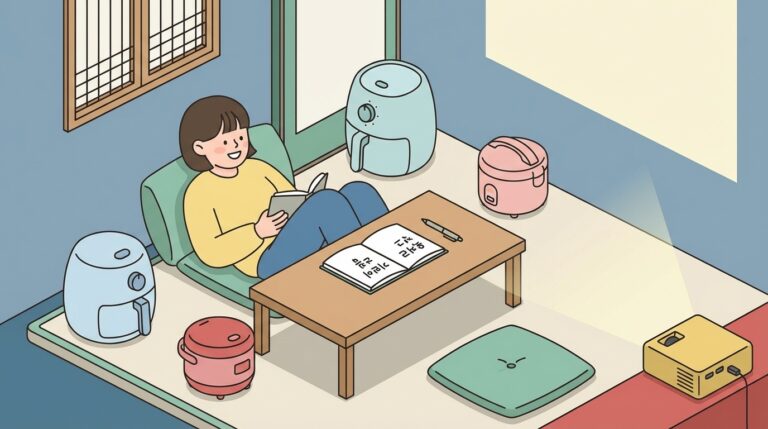
Phase 1: Empathy (Welcome to the Real K-Drama Life!)\n\nHello! I’m your Daily Hangul Editor.\n\nYou’ve definitely seen this scene in a K-Drama: The resilient protagonist moves into a tiny rooftop room (옥탑방), unpacks a single box, and immediately plugs in a pastel-colored mini rice cooker. They sit cross-legged on the floor, eating ramen directly from the pot lid. It looks incredibly cozy and romantic, right?\n\nBut behind this aesthetic lies one of modern Korea’s biggest lifestyle shifts. Today, over 30% of South Korean households consist of just one person—a demographic known as 1인 가구 (Single Households). This trend has completely transformed the Korean consumer market, giving birth to an obsession with 1인용 가전제품 (Single-person appliances).\n\nFrom mini air-fryers and personal beam projectors to wall-mounted micro washing machines, these gadgets are essential for modern survival in Seoul’s notoriously compact studio apartments (원룸). If you’re an expat setting up your new life in Korea, or just a K-Culture fan trying to understand why your favorite idol was showing off their tiny smart-fridge on a vlog, this guide is for you. Let’s dive into the vocabulary that will help you survive and thrive in your solo Korean adventure!\n\n—\n\n## Phase 2: Core Expression Deep Dive\n\n> ### 1. 자취하다 (To live independently/alone)\n> \n> – Pronunciation: jachwihada [ja-chwi-ha-da]\n> – Meaning: Literal: To leave a trace. / Real nuance: To live away from one’s parents, typically as a student or young unmarried professional, handling your own cooking and chores.\n> – K-Culture Moment: Whenever a K-Pop idol moves out of the group dorm to get their own place, fans excitedly talk about their “자취” life. Vlogs titled “자취생 브이로그” (Living alone vlog) get millions of views.\n> – Editor’s Insight: This word has a youthful, slightly struggling-but-independent vibe. If you are 50 and living alone, you wouldn’t usually say “자취해요.” Instead, you’d just say “혼자 살아요” (I live alone).\n> – Situation Spectrum:\n> – Casual (Friends): ✅\n> – Semi-formal (Colleagues): ✅\n> – Formal (Boss/Elders): ✅\n> – 🤔 Think About It: Why is there a specific word for young unmarried adults living alone? What does this tell you about the traditional Korean expectation of living with parents until marriage?\n\n> ### 2. 자취템 (Must-have items for solo living)\n> \n> – Pronunciation: jachwitem [ja-chwi-tem]\n> – Meaning: Literal: Independent living item. / Real nuance: Life-saving gadgets or home appliances designed specifically for single households (e.g., a mini microwave or a single-egg frying pan).\n> – K-Culture Moment: In reality shows like I Live Alone (나 혼자 산다), celebrities show off their clever “자취템,” which instantly sell out online the next day.\n> – Editor’s Insight: It’s a portmanteau of ‘자취’ and ‘아이템’ (item). Knowing this word instantly upgrades you from a textbook learner to a trendy local. \n> – Situation Spectrum:\n> – Casual (Friends): ✅\n> – Semi-formal (Colleagues): ✅\n> – Formal (Boss/Elders): ⚠️ (Slightly informal slang)\n> – 🤔 Think About It: Koreans love shortening words to create new slang (like Jachwi-tem). Does your native language have a similar culture of blending words for modern trends?\n\n> ### 3. 가심비 (Cost-to-psychological satisfaction ratio)\n> \n> – Pronunciation: gasimbi [ga-shim-bi]\n> – Meaning: Literal: Price-heart-ratio. / Real nuance: Buying something slightly expensive, but it brings you immense psychological happiness (like a mini beam projector for your tiny room).\n> – K-Culture Moment: When a drama character comes home from a stressful office job, turns on their aesthetic mood lamp, and drinks a canned beer. They bought the lamp for “가심비.”\n> – Editor’s Insight: You probably learned 가성비 (Cost-effectiveness) in your B1 class. At B2, you need 가심비. Single households might lack space, but they will spend money on small luxury appliances to maximize their happiness in that limited space.\n> – Situation Spectrum:\n> – Casual (Friends): ✅\n> – Semi-formal (Colleagues): ✅\n> – Formal (Boss/Elders): ⚠️ (Good for marketing, maybe too trendy for formal reports)\n> – 🤔 Think About It: The shift from ‘value for money’ (가성비) to ‘value for happiness’ (가심비) highlights a change in generational values. How do young people in your country cope with economic stress?\n\n—\n\n## Phase 3: Textbook vs. Real Korean\n\n[Looking for appliances at a store]\n* 📖 Textbook Korean: 혼자 사는 사람을 위한 전자레인지를 찾고 있습니다. (I am looking for a microwave for a person who lives alone.)\n* 🗣️ Real Korean: 원룸용 미니 전자레인지 추천해 주세요. (Please recommend a mini microwave for a studio apartment.)\n* 💡 Why the difference?: Koreans prioritize efficiency. “원룸용” (For studio use) instantly communicates “small, cheap, and low wattage” without a long explanation.\n\n[Expressing satisfaction with a purchase]\n* 📖 Textbook Korean: 가격에 비해 심리적 만족감이 높습니다. (Compared to the price, the psychological satisfaction is high.)\n* 🗣️ Real Korean: 와, 이거 완전 가심비 최고예요! (Wow, this is totally the best Gasimbi!)\n* 💡 Why the difference?: Slang like “최고” (best) and “대박” (jackpot) combined with modern lifestyle terms makes your speech sound significantly more native and emotive.\n\n> Bottom Note: At the B2 level, transitioning from descriptive phrases (혼자 사는 사람) to cultural keywords (자취생, 1인 가구) is the key to sounding fluent.\n\n—\n\n## Phase 4: Cultural Context — K-Culture Deep Dive\n\n### 4-1. Non-verbal Cue: The “Nunchi” of Second-Hand Trading\nWhen buying mini-appliances in Korea, many single expats use the second-hand app Karrot (당근마켓). But beware! When you meet the seller on the street, you don’t just say “Hello.” You must use your 눈치 (Nunchi) to scan the area for someone holding a shopping bag, cautiously make eye contact, and softly ask, “당근이세요…?” (Are you Karrot…?). It’s an unspoken rule of polite, awkward Korean street commerce!\n\n### 4-2. K-Culture Connection: K-Drama & Reality TV\nIf you want to master B2 Korean related to home life, you must understand the cultural impact of the reality show 나 혼자 산다 (I Live Alone). \n- The Trope: The show highlights the gap between glamorous celebrity life and their relatable, sometimes messy single-household realities. \n- The Trend: Whenever a guest uses a unique 1-person appliance (like a mini soju-chiller or a 1-person waffle maker), it trends on search engines instantly.\n- Critical View: While media makes “living alone” look aesthetic and fun, the reality for many youths involves extreme space constraints, which is exactly why the “mini appliance” market was forced to innovate so rapidly.\n\n—\n\n## Phase 5: Real-world Roleplay Scenario\n\nSetting: Friday evening, 7 PM. Exit 3 of Gangnam Station. You just moved into a tiny 원룸 (studio) and decided to buy a second-hand mini air-fryer through the Karrot app.\n\nCharacters:\n- YOU: An expat setting up your new life in Seoul.\n- Minsu (28): A local Korean who is moving back in with his parents and selling off his single-household appliances.\n\nDialogue:\n\nMinsu: 저기요… 혹시 당근이세요? 🥕\n(Jeogiyo… hoksi danggeun-iseyo?)\n[Excuse me… by any chance, are you Karrot?]\n(🎭 Stage Direction: Minsu looks around awkwardly, making eye contact with your phone screen)\n\nYOU: 아, 네! 미니 에어프라이어 맞으시죠?\n(A, ne! mini eeopeuraieo majeushijyo?)\n[Ah, yes! You’re the one with the mini air fryer, right?]\n\nMinsu: 네, 맞아요. 여기요. 상태 엄청 좋아요. 제가 자취할 때 몇 번 안 썼거든요.\n(Ne, majayo. Yeogiyo. Sangtae eomcheong joayo. Jega jachwihal ttae myeot beon an sseotgeodeunyo.)\n[Yes, that’s right. Here it is. The condition is really good. I barely used it when I was living alone.]\n\nYOU: 와, 진짜 새것 같네요. 가심비 최고예요!\n(Wa, jinjja saegeot gatneyo. Gasimbi choegoyeyo!)\n[Wow, it looks brand new. The psychological satisfaction is top-notch!]\n\nMinsu: 그쵸? 1인용이라 공간 차지도 많이 안 해요. 원룸에 딱이에요.\n(Geuchyo? Irinyong-ira gong-gan chajido mani an haeyo. Wollum-e ttagieyo.)\n[Right? It’s for one person, so it doesn’t take up much space. It’s perfect for a studio apartment.]\n\nYOU: (Looking inside the bag) 네, 부품도 다 있네요. 제가 딱 찾던 자취템이에요.\n(Ne, bupumdo da itneyo. Jega ttak chatdeon jachwitem-ieyo.)\n[Yes, all the parts are here too. It’s exactly the solo-living item I was looking for.]\n\nMinsu: 다행이네요. 그럼 계좌이체 해 주시겠어요?\n(Dahaeng-ineyo. Geureom gyejwa-iche hae jusigesseoyo?)\n[That’s a relief. Then, could you do a bank transfer?]\n\n> 🔀 Your Turn! How do you reply?\n> – A) “네, 바로 입금해 드릴게요.” (Ne, baro ipgeumhae deurilgeyo.)\n> – B) “혹시… 조금만 네고 가능할까요?” (Hoksi… jogeumman nego ganeunghalkkayo?)\n> – C) “너무 비싸요. 깎아주세요!” (Neomu bissayo. Kkakkajuseyo!)\n>\n> ✅ Best Choice: A or B! — A is polite and standard. B uses “네고” (Nego, short for negotiation), which is universally accepted slang on Karrot. Asking politely with “혹시” (by any chance) softens the request perfectly!\n> ⚠️ Choice C Analysis: Too direct and borderline aggressive for a B2 speaker interacting with a stranger. It lacks nunchi (social tact)!\n\n[K-Culture Bonus Roleplay: Moving into a Studio]\nYou are touring a new studio apartment with a real estate agent.\n- Realtor: “세탁기랑 미니 냉장고는 풀옵션이에요.” (Washing machine and mini fridge are fully included.)\n- YOU: “에어컨도 있나요?” (Is there an AC too?)\n- Realtor: “그럼요, 1인 가구 맞춤형이죠. 몸만 오시면 됩니다!” (Of course, it’s tailored for single households. Just bring yourself!)\n\n—\n\n## Phase 6: 10-Second Shadowing Drill\n\nPractice your rhythm and intonation! Follow the slash marks for natural pausing.\n\n😊 저는 / 자취를 해서 / 미니 가전제품이 / 꼭~~~ 필요해요!\n(jeo-neun / jachwi-reul haeseo / mini gajeon-jepum-i / kkok~~~ pilyohaeyo!)\n[Because I live alone, I abso~~~lutely need mini home appliances!]\n\n—\n\n## Phase 7: K-Culture Mini Dictionary\n\n| 한국어 | Romanization | English | Cultural Context |\n|—|—|—|—|\n| 눈치 | nunchi | Social tact / awareness | The quintessential Korean social skill of reading the room. |\n| 원룸 | wollum | Studio apartment | Literally “One room.” The standard housing for singles in Korea. |\n| 풀옵션 | pul-opsyeon | Fully furnished | Apartments that come with basic appliances (washing machine, fridge, AC). |\n| 당근 | danggeun | Karrot App | Short for the second-hand app 당근마켓 (meaning: near my neighborhood). |\n| 소확행 | sohwakhaeng | Small but certain happiness | Finding joy in small things, like buying a mini-waffle maker. |\n\n—\n\n## Phase 8: Traveler Survival Kit\n\nEven if you aren’t moving to Korea permanently, you might stay in an Airbnb or need small gadgets from stores like Daiso or Electro Mart!\n\n> 🆘 Survival Expressions TOP 3\n> 1. 🇰🇷 “1인용 사이즈 있나요?” (Irinyong saijeu itnayo?)\n> – 🗣️ Meaning: Do you have a single-person size?\n> 2. 🇰🇷 “이거 돼지코(변환 어댑터) 필요한가요?” (Igeo dwaejiko pil-yohangayo?)\n> – 🗣️ Meaning: Does this need a conversion adapter (pig-nose)?\n> 3. 🇰🇷 “제일 작은 걸로 주세요.” (Jeil jageun geollo juseyo.)\n> – 🗣️ Meaning: Please give me the smallest one.\n\n> 📌 Editor’s Travel Note\n> – Voltage Warning: Korea uses 220V. If you buy a cute mini hair straightener at Olive Young, make sure your home country supports the voltage!\n> – Daiso is King: Need a cheap mini-fan or adapter for your solo trip? Daiso in Korea has entire aisles dedicated to “1인 가구” survival items!\n\n—\n\n## Phase 9: Critical Thinking Corner — “One Step Deeper”\n\nMedia vs Reality: The Truth Behind the Cozy Rooftop Room\n\n> 🧠 Think Deeper:\n> In K-Dramas, the 옥탑방 (rooftop room) is often romanticized with fairy lights, rooftop BBQs, and starry-eyed lovers. However, in reality, these rooms are known for being extremely hot in summer, freezing in winter, and severely lacking in space. This stark reality is exactly what fueled the explosive innovation in Korea’s 1-person appliance market. Young Koreans couldn’t change their tiny living spaces, so they changed their lifestyle—opting for high-tech, space-saving gadgets that provide “소확행” (small but certain happiness) to cope with the economic realities of modern Seoul.\n>\n> 💬 Your Turn: How does media in your culture romanticize the struggles of living alone? Does your country have a similar trend of miniaturizing products? Share your thoughts in the comments!\n\n—\n\n## Phase 10: FAQ & Avoiding Misunderstandings\n\nQ: Can I use “자취하다” if I am married and living temporarily away from my spouse?\n- No. The term 자취 is strictly associated with unmarried singles (students or young workers). If you are married but living alone (e.g., for work), Koreans use the term “기러기” (Goose) or simply say “혼자 지내요” (I am staying alone).\n\nQ: If I meet a Karrot seller, should I bow and use formal language?\n- Yes! Even though you might be using slang like “네고” (negotiation), always use polite ending forms (존댓말 – ~요/습니다). Never use banmal (casual speech) with a stranger on an app!\n\n> ❌ Common Mistake #1: \n> Saying “1인 가족” (1-person family) instead of “1인 가구” (1-person household) when talking about demographics.\n> ✅ Do this instead: Stick to “가구” (household) when discussing housing or appliance trends!\n\n—\n\n## Phase 11: Summary & Action Items\n\nOne-Liner Summary: Mastering the vocabulary of 1인 가구 (Single Households) unlocks the door to understanding modern Korean lifestyle trends, from finding the perfect 자취템 to maximizing your 가심비!\n\nAction Mission 3 Steps:\n- 🥉 Bronze: Stand in your room and point to 3 items, saying “이건 필수 자취템이에요!” (This is a must-have solo living item!).\n- 🥈 Silver: Leave a comment on a Korean YouTube vlog (search: 자취 브이로그) saying “가심비 최고네요!” (The psychological satisfaction is the best!).\n- 🥇 Gold: Download the 당근마켓 (Karrot) app, browse the “가전제품” (appliances) section, and see how many times you can spot the word “1인용”!\n\nK-Culture Mission: \nWatch a clip of the reality show 나 혼자 산다 (I Live Alone) on YouTube. Try to spot at least one “미니 가전제품” (mini appliance) the celebrity is using in their home!\n\nDid you learn something new today? What is the ultimate ‘자취템’ in your country? Let me know in the comments below!\n\n—\n\n## Phase 12: Quiz — Interactive Challenge\n\n1. Situational Judgment:\nYou are at a store looking for a small rice cooker because your studio apartment has a tiny kitchen. What is the most natural B2-level way to ask the staff?\n- A) 아주 작은 밥솥을 주세요. (Please give me a very small rice cooker.)\n- B) 원룸에 딱 맞는 자취템 추천해 주세요. (Please recommend a solo-living item perfect for a studio apartment.)\n- C) 혼자 먹을 밥을 요리할 기계를 찾아요. (I am looking for a machine to cook rice to eat alone.)\n\n2. Fill in the Blank:\n”It was a bit expensive, but it makes me so happy every day! 완전 _____ 최고예요!”\n- A) 가성비 (Cost-effectiveness)\n- B) 가심비 (Cost-to-satisfaction ratio)\n\n3. True or False — K-Culture Edition:\n”자취하다” can be used by a 60-year-old married man who is living alone on a business trip.\n- T / F\n\n(Answers: 1. B – It uses natural lifestyle vocabulary. / 2. B – It focuses on emotional satisfaction over price. / 3. False – He should say ‘혼자 지내요’.)
Frequently Asked Questions (FAQ)
Q: What does "1인 가구" mean in Korean and how do you pronounce it?
A: In Korean, "1인 가구" is pronounced [Single Households] and means: . This trend has completely transformed the Korean consumer market, giving birth to an obsession with
Q: What does "1인용 가전제품" mean in Korean and how do you pronounce it?
A: In Korean, "1인용 가전제품" is pronounced [Single-person appliances] and means: .\n\nFrom mini air-fryers and personal beam projectors to wall-mounted micro washing machines, these gadgets are essential for modern survival in Seoul's notoriously compact studio apartments (
Q: What does "눈치" mean in Korean and how do you pronounce it?
A: In Korean, "눈치" is pronounced [Nunchi] and means: to scan the area for someone holding a shopping bag, cautiously make eye contact, and softly ask, "당근이세요...?" (Are you Karrot...?). It's an unspoken rule of polite, awkward Korean street commerce!\n\n### 4-2. K-Culture Connection: K-Drama & Reality TV\nIf you want to master B2 Korean related to home life, you must understand the cultural impact of the reality show
Q: What does ""기러기"" mean in Korean and how do you pronounce it?
A: In Korean, ""기러기"" is pronounced [Goose] and means: or simply say "혼자 지내요" (I am staying alone).\n\n







