

Phase 1: Empathy & K-Culture Cold Open
Hello! I’m your Daily Hangul editor.
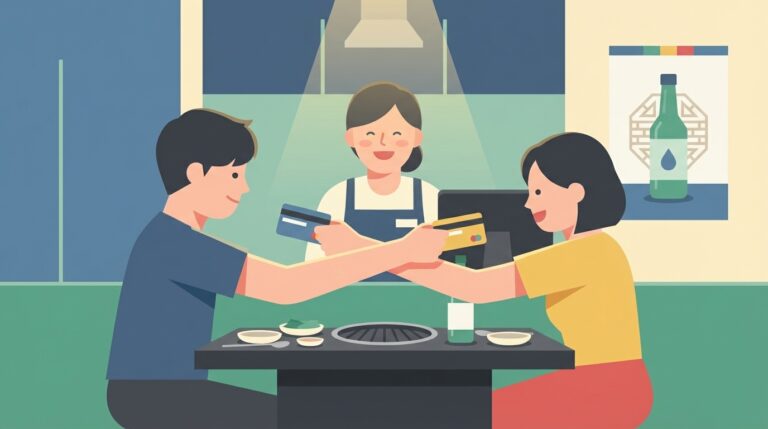
Imagine this: You’re on a fantastic first date in Seoul. The Samgyeopsal (pork belly) was sizzling, the Soju went down smooth, and the conversation was flawless. But then… the bill arrives. Suddenly, you’re thrust into one of the most intense, unspoken battlegrounds in Korea: The Counter.
In K-Dramas, the wealthy male lead usually slides a sleek black card to the cashier without looking. But in reality? You might witness two people literally wrestling over the card reader, shouting, “아니야, 내가 낼게!” (No, I’ll pay!). Should you grab your wallet? Should you suggest splitting it exactly in half? Or will that make you look “cheap” in Korean culture?
If you don’t know the cultural nuances of paying on a date in Korea, a perfectly romantic evening can quickly turn into an awkward nunchi (reading the room) game. This guide, built from the frantic questions of my B2-level tutoring students, will help you navigate the Korean dating expense debate like a true local.
Phase 2: Core Expressions Deep Dive
Let’s break down the most essential phrases you need when the check arrives.
1. 오늘은 제가 쏠게요!
- Pronunciation: oneureun jega ssolgeyo! (Sound: ‘ssol’ sounds like the word ‘soul’, but with a very sharp, tense ‘S’.)
- Meaning: I’ll treat today! (Literal: I will shoot today!)
- K-Culture Moment: You’ll hear this constantly in both dating and workplace dramas. When someone gets a bonus or wants to celebrate, they “shoot” the food. It’s a confident, generous way to claim the bill.
- Editor’s Insight: This isn’t just about paying; it’s a mood-maker. It sounds energetic and upbeat. Say it with a smile while reaching for your card.
- Situation Spectrum:
- Casual (Dates/Friends): ✅
- Semi-formal (Co-workers): ⚠️ (Okay for peers, but maybe too casual for a strict boss)
- Formal (Seniors/Elders): 🚫 (Use 제가 대접하겠습니다 instead)
- 🤔 Think About It: Why use the verb “to shoot” (쏘다) for paying? Perhaps because paying for a group makes a sudden, impactful statement, just like an arrow hitting a target. How do you say “I’ll treat” in your native language?
2. 밥은 OO씨가 샀으니까, 2차는 제가 낼게요.
- Pronunciation: babeun OO-ssiga sasseunikka, ichaneun jega naelgeyo. (Sound: ‘icha’ sounds like ‘ee-chah’)
- Meaning: Since you bought dinner, I’ll pay for the 2nd round (usually drinks or dessert).
- K-Culture Moment: This is the golden rule of Korean dating. If one person buys the main meal, the other person smoothly transitions the date to a cafe or a bar and pays for it.
- Editor’s Insight: This is the ultimate “green flag” sentence. It shows you are considerate, financially responsible, and most importantly, it naturally extends the date!
- Situation Spectrum:
- Casual: ✅
- Semi-formal: ✅
- Formal: ✅
- 🤔 Think About It: Koreans love the “round” (차) culture—1차 dinner, 2차 cafe, 3차 karaoke. Why do you think Koreans prefer moving locations rather than staying in one restaurant for hours?
3. 우리 반반 내요 / 더치페이 해요.
- Pronunciation: uri banban naeyo / deochipei haeyo. (Sound: ‘deochipei’ is Konglish for Dutch Pay).
- Meaning: Let’s split it half and half / Let’s go Dutch.
- K-Culture Moment: While older generations rarely split bills on dates, the MZ generation (Gen Z and Millennials) heavily uses this, especially on first dates from dating apps (like Tinder or Glam) to avoid any burden or expectations.
- Editor’s Insight: If the date was just “okay” and you don’t want to owe them anything, “더치페이 해요” is a polite but firm boundary.
- Situation Spectrum:
- Casual (New dates/Friends): ✅
- Semi-formal: ⚠️
- Formal: 🚫
- 🤔 Think About It: In many Western cultures, splitting the bill on a first date is standard. In Korea, it’s becoming common, but some still feel it lacks “jeong” (정, emotional connection). Which side do you agree with?
Phase 3: Textbook vs. Real Korean
| Situation | 📖 Textbook Korean | 🗣️ Real Korean | 💡 Why the difference? |
|---|---|---|---|
| Offering to pay | 제가 계산하겠습니다. (I will calculate.) | 내가 쏠게! / 오늘은 내가 살게. | Textbook is too formal for a romantic date. “쏘다/살다” is much more natural. |
| Splitting the bill | 각자 비용을 지불합시다. (Let us pay our respective costs.) | 제가 카카오페이로 보낼게요! (I’ll send it via KakaoPay!) | Koreans rarely ask the cashier to split the card. One person pays, the other wires half instantly via app. |
| Changing locations | 다음 장소로 이동할까요? (Shall we move to the next location?) | 2차 가요! 커피는 제가 살게요. | The concept of “2차” (2nd round) implies moving locations naturally. |
Phase 4: Cultural Context — K-Culture Deep Dive
4-1. Non-Verbal Game: The “Wallet Reach”
Language isn’t enough; you need the choreography. When the bill comes, you must at least perform the “Fake Wallet Reach” (지갑 꺼내는 시늉). Even if you know your date wants to treat you, sitting perfectly still with your hands on your lap while they pay is considered lacking Nunchi (social tact). Reach for your bag, say “제가 낼게요~” (I’ll pay~), and let them politely refuse. It’s a beautifully choreographed dance of manners.
4-2. K-Drama vs. Real Life Counter Battles
In K-Dramas, the lead characters might flirt over the bill, or one magically pre-pays while going to the restroom. In real life, the “Counter Battle” is a genuine cultural phenomenon. You will see two adults physically trying to block each other’s credit cards from reaching the cashier’s hand.
Critical View: While dramas portray the man paying for everything as the pinnacle of romance, modern Korean dating (especially among university students and young professionals) heavily leans toward taking turns or using a 데이트 통장 (Dating Bank Account). This is a shared bank account where both partners deposit a set amount monthly (e.g., $150 each) and use a shared debit card for all dates. It completely eliminates the “who pays” stress!
Phase 5: Real-Life Roleplay Scenario
Setting: Friday night, 8:30 PM. You just finished a fantastic dinner at a trendy pasta place in Yeonnam-dong on a second date. The waiter brings the check to the table.
Characters:
– YOU: An expat working in Seoul, really liking this date.
– Ji-hoon (28): Your Korean date. Sweet, but a bit traditional when it comes to manners.
Dialogue:
Ji-hoon: 파스타 진짜 맛있었죠? 배불러요? 😊
(paseuta jinjja masisseotjyo? baebulleoyo?)
[The pasta was really good, right? Are you full?]
(🎭 Stage Direction: Ji-hoon smiles and picks up the bill from the table.)
YOU: 네, 완전 맛있었어요! 잘 먹었습니다.
(ne, wanjeon masisseosseoyo! jal meogeotseumnida.)
[Yes, it was totally delicious! I ate well.]
Ji-hoon: 다행이네요. 가실까요? 제가 계산할게요.
(dahaengineyo. gasilkkayo? jega gyesanhalgeyo.)
[I’m glad. Shall we go? I’ll pay for this.]
🔀 Your Turn! How do you respond?
– A) 아, 감사합니다! 그럼 안녕히 계세요! (Oh, thank you! Well, goodbye!)
– B) 아니에요, 우리 더치페이 해요. 정확히 반반 내요. (No, let’s go Dutch. Let’s pay exactly half and half.)
– C) 아, 진짜요? 그럼 밥은 지훈 씨가 샀으니까, 2차 커피는 제가 살게요!
✅ Best Choice: C
Why? Choice C flawlessly executes the “Dinner-Coffee” rule. It shows gratitude, avoids awkward penny-pinching at the counter, and guarantees a second location (prolonging the date!).
⚠️ Choice B Analysis: Insisting on strict Dutch pay (exact halves) right at the counter can sometimes kill the romantic mood and feel too business-like to someone trying to treat you.
Phase 6: 10-Second Shadowing Drill
Practice this out loud. It’s your secret weapon for extending a great date!
😊 밥은 / 지훈 씨가 샀으니까, / 2차는 / 제가 쏠게요!
(babeun / ji-hun ssiga sasseunikka, / i-chaneun / jega ssolgeyo!)
Smile warmly, tilt your head slightly, and point toward the door when saying 2차는!
Phase 7: K-Culture Mini Dictionary
| Korean | Romanization | English | Cultural Context |
|---|---|---|---|
| 눈치 | nunchi | Social tact / reading the room | Crucial when deciding who pays. You must read if they genuinely want to treat or are just being polite. |
| 2차 | i-cha | 2nd round | Dates in Korea rarely happen in one place. Dinner is 1차, cafe or bar is 2차. |
| 데이트 통장 | deiteu tongjang | Dating account | A modern MZ generation solution: a shared bank account used exclusively for dating expenses. |
| 쏘다 | ssoda | To treat / buy | Slang for treating someone to food/drinks. “내가 쏠게!” (I’ll treat!) |
| 송금할게요 | songgeumhalgeyo | I’ll wire the money | Used when one person pays the full bill and the other transfers their half via apps like Toss or KakaoPay. |
Phase 8: Traveler Survival Kit
Even if you’re not on a romantic date, you’ll need these when hanging out with Korean friends or paying at restaurants.
🆘 Survival Phrases TOP 3
– 🇰🇷 “따로 계산할게요.” (ttaro gyesanhalgeyo.)
– 🗣️ Meaning: We will pay separately.
– 📍 Where to use: Cafes or casual dining when you don’t want the hassle of wiring money later.
- 🇰🇷 “영수증 버려주세요.” (yeongsujeung beoryeojuseyo.)
- 🗣️ Meaning: Please throw away the receipt.
- 📍 Where to use: Everywhere. Koreans almost never keep paper receipts anymore.
🇰🇷 “카카오페이 되나요?” (kakaopei doenayo?)
- 🗣️ Meaning: Do you accept KakaoPay?
- 📍 Where to use: Convenience stores, restaurants.
📌 Editor’s Travel Note
– No Tipping: Korea strictly has a NO TIP culture. If you leave money on the table after your date, the waiter will literally run down the street to return it to you thinking you forgot your change!
– Card is King: Cash is almost obsolete in Seoul. However, street food vendors in Myeongdong or Gwangjang Market still prefer cash or direct bank transfers.
Phase 9: Critical Thinking — “One Step Deeper”
🧠 Think Deeper: Societal Shifts & The “Dating Account”
For decades, traditional gender roles in Korea dictated that men paid for the majority of dating expenses, reflecting a patriarchal structure where men were the primary earners. However, modern Korea has changed rapidly. With the rising cost of living in Seoul and changing views on gender equality, the “Dating Account” (데이트 통장) emerged. It’s a deeply practical, uniquely Korean solution to modern romance. It removes the power dynamic of “who owes whom” and turns dating into a shared financial project.
💬 Your Turn: Does your country have a clear rule on who pays on a first date? Do people use shared accounts for dating? Share your culture in the comments!
Phase 10: FAQ & Avoiding Misunderstandings
Q: “My Korean date paid for everything and refused to let me pay. Does this mean they like me?”
A: Usually, yes! While friends split bills, insisting on paying for the entire first date (both 1차 and 2차) is often a strong signal of romantic interest in Korea.
Q: “Can I use ‘내가 쏠게’ to older people?”
A: NO! 🚫 ‘쏘다’ is slang. If you want to treat a professor or an older colleague, say “제가 대접하고 싶습니다” (I would like to host/treat you).
❌ Common Mistake #1: Calculating pennies at the counter.
✅ Do this instead: In Korea, calculating exactly $14.52 each at the register is seen as awkward. Just let one person pay the whole amount, and then playfully say, “카카오페이로 반 보낼게요!” (I’ll KakaoPay you my half!).
Phase 11: Summary & Action Items
💡 One-Liner Summary: In Korean dating, don’t fight at the register—master the “You buy dinner, I’ll buy coffee” rule to keep the romance flowing!
🎬 Action Mission 3 Steps:
– 🥉 Bronze (Solo): Stand in front of a mirror, pretend to pull out a card, and say naturally, “2차는 제가 쏠게요!”
– 🥈 Silver (Online): Leave a comment below answering the “Your Turn” question about dating expenses in your country.
– 🥇 Gold (Real Life): Next time you grab coffee with a Korean friend, beat them to the counter and say, “오늘은 제가 쏠게요!”
💖 K-Culture Mission:
Watch any K-Drama episode tonight. I guarantee you will find at least one scene where characters argue over who pays the bill at a BBQ restaurant. Spot it and analyze their body language!
Phase 12: Quiz — Interactive Challenge
1. Situational Judgment:
You are at a cafe with a senior colleague (Manager/과장님) who helped you immensely today. You want to buy their coffee. What should you say?
– A) 과장님, 오늘 제가 쏠게요!
– B) 과장님, 각자 계산할까요?
– C) 과장님, 오늘은 제가 대접하고 싶습니다.
Toggle for Answer:
Click to reveal
Answer: C. Option A uses slang (쏠게요), which is rude to a boss. Option B is asking to split, defeating the purpose of thanking them!
2. True or False — K-Culture Edition:
In Korea, it is polite to leave a 15% tip if your date went exceptionally well and the service was great.
Toggle for Answer:
Click to reveal
Answer: FALSE. There is zero tipping culture in Korea. The price on the menu is exactly what you pay. Giving a tip will cause confusion!
Frequently Asked Questions (FAQ)
Q: What does "오늘은 제가 쏠게요!" mean in Korean and how do you pronounce it?
A: In Korean, "오늘은 제가 쏠게요!" is pronounced [oneureun jega ssolgeyo! (Sound: 'ssol' sounds like the word 'soul', but with a very sharp, tense 'S'.] and means: I'll treat today! (Literal: I will shoot today!)
Q: What does "밥은 OO씨가 샀으니까, 2차는 제가 낼게요." mean in Korean and how do you pronounce it?
A: In Korean, "밥은 OO씨가 샀으니까, 2차는 제가 낼게요." is pronounced [babeun OO-ssiga sasseunikka, ichaneun jega naelgeyo. (Sound: 'icha' sounds like 'ee-chah'] and means: Since you bought dinner, I'll pay for the 2nd round (usually drinks or dessert).
Q: What does "우리 반반 내요 / 더치페이 해요." mean in Korean and how do you pronounce it?
A: In Korean, "우리 반반 내요 / 더치페이 해요." is pronounced [uri banban naeyo / deochipei haeyo. (Sound: 'deochipei' is Konglish for Dutch Pay] and means: Let's split it half and half / Let's go Dutch.







