

Phase 1: Empathy (Cold Open)
Hello! I’m your Daily Hangul editor.
You know those romantic K-Drama scenes? The ones where the male lead runs in the pouring rain, sharing a yellow umbrella with his crush while soft acoustic music plays in the background? Beautiful, right?
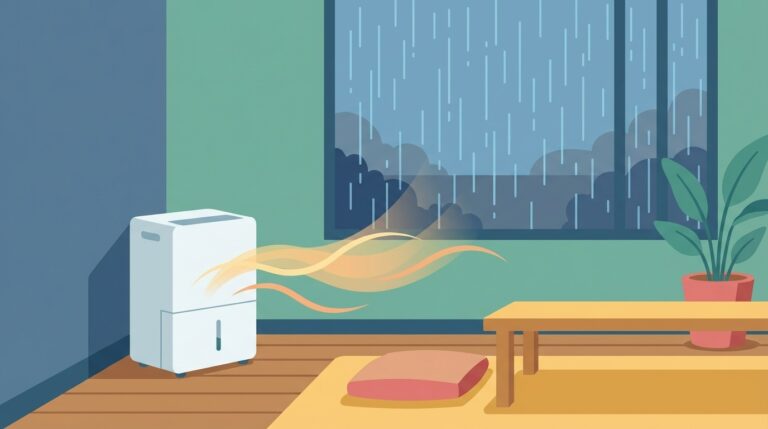
But let me tell you what happens the second the director yells “Cut!” Every Korean on set rushes indoors, complaining about the humidity, and scrambles to turn on their absolute summer lifeline: the Jeseupgi (제습기 – Dehumidifier).
Korea’s summer monsoon season, called Jangma (장마), usually hits from late June to mid-July. If you are staying in an Airbnb, a guesthouse, or visiting a Korean friend’s home during this time, knowing how to talk about the humidity and ask for a dehumidifier is pure survival. If you only use textbook Korean, you’ll sound like a weather reporter. But if you use the phrases we cover today, Koreans will look at you and think, “Wow, this person truly understands the Korean summer!”
(Note: This guide is based on real SOS messages from our students who spent their first summer in Seoul!)
Phase 2: Core Expressions Deep Dive
Here are the 3 lifesaver expressions you need when the humidity hits 90%.
1. 아, 너무 꿉꿉해요! (Ah, neomu kkupkkupaeyo!)
- Pronunciation: [ah, neo-mu kkoob-kkoob-hae-yo!] (‘꿉’ sounds like a sharp ‘koop’, spoken from the back of your throat)
- Meaning: Literal = Oh, it’s very damp! / Real nuance = Ah, I’m so sticky and sweaty, the air feels heavy, I hate this!
- K-Culture Moment: You walk into a cafe after 10 minutes of walking in the rain. You shake off your umbrella, let out a sigh, and say this to your Korean friend. They will instantly nod in deep sympathy.
- Editor’s Insight: This isn’t just about the weather; it’s a feeling. It describes that heavy, sticky sensation on your skin. It’s the ultimate bonding phrase during Jangma.
- Situation Spectrum:
- Close Friends (Casual): ✅ (아, 진짜 꿉꿉해!)
- Co-workers (Semi-formal): ✅ (오늘 날씨 좀 꿉꿉하네요.)
- Boss/Elders (Formal): ⚠️ (Use with caution; better to just say “습하네요” – it’s humid.)
- 🤔 Think About It: Korean is incredibly rich in mimetic words (words that mimic sensations). Why do you think Koreans developed a specific word just for the ‘sticky feeling’ of summer, rather than just saying “It’s hot”?
2. 제습기 좀 틀어주세요. (Jeseupgi jom teureojuseyo.)
- Pronunciation: [Je-seup-gi jom teu-reo-ju-se-yo.]
- Meaning: Literal = Please turn on the dehumidifier. / Real nuance = Can we please get the dehumidifier going? I’m melting.
- K-Culture Moment: You are in a Seoul Airbnb, and it smells a bit damp. You message your host this exact phrase.
- Editor’s Insight: Notice we use 틀다 (teulda) instead of the textbook word 켜다 (kyeoda) for turning on a machine. In spoken Korean, appliances with motors, fans, or running mechanisms (like ACs, dehumidifiers, or even music) often take ‘틀다’.
- Situation Spectrum:
- Close Friends (Casual): ✅ (야, 제습기 좀 틀자.)
- Co-workers/Hosts (Semi-formal): ✅ (제습기 좀 틀어주세요.)
- Boss/Elders (Formal): ⚠️ (제습기 좀 켜 주시겠어요? is safer.)
- 🤔 Think About It: Look at the word “좀” (a little). Koreans insert “좀” into requests to soften the blow. Does your language have a “buffer word” to make commands sound less aggressive?
3. 물통 비워야 돼요. (Multong biwoya dwaeyo.)
- Pronunciation: [Mul-tong bi-wo-ya dwae-yo.]
- Meaning: Literal = Must empty the water tank. / Real nuance = The dehumidifier is beeping because it’s full of water!
- K-Culture Moment: You are hanging out at a friend’s dorm. Suddenly, the machine plays a little melody and stops working. Your friend groans because it’s their turn to do the chore.
- Editor’s Insight: “비우다” means to empty. Dehumidifiers in Korea fill up incredibly fast during Jangma. Knowing this phrase proves you’ve actually lived the Korean summer life.
- Situation Spectrum:
- Close Friends (Casual): ✅ (물통 비워야 돼.)
- Co-workers (Semi-formal): ✅ (물통 비워야 돼요.)
- Boss/Elders (Formal): 🚫 (Just empty it quietly yourself if you’re the junior!)
Phase 3: Textbook vs. Real Korean
| Situation | 📖 Textbook Korean | 🗣️ Real Korean | 💡 Why the difference? |
|---|---|---|---|
| Complaining about weather | 날씨가 매우 습합니다. (The weather is very humid.) | 아, 진짜 꿉꿉하다! (Ah, it’s so sticky!) | Textbooks use scientific terms; real life uses sensory/mimetic words for empathy. |
| Turning on the machine | 제습기를 켜 주세요. (Please turn on the dehumidifier.) | 제습기 좀 틀어주세요. / 에어컨 제습 모드 좀 해줘. | Spoken Korean favors “틀다” for airflow appliances, and often uses the AC’s dry mode. |
| Saying it feels nice now | 공기가 건조해졌습니다. (The air has become dry.) | 아, 이제 좀 뽀송뽀송하네~ (Ah, it’s nice and fresh now~) | “건조하다” sounds like your skin is cracking. “뽀송뽀송하다” is a happy, fresh dryness! |
Phase 4: Cultural Context — K-Culture Deep Dive
4-1. The Non-Verbal “Nunchi” of Jangma
During the rainy season, Korea’s “Discomfort Index” (불쾌지수 – Bulkwaejisu) is a real metric reported on the evening news! Because everyone is sticky and sensitive, maintaining good Nunchi is crucial. If you enter a shared space (like an office or a cafe) and notice people fanning their faces or sighing, that’s your cue. You don’t just turn on the AC/Dehumidifier without asking; you look around, catch someone’s eye, and softly say, “좀 꿉꿉하죠? 틀까요?” (A bit sticky, right? Shall I turn it on?).
4-2. K-Travel Connection: The Airbnb Survival
When traveling in Korea during summer, your accommodation will likely have a dual-purpose Air Conditioner. Instead of a standalone dehumidifier, many homes rely on the AC’s 제습 모드 (Jeseup Mode – Dehumidify Mode).
If you can’t read the Korean remote control, you might accidentally turn on the heater! Look for the icon that looks like a Water Drop (💧). That is the magic button that turns a damp, miserable room into a crisp, cool oasis. Knowing how to communicate about this with your Korean host will make your stay 100x better.
Phase 5: Real-Life Roleplay Scenario
Setting: Mid-July, inside a cozy Airbnb in Yeonnam-dong, Seoul. You just arrived after walking from the subway station in the pouring rain. Your host, Min-ji, is showing you around.
Characters:
– YOU: A traveler visiting Korea for the summer, currently feeling like a wet sponge.
– Min-ji (28): Your friendly Airbnb host.
Dialogue:
Min-ji: 오시느라 고생하셨어요! 비 엄청 오죠? ☔
(Oshineura gosaenghasyeosseoyo! Bi eomcheong ojyo?)
[Thank you for coming all this way! It’s raining a lot, right?]
(🎭 Stage Direction: Min-ji hands you a dry towel.)
YOU: 네, 진짜 많이 오네요. 감사합니다.
(Ne, jinjja mani oneyo. Gamsahamnida.)
[Yes, it’s really pouring. Thank you.]
Min-ji: 수건은 저기 있고, 에어컨 리모컨은 여기 있어요.
(Sugeoneun jeogi itgo, eeokeon rimokoneun yeogi isseoyo.)
[Towels are over there, and the AC remote is here.]
🔀 Your Turn! How do you express your discomfort and ask for the magic mode?
– A) “날씨가 나빠요. 기계를 켜십시오.” (The weather is bad. Operate the machine.)
– B) “방이 덥네요. 얼음 좀 주세요.” (The room is hot. Give me ice.)
– C) “아, 너무 꿉꿉해요! 제습 모드 좀 틀어도 돼요?” (Ah, it’s so sticky! Can I turn on the dehumidifier mode?)✅ Best Choice: C — Reason: It perfectly describes the specific summer discomfort using a native word (꿉꿉해요) and asks permission politely using the natural verb “틀다”.
⚠️ Choice A Analysis: You sound like a military robot from a sci-fi movie. Never say “기계를 켜십시오” in daily life!
Min-ji: (Laughs) 아, 맞아요! 지금 바로 틀어드릴게요. 💧
(Ah, majayo! Jigeum baro teureodeurilgeyo.)
[Ah, right! I’ll turn it on for you right away.]
Phase 6: 10-Second Shadowing Drill
Repeat this sentence out loud. Pay attention to the pauses (/) and the emotion!
😩 아, / 날씨가 너무 / 꿉꿉해요! / 제습기 좀 / 틀어주세요~
(Ah, / nalssiga neomu / kkupkkupaeyo! / jeseupgi jom / teureojuseyo~)
Emotion: Express slight frustration at the first half (like you are wiping sweat), and a pleading, hopeful tone at the end!
Phase 7: K-Culture Mini Dictionary
| Korean | Romanization | English | Cultural Context |
|---|---|---|---|
| 장마 | jangma | Monsoon Season | The rainy season (late June – July). A time for Makgeolli (rice wine) and Pajeon (scallion pancakes)! |
| 꿉꿉하다 | kkupkkuphada | Sticky/Damp | The ultimate word for summer discomfort. Clothes won’t dry, skin feels sticky. |
| 제습 | jeseup | Dehumidification | Look for this word or a water drop (💧) icon on any Korean remote control. |
| 뽀송뽀송하다 | pposongpposonghada | Dry & Fresh | The exact opposite of 꿉꿉하다. The feeling of fresh laundry or skin after a shower. |
| 불쾌지수 | bulkwaejisu | Discomfort Index | A weather metric Koreans use to explain why everyone is easily annoyed in summer. |
Phase 8: Traveler Survival Kit 🆘
If you are traveling in Korea during summer, mastering the AC/Dehumidifier remote is your most important mission.
🆘 Survival Phrases: The Remote Control Guide
– 🇰🇷 “이거 제습 모드 어떻게 해요?” (Igeo jeseup modeu eotteoke haeyo?)
– 🗣️ English: How do I put this on dehumidify mode?
– 📍 Where to use: Airbnb, Guesthouse, Hotel📌 Editor’s Travel Note: Reading the Korean Remote
To survive, memorize these 4 buttons on a Korean remote:
– 전원 / 운전/정지: Power (On/Off)
– 냉방 (❄️): Cooling (Standard AC)
– 제습 (💧): Dehumidifying (Your Jangma best friend!)
– 온도 (🔼/🔽): Temperature
Pro Tip: If you wash your clothes in a Korean Airbnb during Jangma, they will NEVER dry naturally. You MUST hang them on a rack and point a running dehumidifier directly at them!
Phase 9: Critical Thinking — “One Step Deeper”
Media vs. Reality (K-Drama vs. Real Korean Life)
🧠 Think Deeper:
If you watch K-Dramas, summer rain is depicted as a tool for romance. The protagonists get caught in a sudden downpour, seek shelter under an awning, and fall in love. But the reality of Jangma is much more practical. Real Korean life during this season revolves around “defending” one’s home from mold and dampness. The obsession with Jeseupgi (dehumidifiers) and checking the Discomfort Index shows a culture highly adapted to extreme seasonal shifts. It proves that behind the polished media image, everyday Koreans are extremely practical and sensitive to their environment.💬 Your Turn: Does media in your country romanticize certain weather conditions that are actually terrible in real life? Share in the comments!
Phase 10: FAQ & Avoiding Mistakes
Q: Can I use “틀다” (teulda) for everything? Like turning on the lights?
A: No! “틀다” is only for things with a flow, sound, or motor (Water, AC, Heater, Music, TV). For lights (불), you must use “켜다” (kyeoda).
Q: Is it rude to say “꿉꿉해요” to a shop owner?
A: Not rude, but it’s a bit casual. It’s like walking into a shop and saying “Gosh, it’s sticky out there!” If you say it with a friendly smile, they will likely agree and say “맞아요, 너무 덥죠!” (Right, it’s so hot!).
❌ Common Mistake #1: Saying “날씨가 축축해요” (The weather is wet).
✅ How to fix: “축축하다” means physically wet (like a wet sponge). For the heavy, humid air, you must use “습해요” or “꿉꿉해요”.
Phase 11: Summary & Action Items
💡 One-Liner Summary: To survive the Korean rainy season, ditch the textbook and complain about the stickiness by saying “아, 꿉꿉해요!” and always know how to ask for the dehumidifier (제습기 좀 틀어주세요).
🚀 Action Missions:
– 🥉 Bronze (Solo): Look at your own AC remote control at home and pretend to press the dehumidify button while saying “제습기 좀 틀어주세요.”
– 🥈 Silver (Online): Go to a K-Pop idol’s live stream (V-live/Weverse) during July and comment: “한국 날씨 꿉꿉하죠? 건강 조심하세요!” (The weather in Korea is sticky, right? Take care of your health!)
– 🥇 Gold (Real Life): Next time you enter a Korean restaurant or cafe during a rainy day, wipe your forehead, smile at the owner, and drop a natural “아, 오늘 진짜 꿉꿉하네요!” (Ah, it’s really sticky today!). Watch their eyes light up in surprise!
Did you check your local weather today? What’s your “Discomfort Index” right now? Let me know below! 👇
Frequently Asked Questions (FAQ)
Q: What does "아, 너무 꿉꿉해요! (Ah, neomu kkupkkupaeyo!)" mean in Korean and how do you pronounce it?
A: In Korean, "아, 너무 꿉꿉해요! (Ah, neomu kkupkkupaeyo!)" is pronounced [ah, neo-mu kkoob-kkoob-hae-yo!] and means: Literal = Oh, it's very damp! / Real nuance = Ah, I'm so sticky and sweaty, the air feels heavy, I hate this!
Q: What does "제습기 좀 틀어주세요. (Jeseupgi jom teureojuseyo.)" mean in Korean and how do you pronounce it?
A: In Korean, "제습기 좀 틀어주세요. (Jeseupgi jom teureojuseyo.)" is pronounced [Je-seup-gi jom teu-reo-ju-se-yo.] and means: Literal = Please turn on the dehumidifier. / Real nuance = Can we please get the dehumidifier going? I'm melting.
Q: What does "물통 비워야 돼요. (Multong biwoya dwaeyo.)" mean in Korean and how do you pronounce it?
A: In Korean, "물통 비워야 돼요. (Multong biwoya dwaeyo.)" is pronounced [Mul-tong bi-wo-ya dwae-yo.] and means: Literal = Must empty the water tank. / Real nuance = The dehumidifier is beeping because it's full of water!







