

Phase 1: Empathy & Immersion
Hello there! I’m your lead editor and tutor at Daily Hangul.
Imagine this: You are having the time of your life in Hongdae. You’ve eaten delicious K-BBQ, visited a few trendy cafes, and suddenly realize the streets are getting a bit quiet. You reach for your phone to check the time so you don’t miss the last subway train… and your screen is black. 0% battery.
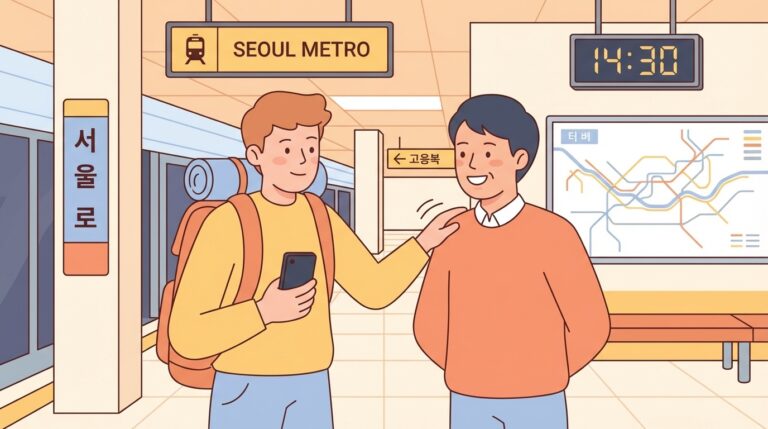
Panic sets in! The subway station is nearby, but you need to know if you still have time to make it or if you should start looking for a taxi. You see a friendly-looking local waiting for a bus. How do you ask them for the time without sounding like a robot from a textbook?
If you don’t know how to ask for the time naturally, you might miss your favorite K-Pop idol’s concert opening, arrive late for a dinner date, or find yourself stranded after the subway closes.
Don’t worry! This guide is based on real questions from my students who have successfully navigated the bustling streets of Seoul. Let’s dive into how to ask “What time is it?” like a true local.
Phase 2: Core Expressions Deep Dive
1. 지금 몇 시예요?
- Pronunciation: Jigeum myeot siyeyo? [jee-geum myut shee-ye-yo?]
- Sound-alike guide: ‘몇 (myeot)’ sounds like saying ‘mut’ (as in mutt) but with a ‘y’ sound: ‘myut’. Cut the sound off sharply at the end.
- Meaning: (Literal) Now what hour is it? / (Real nuance) What time is it now?
- K-Culture Moment: This is the most standard, everyday way to ask the time. You’ll hear this in K-Dramas when a character wakes up late, frantically asks their roommate this question, and rushes out the door with a piece of toast in their mouth.
- Editor’s Insight: The word ‘지금 (jigeum)’ means ‘now’. While you can just say “몇 시예요?”, adding ‘지금’ makes it sound much more natural and conversational.
- Situation Spectrum:
- Friends (Casual): ✅ (Drop the ‘요’ -> 지금 몇 시야?)
- Coworkers (Semi-formal): ✅
- Boss/Elders/Strangers (Formal): ⚠️ (It’s okay, but there’s a better way for strangers!)
- 🤔 Think About It: Why do Koreans often add ‘지금 (now)’ when asking the time? Could it reflect the fast-paced ‘빨리빨리 (Palli-palli / Hurry-hurry)’ culture where the present second is crucial?
2. 실례지만, 지금 몇 시인지 아세요?
- Pronunciation: Sillyejiman, jigeum myeot siinji aseyo? [shill-ye-jee-man, jee-geum myut shee-in-jee ah-se-yo?]
- Sound-alike guide: ‘실례 (Sillye)’ sounds a bit like ‘sheel-lyeh’. It’s the Korean equivalent of ‘Excuse me’.
- Meaning: (Literal) It is an impoliteness, but do you know what time it is now? / (Real nuance) Excuse me, do you have the time?
- K-Culture Moment: Picture a romantic K-Drama scene where the male lead approaches the female lead on a park bench just to strike up a conversation. This is the polite, respectful way to interrupt a stranger.
- Editor’s Insight: Korean culture places high importance on respecting others’ personal space and time. Starting with “실례지만 (Excuse me / I’m being a nuisance)” instantly softens your approach and makes the listener much more willing to help.
- Situation Spectrum:
- Friends (Casual): 🚫 (Too formal, they will think you are joking)
- Coworkers (Semi-formal): ⚠️
- Boss/Elders/Strangers (Formal): ✅
3. 우리 몇 시에 만날까요?
- Pronunciation: Uri myeot sie mannalkkayo? [oo-ree myut shee-eh man-nal-kka-yo?]
- Meaning: (Literal) We at what time shall meet? / (Real nuance) What time should we meet?
- K-Culture Moment: You’ve successfully made a Korean friend, and you are planning to go to a cafe in Seongsu-dong. This is the magic phrase to set up your schedule.
- Editor’s Insight: The ending ‘~을까요/ㄹ까요 (~eulkkayo/lkkayo)’ means ‘Shall we?’. It’s a soft, suggestive way to ask for an opinion rather than demanding a time.
- Situation Spectrum:
- Friends (Casual): ✅ (Drop ‘요’ -> 우리 몇 시에 만날까?)
- Coworkers (Semi-formal): ✅
- Boss/Elders (Formal): 🚫 (Use ‘몇 시에 뵐까요?’ instead)
Phase 3: Textbook vs. Real Korean
| Situation | 📖 Textbook Korean | 🗣️ Real Korean | 💡 Why the difference? |
|---|---|---|---|
| Asking a friend | 지금은 몇 시입니까? (Jigeumeun myeot siimnikka?) | 지금 몇 시야? (Jigeum myeot siya?) | ‘~입니까’ is military/news style. Friends use casual banmal (반말) for closeness. |
| Asking a stranger | 실례합니다. 시간 좀 알려주십시오. (Sillyehamnida. Sigan jom allyeojusipsio.) | 저기요, 실례지만 지금 몇 시예요? (Jeogiyo, sillyejiman jigeum myeot siyeyo?) | ‘저기요 (Excuse me/Hey there)’ is the ultimate attention-grabber in real life! |
| Setting a time | 몇 시에 만나는 것이 좋습니까? (Myeot sie mannaneun geosi joseumnikka?) | 몇 시쯤 볼까? (Myeot sijjeum bolkka?) | ‘쯤 (jjeum)’ means ‘around’. Koreans love leaving a bit of flexible buffer room! |
Phase 4: Cultural Context — K-Culture Deep Dive
4-1. Non-verbal Communication
When asking a stranger for the time, avoid tapping your wrist like you might in Western cultures. It can come off as slightly impatient or demanding. Instead, approach them with a slight bow of your head (a nod), make brief eye contact, and use an apologetic, polite tone.
4-2. K-Travel & The 24-Hour City
Asking the time in Korea is a vital survival skill because Korea (especially Seoul) is a 24-hour city. You have 24-hour convenience stores, late-night PC bangs (internet cafes), and restaurants that never close. However, public transportation does sleep!
The 막차 (Makcha – last train/bus) usually runs around midnight. If you lose track of time while enjoying the nightlife, you might be forced to take an expensive late-night taxi. Knowing how to ask the time and understanding schedules is the key to mastering K-Travel without breaking your budget.
Phase 5: Real-Life Roleplay Scenario
Setting: It’s 11:45 PM on a Friday. You are at the entrance of Hongdae Subway Station. Your phone died 10 minutes ago, and you are desperately trying to figure out if you’ve missed the last train to Gangnam. You spot a friendly local student holding an iced Americano.
Characters:
– YOU: A foreign traveler who needs to catch the last train.
– Min-ho (22): A local university student waiting for his friend.
Dialogue:
YOU: 저기요… 실례지만, 지금 몇 시예요? 🥺
(Jeogiyo… sillyejiman, jigeum myeot siyeyo?)
(Excuse me… I’m sorry to bother, but what time is it now?)
(🎭 Stage Direction: You approach Min-ho with a slightly worried look and a small bow.)
Min-ho: 아, 네! 지금 11시 45분이에요.
(Ah, ne! jigeum yeol-han-si sa-sib-o-bun-ieyo.)
(Ah, yes! It’s 11:45 right now.)
YOU: 헉! 진짜요? 강남행 막차 안 끊겼겠죠?
(Heok! Jinjjayo? Gangnam-haeng makcha an kkeungyeotgetjyo?)
(Gasp! Really? The last train to Gangnam hasn’t ended yet, right?)
Min-ho: 음… 잠시만요. 지하철 어플 한번 볼게요.
(Eum… jamsimanyo. Jihacheol eopeul hanbeon bolgeyo.)
(Hmm… wait a moment. Let me check the subway app.)
(🎭 Stage Direction: Min-ho quickly taps on his phone screen.)
Min-ho: 아슬아슬하네요! 11시 52분에 막차가 있어요. 빨리 가셔야 될 것 같아요!
(Aseulaseulhaneyo! yeol-han-si o-sib-i-bune makchaga isseoyo. Ppal-li gasyeoya doel geot gatayo!)
(It’s close! There’s a last train at 11:52. I think you need to go fast!)
🔀 Your Turn! Decision Point: How do you respond and say goodbye before running?
– A) “감사합니다! 안녕히 계세요!” (Thank you! Goodbye!)
– B) “몇 시예요?” (What time is it?)
– C) “대박! 짱!” (Awesome! Best!)✅ Best Choice: A — It’s textbook, but it’s the safest and most polite way to thank a stranger who went out of their way to check an app for you.
⚠️ Choice C Analysis: “대박 (Daebak)” is fun, but shouting slang at a stranger as you run away might leave them confused! And B makes no sense since he just told you the time.
Phase 6: 10-Second Shadowing Drill
Repeat after me! Pay attention to the pauses (/) and the emotion.
- 🥺 Polite & Apologetic:
저기요, / 실례지만 / 지금 몇 시인지 / 아세요?
(jeo-gi-yo, / sil-lye-ji-man / ji-geum myeot si-in-ji / a-se-yo?) -
🏃♂️ Urgent:
지금 / 몇 시예요?! / 저 / 늦었어요!
(ji-geum / myeot si-ye-yo?! / jeo / neu-jeot-seo-yo!) -
😊 Friendly Suggestion:
우리 내일 / 몇 시에 / 만날까요?
(u-ri nae-il / myeot si-e / man-nal-kka-yo?)
Phase 7: K-Culture Mini Dictionary
| Korean | Romanization | English | Cultural Context |
|---|---|---|---|
| 막차 | makcha | Last train/bus | The most crucial word for night owls in Korea. Missing the ‘makcha’ means a costly taxi ride or staying up until 5 AM! |
| 지각 | jigak | Being late | Korean culture values punctuality, especially in school and workplaces. Try to arrive 10 minutes early! |
| 눈치 | nunchi | Social awareness | If you ask the time and the person is frantically running, having ‘nunchi’ means realizing you should ask someone else. |
| 시간표 | siganpyo | Schedule/Timetable | Used for train schedules, university classes, or even K-Pop idol comeback schedules. |
Phase 8: Traveler’s Survival Kit
When traveling in Korea, you are bound to need to ask about time-related things. Here are the top survival phrases you must know!
🆘 Survival Phrases TOP 3
– 🇰🇷 1. “언제 문 열어요?” (Eonje mun yeoreoyo?)
– 🗣️ Meaning: When do you open?
– 📍 Where to use: Outside a closed cafe or store you really want to visit.
– 🇰🇷 2. “언제 문 닫아요?” (Eonje mun dadayo?)
– 🗣️ Meaning: When do you close?
– 📍 Where to use: When you enter a restaurant late at night.
– 🇰🇷 3. “얼마나 걸려요?” (Eolmana geollyeoyo?)
– 🗣️ Meaning: How long does it take?
– 📍 Where to use: Asking a taxi driver or ordering food.📌 Editor’s Travel Note
– Digital Clocks: Koreans mostly use the 12-hour clock in conversation (AM = 오전 / PM = 오후), but you will frequently see the 24-hour clock (military time) on digital displays, train tickets, and bus schedules. 18:00 is 6 PM (오후 6시)!
– Apps: To never get lost in time or space, download Naver Map or KakaoMetro. Google Maps does not give accurate walking or driving directions in Korea!
Phase 9: Critical Thinking Corner — “One Step Deeper”
Language & Power: The Politeness of Interrupting
🧠 Think Deeper:
Have you noticed that in English, asking “Do you have the time?” is quite direct, while in Korean, we almost always preface it with “실례지만 (Excuse me / It is a discourtesy, but…)”? In densely populated Korean cities where everyone is rushing, interrupting someone’s personal time is considered an intrusion. The Korean language uses these polite ‘buffer’ phrases to show respect for the other person’s boundaries and status before asking for a favor. It’s a verbal way of bowing before speaking.💬 Your Turn: How do you ask strangers for the time in your culture? Is it very casual, or do you have to apologize first? Share your thoughts in the comments!
Phase 10: FAQ & Avoiding Mistakes
Q: Can I ask an older person for the time using “지금 몇 시예요?”
Maybe, but it’s risky! While “~요” is polite, it’s not the most polite. If the person looks significantly older than you (like a grandfather or grandmother), it’s much better to use the formal version: “어르신, 실례지만 지금 몇 시인지 아세요?” (Elder, excuse me, but do you know what time it is?).
Q: How do Koreans read the numbers for time?
Ah, the ultimate boss battle of Korean time!
❌ Common Mistake #1: Mixing up the number systems!
Foreigners often say “일 시 일 분 (Il si il bun)” for 1:01. This is wrong!
✅ Do this instead: Koreans use Pure Korean numbers for the HOUR (한 시 – han si) and Sino-Korean numbers for the MINUTE (일 분 – il bun). So 1:01 is 한 시 일 분 (Han si il bun). Memorize this rule: Hours are native, minutes are imported!
Q: Do I need to say AM (오전) and PM (오후)?
Usually, no. In daily conversation, context makes it obvious. If you are eating lunch and ask the time, people know it’s 1 PM, not 1 AM. Only use 오전/오후 if you are scheduling a future meeting where it might be ambiguous.
Phase 11: Summary & Action Items
- One-Liner Summary: Always use “실례지만” (Excuse me) when asking strangers for the time, and remember the magical question: “지금 몇 시예요?”
Action Mission 3 Steps:
– 🥉 Bronze (Solo): Look at your phone right now. Say “지금 몇 시예요?” out loud to yourself 3 times.
– 🥈 Silver (Online): Find a Korean time-telling quiz online and practice the Pure Korean (Hours) + Sino-Korean (Minutes) rule.
– 🥇 Gold (Real-world): Cover up the clock on your phone and ask a Korean speaking friend or a staff member at a Korean restaurant, “실례지만 지금 몇 시예요?”
K-Culture Mission:
Go to YouTube and search for a K-Pop idol’s “Music Bank” arrival video (출근길). Notice how fans and reporters are waiting. Imagine you just arrived at the scene. Practice asking the person next to you what time the idol is supposed to arrive!
Phase 12: Quiz — Interactive Challenge
1. Situational Judgment:
You are at a coffee shop and your phone is dead. You want to ask the friendly barista what time it is. What is the BEST phrase to use?
– A) 야, 몇 시야?
– B) 저기요, 실례지만 지금 몇 시예요?
– C) 지금은 몇 시입니까?
2. True or False – K-Culture Edition:
“Koreans always use the 24-hour clock (e.g., 14:00) when speaking to friends.”
– True or False?
3. Fill in the Blank:
You are planning a dinner date.
우리 내일 저녁 _____에 만날까요? (What time shall we meet tomorrow evening?)
– A) 몇 분
– B) 몇 시간
– C) 몇 시
(Answers: 1. B – ‘A’ is too rude/casual for a stranger, ‘C’ is too robotic. / 2. False – They use the 12-hour clock in speech! / 3. C – 몇 시 means ‘what time’.)
Happy learning, and see you in the next lesson! Don’t be late! 😉
Frequently Asked Questions (FAQ)
Q: What does "지금 몇 시예요?" mean in Korean and how do you pronounce it?
A: In Korean, "지금 몇 시예요?" is pronounced [Jigeum myeot siyeyo? [jee-geum myut shee-ye-yo?] and means: (Literal) Now what hour is it? / (Real nuance) What time is it now?
Q: What does "실례지만, 지금 몇 시인지 아세요?" mean in Korean and how do you pronounce it?
A: In Korean, "실례지만, 지금 몇 시인지 아세요?" is pronounced [Sillyejiman, jigeum myeot siinji aseyo? [shill-ye-jee-man, jee-geum myut shee-in-jee ah-se-yo?] and means: (Literal) It is an impoliteness, but do you know what time it is now? / (Real nuance) Excuse me, do you have the time?
Q: What does "우리 몇 시에 만날까요?" mean in Korean and how do you pronounce it?
A: In Korean, "우리 몇 시에 만날까요?" is pronounced [Uri myeot sie mannalkkayo? [oo-ree myut shee-eh man-nal-kka-yo?] and means: (Literal) We at what time shall meet? / (Real nuance) What time should we meet?







