

Phase 1: Welcome to the Gray Days of Spring
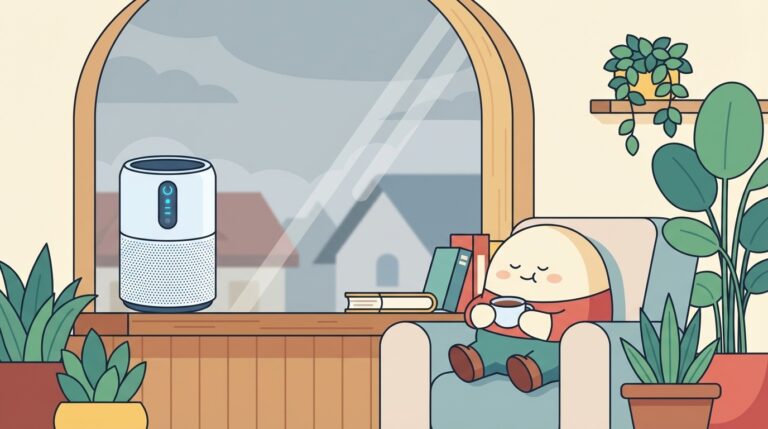
Hello! I’m your Daily Hangul editor. Imagine this: You’ve finally arrived in Seoul. You drop your bags at your cozy Airbnb in Hongdae, ready to explore the neon-lit streets you’ve seen in countless K-Dramas. But when you look out the window, the N Seoul Tower is hiding behind a hazy, gray fog.
No, it’s not a romantic morning mist. Welcome to Korea’s 미세먼지 (Mise-meonji, Fine Dust) season.
In K-Dramas, you might see the handsome lead checking a weather app before handing his crush a mask. But in real life? The true hero is the 공기청정기 (Air Purifier). Whether you’re in an Airbnb, a trendy cafe, or a friend’s house, knowing how to ask someone to turn on the air purifier is a literal breath of fresh air.
Don’t worry if you’re an absolute beginner (A1 level). Today, I’ll teach you exactly how to survive the fine dust season like a true local!
Phase 2: Core Expressions – Deep Dive
Let’s learn the magic words to get that fresh air flowing.
1. 공기청정기 좀 켜 주세요.
- Pronunciation: Gong-gi-cheong-jeong-gi jom kyeo ju-se-yo.
- Sound-alike guide:
- Gong-gi (rhymes with ‘pong-gee’) = Air
- Cheong-jeong (chung-jung) = Clean
- Gi (gee) = Machine
- Kyeo (k-yo) = Turn on
- Meaning: (Literal) Please turn on the air clean machine a little. (Real) Please turn on the air purifier.
- K-Culture Moment: You walk into a beautifully aesthetic cafe in Seongsu-dong, but the door has been open all morning. The air feels heavy. You walk up to the barista, smile, and say this phrase. They’ll instantly nod and crank up the giant, sleek air purifier in the corner.
- Editor’s Insight: The word 좀 (jom) literally means “a little,” but we use it as a social softener. It makes a direct request sound much more polite and gentle, like adding “could you please” instead of just “do this.”
- Situation Spectrum:
- Close Friends (Casual): 🚫 (Too formal, drop ‘ju-se-yo’)
- Cafe Staff/Airbnb Host (Semi-formal): ✅ (Perfect!)
- Elders/Boss (Formal): ✅ (Safe and polite)
- 🤔 Think About It: Why do Koreans love adding “좀 (a little)” to soften requests? Does your native language have a similar way to make an order sound less bossy?
2. 미세먼지가 심해요.
- Pronunciation: Mi-se-meon-ji-ga sim-hae-yo.
- Sound-alike guide: Mi-se-mun-jee-gah sheem-hay-yo.
- Meaning: The fine dust is severe/bad.
- K-Culture Moment: This is the ultimate small-talk starter in Korea during spring. Just like British people talk about the rain, Koreans bond over complaining about mise-meonji while waiting for the bus.
- Editor’s Insight: Use this right before asking to turn on the air purifier. It gives a perfect, polite reason for your request!
- Situation Spectrum:
- Close Friends (Casual): ⚠️ (Say “심하다” instead)
- Coworkers/Acquaintances (Semi-formal): ✅
- Strangers (Formal): ✅
- 🤔 Think About It: Small talk topics vary by geography. What is the most common “weather complaint” small talk in your hometown?
Phase 3: Textbook vs. Real Korean
| Situation | 📖 Textbook Korean | 🗣️ Real Korean | 💡 Why the difference? |
|---|---|---|---|
| Asking cafe staff to turn on the purifier | 공기청정기를 작동시켜 주시겠습니까? (Would you please operate the air purifier?) | 공기청정기 좀 켜 주세요. (Please turn on the air purifier.) | “작동시키다 (operate)” sounds like you are launching a spaceship. Keep it simple with “켜다 (turn on)”. |
| Talking about bad air | 오늘 대기 오염이 심각합니다. (Today’s air pollution is serious.) | 오늘 미세먼지 장난 아니에요. (Today’s fine dust is no joke.) | “장난 아니다 (no joke)” is a super common, natural way to express that something is extreme. |
Bottom Note: For beginners, “켜 주세요 (Please turn on)” is your golden ticket. You can put almost any electronic device in front of it! (TV 좀 켜 주세요, 에어컨 좀 켜 주세요).
Phase 4: Cultural Context — K-Culture Deep Dive
4-1. Non-Verbal Communication (Nunchi)
In Korea, reading the room (눈치 – Nunchi) is crucial. If you’re in a tiny cafe and everyone else seems fine, demanding the air purifier on high blast might be a bit too much.
Pro Tip: Instead of shouting across the room, walk quietly to the counter, point gently at the air purifier (use your whole hand, not just one finger!), and softly say, “공기청정기 좀 켜 주세요.”
4-2. The “Mise-Mise” App Lifestyle
If you live in or visit Korea, downloading a fine dust app is mandatory. The most famous one is called 미세미세 (Mise-mise).
It doesn’t just show numbers; it shows dramatic emojis. When the air is great, you see a grinning face with hearts. When it’s bad, the screen turns black with a literal gas-mask-wearing devil emoji!
When Koreans see that black screen, it means one thing: cancel the outdoor Han River picnic, order delivery food on Baemin, and hug your indoor air purifier.
Phase 5: Real-Life Roleplay Scenario
Setting: It’s 2:00 PM on a dusty Thursday. You are staying at a guesthouse in Bukchon Hanok Village. The living room looks beautiful, but your throat feels scratchy from the outdoor air. The Guesthouse Manager is organizing some brochures.
Characters:
– YOU: A traveler trying to survive the spring dust.
– Manager Kim: A friendly Korean host in her 40s.
Dialogue:
Manager Kim: 오늘 여행은 어땠어요? 재미있었어요? 😊
(Oneul yeohaeng-eun eottaesseoyo? Jaemi-isseosseoyo?)
[How was your trip today? Was it fun?]
YOU: 네! 근데 밖이 너무 뿌얘요.
(Ne! Geunde bakki neomu ppuyaeyo.)
[Yes! But it’s so hazy outside.]
Manager Kim: 맞아요. 오늘 미세먼지가 너무 심하죠?
(Majayo. Oneul mi-se-meon-ji-ga neomu simhajo?)
[Right. The fine dust is really bad today, isn’t it?]
(🎭 Stage Direction: Manager Kim coughs lightly and looks out the window)
🔀 YOUR TURN! How do you respond?
– A) (Cough dramatically and point at the machine)
– B) 아, 공기청정기 좀 켜 주세요.
– C) 매니저님, 공기청정기를 작동시켜 주시겠습니까?✅ Best Choice: B. It’s polite, natural, and gets the job done smoothly.
⚠️ Choice A Analysis: While non-verbal communication is okay, speaking shows respect and builds a bond with your host!
⚠️ Choice C Analysis: Too robotic! The manager might think you’re reading from a 1990s textbook.
Manager Kim: 아, 네! 바로 켜 드릴게요.
(Ah, ne! Baro kyeo deurilgeyo.)
[Ah, yes! I’ll turn it on right away.]
YOU: 감사합니다!
(Gamsahamnida!)
[Thank you!]
Phase 6: 10-Second Shadowing Drill
Let’s practice getting the rhythm right! Korean flows best when you pause at the right spots.
🥺 저기요, / 공기청정기 좀 / 켜 주세요~
(Jeogiyo, / gong-gi-cheong-jeong-gi jom / kyeo ju-se-yo~)
[Excuse me, please turn on the air purifier.]
Voice tip: Say “Jeogiyo” softly to get their attention, pause, then say the rest with a gentle, friendly tone. Don’t drop your pitch too sharply at the end; keep it slightly lifted or flat!
Phase 7: K-Culture Mini Dictionary
| Korean | Romanization | English | Context |
|---|---|---|---|
| 미세먼지 | mi-se-meon-ji | Fine Dust | PM 10 particles. The general term for bad air pollution. |
| 초미세먼지 | cho-mi-se-meon-ji | Ultrafine Dust | PM 2.5 particles. The really bad stuff. When this is high, wear a KF94 mask! |
| 마스크 | ma-seu-keu | Mask | Essential survival item. You can buy them at any convenience store. |
| 켜다 / 끄다 | kyeo-da / kkeu-da | Turn on / Turn off | Works for lights, TVs, ACs, and air purifiers. |
| 환기 | hwan-gi | Ventilation | Opening windows to let fresh air in (only done on “good air” days!). |
Phase 8: Traveler’s Survival Kit
Since fine dust affects your travel plans, here are your must-know survival phrases for cafes, taxis, and Airbnbs!
🆘 Survival Phrase #1: In a Taxi
– 🇰🇷 “기사님, 창문 좀 닫아 주세요.”
– 🗣️ Gi-sa-nim, chang-mun jom da-da ju-se-yo.
– [Driver, please close the window.]
– 💡 Pro Tip: Taxis don’t usually have air purifiers, so if the driver has the window open on a dusty day, politely use this phrase!🆘 Survival Phrase #2: Buying a Mask
– 🇰🇷 “마스크 있어요?”
– 🗣️ Ma-seu-keu i-sseo-yo?
– [Do you have masks?]
– 💡 Pro Tip: Head to any CU, GS25, or 7-Eleven. Look for “KF94” on the package. It blocks 94% of fine dust!
📌 Editor’s Travel Note:
– Must-have App: Download Mise-mise (미세미세) or check the Naver Weather app daily.
– Clothing Tip: On high dust days, avoid wearing wool sweaters or fleece as a top layer—they trap the dust!
Phase 9: Critical Thinking — “One Step Deeper”
Environment & Modern Korean Lifestyle
Why are air purifiers in literally every room in Korea? It’s a mix of geography and modern industrialization. Because fine dust blows in seasonally and traps local pollution due to the mountainous terrain, clean air has become a premium commodity. It’s not just an appliance; it’s a symbol of caring for your guests. When a cafe owner installs three massive air purifiers, they are silently communicating to their customers: “I care about your health and comfort.”
🧠 Think Deeper:
This shows how environmental changes shape local consumer culture. In Korea, “clean air” has become a service you provide to others.💬 Your Turn: How does your country deal with air quality? Do you have specific appliances or cultural habits related to the weather? Share in the comments!
Phase 10: FAQ & Avoiding Mistakes
Q: Can I use “켜 주세요” for turning on the lights or the heater?
Yes! That’s the beauty of this phrase.
– TV 좀 켜 주세요 (TV)
– 히터 좀 켜 주세요 (Heater)
– 에어컨 좀 켜 주세요 (Air conditioner)
Q: Is it rude to wear a mask inside a store or while talking to someone?
Not at all! Since COVID-19 and years of fine dust, wearing a mask indoors is completely socially acceptable and seen as a personal health choice.
❌ Common Mistake #1: Trying to translate “machine” (기계) literally. Do not say “공기 기계 (Air machine)”. It sounds like a sci-fi weapon. Stick to 공기청정기 (Gong-gi-cheong-jeong-gi).
❌ Common Mistake #2: Pointing at the machine with your index finger like you’re scolding it. Use an open palm gesture when gesturing toward the appliance to be polite!
Phase 11: Summary & Action Items
One-Liner Summary: Add “공기청정기 좀 켜 주세요” to your survival vocabulary, and you’ll always breathe easy in Korea!
Your 3-Step Action Mission:
– 🥉 Bronze (Solo): Look around your room right now, point at any electronic device, and say “[Device Name] 좀 켜 주세요” out loud 3 times.
– 🥈 Silver (Online): Download a Korean weather app (like Naver Map’s weather widget or Mise-mise) and check today’s air quality in Seoul!
– 🥇 Gold (Real-world): Next time you visit a Korean restaurant or cafe, find where their air purifier is hiding. (I guarantee they have one!)
K-Culture Mission: Watch any modern K-Drama set in an office. Look at the background of the CEO’s office or the living room. I challenge you to spot the sleek, white air purifier!
Phase 12: Interactive Quiz
Test your new survival skills!
1. You are freezing in a Korean cafe. How do you ask them to turn on the heater (히터)?
A) 히터가 심해요.
B) 히터 좀 켜 주세요.
C) 마스크 있어요?
2. True or False: In Korea, it’s considered rude to wear a mask while talking to a cashier.
3. Which app is the ultimate survival tool for checking fine dust in Korea?
A) KakaoTaxi
B) Baedal Minjok
C) Mise-mise
Answers (Click to reveal!)
1. B (히터 좀 켜 주세요 – Please turn on the heater.)
2. False (It’s perfectly normal and expected, especially during fine dust season!)
3. C (Mise-mise! Look for the angry devil mask when the air is bad!)
Frequently Asked Questions (FAQ)
Q: What does "공기청정기 좀 켜 주세요." mean in Korean and how do you pronounce it?
A: In Korean, "공기청정기 좀 켜 주세요." is pronounced [Gong-gi-cheong-jeong-gi jom kyeo ju-se-yo.] and means: a key conversational Korean expression covered in this lesson.
Q: What does "미세먼지가 심해요." mean in Korean and how do you pronounce it?
A: In Korean, "미세먼지가 심해요." is pronounced [Mi-se-meon-ji-ga sim-hae-yo.] and means: a key conversational Korean expression covered in this lesson.







