

Hello! I’m the Lead Editor of Daily Hangul.
Imagine this: You’re watching a classic K-Drama. The male lead—usually a young, handsome Chaebol CEO—is dealing with massive corporate stress or a broken heart. What does he do? He goes to an empty, dimly lit, luxurious indoor pool and aggressively swims the butterfly stroke (접영). The water splashes dramatically in slow motion.
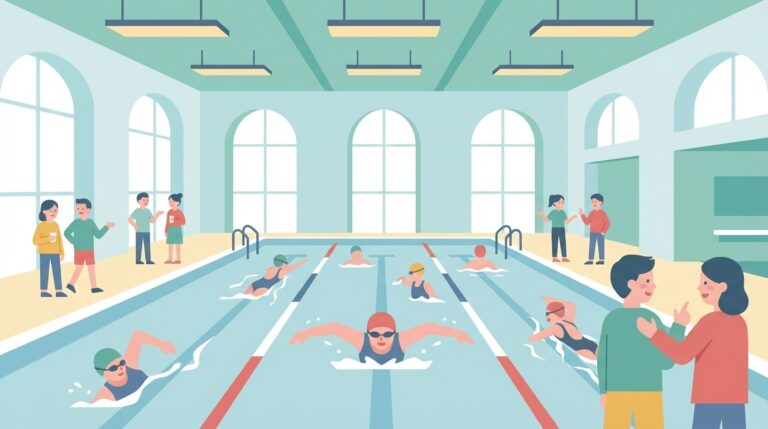
But let’s cut to reality. If you visit a local ‘구민체육센터’ (district sports center) in Seoul at 6 AM, there’s no brooding CEO. Instead, you’ll find a fiercely energetic squad of Korean ajummas and ajeossis doing relentless laps, chatting at the end of the lane, and sharing post-workout snacks.
As a C1 Korean learner, you already know the basic verb 수영하다 (to swim). But if you join a pool in Korea, you’ll quickly realize that knowing the names of the strokes—자유형 (Freestyle), 평영 (Breaststroke), 배영 (Backstroke), and 접영 (Butterfly)—is just the tip of the iceberg. To truly fit in, you need to understand the pool nunchi, the intense coaching jargon, and the unique community culture that thrives in the humid air of a Korean swimming pool.
Let’s dive into the deep end of real Korean swimming culture!
Phase 2: Core Expressions Deep Dive
If you want to talk to your Korean coach or your lane-mates naturally, these are the expressions you need.
1. 자유형 할 때 호흡이 안 트여요.
- Pronunciation: jayuhyeong hal ttae hoheubi an teuyeoyo. (ho-heu-bi an teu-yeo-yo)
- Meaning: (Literal) My breathing doesn’t open up when doing freestyle. / (Real nuance) I can’t catch my breath/find a natural breathing rhythm during freestyle.
- K-Culture Moment: You’ll hear this constantly in the beginner and intermediate lanes. In Korea, coaches emphasize breathing heavily. ‘호흡이 터지다’ (breathing bursts open) is a common sports idiom used when a runner or swimmer finally finds their second wind and their breathing becomes effortless.
- Editor’s Insight: The verb ‘트이다’ means ‘to be cleared’ or ‘opened up’. We use it for blocked roads, blocked ears, and yes, blocked breathing in sports. It shows a much higher level of fluency than just saying ‘숨쉬기 어려워요’ (It’s hard to breathe).
- Situation Spectrum:
- Casual with pool buddies: ✅
- Semi-formal to your coach: ✅
- Formal business: 🚫 (Unless discussing literal sports)
- 🤔 Think About It: Why do Koreans use the passive/intransitive verb ‘트이다’ (to be opened) instead of ‘I can’t breathe’? It reflects a mindset where a physical state is something that happens to you over time, rather than something you actively control right away.
2. 물을 제대로 잡아야 앞으로 쭉쭉 나가죠.
- Pronunciation: mureul jedaero jabaya apeuro jjukjjuk nagajyo.
- Meaning: (Literal) You have to catch the water properly to go straight forward. / (Real nuance) You need a good ‘catch’ in your stroke to glide through the water efficiently.
- K-Culture Moment: This is the ultimate advice from the ‘고인물’ (veteran/expert) at the pool. When you are struggling with your backstroke (배영) or breaststroke (평영), an older swimmer might tap you on the shoulder and give you this advice.
- Editor’s Insight: ‘물을 잡다’ (catching water) is the exact terminology Korean coaches use for the pull phase of a stroke. The mimetic word ‘쭉쭉’ adds the visual feeling of gliding effortlessly.
- Situation Spectrum:
- Casual: ✅
- Semi-formal: ✅
- Formal: 🚫
- 🤔 Think About It: Korean is incredibly rich in mimetic words (의태어) like ‘쭉쭉’ (stretching out) or ‘첨벙첨벙’ (splashing). How does adding these sound-words change the flavor of a conversation compared to English?
3. 수영의 꽃은 접영 아닙니까? 오늘 뺑뺑이 좀 돕시다!
- Pronunciation: suyeongui kkocheun jeobyeong animnikka? oneul ppaengppaengi jom dopsida!
- Meaning: (Literal) Isn’t butterfly the flower of swimming? Let’s turn around and around today! / (Real nuance) Butterfly is the ultimate swimming stroke! Let’s do non-stop laps today!
- K-Culture Moment: In Korea, learning the butterfly stroke (접영) is considered graduation from amateur status. It’s often called ‘수영의 꽃’ (the flower of swimming)—meaning the highlight or the pinnacle. ‘뺑뺑이’ is a fun, slightly intense slang term for doing continuous, grueling laps without resting.
- Editor’s Insight: If you jokingly suggest ‘뺑뺑이 돌다’ to your Korean friends, they will instantly accept you as an insider. It implies a love-hate relationship with tough workouts.
- Situation Spectrum:
- Casual/Swim Buddies: ✅
- Semi-formal (Coach to student): ⚠️ (Coaches use it, but students shouldn’t command coaches!)
- Formal: 🚫
Phase 3: Textbook vs. Real Korean
When you leave the textbook and hit the chlorinated water, the vocabulary shrinks into highly efficient slang.
| Situation | 📖 Textbook Korean | 🗣️ Real Korean | 💡 Why the difference? |
|---|---|---|---|
| Going for a free swim | 오늘 자유 수영 갈 거예요. | 오늘 자수 갈 거예요. | Koreans love abbreviating 4-syllable words into 2 syllables for efficiency. |
| Talking to a pool friend | 제 수영장 친구예요. | 제 수친이에요. | Just like ‘밥친’ (meal friend), modern Koreans categorize friends by specific activities. |
| Buying a swimsuit | 새 수영복을 샀어요. | 새 셩복 샀어요. | ‘수영’ is often contracted to ‘셩’ in typing and casual speech. |
| Swimming laps continuously | 왕복으로 계속 수영합시다. | 우리 뺑뺑이 돕시다. | ‘뺑뺑이’ emphasizes the dizzying, repetitive nature of the exercise. |
Bottom Note: As a C1 learner, dropping a casual “오늘 자수 가세요?” (Are you going to free swim today?) to your lane-mate will earn you instant respect.
Phase 4: Cultural Context — K-Culture Deep Dive
4-1. The Ultimate ‘Nunchi’ Zone: The Swimming Lane
A Korean swimming pool is a microcosm of Korean society. There are strict, unwritten rules driven by 눈치 (Nunchi). Lanes are usually divided by speed: 초급 (Beginner), 중급 (Intermediate), 상급 (Advanced), and 연수/마스터즈 (Masters).
If you jump into the 상급 (Advanced) lane and do a slow breaststroke while others are doing high-speed butterfly sprints, you will feel the burning gaze of a dozen people. Nunchi dictates that you:
1. Always swim on the right side of the lane.
2. If someone taps your toes, it means they are faster; you must pause at the end of the lane to let them pass.
3. Never rest in the middle of the wall—stand at the corners so others can do their flip turns!
4-2. The Post-Swim Ritual (K-Food Connection)
If K-Dramas have taught us anything, it’s that every strenuous activity in Korea is followed by specific food. After going to a public bathhouse (목욕탕), you drink Banana Flavored Milk (바나나맛 우유). The same rule applies to the community swimming pool. The mixture of the smell of chlorine, the exhaustion from 뺑뺑이, and the sweet taste of a cold banana milk in the lobby is a core memory for anyone who grew up swimming in Korea. Furthermore, if you take morning classes, ‘수친’ (swim friends) often head straight to a local ‘국밥’ (hot soup and rice) restaurant together. Sweating in the pool, sweating over hot soup—it’s the ultimate Korean bonding experience.
Phase 5: Real-Life Roleplay Scenario
Setting: Tuesday, 7:00 AM. The Advanced Lane at a local district sports center in Seoul. You are leaning against the pool wall, completely out of breath. The water is churning as people finish their laps.
Characters:
– YOU: An expat who recently moved up to the Advanced lane. Still struggling with stamina.
– Minji (30s): Your ‘수친’ (swim buddy). Enthusiastic, swims like a dolphin, and loves giving advice.
Minji: 헉헉… 오늘 강사님 진짜 너무한 거 아니에요? 😭
(heokheok… oneul gangsanim jinjja neomuhan geo anieyo?)
[Translation] Pant, pant… Isn’t the instructor being too harsh today?
(🎭 Stage Direction: Minji wipes water from her goggles and takes deep breaths.)
YOU: 제 말이요. 아까 접영으로 뺑뺑이 돌 때 진짜 죽는 줄 알았어요.
(je mariyo. akka jeobyeong-euro ppaengppaengi dol ttae jinjja jungneun jul arasseoyo.)
[Translation] Tell me about it. I thought I was going to die earlier when we were doing continuous butterfly laps.
Minji: OO씨 그래도 자유형 할 때 물 엄청 잘 타던데요? 폼이 완전 부드러워졌어요!
(OO-ssi geuraedo jayuhyeong hal ttae mul eomcheong jal tadeondeyo? pomi wanjeon budeureowojyeosseoyo!)
[Translation] But OO, you were really riding the water well during freestyle! Your form has become so smooth!
🔀 Your Turn! How do you respond to the compliment?
– A) “아니에요, 아직 배영할 때 다리가 자꾸 가라앉아서 고민이에요.” (Humble and realistic)
– B) “네, 제가 수영에 좀 소질이 있는 것 같아요!” (Confident, but risky)
– C) “강사님이 잘 가르쳐주신 덕분이죠 뭐.” (Textbook perfect, slightly formal)✅ Best Choice for C1: A — Why? In Korean culture, denying a compliment while pointing out a specific area you are still working on (like your legs sinking during backstroke) shows humility and provides a great conversation starter for Minji to give you tips.
⚠️ Choice B Analysis: While confidence is great, saying you have a ‘talent’ (소질) right after struggling might make you sound a bit boastful to a Korean peer, breaking the mutual bonding over exhaustion.
Minji: 배영이 원래 코어 힘이 많이 필요하잖아요. 끝나고 바나나 우유 하나 콜?
(baeyeongi wollae koeo himi mani piryohajannayo. kkeunnago banana uyu hana kol?)
[Translation] Backstroke naturally requires a lot of core strength. Wanna grab a banana milk after we finish?
YOU: 무조건 콜이죠! 제가 쏠게요.
(mujogeon korijyo! jaega ssolkkeyo.)
[Translation] Absolutely! It’s on me.
Phase 6: 10-Second Shadowing Drill
Time to sound like a native who just survived a grueling workout. Pay attention to the pauses (/) and the intonation!
😫 아, / 오늘 접영으로 / 뺑뺑이 돌았더니 / 팔이 안 올라가요...
(Ah, / oneul jeobyeong-euro / ppaengppaengi doratdeoni / pari an ollagayo…)
Meaning: Ah, my arms won’t go up after doing continuous butterfly laps today…
- Tip: Drag out the “아~” with a deep sigh to show true exhaustion. Emphasize “뺑뺑이” with a strong ‘ㅃ’ sound!
Phase 7: K-Culture Mini Dictionary
Master these terms to navigate the pool like a local.
| Korean | Romanization | English | Context/Explanation |
|---|---|---|---|
| 수켓팅 | suketing | Swimming Registration Warfare | A portmanteau of 수영 (swimming) + 티켓팅 (ticketing). Getting a spot in a public pool class is as hard as buying K-Pop concert tickets. |
| 자수 | jasu | Free Swimming | Short for 자유 수영. Non-class hours where you swim at your own pace. |
| 오리발 | oribal | Swim Fins / Playing Dumb | Literally ‘duck feet’. Used for the equipment, but “오리발 내밀다” is a famous idiom meaning to feign innocence or pretend you don’t know something. |
| 뺑뺑이 | ppaengppaengi | Continuous Laps | Slang for swimming back-and-forth continuously without stopping. |
| 킥판 | kikpan | Kickboard | The essential tool for practicing your 평영 (breaststroke) kicks! |
Phase 8: Traveler Survival Kit 🧳
If you’re visiting Korea and want to maintain your swimming routine, here is what you need to know at the community sports center.
🆘 Survival Phrases for the Front Desk
– 🇰🇷 “오늘 일일 입장(자유 수영) 되나요?”
– 🗣️ (oneul iril ipjang (jayu suyeong) doenayo?)
– 🇺🇸 “Can I get a daily pass (for free swimming) today?”
– 💡 Pro Tip: Public pools have strict hours for ‘일일 입장’ (daily entry). You cannot just walk in at any time. Always check the schedule first!📌 Editor’s Travel Note: The Mandatory Shower Rule
This is crucial! In Korea, it is strictly forbidden to put on your swimsuit at home and jump into the pool. You must take a full shower with soap and shampoo in the locker room shower area before putting on your swimsuit and entering the pool. If you walk into the pool area completely dry, the ajummas will definitely scold you. It’s a matter of public hygiene and deep respect for shared spaces.
Phase 9: Critical Thinking Corner — “한 발 더 깊이”
🧠 Think Deeper: The Community of the Public Bath and Pool
In many Western cultures, swimming is often an individual, highly private workout. However, in Korea, public swimming pools are extensions of the traditional 목욕탕 (public bathhouse) culture. The locker rooms and shower areas are places of intense social bonding. People share their shampoo, scrub each other’s backs, and share local gossip. This blurs the line between public and private spaces. Even the strict rules—like the mandatory pre-shower or lane nunchi—exist because Koreans view the pool as a shared, collective entity rather than a facility for independent use.
💬 Your Turn: Does your home country have sports facilities that serve as community hubs? How does the etiquette differ from what you’ve read about Korea? Let’s discuss in the comments!
Phase 10: FAQ & Avoiding Misunderstandings
Q: Is it okay to overtake someone in the lane if they are swimming too slowly?
A: Yes, but only in specific ways. You should lightly tap their foot once. This is the universal nunchi signal. At the end of the lane, the slower swimmer will move to the right corner, and you can pass them. Do not aggressively swim over them mid-lane!
Q: Can I use the slang ‘뺑뺑이’ with the front desk staff?
A: No, ‘뺑뺑이’ is casual slang for the physical act of swimming laps. If you are asking about the pool structure, use “왕복 수영” (round-trip swimming).
❌ Common Mistake #1: Calling the strokes by their English names with a Korean accent (e.g., “프리스타일”, “버터플라이”).
✅ Do This Instead: While young people might understand, standard Korean swimming terminology strictly uses the Sino-Korean words: 자유형, 평영, 배영, 접영.
Phase 11: Summary & Action Items
- One-Liner Summary: Mastering Korean swimming strokes (자유형, 평영, 배영, 접영) is just as much about learning the physical technique as it is about reading the nunchi of the lane and embracing the community culture!
🎯 Action Missions:
– 🥉 Bronze: Say the four strokes out loud in front of a mirror: “자유형, 평영, 배영, 접영.”
– 🥈 Silver: Leave a comment below using the word ‘수친’ to describe someone you’d like to go swimming with.
– 🥇 Gold: Next time you visit a pool in Korea, ask the person next to you, “접영할 때 물잡기 너무 어렵지 않아요?” (Isn’t catching the water during butterfly so hard?)
🏊♀️ K-Culture Mission:
Search YouTube for “한국 수영장 브이로그” (Korean Swimming Pool Vlog). Observe the fast-paced nature of the lanes and see if you can spot anyone drinking banana milk afterward!
Phase 12: Interactive Challenge (Quiz)
Let’s test your C1 Korean intuition!
1. Situational Judgment: You are resting at the wall. A very fast swimmer behind you taps your foot right before the wall. What should you do?
– A) Immediately start swimming faster to keep up.
– B) Stop at the center of the wall and apologize.
– C) Move to the corner of the wall so they can do their flip turn and pass you.
2. Fill in the Blank:
“오늘 강사님이 안 오셔서, 한 시간 내내 ( ) 돌았어요. 팔이 끊어질 것 같아요.”
– A) 오리발
– B) 뺑뺑이
– C) 수켓팅
3. True or False – K-Culture Edition:
It is acceptable to wear your swimsuit from home to the pool as long as you rinse off quickly before jumping in. (T/F)
(Answers: 1: C, 2: B, 3: False – You must take a full shower with soap before putting on your swimsuit!)
Frequently Asked Questions (FAQ)
Q: What does "자유형 할 때 호흡이 안 트여요." mean in Korean and how do you pronounce it?
A: In Korean, "자유형 할 때 호흡이 안 트여요." is pronounced [jayuhyeong hal ttae hoheubi an teuyeoyo. (ho-heu-bi an teu-yeo-yo] and means: (Literal) My breathing doesn't open up when doing freestyle. / (Real nuance) I can't catch my breath/find a natural breathing rhythm during freestyle.
Q: What does "물을 제대로 잡아야 앞으로 쭉쭉 나가죠." mean in Korean and how do you pronounce it?
A: In Korean, "물을 제대로 잡아야 앞으로 쭉쭉 나가죠." is pronounced [mureul jedaero jabaya apeuro jjukjjuk nagajyo.] and means: (Literal) You have to catch the water properly to go straight forward. / (Real nuance) You need a good 'catch' in your stroke to glide through the water efficiently.
Q: What does "수영의 꽃은 접영 아닙니까? 오늘 뺑뺑이 좀 돕시다!" mean in Korean and how do you pronounce it?
A: In Korean, "수영의 꽃은 접영 아닙니까? 오늘 뺑뺑이 좀 돕시다!" is pronounced [suyeongui kkocheun jeobyeong animnikka? oneul ppaengppaengi jom dopsida!] and means: (Literal) Isn't butterfly the flower of swimming? Let's turn around and around today! / (Real nuance) Butterfly is the ultimate swimming stroke! Let's do non-stop laps today!







