

Phase 1: Empathy — The Morning Panic
Hello! I’m your Lead Editor at Daily Hangul, and your personal guide to all things Korean.
Picture this: You’re in a beautiful hotel in Seoul. Last night, you stayed up until 3 AM binge-watching that new K-Drama and eating crispy Korean fried chicken. Now, you wake up, look at your phone, and your heart drops. Wait, what time do I have to leave? Is it 11 AM? 12 PM?
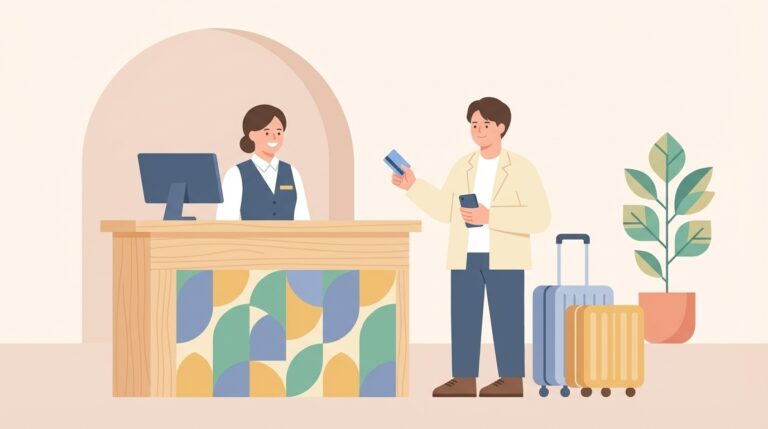
You rush to the lobby, approach the front desk, and… your mind goes blank. In the drama, they just said “I’m leaving!” and dramatically stormed out. But you can’t exactly do that with your heavy suitcase, right?
I’ve seen so many of my students panic in this exact situation. They try to use complex textbook grammar to ask about departure procedures, only to be met with a confused blink from the hotel staff. Don’t worry! Today, we are going to learn the easiest, most natural way to ask about checkout times and even sneak in a request for a late checkout, Korean style.
This guide is packed with real-life experiences from travelers just like you. Let’s dive in!
Phase 2: Deep Dive into Core Expressions
Here are the top phrases you need to survive a Korean hotel morning.
1. 체크아웃이 몇 시예요? (What time is checkout?)
- Pronunciation: chekeu-ausi myeot siyeyo? [che-koo-out-shee myut she-yeah-yo?]
- Meaning: Literal: Checkout, what time is it? / Real nuance: What time is checkout?
- K-Culture Moment: You’ll hear this English loanword (체크아웃) used absolutely everywhere in Korea. You don’t need to learn a fancy traditional word for “vacating the room.” Just add “몇 시예요?” (What time is it?) to the end of any event!
- Editor’s Insight: The pronunciation of ‘si’ (시) sounds exactly like the English word “she”. Don’t overthink it!
- Situation Spectrum:
- Casual with friends: 휴 체크아웃 몇 시야? (Wait, what time is checkout?)
- Semi-formal (Hotel Staff): ✅ 체크아웃이 몇 시예요?
- Highly Formal: ⚠️ (체크아웃 시간이 언제입니까? – A bit too robotic for a tourist).
- 🤔 Think About It: Notice how Koreans use the English word “Checkout” instead of translating it? In modern Korea, hospitality terms are heavily influenced by English. Why do you think that is?
2. 늦게 체크아웃할 수 있어요? (Can I check out late?)
- Pronunciation: neutge chekeu-aut-hal su isseoyo? [noot-geh che-koo-out-hal soo ee-suh-yo?]
- Meaning: Literal: Can I do late checkout? / Real nuance: Is a late checkout possible?
- K-Culture Moment: You just had a “Hocance” (회캉스 – Hotel + Vacance), and you want to enjoy the fluffy hotel bed for just one more hour. This is your magic phrase.
- Editor’s Insight: The pattern “~ 할 수 있어요?” means “Can I… / Is it possible to…”. It’s the ultimate polite request pattern for A2 learners!
- Situation Spectrum:
- Hotel Staff: ✅ Perfectly polite and clear.
- 🤔 Think About It: Koreans value politeness, but they also value directness in business. This phrase perfectly balances a polite request with a direct question.
3. 짐을 맡겨도 돼요? (Can I leave my luggage here?)
- Pronunciation: jimeul matgyeodo dwaeyo? [jee-meul mat-gyuh-do dway-yo?]
- Meaning: Literal: Is it okay if I entrust my luggage? / Real nuance: Can I store my bags here after checkout?
- K-Culture Moment: Your flight isn’t until 8 PM, but checkout is at 11 AM. You want to go shopping in Myeongdong unburdened. Every tourist needs this phrase!
- Editor’s Insight: Most Korean hotels and guesthouses offer free luggage storage. Just smile, point to your bags, and say this.
Phase 3: Textbook vs. Real Korean
Let’s see why your language app might be making you sound like a historical drama character.
| Situation | 📖 Textbook Korean | 🗣️ Real Korean | 💡 Why the difference? |
|---|---|---|---|
| Asking the time | 퇴실 시간은 언제입니까? (When is the room vacating time?) | 체크아웃 몇 시예요? | Real life uses Konglish (Checkout) and simple endings (요) instead of stiff business endings (습니까). |
| Requesting late checkout | 체크아웃 시간을 연장하고 싶습니다. (I wish to extend my checkout time.) | 늦게 체크아웃할 수 있어요? | Koreans prefer asking if something is possible rather than stating their desire directly to staff. |
| Handing over the key | 여기 방 열쇠가 있습니다. (Here is the room key.) | 카드 여기 있습니다! (Here’s the card!) | Physical keys are practically extinct in Korea. Everything is a keycard (카드). |
Phase 4: Cultural Context — K-Culture Deep Dive
4-1. The “Palli-Palli” Checkout Culture
If you’re from a country where hotels let you stay until 12 PM or even 1 PM, be careful! Most Korean hotels and Airbnbs have a strict 11 AM checkout (sometimes even 10 AM for guesthouses!).
Why? It’s tied to Korea’s 빨리빨리 (Palli-palli / Hurry-hurry) culture. The cleaning staff works with incredible speed and efficiency to prepare for the 3 PM check-in rush. If you stay late without asking, you might hold up the entire highly-organized system. Always use your Nunchi (눈치, the ability to read the room) and ask in advance if you need extra time!
4-2. Non-Verbal Tips at the Front Desk
When handing over your keycard, use two hands or support your right elbow with your left hand. This is a subtle sign of respect in Korea. Also, a slight head nod (a mini-bow) while saying “감사합니다” (Thank you) will instantly make you the staff’s favorite guest.
Phase 5: Real-Life Roleplay Scenario
Setting: 10:30 AM. The sleek marble lobby of a boutique hotel in Hongdae. You just realized you need an extra hour to pack because you bought way too many K-beauty face masks.
Characters:
– YOU: A tired but polite tourist trying to negotiate time.
– Jiwon: The friendly but professional front desk clerk.
Dialogue:
YOU: 저기요, 체크아웃이 몇 시예요? 😬
(Jeogiyo, chekeu-ausi myeot siyeyo?)
[Excuse me, what time is checkout?]
Jiwon: 11시입니다, 고객님.
(Yeol-han-si-imnida, gogaengnim.)
[It’s 11 AM, sir/ma’am.]
🔀 Your Turn! How do you ask for more time?
– A) “내가 더 있을게요!” (I will stay longer!)
– B) “혹시… 12시에 체크아웃할 수 있어요?”
– C) “빨리빨리 안 해요!” (I won’t hurry!)✅ Best Choice: B — You use “혹시” (By any chance) to soften the request, followed by our golden phrase.
⚠️ Choice A & C Analysis: Choice A sounds like a weird threat. Choice C is grammatically odd and quite rude!
Jiwon: 네, 가능합니다. 하지만 추가 요금이 있어요.
(Ne, ganeunghamnida. Hajiman chuga yogeumi isseoyo.)
[Yes, it is possible. But there is an extra charge.]
(🎭 Stage Direction: Jiwon types something on her keyboard and smiles apologetically)
YOU: 아, 그럼 그냥 11시에 할게요! 감사합니다. 😅
(Ah, geureom geunyang yeol-han-sie halgeyo! Gamsahamnida.)
[Ah, then I’ll just do it at 11! Thank you.]
Phase 6: 10-Second Shadowing Drill
Let’s practice the flow! Follow the slash marks for natural pausing, and try to match the emotion.
🥺 저기요, / 혹시 / 늦게 체크아웃할 수 / 있어요?
(jeogiyo, / hoksi / neutge chekeu-aut-hal su / isseoyo?)
Tip: Stretch the “hoksi~” slightly to sound extra polite and a bit pleading!
Phase 7: K-Culture Mini Dictionary
| Korean | Romanization | English | Context |
|---|---|---|---|
| 호캉스 | hocance | Hotel + Vacance (Staycation) | A huge trend in Korea. Spending a weekend purely enjoying hotel amenities. |
| 프런트 | peureonteu | Front Desk | They rarely say “reception.” Just ask for the “front.” |
| 객실 | gaeksil | Guest room | The formal word for your hotel room, often seen on signs. |
| 짐 보관 | jim bogwan | Luggage storage | Look for this sign near the lobby! |
Phase 8: Traveler’s Survival Kit
Since checking out means you’re on the move, here are your top survival phrases for the day!
🆘 Survival Phrase #1: Leaving your bags
– 🇰🇷 “짐을 맡겨도 돼요?” (jimeul matgyeodo dwaeyo?)
– 💡 Pro Tip: Most hotels offer this for free. If you’re in a subway station, look for “T-Locker” automated storage boxes!🆘 Survival Phrase #2: Getting to the airport
– 🇰🇷 “공항버스 정류장이 어디예요?” (Gonghang beoseu jeongnyujangi eodiyeyo?)
– 🗣️ Meaning: Where is the airport bus stop?📌 Editor’s Travel Note: The Tipping Truth
– No Tipping: There is absolutely NO tipping culture in Korea. You do not need to leave a tip on the hotel bed for the housekeeping staff. If you hand cash to the front desk, they will be very confused and run after you to return your “forgotten” change!
– Navigation: Google Maps doesn’t work well for walking/driving in Korea. Download Naver Map or KakaoMap before you check out!
Phase 9: Critical Thinking Corner — “One Step Deeper”
The Global Era of Korean: Why So Much English?
If you look closely at hotel vocabulary—체크아웃 (Checkout), 프런트 (Front), 로비 (Lobby), 카드 (Card)—you might wonder, “Am I even speaking Korean?” As Korea rapidly modernized and became a global hub, Western hospitality systems were imported whole. Instead of inventing new words, Koreans adopted the English terms (Konglish). While some purists worry about losing traditional Korean vocabulary, others argue it makes traveling in Korea incredibly convenient for foreigners.
💬 Your Turn: In your home country, do hotels use native words or imported English terms for hospitality? Let me know in the comments!
Phase 10: FAQ & Avoiding Common Mistakes
Q: Can I use AM and PM when asking about time?
In English, we say 11 AM. In Korean, we say 오전 11시 (AM 11-o’clock). However, in everyday conversation, it’s more natural to just say “아침 11시” (Morning 11) or just “11시” since the context of checking out is obvious!
❌ Common Mistake #1: Saying “체크아웃 언제예요?” (When is checkout?)
✅ Do this instead: “체크아웃 몇 시예요?” (What time is checkout?)
Why? “언제” (When) is very broad. It sounds like you are asking what day or month you are checking out! “몇 시” (What time) is much more specific and natural.
Q: Do I need to use formal speech (습니다) to hotel staff?
No! As a guest, the polite standard form (요 ending) is perfectly respectful. The staff will use formal speech to you, but you don’t have to mirror it.
Phase 11: Summary & Action Items
✨ One-Liner Summary: To ask about checkout time, simply say “체크아웃이 몇 시예요?” and remember to use two hands when returning your keycard!
Your Missions for Today:
– 🥉 Bronze: Stand in front of your mirror and ask yourself, “체크아웃이 몇 시예요?” three times.
– 🥈 Silver: Leave a comment below translating this: “What time is checkout? Can I leave my bags?”
– 🥇 Gold: On your next trip to Korea (or at a local Korean-run guesthouse), use this exact phrase at the front desk!
– 🇰🇷 K-Culture Mission: Open Google Street View, drop yourself in front of a hotel in Seoul (like Gangnam or Hongdae), and imagine walking up to the desk to ask for a late checkout!
Phase 12: Interactive Quiz — Test Your Nunchi!
1. Fill in the blank:
You want to sleep in. You approach the desk and ask, “늦게 체크아웃할 ______ 있어요?”
A) 방 (room)
B) 수 (possibility/ability)
C) 시간 (time)
2. True or False – K-Culture Edition:
You should leave a 5,000 KRW bill on your pillow as a tip for the cleaning staff before you check out.
3. Situational Judgment:
The staff tells you checkout is at 11 AM, but your flight is at 9 PM. What is the most natural thing to ask next?
A) 짐을 맡겨도 돼요? (Can I leave my bags?)
B) 체크아웃 몇 시예요? (What time is checkout?)
C) 아침 먹어요? (Do you eat breakfast?)
(Answers: 1. B, 2. False! No tipping in Korea., 3. A)
How did you do? Let me know in the comments below, and see you in the next Daily Hangul lesson! 👋
Frequently Asked Questions (FAQ)
Q: What does "체크아웃이 몇 시예요? (What time is checkout?)" mean in Korean and how do you pronounce it?
A: In Korean, "체크아웃이 몇 시예요? (What time is checkout?)" is pronounced [chekeu-ausi myeot siyeyo? [che-koo-out-shee myut she-yeah-yo?] and means: Literal: Checkout, what time is it? / Real nuance: What time is checkout?
Q: What does "늦게 체크아웃할 수 있어요? (Can I check out late?)" mean in Korean and how do you pronounce it?
A: In Korean, "늦게 체크아웃할 수 있어요? (Can I check out late?)" is pronounced [neutge chekeu-aut-hal su isseoyo? [noot-geh che-koo-out-hal soo ee-suh-yo?] and means: Literal: Can I do late checkout? / Real nuance: Is a late checkout possible?
Q: What does "짐을 맡겨도 돼요? (Can I leave my luggage here?)" mean in Korean and how do you pronounce it?
A: In Korean, "짐을 맡겨도 돼요? (Can I leave my luggage here?)" is pronounced [jimeul matgyeodo dwaeyo? [jee-meul mat-gyuh-do dway-yo?] and means: Literal: Is it okay if I entrust my luggage? / Real nuance: Can I store my bags here after checkout?







