

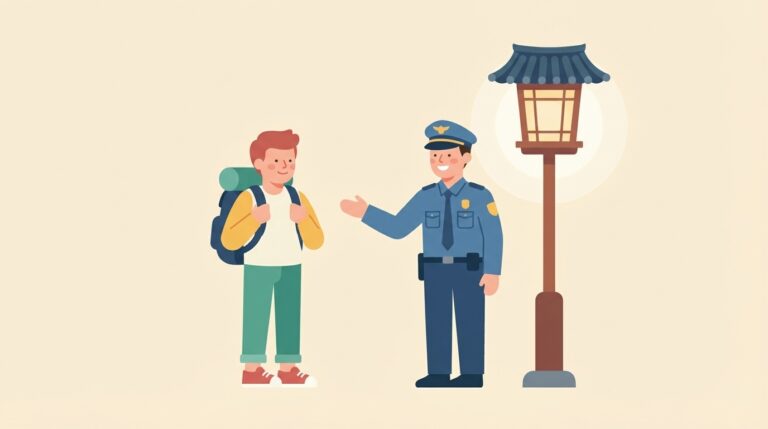
Phase 1: Empathy
Hello! I’m the lead editor of Daily Hangul, your Korean friend and veteran tutor.
Picture this: You are watching an intense Korean thriller drama. The main character is running down a dark alley, desperately needing help. They don’t just yell “Help!”—they shout, “Police!”
As a tourist or a beginner living in Korea, the chances of you ending up in a K-Drama thriller are almost zero. In fact, Korea is famous for being incredibly safe (yes, we leave our laptops and phones on cafe tables to reserve seats!). But what if you lose your passport? What if you get involved in a minor traffic accident? Knowing how to ask for help—specifically, how to call the police—is the ultimate survival tool.
Today, we are going to learn exactly how to ask for help like a local. No complicated grammar, just the exact words you need to stay safe and confident. This guide is built from the real-life experiences of my A1 students who panicked when they realized 911 doesn’t work the same way here!
Phase 2: Core Phrases Deep Dive
1. 도와주세요 (Help me!)
- Pronunciation: dowajuseyo [doh-wa-joo-seh-yo]
- Meaning: Please help me. (Literal: Give me help)
- K-Culture Moment: You’ll hear this in every historical K-Drama when villagers are running from the bad guys! But in real life, you can also use this if you trip and hurt yourself, or if you drop a heavy suitcase down the subway stairs and need a hand.
- Editor’s Insight: The
yoat the end makes it polite. Even in an emergency, Koreans naturally use polite language to strangers. If it’s a life-or-death situation, you can drop theyoand just scream “도와줘! (do-wa-jwo!)”- Situation Spectrum:
- Casual (Friends): ✅
- Semi-formal (Strangers): ✅
- Formal (Elders/Boss): ✅
- 🤔 Think About It: Why do Koreans use polite language (
juseyo= please give) even when they are the ones in danger? How does this reflect the Korean respect system?2. 경찰 불러주세요 (Please call the police)
- Pronunciation: gyeongchal bulleojuseyo [gyung-chal bool-luh-joo-seh-yo]
- Meaning: Please call the police.
- K-Culture Moment: If there’s a loud argument at a Pojangmacha (street tent bar) and things get out of hand, the owner will point at an employee and yell this.
- Editor’s Insight:
Gyeongchalmeans police.Bulleojuseyomeans “please call (for me).” Tourists often don’t have Korean phone numbers to make calls themselves, so asking a local to do it is the fastest way to get help.- Situation Spectrum:
- Casual: ✅
- Semi-formal: ✅
- Formal: ✅
- 🤔 Think About It: In your country, do people usually ask others to call the police, or do they do it themselves?
3. 112 눌러주세요 (Please dial 112)
- Pronunciation: il-il-i nulleojuseyo [ill-ill-ee nool-luh-joo-seh-yo]
- Meaning: Please press 112.
- K-Culture Moment: 112 is the police emergency number in Korea. (Remember: 119 is for fire/ambulance!). Saying the number directly is sometimes faster than saying “police.”
Phase 3: Textbook vs. Real Korean
| Situation | 📖 Textbook Korean | 🗣️ Real Korean | 💡 Why is it different? |
|---|---|---|---|
| Asking to call the police | 경찰에 신고해 주시겠습니까? (Would you please report to the police?) | 경찰 불러주세요! (Call the police!) | Emergencies require short, direct action. Long polite sentences waste time! |
| Asking for general help | 도움이 필요합니다. (I need help.) | 저기요, 도와주세요! (Excuse me, help me!) | Adding “저기요” (Excuse me) catches people’s attention immediately. |
Bottom Note: At the A1 level, don’t worry about perfect grammar. In emergencies, pointing and shouting “경찰! (Police!)” is more than enough.
Phase 4: Cultural Context — K-Culture Deep Dive
4-1. Non-verbal Communication: The “Bystander Effect” Hack
When asking for help in a crowded place like Myeongdong or Hongdae, do not just yell into the air. Koreans might think you are filming a TikTok or a YouTube prank!
Pro Tip: Look at one specific person, point at them, and describe them. “저기요! 거기 파란 셔츠 입으신 분, 경찰 불러주세요!” (Excuse me! You in the blue shirt, call the police!). This breaks the bystander effect instantly.
4-2. K-Travel Link: Is Korea really dangerous?
You might be learning this phrase and thinking, “Is Korea dangerous?” Absolutely not! You’ve probably seen K-Dramas where crime is rampant, but in reality, Korea has CCTV on almost every corner. You can leave your wallet on a cafe table to go to the restroom, and it will still be there.
However, as a traveler, you might need the police for lost items (like passports or phones left in taxis) or minor misunderstandings. The police here are incredibly helpful and often act as community guides!
Phase 5: Real-Life Roleplay Scenario
Setting: It’s Friday night, 10 PM. You are at the busy Gangnam Subway Station. You just realized your bag with your passport and wallet is missing! You are panicking and need to ask a local for help.
Characters:
– YOU (Reader): A panicked traveler.
– Minji (25, Female): A kind Korean student walking by with an iced Americano.
Dialogue:
YOU: (Looking around frantically) Oh no… my bag!
(🎭 Stage Direction: You see Minji and wave your hands to get her attention)
YOU: 저기요! 도와주세요!
(jeogiyo! dowajuseyo!)
[Excuse me! Help me!]
Minji: 네? 무슨 일이세요?
(ne? museun iriseyo?)
[Yes? What’s the matter?]
YOU: 제 가방이… 가방이 없어요!
(je gabang-i… gabang-i eopseoyo!)
[My bag… my bag is not here!]
Minji: 헐! 지하철에 두고 내리셨어요?
(heol! jihacheore dugo naerisyeosseoyo?)
[OMG! Did you leave it on the subway?]
🔀 YOUR TURN! How do you respond?
– A) “경찰 불러주세요!” (gyeongchal bulleojuseyo!) – Call the police!
– B) “네. 도와주세요!” (ne. dowajuseyo!) – Yes. Help me!
– C) “아싸!” (assa!) – Yay!✅ Best Choice: B — Why: For lost items in the subway, you don’t immediately need the police. Minji can take you to the station office (역무실). However, if someone stole it, A is the perfect choice!
⚠️ Choice C Analysis: Never say “Assa” (Yay/Awesome) when you lose something! That’s for happy moments.
Bonus K-Culture Scenario: Leaving a phone in a Taxi
If you leave your phone in a taxi, find a police box (파출소). The police can track the taxi using the city’s CCTV network. Just walk in and say: “택시에 핸드폰을 두고 내렸어요” (I left my phone in the taxi) and “도와주세요” (Help me).
Phase 6: 10-Second Shadowing Drill
Practice these with the right emotion! Read the slash (/) as a tiny pause.
- 🥺 절실하게 (Desperately): 저기요! / 제발 / 도와주세요! (jeogiyo! / jebal / dowajuseyo!)
- 😤 단호하게 (Firmly): 당장 / 경찰 / 불러주세요! (dangjang / gyeongchal / bulleojuseyo!)
- 😢 아쉽게 (Sadly): 지갑을 / 잃어버렸어요. / 도와주세요. (jigabeul / ireobeoryeosseoyo. / dowajuseyo.)
Phase 7: K-Culture Mini Dictionary
| Korean | Romanization | English | Cultural Context |
|---|---|---|---|
| 112 | il-il-i | Police | The emergency number for police in Korea. |
| 119 | il-il-gu | Fire/Ambulance | Call this for medical emergencies or fires. |
| 파출소 | pachulso | Police Substation | Small local police stations found in almost every neighborhood. Very approachable! |
| 소매치기 | somaechigi | Pickpocket | Very rare in Korea, but good to know just in case. |
| 눈치 | nunchi | Social Awareness | Reading the room. If someone yells for help, Koreans use nunchi to quickly assess the situation. |
Phase 8: Traveler’s Survival Kit
🆘 Survival Phrases TOP 3
– 🇰🇷 “경찰서가 어디예요?” (gyeongchalseoga eodiyeyo?)
– 🗣️ Pronunciation: gyung-chal-suh-ga uh-di-yeh-yo?
– 📍 Where to use: Asking for directions to the police station.
- 🇰🇷 “여권 잃어버렸어요.” (yeogwon ireobeoryeosseoyo)
- 🗣️ Pronunciation: yuh-gwon ee-ruh-buh-ryuh-ssuh-yo.
- 📍 Where to use: At the police station, reporting a lost passport.
🇰🇷 “영어 할 수 있어요?” (yeongeo hal su isseoyo?)
- 🗣️ Pronunciation: yung-uh hal soo isseo-yo?
- 📍 Where to use: Asking if the officer speaks English.
📌 Editor’s Travel Note
– The Magic Number 1330: If it is NOT a life-threatening emergency, dial 1330 (Korea Travel Helpline). They offer 24/7 translation services in multiple languages and can speak to the police or taxi drivers on your behalf!
– No 911: Dialing 911 won’t work in Korea. Memorize 112 (Police) and 119 (Medical).
Phase 9: Critical Thinking — “One Step Deeper”
🧠 Think Deeper: Media vs Reality (미디어와 현실의 차이)
If you watch Korean crime thrillers or revenge K-Dramas, you might think Seoul is full of dangerous alleys and gangsters. However, Korea consistently ranks as one of the safest countries globally. This contrast exists because a highly safe society actually makes crime fiction more thrilling and entertaining for locals! The “fear” on TV is a form of entertainment precisely because it is so removed from their daily reality.
💬 Your Turn: Have K-Dramas ever given you a wrong impression of what living in Korea is actually like? Share in the comments!
Phase 10: FAQ & Avoiding Misunderstandings
Q: Can I use “도와주세요” (Help me) to ask for a favor, like taking a photo?
No! “도와주세요” implies a serious situation or a physical struggle. If you just want someone to take your picture, say “사진 좀 찍어주시겠어요?” (Could you take a picture?).
Q: Do Korean police officers speak English?
Some do, but many don’t. That’s why dialing 1330 (Tourist Helpline) is highly recommended for non-emergencies. If you call 112, they will connect you to a translator.
❌ Common Mistake #1: Yelling “Help!” in English.
✅ Do this instead: Yell “도와주세요!” or simply “경찰!” (Police!). Locals will react much faster to their native language.
Phase 11: Summary & Action Items
One-Liner Summary: In an emergency, forget the complex grammar and confidently shout, “경찰 불러주세요!” (Call the police!).
Action Mission 3 Steps:
– 🥉 Bronze (Solo): Say “경찰 불러주세요” out loud 3 times right now.
– 🥈 Silver (Online): Write down “112 = Police, 119 = Medical” in your phone’s note app.
– 🥇 Gold (Real Life): When walking down a street in Korea (or on Google Street View), spot a local 파출소 (Police Substation) and mentally practice walking in.
🎬 K-Culture Mission: Watch a thriller K-Drama this week. Try to spot the exact moment the character dials 112 or shouts “경찰!”
Did you know 112 is for police and 119 is for fire? Let me know in the comments if your country uses different numbers!
Phase 12: Interactive Quiz
Q1. You left your wallet at a cafe. You need the barista’s help to check the CCTV. What do you say?
A) 당장 경찰 불러주세요! (Call the police immediately!)
B) 저기요, 도와주세요. 지갑이 없어요. (Excuse me, help me. My wallet is gone.)
C) 아싸! 도와주세요. (Yay! Help me.)
Q2. True or False: In Korea, you should dial 911 for an ambulance.
True / False
(Answers below)
Click here for answers!
Q1 Answer: B. (A is too aggressive for a lost wallet, and C uses the wrong emotion!).
Q2 Answer: False! 119 is for ambulances and fires. 112 is for police.
Frequently Asked Questions (FAQ)
Q: What does "도와주세요 (Help me!)" mean in Korean and how do you pronounce it?
A: In Korean, "도와주세요 (Help me!)" is pronounced [dowajuseyo [doh-wa-joo-seh-yo] and means: Please help me. (Literal: Give me help)
Q: What does "경찰 불러주세요 (Please call the police)" mean in Korean and how do you pronounce it?
A: In Korean, "경찰 불러주세요 (Please call the police)" is pronounced [gyeongchal bulleojuseyo [gyung-chal bool-luh-joo-seh-yo] and means: Please call the police.
Q: What does "112 눌러주세요 (Please dial 112)" mean in Korean and how do you pronounce it?
A: In Korean, "112 눌러주세요 (Please dial 112)" is pronounced [il-il-i nulleojuseyo [ill-ill-ee nool-luh-joo-seh-yo] and means: Please press 112.







