

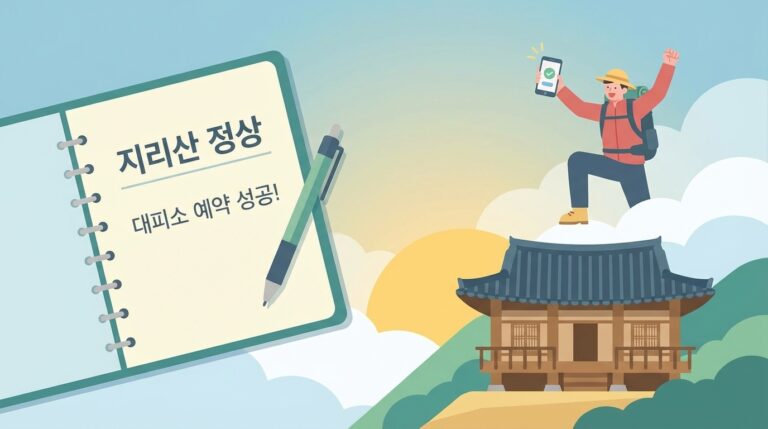
Conquering Jirisan: From Blood-Ticketing Shelters to the Sea of Clouds
Phase 1: Empathy (Immersive Open)
Hello! I’m your Daily Hangul Editor.
Picture this: You are standing above a breathtaking sea of clouds (운무), experiencing the exact majestic scenery you saw in the K-Drama Jirisan starring Jun Ji-hyun. The wind is howling, your legs are burning, and you’ve just conquered Cheonwangbong, the highest peak of mainland Korea. But wait—before you even packed your backpack, you had to survive a battle far more brutal than the hike itself: booking a bed at the mountain shelter (대피소).
In Korea, hiking isn’t just a weekend hobby; it’s a national obsession. And conquering a major mountain ridge (종주) requires surviving what locals call ‘피켓팅’ (blood-ticketing) to secure a sleeping spot. If you don’t know the advanced terminology, the frantic pace of the reservation system, or the unwritten rules of the shelter, you might end up having to hike back down in the dark.
This guide isn’t just about vocabulary; it’s about navigating the intense, deeply communal, and highly structured world of Korean mountain travel. As a C1-level learner, you already know how to say “I like hiking” (등산을 좋아해요). Now, let’s learn how to speak like a seasoned Korean mountaineer.
Phase 2: Core Expressions Deep Dive
1. 종주하다 (To traverse / hike a ridge)
- Pronunciation: [jong-ju-ha-da] / sounds like “jong-joo-ha-da”
- Meaning: Literal: To traverse longitudinally. / Real nuance: To endure an epic, multi-peak hike across a massive mountain range.
- K-Culture Moment: When you tell a Korean coworker you are doing a “Jirisan Jongju,” they won’t just say “Have fun.” They will look at you with deep respect, offer you energy bars, and ask, “Are you doing 2 nights or 1 night?” It’s seen as a badge of honor and a test of mental fortitude.
- Editor’s Insight: We don’t use this word for a casual Sunday hike. It implies serious commitment, heavy backpacks, and profound exhaustion. It carries a heavy, almost heroic weight in conversation.
- Situation Spectrum:
- Casual with hiking buddies: ✅ (e.g., “이번 주말에 종주 뛰자!”)
- Semi-formal at work: ✅ (A great icebreaker with older Korean bosses)
- Formal: ✅
- 🤔 Think About It: Why does Korean hiking culture place such high prestige on enduring physical hardship (like a Jongju)? How does this reflect the broader Korean societal value placed on grit and perseverance?
2. 피켓팅 (Blood-ticketing)
- Pronunciation: [pi-ket-ting] / sounds like “pee-ket-ting”
- Meaning: Literal: Blood + Ticketing. / Real nuance: A fiercely competitive reservation process where slots disappear in milliseconds.
- K-Culture Moment: This word originated in the K-Pop fandom for concert tickets, but it seamlessly transferred to National Park shelter reservations. At exactly 9:59 AM, hikers all over Korea are refreshing their screens in internet cafes (PC Bangs) to snatch a spot at the Jangteomok shelter.
- Editor’s Insight: The prefix ‘피’ (blood) is added to emphasize the cutthroat nature of the task. If you use this word to describe your shelter booking experience, locals will immediately sympathize with your stress.
- Situation Spectrum:
- Casual friends: ✅
- Semi-formal: ⚠️ (Can be used casually with younger colleagues, but avoid in serious business meetings)
- Formal: 🚫
- 🤔 Think About It: South Korea boasts one of the fastest internet speeds globally, creating a culture of “click-speed competition.” Do you have a similar “first-come, first-served” digital battleground in your country?
3. 튕기다 (To bounce / To get kicked out of a server)
- Pronunciation: [twing-gi-da] / sounds like “twing-ghee-da”
- Meaning: Literal: To bounce off. / Real nuance: To be forcibly logged out or met with an error screen during a high-traffic online transaction.
- K-Culture Moment: You clicked ‘Pay’, the loading circle spins… and suddenly, a blank white screen appears. You just “bounced.” It’s the ultimate tragedy of K-Ticketing, often followed by a dramatic sigh and a shot of Soju later that evening.
- Editor’s Insight: A crucial C1 vocabulary word for modern digital life in Korea. Don’t say “서버가 작동하지 않아요” (The server isn’t working—too robotic). Say “아, 서버 튕겼어요!” (Ah, the server kicked me out!)
- Situation Spectrum:
- Casual: ✅
- Semi-formal: ✅
- Formal: 🚫 (Use “시스템 오류가 발생했습니다” instead)
- 🤔 Think About It: Language evolves with technology. How often do digital-exclusive terms like ‘튕기다’ cross over into everyday spoken language in your native tongue?
Phase 3: Textbook vs. Real Korean
| Situation | 📖 Textbook Korean | 🗣️ Real Korean | 💡 Why is it different? |
|---|---|---|---|
| Completing a major hike | 산 정상에 도착했습니다. (I arrived at the top.) | 천왕봉 찍고 왔어. (I went and ‘stamped’ Cheonwangbong.) | Using “찍다” (to stamp/dot) emphasizes the achievement of hitting a specific goal, reflecting Korea’s fast-paced, goal-oriented culture. |
| Failing a reservation | 예약을 못 했습니다. (I couldn’t make a reservation.) | 광클했는데 광탈했어. (I mad-clicked but got mad-eliminated.) | MZ slang blends “광” (crazy/mad) with verbs to add dramatic flair to digital failures. |
| Asking about the queue | 기다리는 사람이 많나요? (Are there many people waiting?) | 대기열 몇 명이야? (How many in the queue?) | “대기열” (queue line) is the exact UI terminology used on Korean ticketing platforms. |
Editor’s Bottom Note: At the C1 level, mixing advanced technical terms (대기열) with highly colloquial slang (광탈) demonstrates true native-like fluency.
Phase 4: Cultural Context — K-Culture Deep Dive
4-1. The Unspoken Rules (Nunchi) of the Shelter
Korean mountain shelters (대피소) are extremely communal. You sleep shoulder-to-shoulder with strangers on wooden floors. The ultimate test of Nunchi (눈치) happens after the 9:00 PM lights-out. If you rustle your plastic bags or talk loudly, you will feel the intense, silent glares of 50 exhausted hikers. Master the art of whispering and pack your items in soft cloth bags to avoid the crinkling noise!
4-2. The Sacred Ritual of Peak Ramyeon (K-Food)
Why do Koreans carry heavy thermoses of hot water and delicate cup noodles up a 1,900m mountain? Because eating Ramyeon at the peak, surrounded by the sea of clouds, is a profound cultural ritual. It’s not just sustenance; it’s a reward. In K-Dramas, sharing a cup of Ramyeon at a shelter is often the exact moment characters transition from acquaintances to close friends. The phrase “산에서 먹는 라면이 진리다” (Ramyeon eaten on a mountain is the ultimate truth) is universally accepted.
Phase 5: Real-Life Roleplay Scenario
Setting: Friday, 9:58 AM. A dimly lit, noisy PC Bang in Sinchon. You and your Korean hiking buddy are staring intently at dual monitors. The Korea National Park reservation site is open. The clock is ticking.
Characters:
– YOU: An advanced Korean learner, ambitious enough to attempt the Jirisan traverse.
– Minho (28): Your Korean friend, a hardcore hiking enthusiast fully decked out in Gorpcore fashion.
Dialogue:
Minho: 야, 2분 남았어. 서버 시간 띄워놨지?
(Ya, 2-bun namasseo. Seobeo sigan ttiwonwatji?)
(Hey, 2 minutes left. You have the server clock pulled up, right?)
YOU: 응, 네이비즘 켜놨어. 나 지금 피켓팅 처음이라 심장 터질 것 같아.
(Eung, neibijeum kyeonwasseo. Na jigeum piketting cheoeumira simjang teojil geot gata.)
(Yeah, I have Navyism [a server clock site] on. It’s my first blood-ticketing, my heart is exploding.)
Minho: 10시 정각 되는 순간 바로 장터목 대피소 누르고 결제창으로 넘어가. 버벅거리면 끝이야.
(10-si jeonggak doeneun sungan baro Jangteomok daepiso nureugo gyeoljechangeuro neomeoga. Beobeokgeorimyeon kkeutiya.)
(The second it hits 10:00, click Jangteomok shelter and proceed to payment. If you lag, it’s over.)
YOU: 알았어. 만약 우리 예약 실패하면, 당일에 다 올라갔다 내려와야 하는 거야?
(Arasseo. Banyak uri yeyak silpaehamyeon, dangire da ollagatda naeryeowaya haneun geoya?)
(Got it. If we fail the reservation, do we have to go up and down in one day?)
Minho: 당연하지. 무박 종주 하다가 무릎 나가는 수가 있어. 자, 10초 전! 집중해!
(Dangyeonhaji. Mubak jongju hadaga mureup naganeun suga isseo. Ja, 10-cho jeon! Jipjunghae!)
(Of course. Doing an overnight traverse without sleep can ruin your knees. Alright, 10 seconds! Focus!)
YOU: 5, 4, 3, 2, 1… 눌렀어!
(5, 4, 3, 2, 1… nulleosseo!)
(5, 4, 3, 2, 1… Clicked!)
Minho: 아씨, 난 튕겼어! 대기열 500명이야. 너는?
(Assi, nan twinggyeosseo! Daegiyeol 500-myeongiya. Neoneun?)
(Ah damn, I got kicked out! 500 people in the queue. You?)
YOU: 어? 내 화면은 하얗게 멈췄어…
(Eo? Nae hwamyeoneun hayake meomchwosseo…)
(Huh? My screen just froze white…)
🔀 Your Turn! The screen is white. What do you say/do next?
– A) “새로고침(F5) 누를까?” (Should I press refresh?)
– B) “망했다. 포기하자.” (We’re doomed. Let’s give up.)
– C) “기다려봐. 로딩 중인 것 같아.” (Wait. I think it’s loading.)✅ Best Choice: C — Never, ever press F5 (refresh) during Korean ticketing! You will lose your spot in the invisible queue.
⚠️ Choice A Analysis: Minho might actually scream if you press F5. Patience is the only way to survive the white screen of death.
(Assuming you waited…)
YOU: 아, 넘어갔다! 결제창 떴어!
(A, neomeogatda! Gyeoljechang tteosseo!)
(Ah, it went through! The payment screen is up!)
Minho: 대박! 미쳤다! 빨리 결제해! 시간 초과되기 전에!
(Daebak! Micheotda! Ppalli gyeoljehae! Sigan chogwadoegi jeone!)
(Daebak! Crazy! Pay quickly! Before it times out!)
YOU: 결제 완료! 우리 지리산 간다!
(Gyeolje wallyo! Uri Jirisan ganda!)
(Payment complete! We are going to Jirisan!)
Phase 6: 10-Second Shadowing Drill
Speak this with intense relief and excitement, just like you won the lottery!
😲 와, / 나 드디어 / 장터목 대피소 / 예약 성공했어!!!
(wa, / na deudieo / jangteomok daepiso / yeyak seonggonghaesseo!!!)
“Wow, I finally succeeded in booking the Jangteomok shelter!!!”
Phase 7: K-Culture Mini Dictionary
| 한국어 | Romanization | English | Context |
|---|---|---|---|
| 고프코어 | gopeu-koeo | Gorpcore | The MZ generation’s trendy hiking fashion, contrasting with the bright neon gear of older generations. |
| 산스장 | san-seu-jang | Mountain Gym | A portmanteau of 산 (mountain) and 헬스장 (gym). Outdoor workout areas found on trails. |
| 무박 종주 | mu-bak jong-ju | Zero-night traverse | Hiking a massive ridge through the night without booking a shelter. Only for the elite! |
| 인증샷 | in-jeung-syat | Proof shot | The mandatory photo taken at the peak’s stone marker to prove you conquered it. |
Phase 8: Traveler Survival Kit
If you successfully make it to the Jirisan shelter, you need these phrases to survive the night.
🆘 Survival Phrases for the Shelter
– 🇰🇷 “예약자 신분증 여기 있습니다.” (yeyakja sinbunjeung yeogi itseumnida.)
– 🗣️ Meaning: Here is the ID of the person who booked.
– 📍 Note: Shelters absolutely require a physical ID matching the reservation.
– 🇰🇷 “혹시 모포 대여 되나요?” (hoksi mopo daeyeo doenayo?)
– 🗣️ Meaning: Can I rent a blanket?
– 🇰🇷 “내일 천왕봉 일출은 몇 시쯤이에요?” (naeil cheonwangbong ilchureun myeot sijjeumieyo?)
– 🗣️ Meaning: What time is the sunrise at Cheonwangbong tomorrow?📌 Editor’s Travel Note
– Cooking Food: Shelters do NOT sell cooked meals. You must bring your own burner, gas, and food to cook in the designated ‘취사장’ (cooking area). They only sell microwave rice (햇반) and water.
– Trash: Leave no trace. There are no trash cans. You must carry all your garbage down the mountain.
– Apps: Download “KakaoMap” for trail tracking and the “Korea National Park” app for reservations.
Phase 9: Critical Thinking — “One Step Deeper”
🧠 Think Deeper: Food & Identity at 1,900 Meters
In Korea, hiking isn’t a solitary escape into nature; it is a profound extension of community. This is most visible in the shelter’s cooking areas. Despite the exhausting climb, Korean hikers will haul massive amounts of Samgyeopsal (pork belly), kimchi, and Soju up the mountain just to share a feast with their group. The act of cooking and sharing food in the freezing cold fosters an intense camaraderie called Jeong (정). Eating a simple energy bar alone is often viewed with pity. The heavy backpack is a sacrifice made for the joy of the collective meal.
💬 Your Turn: In your culture, do outdoor activities emphasize solitude and minimalism, or communal feasting? Share your thoughts in the comments!
Phase 10: FAQ & Mistake Prevention
- Q: Can I just bring a tent and sleep anywhere on Jirisan?
- No. Bivouacking (비박) or camping outside designated shelters in National Parks is strictly illegal in Korea and carries heavy fines.
- Q: Should I bow to people I pass on the trail?
- Maybe. You don’t need to bow deeply, but a light nod and a breathless “안녕하세요” or “수고하십니다” (Keep up the good work) is excellent trail etiquette.
❌ Common Mistake #1: Asking “식당 어디에요?” (Where is the restaurant?) at the shelter.
✅ Do This Instead: Ask “취사장 어디에요?” (Where is the cooking area?). Remember, there are no restaurants at the peak!
Phase 11: Summary & Action Items
One-Liner Summary: Conquering Jirisan requires mastering the digital battlefield of ‘피켓팅’ and understanding the communal heart of Korean mountain culture.
Action Mission:
– 🥉 Bronze: Say “아, 서버 튕겼어!” out loud the next time an app crashes on your phone.
– 🥈 Silver: Leave a comment below using the word “종주” about a mountain you want to conquer.
– 🥇 Gold: Navigate to the Korea National Park reservation site (Korean version) and try to find the ‘대기열’ (Queue) screen!
K-Culture Mission:
Watch a clip of the K-Drama Jirisan (or any Korean variety show featuring hiking) and spot the mandatory “peak Ramyeon” eating scene!
Phase 12: Interactive Quiz
1. Situational Judgment: You are trying to book a shelter. The clock hits 10:00 AM, you click, and the screen turns completely white and stays that way. What should you do?
– A) Immediately press F5 to reload.
– B) Close the browser and try on your phone.
– C) Wait patiently without touching anything.
(Answer: C. Pressing refresh will kick you out of the invisible queue!)
2. Fill in the Blank:
“나 BTS 콘서트 예매해야 하는데, 이거 완전 ( _______ )이야.”
(I need to book BTS concert tickets, this is total _______.)
(Answer: 피켓팅 / piketting)
3. True or False – K-Culture Edition:
Korean mountain shelters serve hot meals like Kimchi Jjigae in their cafeterias.
(Answer: False. You must bring your own ingredients and portable stove to cook in the communal area.)
4. Roleplay Consequence: In Phase 5, if you had told Minho you were doing a “무박 종주” (zero-night traverse), what would be his likely reaction?
– A) He would think you are very lazy.
– B) He would be deeply concerned for your knees and stamina.
(Answer: B. A zero-night traverse is brutally difficult and implies hiking non-stop through the night!)
Frequently Asked Questions (FAQ)
Q: What does "종주하다 (To traverse / hike a ridge)" mean in Korean and how do you pronounce it?
A: In Korean, "종주하다 (To traverse / hike a ridge)" is pronounced [jong-ju-ha-da] and means: Literal: To traverse longitudinally. / Real nuance: To endure an epic, multi-peak hike across a massive mountain range.
Q: What does "피켓팅 (Blood-ticketing)" mean in Korean and how do you pronounce it?
A: In Korean, "피켓팅 (Blood-ticketing)" is pronounced [pi-ket-ting] and means: Literal: Blood + Ticketing. / Real nuance: A fiercely competitive reservation process where slots disappear in milliseconds.
Q: What does "튕기다 (To bounce / To get kicked out of a server)" mean in Korean and how do you pronounce it?
A: In Korean, "튕기다 (To bounce / To get kicked out of a server)" is pronounced [twing-gi-da] and means: Literal: To bounce off. / Real nuance: To be forcibly logged out or met with an error screen during a high-traffic online transaction.







