

Phase 1: Empathy (The K-Culture Cold Open)
Hello! I’m your Daily Hangul Editor.
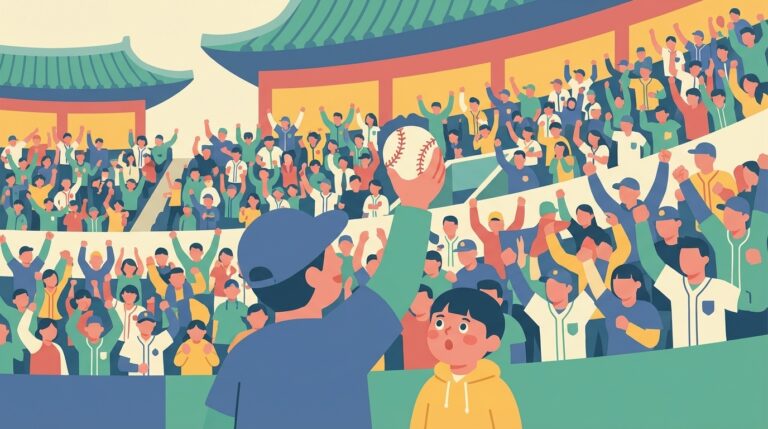
Imagine this: You are at Jamsil Baseball Stadium. The crisp evening air smells of fried chicken and cold beer (Chimaek). Suddenly, CRACK! The batter hits a massive home run, and the ball is flying straight toward your section. You reach out your hands—smack! You caught it! You feel like a hero. But just as you’re about to celebrate, you notice something strange. The entire section is staring at you, and 1,000 people suddenly start chanting in unison, pointing at a 7-year-old kid standing next to you.
Are you in trouble? Did you break a rule?
Welcome to the wild, passionate, and community-driven world of Korean Baseball Culture (KBO). If you don’t know the unwritten rules of the stadium, what should be your proudest moment could quickly become an awkward cultural faux pas. Today, we’re going to dive into the exact expressions and the unique Nunchi (social awareness) you need to survive—and thrive—during a Korean home run ball scramble!
Phase 2: Core Expressions Deep Dive
1. 아주라! (Give it to the kid!)
- Pronunciation: [a-ju-ra!] (Sounds like: Ah-joo-rah!)
- Meaning: Literal: “Give it to the child” (Busan dialect). Real nuance: “Hand that baseball over to the kid next to you, or we won’t stop chanting!”
- K-Culture Moment: This originated from the hardcore fans of the Lotte Giants in Busan but has become a nationwide meme. In K-Dramas like Reply 1994, you’ll see characters passionately screaming in dialects at sports events. When an adult catches a ball, the crowd chants this to pressure them into giving the ball to a nearby child.
- Editor’s Insight: It’s an imperative (command) form in a regional dialect. It sounds aggressive to outsiders, but it’s actually meant to be a fun, collective joke. You are not forced to do it by law, but the social pressure is real!
- Situation Spectrum:
- Stadium Crowd Chant: ✅
- Friends (as a joke): ✅
- Your Boss: 🚫 (Never use this imperative form on elders!)
- 🤔 Think About It: Why does the crowd care who gets the ball? How does this reflect the Korean proverb “It takes a village to raise a child”?
2. 아, 아깝다! (So close! / What a shame!)
- Pronunciation: [a, a-kkap-tta!] (Sounds like: Ah, ah-gap-dah! – Emphasize the double ‘kk’ and ‘tt’ like you’re slightly frustrated)
- Meaning: Literal: “It’s a waste/It’s precious.” Real nuance: “Ah, you almost had it!”
- K-Culture Moment: You reach for the foul ball, it grazes your fingertips, and the guy behind you snatches it. Your Korean friend will pat your back and say, “아깝다!” You’ll also hear this constantly in Korean gaming cafes (PC Bangs) when someone loses a match by one point.
- Editor’s Insight: We use this word when an opportunity slips away. It implies that the lost opportunity was “precious” and therefore, a “waste” to lose.
- Situation Spectrum:
- Casual/Friends: ✅
- Workplace (Semi-formal): ⚠️ (Use ‘아깝네요’ [a-kkam-ne-yo] instead)
- Formal: 🚫
- 🤔 Think About It: Your native language probably has a phrase for “almost.” How does the feeling of “waste” (아깝다) change the psychological nuance of missing out?
3. 양보해 주셔서 감사합니다 (Thank you for yielding/giving it up)
- Pronunciation: [yang-bo-hae ju-syeo-seo gam-sa-ham-ni-da]
- Meaning: Literal: “Thank you for making a concession.” Real nuance: “Thank you for letting the kid have the ball.”
- K-Culture Moment: If you do give the ball to the child, the parents will bow repeatedly and say this phrase. 양보 (Yang-bo) is a massive cultural keyword in Korea, seen everywhere from yielding subway seats to elders, to letting someone merge in traffic.
- Editor’s Insight: This is the ultimate polite phrase. It acknowledges the other person’s sacrifice.
- Situation Spectrum:
- Strangers/Parents to you: ✅
- Boss/Elders: ✅
- Close Friends: ⚠️ (Too formal! Friends would just say “고마워!” [go-ma-wo])
Phase 3: Textbook vs. Real Korean
| Situation | 📖 Textbook Korean | 🗣️ Real Korean | 💡 Why is it different? |
|---|---|---|---|
| Telling someone to give the ball to a kid | 어린이에게 양보하세요. (Please yield to the child.) | 아주라! (Give it to the kid!) | Dialects carry emotional weight and become cultural memes that unite the stadium crowd. |
| Missing the catch | 안타깝습니다. (It is regrettable.) | 아, 아까비! (Ah, so close!) | ‘아까비’ is a cute, slang variation of ‘아깝다’ heavily used by Millennials and Gen Z. |
| Catching a great ball | 훌륭하게 잡았습니다. (You caught it excellently.) | 와, 나이스 캐치! 대박! (Wow, nice catch! Daebak!) | Koreans frequently mix Konglish (Nice catch) and slang (Daebak) in highly energetic situations. |
Bottom Note for B2 Learners: You don’t need to yell “아주라” yourself, but recognizing it immediately elevates you from a ‘tourist’ to an ‘insider’.
Phase 4: Cultural Context — K-Culture Deep Dive
4-1. The Non-Verbal Language of ‘Nunchi’ (눈치)
Catching a baseball in Korea is the ultimate test of Nunchi (the art of reading the room). When you catch the ball, do not immediately pocket it. Pause. Look around. Is there a child looking at you with puppy-dog eyes? Are the cameras zooming in on you? If you read the room and hand over the ball, the crowd will cheer for you like you just hit the home run yourself!
4-2. The K-Pop DNA in K-Baseball
If you’ve ever been to a BTS or BLACKPINK concert, you know about Fanchants (응원법). Korean baseball took this K-Pop energy and amplified it. Every single player has their own theme song, complete with synchronized dancing and light-up cheering sticks (막대풍선). The “Ajura” chant is essentially a spontaneous fanchant directed at you.
Phase 5: Real-Life Roleplay Scenario
🎬 Setting: Friday evening, 7:30 PM. Jamsil Baseball Stadium. The stadium is shaking from the bass of the cheer songs. You are eating sweet and spicy fried chicken with your Korean coworker, Minsoo (32, friendly and highly competitive).
Minsoo: 야, 조심해! 공 날아온다! ⚾
(Ya, jo-sim-hae! gong na-ra-on-da!)
[Hey, watch out! The ball is coming!]
(🎭 Stage Direction: The ball bounces off a seat and lands perfectly in your lap. You hold it up!)
YOU: 와, 제가 잡았어요! 대박!
(Wa, je-ga ja-ba-sseo-yo! dae-bak!)
[Wow, I caught it! Awesome!]
Minsoo: 와, 진짜 럭키가이! 근데… 옆에 봐봐.
(Wa, jin-jja reok-ki-ga-i! geun-de… yeo-pe bwa-bwa.)
[Wow, what a lucky guy! But… look next to you.]
(🎭 Stage Direction: A 5-year-old boy in a baseball uniform is staring at your ball. Suddenly, the people in the rows behind you start chanting rhythmically.)
Crowd: 아-주-라! 아-주-라!
(A-ju-ra! A-ju-ra!)
[Give it to the kid!]
Minsoo: (Laughing) 이거 어쩔 수 없겠는데요?
(i-geo eo-jjeol su eop-gen-neun-de-yo?)
[I don’t think you have a choice here, huh?]
🔀 Your Turn! How do you react?
– A) “안 돼요! 제 거예요!” (No! It’s mine!)
– B) “자, 여기 있어. 야구 재밌게 봐!” (Here you go. Enjoy the game!)
– C) “얼마 줄래?” (How much will you pay me?)✅ Best Choice: B — Handing it to the kid gracefully makes you the hero of the section. The parents will likely buy you a beer as a thank you!
⚠️ Choice A Analysis: While technically true (it is yours), ignoring the “Ajura” chant might result in some playful booing. (Though nowadays, many Koreans advocate for letting the catcher keep the ball if they really want it).
(Assuming you chose B)
Kid’s Mother: 어머, 정말 감사합니다! 양보해 주셔서 감사해요. 이거 드세요!
(Eo-meo, jeong-mal gam-sa-ham-ni-da! Yang-bo-hae ju-syeo-seo gam-sa-hae-yo. I-geo deu-se-yo!)
[Oh my, thank you so much! Thank you for yielding. Please have this! (Hands you a cold beer)]
Phase 6: 10-Second Shadowing Drill
Let’s practice the feeling of almost catching the ball.
😢 아, / 아깝다! / 내가 / 잡을 수 있었는데!
(a, / a-kkap-tta! / nae-ga / ja-beul su i-sseon-neun-de!)
[Ah, so close! I could have caught it!]
Vocal Tip: Drop your shoulders on “아” (Ah), and hit the double consonants hard on “깝” (kkap).
Phase 7: K-Culture Mini Dictionary
| Korean | Romanization | English | Cultural Context |
|---|---|---|---|
| 직관 | jik-gwan | Attending in person | Short for 직접 관람 (direct viewing). A proud tag used on Instagram when attending games. |
| 치맥 | chi-maek | Chicken & Beer | The holy trinity of Korean baseball: Baseball, Fried Chicken, and Draft Beer. |
| 견제구 | gyeon-je-gu | Pickoff throw | When the pitcher throws to first base, the crowd yells distinct, funny insults at the pitcher. |
| 양보 | yang-bo | Yielding / Concession | The core social virtue of giving up your space or item for someone more vulnerable. |
Phase 8: Traveler Survival Kit (Stadium Edition)
Heading to a Korean baseball stadium? Keep these survival phrases in your back pocket!
🆘 Survival Phrases TOP 3
– 🇰🇷 “여기 제 자리인 것 같은데요.” (yeo-gi je ja-ri-in geot ga-teun-de-yo.)
– 🗣️ Meaning: “I think this is my seat.”
– 📍 Where to use: Stadiums are packed. If someone is in your assigned seat, say this politely.
- 🇰🇷 “생맥주 두 잔 주세요.” (saeng-maek-ju du jan ju-se-yo.)
- 🗣️ Meaning: “Two draft beers, please.”
- 📍 Where to use: To the roaming “Beer Boy” carrying a keg on his back!
🇰🇷 “응원 막대 어디서 사요?” (eung-won mak-dae eo-di-seo sa-yo?)
- 🗣️ Meaning: “Where do I buy the cheering sticks?”
- 📍 Where to use: Before the game at the team merchandise store.
📌 Editor’s Travel Note:
– Ticketing App: You usually need a Korean phone number to use the ‘Ticket Link’ or ‘Interpark’ apps. If you’re a tourist, arrive 2 hours early to buy tickets at the physical box office!
– Food Delivery: You can literally order delivery food (like pizza or Jokbal) straight to the stadium gates using the Baedal Minjok app.
Phase 9: Critical Thinking Corner — “One Step Deeper”
🧠 Think Deeper: Community vs. Individualism in Korean Sports
In many Western cultures, catching a foul ball is a moment of pure individual luck and triumph—it’s your souvenir. However, the “Ajura” culture highlights Korea’s deep-rooted collectivism. The joy of the stadium isn’t just about personal gain; it’s about shared happiness. By sacrificing your personal souvenir for a child, you contribute to the collective joy of the crowd, and in return, the crowd rewards you with social approval and gratitude. Language reflects this: notice how often Koreans say “우리” (our) instead of “내” (my) – 우리 팀 (our team), 우리 나라 (our country).
💬 Your Turn: If you caught a home run ball hit by your favorite player, would you give it to the crying child next to you? Does your culture have any similar “unspoken rules” at sporting events? Let us know in the comments!
Phase 10: FAQ & Avoiding Misunderstandings
Q: “If everyone yells ‘Ajura’, do I legally have to give the ball away?”
A: No! Especially for highly valuable balls (like a player’s 100th home run), no one will force you. Recently, many younger Koreans are actually against the “Ajura” culture, arguing that the person who caught it should keep it. Just use your Nunchi!
Q: “Can I yell ‘Ajura’ to my boss if we play a casual game?”
A: Absolutely not! Even as a joke, yelling an imperative dialect command to a superior crosses the line.
❌ Common Mistake #1: Saying “아이 줘라” (A-i jwo-ra) using standard textbook Korean.
✅ Do This Instead: You must use the dialect pronunciation “아주라” (A-ju-ra) for the cultural meme to work.
Phase 11: Summary & Action Items
- One-Liner Summary: Surviving a Korean home run catch is all about Nunchi—knowing when to celebrate and when to yield (양보) to the chanting crowd!
🚀 Action Mission:
– 🥉 Bronze: Say “아, 아깝다!” out loud next time you drop something or miss a bus.
– 🥈 Silver: Search YouTube for “KBO 아주라” and watch how the crowd reacts in real life.
– 🥇 Gold (K-Culture Mission): Go to a local batting cage (야구 연습장) in Korea, hit a ball, and yell “나이스 캐치!” with your friends!
Phase 12: Quiz — Interactive Challenge
1. You almost caught a foul ball, but missed it by an inch. What is the most natural Korean reaction?
A) 안타깝습니다. (An-ta-kkap-seum-ni-da)
B) 아, 아깝다! (A, a-kkap-tta!)
C) 아주라! (A-ju-ra!)
2. True or False – K-Culture Edition:
“In Korean baseball stadiums, you are strictly not allowed to bring outside food; you must buy it inside.” (T/F)
3. Fill in the blank:
When you give your seat or your baseball to someone else out of politeness, this action is called ____ (yang-bo) in Korean.
(Check your answers by highlighting the text below!)
Answers
1. B – A is too formal and robotic for a sports game. C is what the crowd chants to give the ball to a kid.
2. False – Korea is famous for letting you bring almost any food into the stadium! You can even bring a whole pizza box or have food delivered to the gates.
3. 양보 (Yang-bo)
Frequently Asked Questions (FAQ)
Q: What does "아주라! (Give it to the kid!)" mean in Korean and how do you pronounce it?
A: In Korean, "아주라! (Give it to the kid!)" is pronounced [a-ju-ra!] and means: Literal: "Give it to the child" (Busan dialect). Real nuance: "Hand that baseball over to the kid next to you, or we won't stop chanting!"
Q: What does "아, 아깝다! (So close! / What a shame!)" mean in Korean and how do you pronounce it?
A: In Korean, "아, 아깝다! (So close! / What a shame!)" is pronounced [a, a-kkap-tta!] and means: Literal: "It's a waste/It's precious." Real nuance: "Ah, you almost had it!"
Q: What does "양보해 주셔서 감사합니다 (Thank you for yielding/giving it up)" mean in Korean and how do you pronounce it?
A: In Korean, "양보해 주셔서 감사합니다 (Thank you for yielding/giving it up)" is pronounced [yang-bo-hae ju-syeo-seo gam-sa-ham-ni-da] and means: Literal: "Thank you for making a concession." Real nuance: "Thank you for letting the kid have the ball."







