

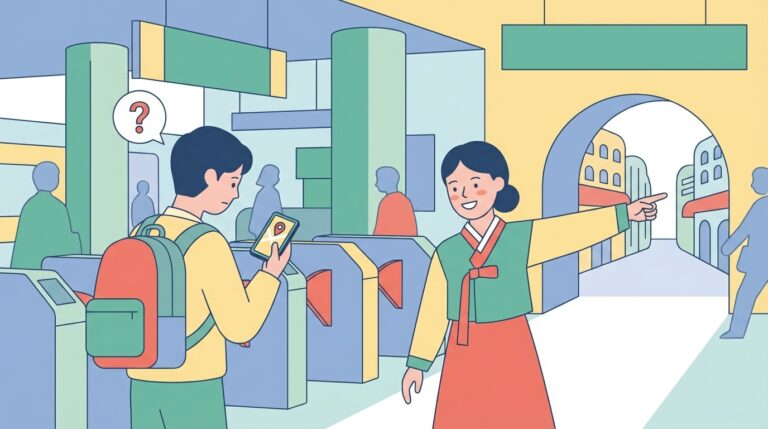
Phase 1: Empathy & K-Culture Cold Open
Hello! I’m the Lead Editor at Daily Hangul, your veteran tutor and cultural navigator.
Picture this: It’s a Friday night. You are standing at Exit 9 of Gangnam Station. It’s the ultimate Korean meeting spot, and naturally, half of Seoul’s population seems to be waiting there too. You check your KakaoTalk, and your friend Minsoo says he’s at Exit 11 because he got confused. Or maybe you finally make it to that trending K-Food restaurant you saw on Instagram, only to find a line of 30 people waiting outside.
In K-Dramas, characters might dramatically run through the rain to find each other at the right spot. But in real-life Korea? You just grab your phone and say, “Hey, let’s change the spot!”
Last time, we talked about changing the time of an appointment. Today, we are tackling the B1-level survival skill: Changing the Meeting Place (약속 장소 바꾸기). If you don’t know how to navigate this smoothly, you might end up eating convenience store ramen instead of that juicy Samgyeopsal! Let’s dive in.
Phase 2: Core Expressions Deep Dive
Here are the top 3 expressions you need when a location change is inevitable.
1. 우리 장소 좀 바꿀까요?
- Pronunciation: [u-ri jang-so jom ba-kkul-kka-yo?]
- Meaning: Shall we change the place a bit? (Literal) -> Let’s meet somewhere else.
- K-Culture Moment: You are organizing a group hangout in a KakaoTalk group chat. Someone realizes the chosen café is closed on Mondays. This is the perfect polite, group-friendly way to suggest a pivot.
- Editor’s Insight: The word ‘좀’ (a little) is the magic sauce here. It softens your suggestion so you don’t sound bossy. It’s the linguistic equivalent of a gentle tap on the shoulder.
- Situation Spectrum:
- Friends (Casual): ✅ (Drop the ‘요’: 장소 좀 바꿀까?)
- Co-workers (Semi-formal): ✅
- Boss/Elders (Formal): ⚠️ (Better to use: 장소를 변경하는 게 어떨까요?)
- 🤔 Think About It: Why do Koreans love using ‘우리’ (our/we) even when talking about their own plans or possessions (like ‘우리 엄마’ – our mom)? How does this reflect the community-centric mindset?
2. 거기는 웨이팅이 너무 길대요.
- Pronunciation: [geo-gi-neun we-i-ting-i neo-mu gil-dae-yo.]
- Meaning: They say the wait there is too long.
- K-Culture Moment: The dreaded “Waiting” (웨이팅). In Korea, popular restaurants (핫플 – Hot Places) have electronic kiosks outside where you register your phone number to wait. If the app says “20 teams ahead,” you drop this sentence to your friend.
- Editor’s Insight: Notice the ‘-대요’ at the end? It’s short for ‘-다고 해요’ (I heard that…). It shifts the blame! You’re not complaining; you’re just passing on the tragic news about the line.
- Situation Spectrum:
- Friends (Casual): ✅
- Co-workers (Semi-formal): ✅
- Boss/Elders (Formal): 🚫
3. 근처 딴 데로 갈까요?
- Pronunciation: [geun-cheo ttan de-ro gal-kka-yo?]
(Sound analogy: ‘딴’ sounds like a short, sharp ‘ttan’ with a tense double consonant. Imagine the sound of a tight rubber band snapping.)- Meaning: Shall we go somewhere else nearby?
- K-Culture Moment: You met at the original spot, but it’s too noisy to talk. You look around, make eye contact with your friend, and suggest moving to a quieter café just down the street.
- Editor’s Insight: ‘딴 데’ is the spoken contraction of ‘다른 곳’ (another place). Using ‘딴 데’ instantly makes you sound like a local who has lived in Seoul for years.
- Situation Spectrum:
- Friends (Casual): ✅
- Co-workers (Semi-formal): ✅
- Boss/Elders (Formal): 🚫 (Too casual. Use: 다른 곳으로 가실까요?)
Phase 3: Textbook vs. Real Korean
Let’s see how textbooks differ from the streets of Hongdae.
| Situation | 📖 Textbook Korean | 🗣️ Real Korean | 💡 Why the difference? |
|---|---|---|---|
| Suggesting a new place | 약속 장소를 변경합시다. | 우리 딴 데 갈까요? | “변경하다” (to change) is a formal Hanja word, usually reserved for emails or official notices. |
| Asking where to meet | 어디에서 만나는 것이 좋습니까? | 어디서 볼까요? | Koreans love efficiency; “볼까요?” (Shall we see each other?) is much faster than “만날까요?”. |
| Informing the place is closed | 그 식당은 문을 닫았습니다. | 거기 오늘 휴무래요. | Locals use “휴무” (day off) for businesses, often checking it via Naver Map beforehand. |
Bottom Note: As a B1 learner, swapping formal Hanja words for native Korean spoken contractions (like 딴 데 instead of 다른 장소) is the fastest way to level up your fluency.
Phase 4: Cultural Context — K-Culture Deep Dive
4-1. The Art of “Nunchi” in Relocating
When changing a location, Nunchi (눈치) is everything. If you are with someone older or higher in status, you shouldn’t abruptly say, “I don’t like this place, let’s go.” Instead, you read their body language. Are they sweating because the AC is weak? Are they squinting at the menu? That’s your cue to politely ask: “여기가 좀 시끄러운데, 혹시 다른 곳으로 자리 옮기실까요?” (It’s a bit loud here, would you like to move to another place?).
4-2. K-Food Connectivity: The “Catchtable” Culture
Changing meeting places in Korea often revolves around food. Korea has an intense “Hot Place” (핫플) culture. If a place went viral on TikTok, expect a 2-hour wait. Because of this, Koreans usually have a “Plan B” and “Plan C” ready in the same neighborhood. Changing the venue isn’t seen as a failure of planning; it’s a necessary survival tactic in the fast-paced K-Food scene!
Phase 5: Real-Life Roleplay Scenario
Setting: Friday evening, 7 PM. You are standing outside a famous Samgyeopsal place in Gangnam. The smell of roasted pork is in the air, but there’s a crowd of people waiting outside. Your Korean co-worker, Minsoo, just arrived.
Characters:
– YOU: A foreign professional who really wants BBQ but is starving.
– Minsoo (32): Your friendly Korean co-worker who organized the dinner.
Dialogue:
Minsoo: 아, 어떡하죠? 제 앞에 대기 팀이 15팀이나 있어요! 😭
(a, eotteokhajo? je ape daegi tim-i yeoldaseot tim-ina isseoyo!)
[Oh, what should we do? There are 15 teams waiting ahead of me!]
YOU: 15팀이요? 한 시간은 기다려야겠네요.
(yeoldaseot tim-iyo? han sigan-eun gidaryeoyagenneyo.)
[15 teams? We’d have to wait for an hour.]
Minsoo: 네… 다른 고깃집은 제가 잘 모르는데.
(ne… dareun gogijjibeun jega jal moreuneunde.)
[Yeah… I don’t really know other BBQ places around here.]
🔀 Your Turn! How should you reply?
– A) “그냥 여기서 1시간 기다립시다.” (Let’s just wait 1 hour here.)
– B) “장소를 변경하시오.” (Change the location.)
– C) “그럼 근처 딴 데로 갈까요? 제가 지도 앱으로 찾아볼게요!”✅ Best Choice: C
Why? A is polite but Koreans hate waiting when hungry (빨리빨리 culture!). B sounds like a historical drama king giving an order. C is natural, helpful, and uses the native phrase “딴 데로 갈까요?”
(Assuming you chose C)
Minsoo: 아, 진짜요? 그럼 너무 고맙죠! 근처에 조용한 데 있으면 바로 가요.
(a, jinjjayo? geureom neomu gomapjjo! geuncheoe joyonghan de isseumyeon baro gayo.)
[Oh, really? I’d be so grateful! If there’s a quiet place nearby, let’s go right away.]
Phase 6: 10-Second Shadowing Drill
Grab your phone voice recorder and practice this natural flow!
😢 저기요... / 거기는 / 웨이팅이 너무 길대요. (jeogiyo... / geogineun / weiting-i neomu gildayo.)
😊 우리 그냥 / 근처 딴 데로 / 갈까요? (uri geunyang / geuncheo ttan dero / galkkayo?)
Pro Tip: Raise your pitch slightly at the end of “갈까요?” to sound friendly and suggestive, not demanding.
Phase 7: K-Culture Mini Dictionary
| Korean | Romanization | English | Cultural Context |
|---|---|---|---|
| 웨이팅 | we-i-ting | Waiting in line | Used as a noun. Koreans don’t just ‘wait’, they ‘do waiting’ (웨이팅 하다). |
| 핫플 | hat-peul | Hot place | Short for ‘Hot Place’. A trendy spot that usually requires a long wait. |
| 파토내다 | pa-to-nae-da | To cancel plans | B1 Slang: When changing a place fails and the whole plan is ruined. |
| 길치 | gil-chi | Bad with directions | Someone who gets lost easily. Very useful to excuse yourself if you went to the wrong place! |
Phase 8: Traveler Survival Kit 🎒
If you are traveling in Korea, changing destinations on the fly is part of the adventure. Here are your lifesavers:
🆘 Survival Phrases for Moving Spots
– 🇰🇷 “기사님, 목적지 좀 바꿀게요.” (gisanim, mokjeokji jom bakkulgeyo.)
– 🗣️ Meaning: Driver, I’d like to change my destination.
– 📍 Where to use: In a taxi when you realize the café is closed.
- 🇰🇷 “여기서 제일 가까운 지하철역이 어디예요?” (yeogiseo jeil gakkaun jihacheollyeogi eodiyeyo?)
- 🗣️ Meaning: Where is the nearest subway station from here?
- 📍 Where to use: When you decide to abandon a neighborhood and go somewhere else.
📌 Editor’s Travel Note:
– Map Apps: Google Maps doesn’t work well for walking/driving in Korea due to security laws. Naver Map or KakaoMap are absolute must-haves. They will even tell you if a restaurant is currently on a “break time” (브레이크 타임).
Phase 9: Critical Thinking — “One Step Deeper”
🧠 Think Deeper: The Paradox of “Palli-Palli” vs. The 2-Hour Wait
Korean culture is famous for “빨리빨리” (hurry, hurry). Internet speeds are blazing fast, and food delivery arrives in 20 minutes. Yet, paradoxically, young Koreans will happily wait 2 hours outside a trending “Hot Place” café just to take a photo. Why? In the modern K-Culture landscape, waiting is no longer a waste of time; it is a “rite of passage” that proves the value of the experience and boosts one’s social media currency. However, if it’s just a regular dinner with a co-worker, the “Palli-Palli” instinct kicks back in, and they will immediately suggest: “딴 데 가자!” (Let’s go somewhere else!).
💬 Your Turn: In your culture, how long are people willing to wait for a trendy restaurant before giving up and changing the location? Let us know in the comments!
Phase 10: FAQ & Avoiding Misunderstandings
Q: Can I text “우리 장소 좀 바꿀까요?” to an idol in a fan letter?
Yes and no! If you are jokingly suggesting they come to your country instead of another city, it’s cute. But usually, you don’t dictate locations to idols!
Q: I used a map app, but the restaurant isn’t there. What do I say to a local?
Say: “실례지만, 여기 있던 식당 없어졌나요?” (Excuse me, is the restaurant that used to be here gone?). Sometimes businesses in Seoul change locations rapidly.
❌ Common Mistake: Saying “여기 싫어요. 다른 곳 가요.” (I hate it here. Let’s go somewhere else.)
✅ Do This Instead: Koreans value harmony. Even if you hate the place, blame the environment! Say: “여기가 좀 시끄러운데, 딴 데 갈까요?” (It’s a bit loud here, shall we go somewhere else?).
Phase 11: Summary & Action Items
✨ One-Liner Summary: To change a location naturally without sounding bossy, blame the long line and suggest “딴 데로 갈까요?” (Shall we go somewhere else?).
🚀 Action Missions:
– 🥉 Bronze: Say “우리 딴 데 갈까요?” out loud 3 times right now, focusing on the bouncy rhythm.
– 🥈 Silver: Leave a comment below in Korean telling us about a time you had to change a meeting place.
– 🥇 Gold: Download Naver Map, pick a random “Hot Place” in Seoul, and check if it has a “휴무” (day off) listed today!
🎸 K-Culture Mission:
Next time you watch a K-Drama, pay attention to the scene where characters move from a BBQ place to a Karaoke room (노래방). Listen closely—you will almost certainly hear someone shout, “2차 가자! 다른 데로!” (Let’s go to round 2! Somewhere else!).
Phase 12: Interactive Challenge (Quiz)
1. Situational Judgment: You arrive at a café with a senior colleague (Manager/과장님), but there are no seats left (만석). What is the most culturally appropriate thing to say?
– A) 과장님, 딴 데 가요.
– B) 과장님, 자리가 없네요. 다른 카페로 가실까요?
– C) 장소를 변경합시다.
2. Fill in the Blank:
“거기는 ______이 너무 길대요. 우리 그냥 다른 데 가요.”
(Hint: The Korean-English word for standing in a line at a restaurant)
3. True or False – K-Culture Edition:
If a restaurant in Korea has a 2-hour wait, you should always wait because it’s considered rude to the chef if you leave.
👀 Click here for Answers!
- B is correct! It politely states the reason (no seats) and uses the formal ‘-실까요?’. A is too casual (‘딴 데’). C sounds like a robot.
- 웨이팅 (waiting).
- False! It’s not rude at all. Koreans change locations (딴 데로 가다) all the time if the wait is too long. Time is precious!
Frequently Asked Questions (FAQ)
Q: What does "우리 장소 좀 바꿀까요?" mean in Korean and how do you pronounce it?
A: In Korean, "우리 장소 좀 바꿀까요?" is pronounced [u-ri jang-so jom ba-kkul-kka-yo?] and means: Shall we change the place a bit? (Literal) -> Let's meet somewhere else.
Q: What does "거기는 웨이팅이 너무 길대요." mean in Korean and how do you pronounce it?
A: In Korean, "거기는 웨이팅이 너무 길대요." is pronounced [geo-gi-neun we-i-ting-i neo-mu gil-dae-yo.] and means: They say the wait there is too long.
Q: What does "근처 딴 데로 갈까요?" mean in Korean and how do you pronounce it?
A: In Korean, "근처 딴 데로 갈까요?" is pronounced [geun-cheo ttan de-ro gal-kka-yo?] and means: Shall we go somewhere else nearby?







