

Phase 1: Empathy (Immersive Open)
Hello! This is your editor from Daily Hangul. 👋
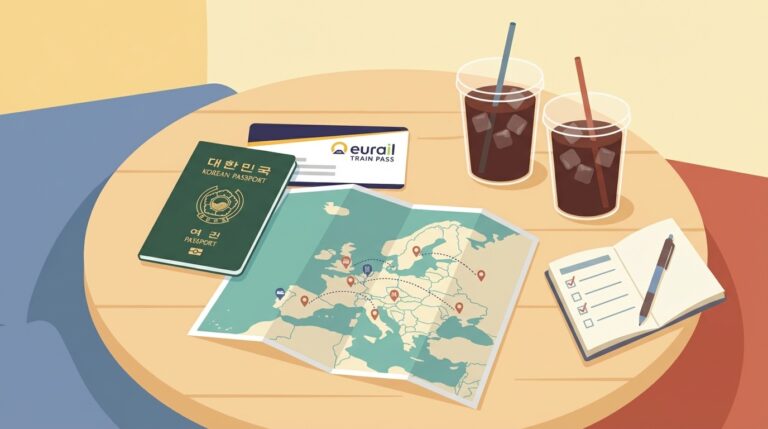
Picture this: You are sitting in a trendy cafe in Yeonnam-dong with your Korean best friend. Spread across the table is a massive map of Europe, two iced americanos, and an iPad displaying the Eurail Pass options.
If you’ve ever watched Korean travel reality shows like Grandpas Over Flowers (꽃보다 할배) or Tent Outside Europe (텐트 밖은 유럽), you know that Koreans don’t just ‘go’ on vacation. They orchestrate it like a high-stakes military operation. The subtitles might say, ‘Let’s plan our trip,’ but what they are actually saying is, ‘Let’s weave our line of movement so we can extract every ounce of value from this flight ticket.’
If you’re at a C2 level in Korean, you already know how to order food and book a hotel. But do you know how to debate logistics, compromise on a grueling schedule, and navigate the intense Korean ‘Power J’ (MBTI Planner) travel mindset? Knowing these expressions won’t just help you plan a Eurail trip; it will earn you the ultimate insider nod from any Korean traveler.
(Note: This guide is crafted from real C2 learners’ experiences who survived planning cross-continental trips with their Korean partners!)
Phase 2: In-Depth Analysis of Core Expressions
1. 동선을 짜다
- Pronunciation: dongseon-eul jjada [dong-sun-eul jja-da]
(The ‘eo’ in seon sounds like the ‘u’ in ‘sun’. The ‘jj’ is a tense, tight sound—like the ‘j’ in ‘jump’ but with your jaw clenched.)- Meaning: Literal: To weave the line of movement. / Real nuance: To plan the itinerary/route efficiently.
- K-Culture Moment: You’ll hear this constantly among Korean backpackers in European hostels. It’s the ultimate ‘Power J’ (Planner) vocabulary. It implies finding the most mathematically perfect route from Paris to Interlaken so you don’t waste 10 minutes backtracking.
- Editor’s Insight: We don’t just ‘make a plan’ (계획을 세우다); we ‘weave a movement line.’ It shows how much Koreans value spatial efficiency and time management.
- Situation Spectrum:
- Friends (Casual): ✅
- Co-workers (Semi-formal): ✅
- Boss/Elders (Formal): ✅ (Often used as 동선을 계획하다 in formal settings)
- 🤔 Think About It: Why does Korean use the verb ‘짜다’ (to weave/squeeze) for planning? How does this reflect the Korean mindset toward time?
2. 일정이 너무 빡빡하다 (or 빡세다)
- Pronunciation: iljeong-i neomu ppakppakhada [il-jung-ee no-moo ppak-ppak-ha-da]
(The ‘pp’ is a sharp, un-aspirated ‘p’. Imagine popping a small balloon with your lips.)- Meaning: Literal: The schedule is too tight/hard. / Real nuance: This itinerary is going to kill us; there’s no breathing room.
- K-Culture Moment: Look at a typical Korean tourist’s Europe itinerary: London, Paris, Rome, Venice, and Interlaken—all in 7 days. When you realize you only have 45 minutes allotted for the Louvre, you drop this phrase.
- Editor’s Insight: ‘빡빡하다’ is the standard word for ‘tight.’ ‘빡세다’ is its slang cousin, heavily used among millennials and Gen Z to mean ‘intense’ or ‘exhausting.’
- Situation Spectrum:
- Friends (Casual): ✅ (Use 빡세다!)
- Co-workers (Semi-formal): ⚠️ (Stick to 빡빡하다)
- Boss/Elders (Formal): 🚫 (Use 일정이 다소 여유가 없습니다)
- 🤔 Think About It: Does your culture treat vacations as a time to ‘do nothing’ or a time to ‘see everything’?
3. 기왕 유럽까지 가는 거…
- Pronunciation: giwang yureop-kkaji ganeun geo… [gee-wang you-rup-kka-jee ga-neun go]
(The ‘으’ in yureop sounds like the disgusted sound you make when stepping in gum.)- Meaning: Literal: Since we are going all the way to Europe anyway… / Real nuance: We spent $1,500 on flights, so we are going to suffer and see every single cathedral whether we want to or not.
- K-Culture Moment: This is the ultimate justification phrase. When your friend suggests adding an overnight train to Prague just for a 2-hour walking tour, they will start the sentence with ‘기왕 가는 거…’
- Editor’s Insight: This phrase embodies the Korean concept of ‘뽕을 뽑다’ (getting one’s money’s worth). It’s driven by the fact that getting out of Asia takes significant time and money.
- Situation Spectrum:
- Friends (Casual): ✅
- Co-workers (Semi-formal): ✅
- Boss/Elders (Formal): ⚠️ (Use 기왕 가시는 김에)
- 🤔 Think About It: How does geography (living on a peninsula with blocked northern borders) affect a nation’s travel psychology?
Phase 3: Textbook vs. Real Korean
| Situation | 📖 Textbook Korean | 🗣️ Real Korean | 💡 Why the difference? |
|---|---|---|---|
| Making a travel plan | 우리 여행 계획을 세웁시다. | 우리 동선 어떻게 짤까? | Real Korean prioritizes the ‘logistics’ (route) over the abstract ‘plan’. |
| Complaining about a busy schedule | 시간이 부족할 것 같습니다. | 야, 일정 너무 빡센 거 아니야? | ‘빡세다’ captures the physical and mental exhaustion of a tight schedule perfectly. |
| Getting a Eurail Pass | 기차 탑승권을 구매합시다. | 유레일 패스 뽕을 뽑자! | ‘뽕을 뽑다’ (getting the max value) is a core economic mindset in Korean slang. |
Phase 4: Cultural Context — K-Culture Deep Dive
4-1. Non-verbal Elements: The Art of Nunchi in Travel
When your Korean friend shows you an Excel spreadsheet with 15-minute intervals for your Paris trip, do not laugh. In Korea, being the ‘planner’ is an act of service. If you want to change the plan, use Nunchi (reading the room). Start by praising their effort: ‘우와, 진짜 고생했다!’ (Wow, you worked so hard on this!) before gently suggesting a break.
4-2. K-Culture Connection: MBTI and the ‘Power J’
In modern Korean culture, MBTI isn’t just a personality test; it’s a social framework. When planning a trip, Koreans immediately divide into ‘J’ (Judging – The Planners) and ‘P’ (Perceiving – The Spontaneous). Planning a 15-day Eurail trip is the Super Bowl for a ‘Power J’.
Critical View: While social media romanticizes the hyper-organized ‘J’ traveler as the ideal, it often leads to severe travel burnout. Realizing that it’s okay to ‘just chill’ at a European piazza is a cultural hurdle for many Korean travelers accustomed to the ‘Ppalli Ppalli’ (hurry hurry) lifestyle.
Phase 5: Real-Life Roleplay Scenario
Setting: A Friday evening at a noisy cafe in Gangnam. You and your Korean friend Minji are planning a 14-day Eurail trip. Minji’s iPad is filled with color-coded Excel sheets.
Characters:
– YOU: An expat in Korea, C2 level, prefers slow travel and sipping wine by the river.
– Minji (28): Your Korean bestie. A self-proclaimed ‘Power J’. Wants to visit 6 countries in 14 days.
Dialogue:
Minji: 자, 파리에서 2박 하고, 바로 야간열차 타고 스위스로 넘어가는 거야. 어때? 🚅
(Ja, parieseo ibak hago, baro yaganyeolcha tago seuwiseuro neomeoganeun geoya. Eottae?)
[Okay, we stay 2 nights in Paris, and immediately take the night train to Switzerland. What do you think?]
(🎭 Stage Direction: Minji points enthusiastically at her iPad screen with her Apple Pencil.)
YOU: 파리에서 2박? 에펠탑만 보고 바로 떠나자고?
(Parieseo ibak? Epeltapman bogo baro tteonajago?)
[2 nights in Paris? You want to leave right after just seeing the Eiffel Tower?]
Minji: 기왕 유럽까지 가는 건데 뽕은 뽑아야지! 스위스에서 융프라우 보고 다음 날 이탈리아로 넘어가는 동선이야.
(Giwang yureopkkaji ganeun geonde ppongeun ppobayaji! Seuwiseueseo yungpeurau bogo daeum nal italliaro neomeoganeun dongseoniya.)
[Since we’re going all the way to Europe, we have to get our money’s worth! The route is seeing Jungfrau in Switzerland and crossing over to Italy the next day.]
🔀 Your Turn! How do you respond to Minji’s intense schedule?
– A) 네 계획은 완전히 틀렸어. (Your plan is completely wrong.)
– B) 좋아! 잠은 한국 돌아와서 자면 되지! (Love it! We can sleep when we get back to Korea!)
– C) 민지야, 고생한 건 아는데… 솔직히 일정 너무 빡센 거 아니야? 우리 하루만 더 여유를 두자.✅ Best Choice: C — Reason: You acknowledge her hard work (‘고생한 건 아는데’) but assertively set boundaries using ‘일정 너무 빡센 거 아니야?’. It’s natural and polite.
⚠️ Choice B Analysis: This is a very common Korean joke (‘잠은 죽어서 자는 거다’ – sleep is for the dead), and Minji will love it, but you will physically suffer in Europe!
Phase 6: 10-Second Shadowing Drill
Master the rhythm and intonation of a true Korean traveler!
😤 기왕 / 유럽까지 가는 건데, / 뽕은 / 뽑아야지! (giwang / yureopkkaji ganeun geonde, / ppongeun / ppobayaji!)
Tip: Hit the ‘기왕’ and ‘뽕’ with strong emphasis. Nod your head confidently on ‘뽑아야지!’
🥺 솔직히... / 일정이 / 너무 빡센 거 아니야? (soljikhi... / iljeongi / neomu ppaksen geo aniya?)
Tip: Drag out the ‘솔직히’ (honestly) to show hesitation, and raise your pitch at the end like a genuine plea for mercy.
Phase 7: K-Culture Mini Dictionary
| Korean | Romanization | English | Context |
|---|---|---|---|
| 파워제이 | pawo jei | Power J | Someone who plans obsessively (from MBTI ‘Judging’). |
| 뽕을 뽑다 | ppongeul ppopda | To get one’s money’s worth | A crucial economic/travel mindset in Korea. |
| 핫플 | hatpeul | Hot place | Trendy spots you MUST visit to post on Instagram. |
| 야간열차 | yaganyeolcha | Night train | A romanticized yet exhausting European travel trope for Koreans. |
Phase 8: Traveler’s Survival Kit (Eurail Edition)
Even if you’re fluent, navigating the Eurail system requires specific vocabulary.
🆘 Survival Expressions for Train Travel
– 🇰🇷 “이 패스는 연속 패스인가요, 아니면 플렉시(선택) 패스인가요?” (Is this a continuous pass or a flexi pass?)
– 🇰🇷 “환승 시간이 15분인데, 현실적으로 가능한 동선인가요?” (The transfer time is 15 minutes; is this route realistically possible?)
– 🇰🇷 “좌석 예약금(예약비)은 따로 내야 하나요?” (Do I need to pay a separate seat reservation fee?)📌 Editor’s Travel Note: Korea vs. Europe Trains
Koreans are used to the KTX—hyper-punctual, no mandatory reservations for pass holders, and ultra-fast Wi-Fi. When planning a Eurail trip with Koreans, you MUST warn them: “유럽 기차는 연착이 잦아!” (European trains are frequently delayed!). They will experience severe culture shock if they plan 10-minute transfers.
Phase 9: Critical Thinking — “One Step Deeper”
🧠 Think Deeper: Vacation as a Mission (Language & Power)
Look at the verbs Koreans use for travel: ‘계획을 짜다’ (to weave a plan), ‘정복하다’ (to conquer a tourist site), ‘도장 깨기’ (to break seals/stamp collecting). The language of Korean travel is deeply intertwined with the vocabulary of work and achievement. In a hyper-competitive society, even leisure must be optimized. A vacation isn’t just a break; it’s a project with tangible KPIs (photos at landmarks, eating at Michelin restaurants). Does this highly efficient mindset maximize joy, or does it turn leisure into an extension of office labor?
💬 Your Turn: Does your culture treat travel as a time to ‘achieve’ or a time to ‘escape’? Share your thoughts in the comments!
Phase 10: FAQ & Mistake Prevention
- Q: Can I use ‘동선을 짜다’ in a business context?
- A: Yes! It’s actually a highly professional term. E.g., “이번 출장 동선을 어떻게 짤까요?” (How should we route this business trip?)
- Q: Why do Koreans ask for my MBTI before planning a trip?
- A: It’s their way of gauging conflict. If they are a ‘J’ and you are a ‘P’, they mentally prepare themselves to take on 100% of the planning burden.
❌ Common Mistake: Translating ‘I want a relaxing trip’ directly to ‘지루한 여행을 원해요’ (I want a boring trip).
✅ Do This Instead: Say ‘여유로운 여행을 하고 싶어요’ (I want a leisurely/relaxed trip). ‘여유’ is the magical word for stress-free schedules.
Phase 11: Summary & Action Items
- One-Liner Summary: To plan a trip like a Korean, focus on weaving efficient routes (동선) and avoid overly brutal schedules (빡센 일정) unless you want to get your money’s worth (뽕을 뽑다).
-
Action Mission:
- 🥉 Bronze: Say “일정이 너무 빡빡해요” out loud next time your calendar is full.
- 🥈 Silver: Text a Korean friend: “우리 나중에 유럽 가면 동선 어떻게 짤까?”
- 🥇 Gold: Try mapping out a fake 3-day itinerary for a trip to Jeju or Busan using Korean apps (Naver Map/Kakao Map) and evaluate if the ‘동선’ makes sense!
- K-Culture Mission: Go to YouTube and search ‘유레일 패스 여행 브이로그’ (Eurail Pass travel vlog). Turn on the auto-generated Korean subtitles and see how many times they mention ‘일정’ (schedule) or ‘기차 연착’ (train delay)!
Phase 12: Quiz — Interactive Challenge
1. Situational Judgment: Your friend suggests visiting London, Paris, Rome, and Barcelona in exactly 5 days. What is the most natural Korean response?
– A) 아주 좋은 생각입니다.
– B) 야, 일정 너무 빡센 거 아니야?
– C) 동선을 아름답게 짜자.
(Answer: B. It’s time to bring them back to reality!)
2. Fill in the Blank:
“유럽까지 비행기 표가 얼만데… 기왕 가는 거 완전히 ___을 뽑아야지!”
*(Answer: 뽕. 뽕을 뽑다 = to get your money’s worth.)*
3. True or False (K-Culture Edition):
When a Korean friend says they are a “Power P” (Perceiver) in MBTI, they usually arrive at the airport with a beautifully color-coded Excel itinerary.
(Answer: False. A “Power P” is spontaneous. The Excel sheet belongs to the “Power J”!)
Frequently Asked Questions (FAQ)
Q: What does "동선을 짜다" mean in Korean and how do you pronounce it?
A: In Korean, "동선을 짜다" is pronounced [dongseon-eul jjada [dong-sun-eul jja-da] and means: Literal: To weave the line of movement. / Real nuance: To plan the itinerary/route efficiently.
Q: What does "일정이 너무 빡빡하다 (or 빡세다)" mean in Korean and how do you pronounce it?
A: In Korean, "일정이 너무 빡빡하다 (or 빡세다)" is pronounced [iljeong-i neomu ppakppakhada [il-jung-ee no-moo ppak-ppak-ha-da] and means: Literal: The schedule is too tight/hard. / Real nuance: This itinerary is going to kill us; there's no breathing room.
Q: What does "기왕 유럽까지 가는 거..." mean in Korean and how do you pronounce it?
A: In Korean, "기왕 유럽까지 가는 거..." is pronounced [giwang yureop-kkaji ganeun geo... [gee-wang you-rup-kka-jee ga-neun go] and means: Literal: Since we are going all the way to Europe anyway... / Real nuance: We spent $1,500 on flights, so we are going to suffer and see every single cathedral whether we want to or not.







