

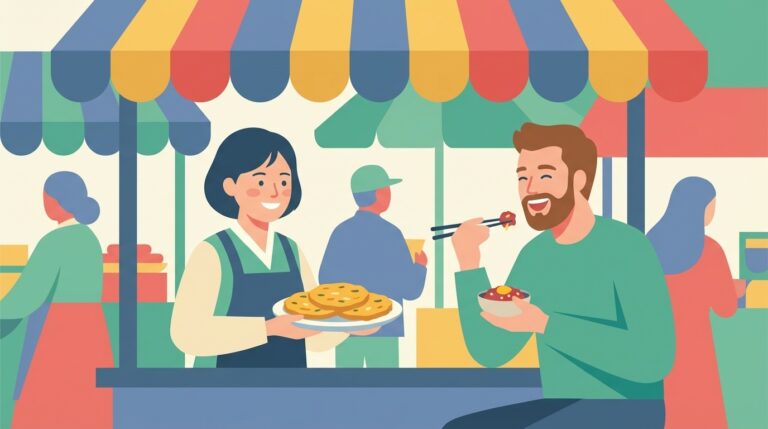
Phase 1: Empathy (Immersive Open)\n\nHello! I’m the lead editor of Daily Hangul. Picture this: You’ve finally made it to Gwangjang Market (광장시장) after seeing it on countless Netflix food documentaries and K-Dramas. The smell of sizzling oil and savory meat fills the air. It’s crowded, loud, and incredibly vibrant. You spot a tiny empty stool next to a group of locals downing Makgeolli (막걸리). The stall owner—a busy ajumma flipping a massive golden pancake—locks eyes with you and shouts something over the noise. Panic sets in. What do you say?\n\nTextbook Korean will tell you to say, “I would like to order.” But in the glorious chaos of a traditional Korean market, formal textbook phrases are going to get lost in the noise. This guide, based on real experiences of our students, will teach you the survival phrases you actually need to grab a seat, order the iconic Yukhoe (raw beef tartare) and Bindaetteok (mung bean pancake), and eat like a true local.\n\n—\n\n### Phase 2: Core Expressions Deep Dive\n\n> ### 1. 여기 자리 있어요? (Is this seat taken?)\n>\n> – Pronunciation: Yeo-gi ja-ri i-sseo-yo? [yeo-gi: ‘yeo’ like ‘yawn’, ja-ri: ‘ja’ like ‘jar’, i-sseo-yo: ‘sseo’ sounds like the ‘suh’ in ‘sun’ but sharper]\n> – Meaning: Literal = Is there a seat here? / Real nuance = Can I sit here? or Is anyone sitting here?\n> – K-Culture Moment: In Gwangjang Market, space is a luxury. You don’t wait for a hostess to seat you. You hunt for an empty stool. If you see half an inch of bench available next to an ahjusshi eating noodles, you point to it and ask this.\n> – Editor’s Insight: It’s polite but practical. It shows you know the unwritten rule of “합석” (hab-seok), which means sharing a table with strangers. You’re asking about the space, not demanding it.\n> – Situation Spectrum:\n> – Casual / Strangers at a market: ✅\n> – Fancy Michelin restaurant: ⚠️ (The staff will seat you instead)\n> – To elders (if spoken politely): ✅\n> – 🤔 Think About It: Why do Koreans ask “Is there a seat?” instead of “Can I sit?” It shifts the focus away from the speaker (“I”) and onto the shared environment (“the seat”), reflecting a more indirect, collective mindset.\n\n> ### 2. 이모(님), 여기 육회 하나, 빈대떡 하나 주세요! (Auntie, one yukhoe and one bindaetteok here!)\n>\n> – Pronunciation: I-mo(-nim), yeo-gi yu-koe ha-na, bin-dae-tteok ha-na ju-se-yo! [yu-koe: ‘koe’ sounds like ‘kwe’, bin-dae-tteok: ‘tteok’ like a sharp ‘duck’ with a tight throat]\n> – Meaning: Literal = Aunt(ie), here one yukhoe, one bindaetteok please. / Real nuance = Excuse me, I’ll order one yukhoe and one bindaetteok!\n> – K-Culture Moment: This is the ultimate insider way to order at a traditional market, pojangmacha (tent bar), or an older mom-and-pop restaurant. Calling the friendly female owner “I-mo” (Aunt) instantly bridges the gap between foreigner and local.\n> – Editor’s Insight: Add “여기” (here) before your order. It literally means “here,” but functionally acts as “To our table, please!” It grabs their attention in a loud environment.\n> – Situation Spectrum:\n> – Market stall / Casual eatery: ✅\n> – Corporate boss / Formal setting: 🚫\n> – Young cafe worker: 🚫\n> – 🤔 Think About It: Calling a stranger “Aunt” or “Uncle” implies a sense of familial closeness. Does your culture use family terms for strangers, or do you keep a strict professional boundary?\n\n> ### 3. 먹고 갈게요 / 포장해 주세요 (I’ll eat here / Please pack it to go)\n>\n> – Pronunciation: Meok-go gal-ge-yo / Po-jang-hae ju-se-yo\n> – Meaning: Literal = I will eat and go / Please do packaging. / Real nuance = For here / To go.\n> – K-Culture Moment: When buying Bindaetteok at the front of the stall, the owner needs to know instantly if she should put it on a plate or in a paper box to keep the line moving.\n> – Editor’s Insight: Never say “take out” at a traditional market. While young people use it in cafes, “포장” (po-jang) is the magic word for packing food to go at markets.\n> – Situation Spectrum:\n> – Casual: ✅\n> – Semi-formal: ✅\n> – Formal: ✅\n> – 🤔 Think About It: “먹고 갈게요” (I will eat and go) highlights the action of leaving afterward. It’s an efficient, fast-paced way of speaking perfectly suited for busy Seoul!\n\n—\n\n### Phase 3: Textbook vs. Real Korean\n\n| 상황 | 📖 Textbook Korean | 🗣️ Real Korean | 💡 Why is it different? |\n|—|—|—|—|\n| Getting the vendor’s attention | “저기요, 주문하겠습니다.” (Excuse me, I will order.) | “이모님~!” or “사장님~!” (Auntie~! / Boss~!) | Markets thrive on a friendly, family-like atmosphere (Jeong) rather than formal service. |\n| Asking to share a table | “제가 여기 앉아도 될까요?” (May I sit here?) | “여기 자리 있어요?” (Is there a seat here?) | Indirect phrasing feels less intrusive in crowded, shared spaces. |\n| Ordering to go | “테이크아웃 하고 싶습니다.” (I want to do takeout.) | “포장해 주세요.” (Please pack it up.) | English loanwords are common in modern cafes, but native terms remain standard in markets. |\n\n—\n\n### Phase 4: Cultural Context — K-Culture Deep Dive\n\n#### 4-1. Non-verbal Nunchi at the Market\nAt Gwangjang Market, your Nunchi (눈치)—the ability to read the room—will be tested. Don’t block the narrow aisles. When eating, keep your elbows tucked in so you don’t bump your neighbor! When paying, hand your card or cash directly to the I-mo with two hands (or one hand supporting your other arm). It’s a fundamental sign of respect, even in a chaotic, greasy market.\n\n#### 4-2. K-Food Connection: The Rain and Sizzling Oil\nDid you know that Bindaetteok and Makgeolli (rice wine) are the ultimate rainy-day soul food in Korea? Koreans say the sound of rain hitting the ground sounds exactly like the sizzling of the mung bean batter hitting the hot oil pan. If you visit Gwangjang Market on a rainy day, getting a seat is like winning the lottery. You’ll hear locals cheering and toasting with copper bowls filled with milky Makgeolli. It’s not just a meal; it’s a deeply ingrained cultural reflex!\n\n—\n\n### Phase 5: Real-world Roleplay Scenario\n\nSetting: Friday evening, 7:30 PM. Gwangjang Market is packed. Neon signs glow, steam rises from massive dumpling pots, and the smell of toasted sesame oil from the Yukhoe alley makes your stomach rumble. You manage to squeeze into a stall next to a friendly Korean salaryman.\n\nCharacters:\n- YOU: A hungry traveler ready to test out your Korean.\n- Imo (이모): The energetic, apron-wearing stall owner.\n- Ahjusshi (아저씨): A 50-something local enjoying his Makgeolli next to you.\n\nYOU: 저기요… 여기 자리 있어요?\n(Jeo-gi-yo… yeo-gi ja-ri i-sseo-yo?)\n[Excuse me… is this seat taken?]\n\nAhjusshi: (Smiles and scoots his stool over) 아유, 앉아요 앉아! 자리 많아.\n(A-yu, an-ja-yo an-ja! Ja-ri ma-na.)\n[Oh, sit down, sit down! There’s plenty of room.]\n\nYOU: 감사합니다! (Looking at the busy owner) 이모님!\n(Gam-sa-ham-ni-da! I-mo-nim!)\n[Thank you! Auntie!]\n\nImo: (Wiping her hands on her apron) 네~ 삼촌(학생), 뭐 줄까?\n(Ne~ sam-chon/hak-saeng, mwo jul-kka?)\n[Yes~ young man/student, what should I give you?]\n\nYOU: 여기 육회 하나, 빈대떡 하나 주세요.\n(Yeo-gi yu-koe ha-na, bin-dae-tteok ha-na ju-se-yo.)\n[One yukhoe and one bindaetteok here, please.]\n\nImo: 막걸리도 하나 줘요? 빈대떡엔 막걸리지!\n(Mak-geol-ri-do ha-na jwo-yo? Bin-dae-tteok-en mak-geol-ri-ji!)\n[Should I give you a Makgeolli too? Bindaetteok calls for Makgeolli!]\n\n> 🔀 Your Turn! How do you respond?\n> – A) “아니요, 물 주세요.” (No, water please. – A bit too blunt)\n> – B) “네, 좋아요! 막걸리 하나 주세요.” (Yes, sounds good! One Makgeolli please.)\n> – C) “막걸리 대박!” (Makgeolli daebak! – Funny, but maybe too slangy for ordering.)\n>\n> ✅ Best Choice: B — Embracing the owner’s recommendation is the best way to experience K-Food culture. “네, 좋아요!” shows enthusiasm without being too informal.\n\nYOU: (Choosing B) 네, 좋아요! 막걸리 하나 주세요.\n(Ne, jo-a-yo! Mak-geol-ri ha-na ju-se-yo.)\n[Yes, sounds good! One Makgeolli please.]\n\nImo: 아이고, 외국인이 먹을 줄 아네! 금방 줄게요.\n(A-i-go, oe-guk-in-i meo-geul jul a-ne! Geum-bang jul-ge-yo.)\n[Oh my, this foreigner knows how to eat! I’ll get it to you right away.]\n(🎭 Stage Direction: Imo brings out a vibrant red Yukhoe topped with a bright yellow egg yolk, and a sizzling, thick Bindaetteok.)\n\n—\n\n### Phase 6: 10-Second Shadowing Drill\n\nLet’s practice the ultimate ordering combo. Pay attention to the pauses (/)!\n\n😊 이모님~! / 여기 / 육회 하나, / 빈대떡 하나 주세요!\n(I-mo-nim~! / yeo-gi / yu-koe ha-na, / bin-dae-tteok ha-na ju-se-yo!)\n(Tip: Wave your hand slightly to catch her eye, and project your voice!)\n\n—\n\n### Phase 7: K-Culture Mini Dictionary\n\n| 한국어 | Romanization | English | Cultural Context |\n|—|—|—|—|\n| 이모 | i-mo | Aunt | Literally “mother’s sister,” but widely used to respectfully and affectionately call female restaurant staff in casual dining spots. |\n| 빈대떡 | bin-dae-tteok | Mung bean pancake | A savory, thick pancake fried in plenty of oil. Gwangjang Market’s most famous street food. |\n| 육회 | yu-koe | Beef tartare | Fresh raw beef seasoned with sesame oil, soy sauce, and garlic, served with pear slices and a raw egg yolk. |\n| 합석 | hab-seok | Sharing a table | A common practice in crowded, older restaurants and markets where you share a table with strangers. |\n| 단골 | dan-gol | Regular customer | A customer who visits frequently. Building ‘dan-gol’ status means you might get free bonus food (서비스 – service)! |\n\n—\n\n### Phase 8: Traveler’s Survival Kit\n\n> 🆘 Survival Phrases for the Market\n> – 🇰🇷 “이거 얼마예요?” (i-geo eol-ma-ye-yo?) – “How much is this?”\n> – 🇰🇷 “계좌이체 할게요.” (gye-jwa-i-che hal-ge-yo.) – “I will do a bank transfer.” (Very common in markets!)\n> – 🇰🇷 “안 맵게 해 주세요.” (an maep-ge hae ju-se-yo.) – “Please make it not spicy.”\n\n> 📌 Editor’s Travel Note\n> – Navigating: Use Naver Map or KakaoMap. Google Maps doesn’t provide accurate walking directions in Korea!\n> – Payment: Korea is a cashless society, but traditional markets are the one exception. Bring some physical cash (Won) just in case, as some tiny stalls don’t have card machines.\n> – Tipping: DO NOT TIP. Tipping does not exist in Korea. If you leave money on the table, the vendor will literally run down the street to return it to you!\n\n—\n\n### Phase 9: Critical Thinking Corner — “A Step Deeper”\n\n> 🧠 Think Deeper: Food & Identity (The Culture of “Jeong”)\n> In Gwangjang Market, eating isn’t just about feeding yourself; it’s a shared communal experience. The physical closeness of sitting shoulder-to-shoulder with strangers, sharing dipping sauces, and the vendor playfully telling you what you should drink all stem from 정 (Jeong)—a unique Korean concept of unspoken affection, attachment, and community spirit. It blurs the lines between “my space” and “our space.” The loud, chaotic market isn’t rude or intrusive; it’s the sound of people connecting.\n>\n> 💬 Your Turn: In your home country, is dining usually a private, guarded experience, or is sharing tables and conversations with strangers common? Let us know in the comments!\n\n—\n\n### Phase 10: FAQ & Avoiding Mistakes\n\n- Q: Can I call a young barista “Imo”?\n A: NO! “Imo” is only for middle-aged or older women in casual settings (like markets or BBQ joints). For young staff in a cafe, simply use “저기요” (Excuse me).\n- Q: Is it safe to eat raw beef (Yukhoe) at a street market?\n A: Yes! Gwangjang Market has a dedicated “Yukhoe Alley.” Turn-over is extremely high, meaning the beef is incredibly fresh. Millions of locals and tourists eat it safely every year.\n- Q: Can I ask for more side dishes?\n A: Absolutely. Side dishes (banchan) are infinitely refillable for free in Korea. Just say, “이모, 김치 좀 더 주세요!” (Auntie, a little more kimchi please!).\n\n> ❌ Common Mistake #1: Saying “테이크아웃 (Takeout)” to an elderly vendor at a traditional market. They might not understand the English loanword.\n> ✅ Do this instead: Say “포장해 주세요” (Po-jang-hae ju-se-yo) to ask for your food to go.\n\n—\n\n### Phase 11: Summary & Action Items\n\nOne-Liner Summary: Ditch the formal textbook Korean and embrace the local vibe by confidently calling out “I-mo!” to order your Yukhoe and Bindaetteok.\n\nAction Mission 3 Steps:\n- 🥉 Bronze (Solo): Stand in front of a mirror and practice ordering with confidence: “이모님! 육회 하나 주세요!”\n- 🥈 Silver (Online): Find a YouTube walking tour of Gwangjang Market and try to spot a vendor you’d want to order from.\n- 🥇 Gold (Real-world): Go to a local Korean restaurant in your city and try saying “포장해 주세요” when you want to take your leftovers home!\n\nK-Culture Mission: Watch an episode of Netflix’s Street Food: Asia featuring Seoul. Notice how the stall owners interact with customers—listen closely for the word “I-mo”!\n\n—\n\n### Phase 12: Quiz — Interactive Challenge\n\n1. Situational Judgment: You are at a crowded stall in Gwangjang Market. You see one empty stool next to a Korean couple. What is the most natural thing to say?\nA) 제가 여기 앉아도 될까요? (May I sit here?)\nB) 여기 자리 있어요? (Is this seat taken?)\nC) 비켜주세요. (Move, please.)\n\n(Answer: B. It’s the most natural, indirect way to ask for a seat in Korea. C is incredibly rude!)\n\n2. True or False – K-Culture Edition: You had a great meal at Gwangjang Market, so you should leave a 10% tip on the table.\n\n(Answer: False! Tipping is not part of Korean culture and will only cause confusion.)
Frequently Asked Questions (FAQ)
Q: What does "정" mean in Korean and how do you pronounce it?
A: In Korean, "정" is pronounced [Jeong] and means: —a unique Korean concept of unspoken affection, attachment, and community spirit. It blurs the lines between "my space" and "our space." The loud, chaotic market isn't rude or intrusive; it's the sound of people connecting.\n>\n>







