

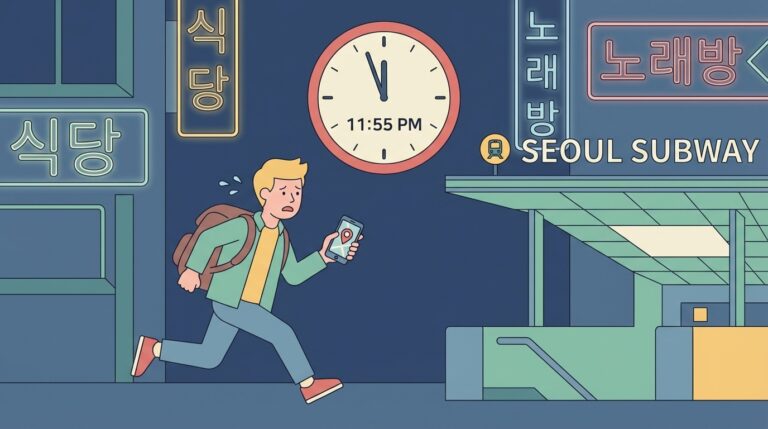
Hello! I’m the Lead Editor at Daily Hangul. Have you ever watched a K-Drama where the main characters are having drinks, and suddenly one of them looks at their watch, their eyes widen in panic, and they yell, ‘I have to go! The last train is leaving!’? Or perhaps they miss the train, which conveniently leads to a romantic late-night walk or the famous ‘Shall we go eat ramyeon?’ trope.
While it’s romantic on TV, missing the last subway in real-life Seoul is less of a rom-com and more of a wallet-draining panic. Unlike New York or London, Seoul’s subway does not run 24 hours. Around midnight, the stations close like Cinderella’s castle. Knowing how to ask about the last train is not just a travel tip—it’s a crucial survival skill, and honestly, the best social excuse you’ll ever learn in Korea.
This guide is built from the panicked text messages of my actual students who found themselves stranded in Hongdae at 1 AM. Let’s make sure that doesn’t happen to you!
Phase 2: Core Expressions Deep Dive
1. 막차가 몇 시예요?
- Pronunciation: [mak-cha-ga myeot si-ye-yo?]
- Sound-alike guide: ‘Mak’ sounds like the ‘Mac’ in Big Mac, and ‘cha’ sounds like the ‘cha’ in cha-cha.
- Meaning: Literal: What time is the last car? / Real nuance: What time is the last train/bus?
- K-Culture Moment: You’re at a K-Pop concert. The encore just ended, and 10,000 people are rushing out. You turn to a security guard or a fellow fan and urgently ask this to see if you need to sprint to the station.
- Editor’s Insight: ‘막차’ (Makcha) is a magical compound word combining ‘막’ (last/final) and ‘차’ (vehicle). You don’t need to specify whether it’s a bus or a train; context does the heavy lifting.
- Situation Spectrum:
- Casual with friends: ✅ (막차 몇 시야?)
- Semi-formal (Co-workers/Strangers): ✅ (막차가 몇 시예요?)
- Formal (Boss): ⚠️ (Use with caution, usually you’d say it to excuse yourself)
- 🤔 Think About It: In many languages, you have to say the full phrase (‘the last train’). Why do you think Koreans shortened it to just a two-syllable word (‘Makcha’)? Could it be related to the fast-paced ‘Pali-pali’ culture?
2. (지하철) 끊겼어요.
- Pronunciation: [(ji-ha-cheol) kkeun-gyeot-seo-yo]
- Sound-alike guide: ‘Kkeun’ sounds similar to the ‘kk’ in ‘skill’ plus ‘un’, with a sharp, tight throat sound.
- Meaning: Literal: The subway is cut off. / Real nuance: The subway stopped running for the night.
- K-Culture Moment: You are sitting at a Pocha (street tent bar) with friends. You check your map app, sigh deeply, and show your phone screen to your friends while saying this. It means you’re officially relying on a taxi tonight.
- Editor’s Insight: This verb (끊기다 – to be cut off) is beautifully dramatic. It perfectly captures the feeling of a lifeline being severed. We don’t say ‘the train finished’; we say ‘it got cut off.’
- Situation Spectrum:
- Casual: ✅ (지하철 끊겼어)
- Semi-formal: ✅ (지하철 끊겼어요)
- Formal: 🚫
- 🤔 Think About It: We also use ‘끊기다’ when a phone call drops or when our allowance is stopped by our parents. How does this reflect the Korean mindset of interconnectedness?
3. 막차 놓쳤어요.
- Pronunciation: [mak-cha no-cheot-seo-yo]
- Sound-alike guide: ‘No’ like ‘no’, ‘cheot’ like ‘chut’ in chutney.
- Meaning: Literal/Real nuance: I missed the last train.
- K-Culture Moment: The classic K-Drama scene where the male lead runs down the subway stairs, only to see the tail lights of the train disappearing into the tunnel. He rests his hands on his knees, panting, and mutters, ‘아, 막차 놓쳤다…’ (Ah, missed the last train…)
- Editor’s Insight: ‘놓치다’ means to miss (a bus, an opportunity, or a person). If you use this expression at a company dinner, your older Korean colleagues will usually sigh with sympathy and might even offer to pay for your taxi!
- Situation Spectrum:
- Casual: ✅
- Semi-formal: ✅
- Formal: ✅ (A perfectly valid excuse for being late the next morning if you had to sleep at a sauna!)
- 🤔 Think About It: Have you ever noticed how often characters in K-Dramas miss things (buses, trains, romantic timings)? How does ‘missing out’ build tension in Korean storytelling?
Phase 3: Textbook vs. Real Korean
| Situation | 📖 Textbook Korean | 🗣️ Real Korean | 💡 Why the difference? |
|---|---|---|---|
| Asking the time of the last train | 마지막 열차가 언제 출발합니까? (When does the last train depart?) | 막차 몇 시예요? (What time is Makcha?) | ‘열차’ (train) sounds like you are at a cross-country railway station, not a city subway. |
| Telling friends you missed it | 저는 마지막 버스를 탑승하지 못했습니다. (I failed to board the final bus.) | 아 헐, 막차 놓쳤어. (Ah omg, missed Makcha.) | ‘헐’ (Heol) is a vital slang exclamation for shock or dismay, adding authentic emotion. |
| Explaining why you can’t stay | 대중교통 운행이 종료되었습니다. (Public transit operations have ended.) | 차 끊겼어요. (Transit got cut off.) | Koreans prefer short, visually descriptive verbs (‘cut off’) over bureaucratic nouns in daily speech. |
Bottom Note for B1 Learners: Don’t worry about memorizing formal broadcast announcements. Sticking to ‘막차’ and ‘끊겼어요’ makes you sound instantly fluent and naturally integrated into local life.
Phase 4: Cultural Context — K-Culture Deep Dive
4-1. Non-verbal Elements: The Art of ‘Nunchi’
When you need to catch the last train during a gathering, you can’t just abruptly stand up and shout, ‘I’m leaving!’ This is where 눈치 (Nunchi)—the subtle art of gauging the mood—comes in. About 20 minutes before your train leaves, you should subtly start checking your phone or watch. You might casually tidy up your belongings on the table. When you finally announce, ‘저 막차 타야 해서요…’ (I have to catch the last train…), make sure to look slightly apologetic, bowing your head slightly to the most senior person at the table.
4-2. The ‘Makcha’ Excuse in K-Drama & Hoesik Culture
In Korea, 회식 (Hoesik)—company dinners—can go on for multiple rounds (1차 BBQ, 2차 Beer, 3차 Karaoke). In the past, refusing to join the next round was seen as killing the mood. However, the ‘Makcha’ is the ultimate, socially acceptable boundary.
No boss, no matter how strict, can argue with the Seoul Metro Corporation. Saying ‘막차 끊겨서요’ (Because the last train will be cut off) is a polite, indirect way of saying, ‘I want to go home now.’ In K-Dramas, you’ll often see the villainous boss try to pressure the rookie to stay, only for the cool senior colleague to step in and say, ‘Let them go, their Makcha is leaving.’ It’s not just transit; it’s a shield against overworking!
Phase 5: Real-life Roleplay Scenario
Setting: Friday night, 11:15 PM. A smoky, bustling Samgyeopsal (BBQ) restaurant in Hongdae. Empty green Soju bottles line the table. You are with three Korean colleagues.
Characters:
– YOU: A foreigner working in Korea, exhausted and wanting to sleep.
– Minsu (32): Your friendly but overly energetic Korean coworker who loves drinking.
Minsu: 자, 여러분! 1차는 여기서 끝내고, 2차로 노래방 어때요?! 🎤
(Ja, yeoreobun! 1-chaneun yeogiseo kkeunnaego, 2-charo noraebang eottaeyo?!)
[Alright everyone! Let’s wrap up round 1 here, how about karaoke for round 2?!]
(🎭 Stage Direction: Minsu triumphantly waves a pair of BBQ tongs in the air)
YOU: 아… 벌써 11시 반이네요.
(Ah… beolsseo 11-si ban-ineyo.)
[Ah… it’s already 11:30.]
Minsu: 에이, 내일 주말인데 달리자! 괜찮죠?
(Ei, naeil jumal-inde dallija! Gwaenchanjyo?)
[Hey, tomorrow is the weekend, let’s run (drink hard)! You’re okay with it, right?]
🔀 Your Turn! How should you respond?
– A) “저는 안 갈래요. 너무 피곤해요.” (I don’t want to go. I’m too tired.)
– B) “저 막차 타야 해서 먼저 일어날게요.” (I have to catch the last train, so I’ll get up first.)
– C) “지하철 끊겼어요?” (Is the subway cut off?)✅ Best Choice: B — This is the ‘Golden Ticket’. It shows you are leaving due to external circumstances (the train schedule), not because you dislike their company. It saves face for everyone.
⚠️ Choice A Analysis: While honest, this is considered too blunt in traditional Korean work culture and might make Minsu feel rejected.
(Assuming you chose B)
Minsu: 아, 진짜요? 막차 몇 시인데요?
(Ah, jinjja-yo? Makcha myeot si-inde-yo?)
[Ah, really? What time is the last train?]
YOU: 11시 45분 차예요. 지금 가야 해요.
(11-si 45-bun cha-yeyo. Jigeum gaya haeyo.)
[It’s the 11:45 train. I have to go now.]
Minsu: 헐, 뛰어가야겠다! 얼른 가요. 월요일에 봐요!
(Heol, ttwieogayagetda! Eolleun gayo. Woryoil-e bwayo!)
[Omg, you have to run! Go quickly. See you on Monday!]
YOU: 네, 재미있게 노세요! 먼저 가보겠습니다.
(Ne, jaemi-itge noseyo! Meonjeo gabogetseumnida.)
[Yes, have fun playing (hanging out)! I’ll be going first.]
🚕 Bonus Scenario: You missed it!
Let’s say you stayed for Karaoke and missed the train. You flag down a taxi.
Taxi Driver: 어디로 모실까요? (Where shall I take you?)
YOU: 기사님, 강남역으로 가주세요. 아… 막차 놓쳐서 너무 힘드네요.
(Gisanim, Gangnam-yeok-euro gajuseyo. Ah… makcha nocheoseo neomu himdeuneyo.)
[Driver, please go to Gangnam station. Ah… I missed the last train so I’m very exhausted.]
(The driver will likely nod in deep sympathy. Missing the Makcha is a universal pain!)
Phase 6: 10-Second Shadowing Drill
Practice this sentence to politely escape any late-night situation. Pay attention to the pauses!
🥺 죄송하지만 / 저 / 막차 시간 때문에 / 먼저 / 일어날게요.
(Joesonghajiman / jeo / makcha sigan ttaemune / meonjeo / ireonalkkeyo.)
“I’m sorry, but / I / because of the last train time / first / will get up (leave).”
Phase 7: K-Culture Mini Dictionary
| Korean | Romanization | English | Cultural Context |
|---|---|---|---|
| 막차 | makcha | Last train/bus | The final transit option of the day, usually around midnight in Seoul. |
| 첫차 | cheotcha | First train/bus | The first transit of the morning (around 5:30 AM). If you miss the Makcha, you stay up for the Cheotcha! |
| 회식 | hoesik | Company dinner | A team bonding dinner that often involves heavy drinking and multiple venues. |
| 눈치 | nunchi | Social intuition | The ability to read the room. Knowing when to mention your last train requires good Nunchi. |
| 심야버스 | simya beoseu | Night bus | The ‘N-Buses’ (Night owls) in Seoul that run from midnight to 4 AM. A lifesaver! |
Phase 8: Traveler’s Survival Kit
If you find yourself watching the taillights of the last subway disappear, don’t panic. Here is your late-night Seoul survival guide.
🆘 Survival Expressions for Late Night
– 🇰🇷 “여기 카카오택시 잡혀요?” (yeogi kakao taeksi japhyeoyo?)
– 🗣️ English meaning: Can we catch a Kakao Taxi here?
– 📍 Where to use: Asking locals if it’s a good spot to hail a ride via app.
– 💡 Pro Tip: At 1 AM in busy areas (Gangnam, Hongdae), catching a regular taxi on the street is a war. Always use the Kakao T app.📌 Editor’s Travel Note
– The N-Bus (Night Bus): Seoul operates ‘올빼미 버스’ (Owl Buses) marked with an ‘N’ (e.g., N13, N26). They run through major routes all night. Open Naver Map or KakaoMap and search for ‘N’.
– Taxi Surcharges (할증): Beware! From 10 PM to 4 AM, there is a late-night surcharge on taxis (up to 40% more expensive between 11 PM and 2 AM).
– PC Bangs / Jjimjilbangs: If a taxi is too expensive, locals often go to a PC Cafe (PC Bang) or a 24-hour sauna (Jjimjilbang) to wait for the first train (첫차) at 5:30 AM!
Phase 9: Critical Thinking — “One Step Deeper”
Language & Power: The Polite Escape
In Korean culture, the hierarchical structure of age and corporate rank is deeply embedded in the language. Saying “I want to go home” to a superior implies that your personal comfort overrides the group’s harmony. However, invoking the “Makcha” shifts the blame to an immovable, neutral third party: the transit system. It acts as a linguistic equalizer. By using “막차 타야 해요” (I need to catch the last train), you are preserving the superior’s authority (you would stay if you could) while fiercely protecting your own boundary. It’s a brilliant cultural workaround that maintains respect while prioritizing survival.
💬 Your Turn: Does your culture have a universally accepted “polite excuse” to leave a party or a work dinner? How do you escape an awkward late-night gathering? Share in the comments!
Phase 10: FAQ & Avoiding Misunderstandings
- “Can I just say ‘last train’ in Konglish (라스트 트레인)?”
- Maybe. Younger people might understand, but ‘막차’ is so universally used that saying ‘라스트 트레인’ sounds very unnatural. Just say ‘Makcha’!
- “If I’m taking a KTX (bullet train) to Busan, is it still Makcha?”
- Yes! ‘Makcha’ applies to subways, city buses, intercity buses, and KTX trains.
❌ Common Mistake #1: Saying “마지막 기차 탔어요.” (I took the final train.)
✅ Do this instead: Say “막차 탔어요.” While ‘마지막 기차’ is grammatically perfect, it sounds like a line translated from a dramatic novel.❌ Common Mistake #2: Assuming Seoul subways run 24/7 on weekends.
✅ Do this instead: They don’t! In fact, weekend last trains sometimes run earlier than on weekdays. Always check your app (KakaoMap/Naver Map) after 11 PM.
Phase 11: Summary & Action Items
- One-Liner Summary: “막차 (Makcha)” is your golden ticket for catching the last ride home and gracefully escaping endless Korean dinners.
-
Action Mission 3 Steps:
- 🥉 Bronze (Solo): Look at your watch and sigh dramatically while saying “아… 막차 끊겼어요” in front of your mirror.
- 🥈 Silver (Online): Download Naver Map or KakaoMap, set a route from Gangnam to Myeongdong, and find the exact time of the ‘막차’ for tonight.
- 🥇 Gold (Real World): The next time you are hanging out late with Korean friends, be the one to check your phone and say, “우리 막차 몇 시야?” (What time is our last train?)
- K-Culture Mission: Watch a K-Drama set in Seoul. Count how many times a character runs frantically down the street or subway stairs around midnight. 90% of the time, they are fighting the Makcha clock!
Enjoyed this lesson? Let me know below what your favorite late-night snack is when you miss the last train! (Mine is definitely convenience store cup ramyeon!)
Phase 12: Quiz — Interactive Challenge
1. Situational Judgment: You are at a company dinner. It’s 11:30 PM, and your boss wants to order more Soju. You live far away. What is the most culturally savvy way to leave?
– A) “부장님, 저는 안 마실게요.” (Boss, I won’t drink.)
– B) “저 막차 끊기기 전에 일어나보겠습니다.” (I’ll get up before my last train is cut off.)
– C) “지하철 문 닫아요!” (The subway doors are closing!)
2. Fill in the Blank:
“아… 어떡해. 눈앞에서 지하철을 _________.”
(Ah… what do I do. Right in front of my eyes, I [missed] the subway.)
3. True or False – K-Culture Edition:
Seoul subways run 24 hours a day on Friday and Saturday nights to accommodate the nightlife. (T/F)
🚨 Click here for Answers!
1. Answer: B. It politely uses the transit schedule as the reason for leaving, saving face for the boss.
2. Answer: 놓쳤어요 (nocheosseoyo). ‘Missed’ is the perfect verb here.
3. Answer: False. Subways generally stop between midnight and 1 AM, even on weekends. You must use N-Buses or Taxis after that!
Frequently Asked Questions (FAQ)
Q: What does "막차가 몇 시예요?" mean in Korean and how do you pronounce it?
A: In Korean, "막차가 몇 시예요?" is pronounced [mak-cha-ga myeot si-ye-yo?] and means: a key conversational Korean expression covered in this lesson.
Q: What does "(지하철) 끊겼어요." mean in Korean and how do you pronounce it?
A: In Korean, "(지하철) 끊겼어요." is pronounced [ji-ha-cheol] and means: a key conversational Korean expression covered in this lesson.
Q: What does "막차 놓쳤어요." mean in Korean and how do you pronounce it?
A: In Korean, "막차 놓쳤어요." is pronounced [mak-cha no-cheot-seo-yo] and means: a key conversational Korean expression covered in this lesson.







