

How to Buy Korean Convenience Store Beer Like a Local: The 4 for 10000 Won Rule
Phase 1: Empathy (Immersive Open)
Hello! Daily Hangul Editor here.
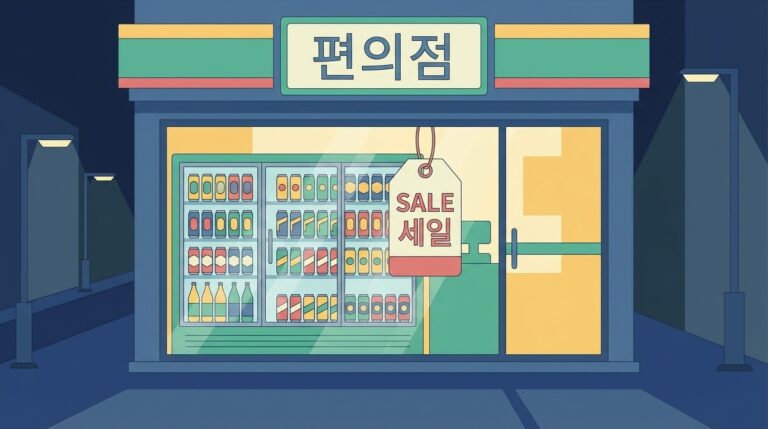
Picture this: It’s 10 PM on a Friday in Seoul. You’ve just finished a long day of exploring or perhaps binge-watching a K-Drama where the main characters have a heart-to-heart talk over a cheap beer at a plastic table outside a convenience store. You want to live that moment! You walk into a brightly lit CU or GS25, head straight to the cooler, and grab two cans of your favorite beer.
But when you get to the register, the cashier points at a brightly colored tag and says something in rapid Korean. You just end up paying and leaving, only to realize later… you paid almost the same price for two cans as you would have for four!
Welcome to the magic of the “4 Cans for 10,000 Won” (맥주 4캔 만원) rule. It’s not just a promotion; it’s a cultural institution in Korea. If you don’t know how this works, you’re missing out on the ultimate K-CVS (Korean Convenience Store) experience. Don’t worry, as your veteran tutor and local Seoulite friend, I’m here to make sure you never miss a beer deal again! (Note: While inflation has pushed this to 11,000 or 12,000 won in many places recently, the phrase “4캔 만원” remains an iconic cultural idiom!)
Phase 2: Core Expressions Deep Dive
Let’s look at the absolute must-know phrases for this situation.
1. 네 캔 [ne kaen]
- Pronunciation: [nay can] (Rhymes with ‘say pan’)
- Meaning: Literal: Four cans / Real nuance: The magic number for a beer discount.
- K-Culture Moment: You’re by the Han River. Your friend says, “I’m going to the CVS.” You yell out, “Get four cans!” In Korean, we use Pure Korean numbers to count items: 하나, 둘, 셋, 넷 becomes 한, 두, 세, 네 when attached to a counter like 캔 (can).
- Editor’s Insight: Saying “네 캔” with confidence makes you sound like you know exactly what you’re doing.
- Situation Spectrum:
- Casual (Friends): ✅
- Semi-formal (Cashiers): ✅
- Formal (Boss): ✅ (It’s just a noun phrase, totally safe!)
- 🤔 Think About It: Why does Korea use two different number systems (Sino-Korean and Pure Korean)? It might seem tricky, but using Pure Korean for counting physical objects shows a deep-rooted historical way of quantifying the world around us. Does your language have specific “counters” for different objects?
2. 만원 [man-won]
- Pronunciation: [Mahn-won]
- Meaning: 10,000 Korean Won (Roughly $7-8 USD).
- K-Culture Moment: The green 10,000 won bill used to be the exact price of Friday night happiness. You hand it to the cashier, grab your heavy plastic bag of beers, and feel like a millionaire.
- Editor’s Insight: Even if the sign says 11,000 won (만천원) or 12,000 won (만이천원) now, the concept of buying in a bundle of four is what matters.
- Situation Spectrum:
- Casual: ✅
- Semi-formal: ✅
- Formal: ✅
- 🤔 Think About It: “Combo deals” exist everywhere, but in Korea, the “4 for X price” beer deal revolutionized how young people drink. It shifted the culture from expensive bars to cozy convenience store hangouts.
3. 교차 가능해요? [gyo-cha ga-neung-hae-yo?]
- Pronunciation: [Gyo-cha gah-neung-hay-yo?]
- Meaning: Literal: Is crossing possible? / Real nuance: Can I mix and match different brands?
- K-Culture Moment: You want a Guinness, a Korean Cass, an Asahi, and a Jeju Ale. You point to the fridge and ask the cashier this. They nod. You’ve just created the ultimate international beer flight!
- Editor’s Insight: This is an insider term. “교차” means cross/intersect. Using this makes you sound like an absolute K-CVS pro.
- Situation Spectrum:
- Casual (Friends): ⚠️ (Friends might just say “섞어도 돼?”)
- Semi-formal (Cashiers): ✅ (Perfect here!)
- Formal (Boss): 🚫 (Too casual/specific for an office setting)
- 🤔 Think About It: Korean convenience stores offer beers from all over the world side-by-side with local brews. This reflects Korea’s incredibly fast-paced adoption of global tastes.
Phase 3: Textbook vs. Real Korean
| Situation | 📖 Textbook Korean | 🗣️ Real Korean | 💡 Why the difference? |
|---|---|---|---|
| Asking for the promo | 이 맥주 네 캔 주십시오. (Please give me 4 cans of this beer.) | 이거 행사 상품 맞아요? (Is this a promo item?) | Textbooks sound like you are ordering at a fancy restaurant. In a CVS, you grab it yourself and just confirm the deal! |
| Asking to mix | 다른 브랜드와 섞어서 구매할 수 있습니까? (May I purchase by mixing with other brands?) | 이거 교차 돼요? (Can I mix and match this?) | Efficiency is key in Korea (빨리빨리 culture). Short, punchy slang like ‘교차 돼요?’ saves time at the register. |
| Realizing you need one more | 아, 한 캔을 더 가져오겠습니다. (Ah, I will go and bring one more can.) | 아, 하나 더 가져올게요! (Ah, I’ll grab one more!) | Natural spoken Korean drops the formal object particles and uses friendly verb endings. |
Bottom Note: As an A1 learner, don’t worry about perfect grammar at the CVS. Pointing and saying “행사 맞아요?” (Promo right?) is more than enough!
Phase 4: Cultural Context — K-Culture Deep Dive
4-1. Non-verbal Nunchi (눈치) at the Register
When you place 3 beers on the counter, a Korean cashier will usually pause. They will look at the beers, look at you, and say something. That is their Nunchi kicking in! They know you’re missing out on the deal. They aren’t trying to upsell you to be greedy; they are trying to save you money. Don’t wave them off; listen for the word “네 캔” (four cans)!
4-2. The K-Drama Trope: Pyeon-uija (편의점 의자)
Have you noticed in K-Dramas how characters always sit on those flimsy plastic chairs outside the convenience store? This is called Pyeon-uija (CVS chair).
When characters are heartbroken, stressed about work, or celebrating a small win, they don’t go to a fancy bar. They go to the CVS, buy “4캔 만원” (or just a bottle of Soju), and pair it with a bag of chips like Saeukkang (새우깡) or instant cup ramen. It represents relatable, working-class comfort.
Critical View: While K-Dramas make drinking outside the CVS look incredibly romantic and peaceful, in reality, doing this late at night in residential areas can lead to noise complaints. Always be mindful of the neighborhood vibe!
Phase 5: Real-Life Roleplay Scenario
Setting: Friday, 11:30 PM. A brightly lit GS25 near your Airbnb in Hongdae. The K-Pop music from the store speakers is loud. You want to relax after a long day of sightseeing, so you grab 3 cans of beer and head to the counter.
Characters:
– YOU: A traveler in Seoul, thirsty and tired.
– Ji-hoon (22): The CVS part-timer. He looks exhausted but is very polite.
Dialogue:
YOU: (Placing 3 beers on the counter) 계산해 주세요.
(gyesanhae juseyo.)
[Please ring this up.]
Ji-hoon: (Scanning the beers… beep, beep, beep)
손님, 이거 행사 상품이에요.
(sonnim, igeo haengsa sangpumieyo.)
[Customer, these are promo items.]
YOU: 네?
(ne?)
[Excuse me?]
Ji-hoon: 세 캔 하시면 9천원인데, 네 캔 하시면 만천원이에요.
(se kaen hasimyeon gucheonwoninde, ne kaen hasimyeon mancheonwonieyo.)
[If you buy 3 cans it’s 9,000 won, but 4 cans are 11,000 won.]
Ji-hoon: 하나 더 가져오시겠어요?
(hana deo gajyeoosigesseoyo?)
[Would you like to go grab one more?]
🔀 YOUR TURN! How do you respond?
– A) “아니요, 그냥 세 개 주세요.” (No, just give me three.)
– B) “아! 진짜요? 하나 더 가져올게요!” (Ah! Really? I’ll grab one more!)
– C) “교차 가능해요?” (Can I mix and match?)✅ Best Choice: B or C!
Why? If you choose A, you are paying almost the same price for 3 beers as you would for 4! It breaks the cashier’s heart. Choosing B shows you appreciate their tip. Choosing C makes you sound like a total local who is ready to pick a different brand for the 4th can!
(🎭 Stage Direction: You run back to the fridge, grab a fruity Jeju Ale, and run back to the counter.)
YOU: 가져왔어요!
(gajyeowasseoyo!)
[I brought it!]
Ji-hoon: (Smiling slightly) 네, 만천원입니다. 봉투 필요하세요?
(ne, mancheonwonimnida. bongtu piryohaseyo?)
[Yes, that’s 11,000 won. Do you need a bag?]
Phase 6: 10-Second Shadowing Drill
Let’s practice the most important phrase when picking your beers. Repeat after me aloud!
😊 저기요, / 이거 / 네 캔 / 교차 / 가능해요?
(jeogiyo, / igeo / ne kaen / gyo-cha / ga-neung-hae-yo?)
[Excuse me, / this / four cans / mixing / is it possible?]
Tip: Pause slightly at the slashes (/). Raise your tone at the very end like you do for a question in English!
Phase 7: K-Culture Mini Dictionary
| Korean | Romanization | English | Cultural Context |
|---|---|---|---|
| 편맥 | pyeon-maek | CVS Beer | Slang combining 편의점 (CVS) + 맥주 (Beer). A popular cheap hangout activity. |
| 안주 | an-ju | Drinking Snacks | Koreans rarely drink alcohol without food. Chips, sausages, or ramen are essential CVS anju! |
| 민증 | min-jeung | ID Card | Short for 주민등록증. Cashiers will ask for your ‘min-jeung’ to verify your age. |
| 행사 | haeng-sa | Promo/Event | You will see 1+1, 2+1, and 4캔 tags everywhere. These are ‘haeng-sa’ items. |
Phase 8: Traveler Survival Kit
Are you heading to a Korean convenience store soon? Save these phrases in your phone!
🆘 CVS Survival Phrases TOP 3
– 🇰🇷 “봉투 주세요.” (bongtu juseyo.)
– 🗣️ English: Please give me a bag. (Plastic bags cost about 50 won, so they always ask!).
– 🇰🇷 “영수증 버려주세요.” (yeongsujeung beoryeojuseyo.)
– 🗣️ English: Please throw away the receipt.
– 🇰🇷 “전자레인지 어디 있어요?” (jeonjareinji eodi isseoyo?)
– 🗣️ English: Where is the microwave? (Crucial for heating up your CVS sausages!).📌 Editor’s Travel Note:
– Age Verification: In Korea, the legal drinking age is 19 (international age). Always bring your physical passport! Pictures of your passport on your phone are often rejected by strict CVS policies.
– Payment: Korea is a cashless society. T-money cards, Apple Pay (in some stores), or foreign credit cards work perfectly.
Phase 9: Critical Thinking Corner — “A Step Deeper”
🧠 Think Deeper: Food, Community, and the CVS
Why does the “4 Cans” promotion exist instead of just making one can cheaper? In Korean culture, food and drinks are inherently communal. The concept of Jeong (정) means sharing what you have. Buying 4 cans implies you are not drinking alone; you are taking them to the Han River to share with friends, or bringing them back to the hotel for your family. The convenience store isn’t just a place to buy goods; it’s the starting point of social connection.
💬 Your Turn:
Does your culture have a “communal discount” or a specific cheap food that everyone shares late at night? Tell us in the comments!
Phase 10: FAQ & Avoiding Misunderstandings
Q: Do I really have to buy 4 cans? What if I want 2?
A: You can absolutely buy just 2! But you won’t get the discount. For example, one can might be 4,000 won. Two cans = 8,000 won. But four cans = 11,000 won. Math-wise, it’s just better to buy 4 and save them in your fridge!
Q: Can I drink the beer inside the convenience store?
A: No! Drinking alcohol inside the CVS is legally forbidden in Korea. You must drink at the tables outside (if provided) or take it away.
❌ Common Mistake:
Grabbing beers from different price tiers.
✅ Do this instead:
Make sure all the beers you grab have the exact same “4캔 행사” (4-can promo) tag color or price listed. You cannot mix a premium craft beer with a standard promo beer to get the deal.
Phase 11: Summary & Action Items
One-Liner Summary: Look for the “네 캔” (4 cans) tag at the Korean CVS, grab four, and ask “교차 가능해요?” to mix and match like a local!
Action Mission:
– 🥉 Bronze: Say “네 캔 만원” out loud 3 times right now.
– 🥈 Silver: Next time you watch a K-Drama, spot the green bottles or beer cans on a convenience store table.
– 🥇 Gold: When you visit Korea, confidently grab 4 mixed beers, hand over your card, and say “영수증 버려주세요!” (Throw away the receipt!).
K-Culture Mission:
Open Google Maps or Naver Map right now. Search for “GS25” or “CU” near “Hongdae Station.” Imagine walking in. What 4 beers would you pick?
Phase 12: Quiz — Interactive Challenge
1. Situational Judgment: You are at a CU convenience store. You have 3 cans of Cass beer. The cashier points to the fridge and says “행사 상품입니다” (Promo item). What should you do?
– A) Say “No, thank you” and pay full price.
– B) Go grab one more beer to get the 4-can discount.
– C) Open a beer and drink it right there.
2. True or False:
– You can drink your “4캔 만원” beers sitting at the noodle counter inside the store. (T / F)
(Toggle for Answers)
1. B! The cashier is looking out for your wallet! Grab that 4th can.
2. False! It is illegal to consume alcohol inside the convenience store. You must drink outside or take it home.
Frequently Asked Questions (FAQ)
Q: What does "네 캔 [ne kaen]" mean in Korean and how do you pronounce it?
A: In Korean, "네 캔 [ne kaen]" is pronounced [nay can] and means: Literal: Four cans / Real nuance: The magic number for a beer discount.
Q: What does "만원 [man-won]" mean in Korean and how do you pronounce it?
A: In Korean, "만원 [man-won]" is pronounced [Mahn-won] and means: 10,000 Korean Won (Roughly $7-8 USD).
Q: What does "교차 가능해요? [gyo-cha ga-neung-hae-yo?]" mean in Korean and how do you pronounce it?
A: In Korean, "교차 가능해요? [gyo-cha ga-neung-hae-yo?]" is pronounced [Gyo-cha gah-neung-hay-yo?] and means: Literal: Is crossing possible? / Real nuance: Can I mix and match different brands?







