

Phase 1: Empathy (The K-Culture Cold Open)
Hello! I’m your Daily Hangul Editor.
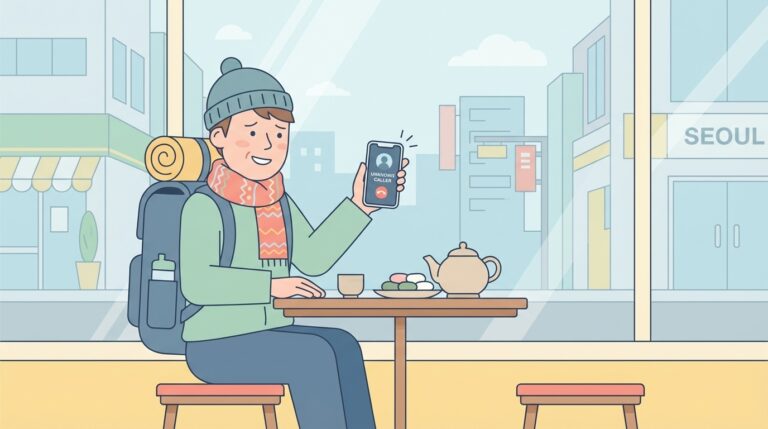
Imagine this: You are sitting in a cozy cafe in Seoul, sipping your iced Americano. Suddenly, your phone screen flashes green, and a cheerful, slightly dramatic melody rings out. Ttiriring~ Ttiriring~
It’s a VoiceTalk (보이스톡) on KakaoTalk from your new Korean friend!
In K-Dramas, when the protagonist gets a call, they confidently pick it up, say a cool one-liner, and hang up. But in reality? If you are an A2 Korean learner, your heart probably drops. “Wait, do I say ‘Hello’? Do I say ‘Annyeonghaseyo’? What if the internet connection is bad?”
Don’t panic! This guide is entirely based on the real-life struggles of my tutoring students. By the end of this article, you won’t just know how to answer the phone—you’ll sound like a true Korean insider (인싸) who knows exactly how to navigate Korea’s unique smartphone culture.
Phase 2: Core Expressions Deep Dive
Here are the top 3 lifesaver expressions you need when that VoiceTalk screen pops up.
1. 여보세요? (Hello?)
- Pronunciation: yeoboseyo? [yo-bo-say-yo]
- Sound-alike guide: Imagine greeting a friend named “Yo,” then asking them to “bow,” and saying “say yo.”
- Meaning: Hello? (Used only on the phone, never in person!)
- K-Culture Moment: You’ve seen this in every thriller K-Drama. The detective answers the phone in a dark room: “Yeoboseyo?”
- Editor’s Insight: This is the most standard phone greeting. It literally comes from “Look here” (여기 보세요). It’s a way to check if the other person is on the line. But here is the secret: friends rarely use this with each other on VoiceTalk because they already see your name on the screen!
- Situation Spectrum:
- Casual (Friends): ⚠️ (A bit awkward, but okay if you don’t know who it is)
- Semi-formal (Coworkers): ✅
- Formal (Elders/Strangers): ✅
- 🤔 Think About It: Why does Korean have a completely different word for “hello” on the phone versus in person? Does your language have a special phone greeting?
2. 목소리 잘 들려요? (Can you hear my voice well?)
- Pronunciation: moksori jal deullyeoyo? [mok-so-ree jal deul-lyuh-yo?]
- Meaning: Can you hear me? / Is the audio okay?
- K-Culture Moment: Picture an idol doing a live stream (Weverse/V-Live) outside. The wind is blowing, and they lean into the camera: “Guys, moksori jal deullyeoyo?”
- Editor’s Insight: VoiceTalk uses internet data. Sometimes the connection drops. Instead of shouting “HELLO?!”, simply ask this. It shows you are considerate of the other person’s experience.
- Situation Spectrum:
- Casual: ✅ (Usually shortened to: 내 목소리 들려?)
- Semi-formal: ✅
- Formal: ✅
- 🤔 Think About It: Koreans heavily emphasize clear communication. Checking if the other person is comfortable (even audibly) is a big part of Korean phone manners.
3. 지금 통화 괜찮아요? (Is it okay to talk now?)
- Pronunciation: jigeum tonghwa gwaenchanayo? [jee-geum tong-hwa gwen-chan-ah-yo?]
- Meaning: Are you free to talk right now?
- K-Culture Moment: Before pouring out some juicy gossip or heavy news, a K-Drama character will text or say this first to make sure the coast is clear.
- Editor’s Insight: This is the ultimate Nunchi (눈치) expression. Because smartphones are always on us, calling someone means interrupting their life. Asking for permission to continue the call is a basic courtesy in Korea.
- Situation Spectrum:
- Casual: ✅ (Shortened: 통화 가능?)
- Semi-formal: ✅
- Formal: ✅
Phase 3: Textbook vs. Real Korean
Let’s see how real Koreans actually answer VoiceTalks compared to textbooks.
| Situation | 📖 Textbook Korean | 🗣️ Real Korean | 💡 Why is it different? |
|---|---|---|---|
| Answering a friend | 여보세요? (Yeoboseyo?) | 어~ 왜~ (Uh~ wae~) / 어 나야 (Uh, naya) | VoiceTalk shows your name/photo! Friends just say “Yeah, what’s up?” or “Yeah, it’s me.” |
| Bad connection | 잘 안 들립니다. (Jal an deullimnida.) | 어? 렉 걸린다! / 자꾸 끊겨! (Uh? Lag geollinda! / Jakku kkeungkyeo!) | Internet slang! “Lag” is widely used for bad data connections in casual speech. |
| Asking to hang up | 안녕히 계세요. (Annyeonghi gyeseyo.) | 어~ 끊어~ (Uh~ kkeuneo~) / 이따 톡할게! (Itta tokhalge!) | “Goodbye” sounds too formal. Friends say “I’ll text you later!” (Talk-halge). |
Bottom Note: As an A2 learner, stick to the safe expressions if you are unsure, but try using “이따 톡할게!” (I’ll KakaoTalk you later!) with your close friends to sound like a native!
Phase 4: Cultural Context — K-Culture Deep Dive
4-1. The Art of “Nunchi” in Calling
In Korea, making a sudden phone call without warning is sometimes considered rude, especially among younger generations. We call this 콜포비아 (Call-phobia). Because KakaoTalk (texting) is so convenient, calling someone demands their immediate attention.
Rule of Thumb: Unless it’s an emergency or you are very close, send a text first: “지금 통화 괜찮아요?” (Can we talk now?)
4-2. The “Bo-Talk” (보톡) Generation
VoiceTalk is so common that Koreans shortened it to 보톡 (Bo-Talk). Since it uses data instead of phone carrier minutes, it’s completely free if you are on Wi-Fi. This is why international K-Pop fans use VoiceTalk to call their Korean friends or coordinate fan events without worrying about international calling fees!
Phase 5: Real-Life Roleplay Scenario
Setting: A noisy subway station in Seoul. You are waiting for your train. Suddenly, your Korean friend Min-su (30, super energetic and talkative) calls you via VoiceTalk.
Characters:
– YOU: An A2 Korean learner, currently overwhelmed by the subway noise.
– Min-su: Your Korean friend.
Dialogue:
Min-su: 어! 지금 어디야? 보톡 가능?
(Uh! Jigeum eodiya? Botok ganeung?)
[Hey! Where are you right now? Can you VoiceTalk?]
(🎭 Stage Direction: The subway announcement plays loudly in the background)
YOU: 여보세요? 민수 씨? 지금 지하철이에요.
(Yeoboseyo? Min-su ssi? Jigeum jihacheorieyo.)
[Hello? Min-su? I’m on the subway right now.]
Min-su: 아 진짜? 오늘 저녁에 치맥 어때? 강남역에서!
(Ah jinjja? Oneul jeonyeoge chimaek eottae? Gangnamyeogeseo!)
[Oh really? How about chicken and beer tonight? At Gangnam station!]
YOU: 어… 목소리가 잘 안 들려요.
(Uh… moksoriga jal an deullyeoyo.)
[Uh… I can’t hear your voice well.]
🔀 Your Turn! How do you end this call politely?
– A) “안녕히 계세요.” (Goodbye.)
– B) “나중에 다시 걸게요!” (I’ll call you back later!)
– C) “끊어!” (Hang up!)✅ Best Choice: B. It explains that you will call back once it’s quiet.
⚠️ Choice C Analysis: “끊어” is only for VERY close friends of the same age or younger. Using it awkwardly might make you sound like an angry K-Drama villain!
Phase 6: 10-Second Shadowing Drill
Practice speaking out loud! Follow the slashes for natural pauses.
😅 아, / 여보세요? / 지금 조금 / 바빠요. (Ah, / yeoboseyo? / jigeum jogeum / bappayo.)
(Ah, hello? I’m a little busy right now.)
😊 네~ / 목소리 / 아주 잘 들려요! (Ne~ / moksori / aju jal deullyeoyo!)
(Yes~ I can hear you very well!)
Phase 7: K-Culture Mini Dictionary
| Korean | Romanization | English | Context |
|---|---|---|---|
| 카톡 | Katok | KakaoTalk | The app 99% of Koreans use. Used as a verb too: “카톡해!” (Kakao me!) |
| 보톡 | Botok | VoiceTalk | Short for VoiceTalk. “보톡하자” (Let’s VoiceTalk). |
| 단톡방 | Dantokbang | Group Chat | Where team projects, family gossip, and fan clubs live. |
| 읽씹 | Ilkssip | Read and Ignore | Slang for reading a message (the ‘1’ disappears) but not replying. Ouch! |
Phase 8: Traveler Survival Kit
Because VoiceTalk requires an internet connection, travelers need data or Wi-Fi to answer the call!
🆘 Survival Phrases for the Internet
– 🇰🇷 “여기 와이파이 돼요?” (Yeogi waipai dwaeyo?)
– 🗣️ Sound: [Yuh-gee Wi-Fi dway-yo?]
– 📍 Where to use: Cafes, restaurants, hotels.
– 💡 Pro Tip: In Korea, 99% of cafes have free Wi-Fi. The password is usually written on the receipt! Look for “비밀번호” (Password).
📌 Editor’s Travel Note:
If you get a regular phone call (not VoiceTalk) from a Korean 010 number while traveling, it might be your delivery driver or a taxi driver from Kakao T! In that case, say: “여보세요? 저 외국인이에요. 문자 부탁드립니다.” (Hello? I am a foreigner. Please text me.)
Phase 9: Critical Thinking — “One Step Deeper”
🧠 Think Deeper: Tech & Reality (Korea’s Hyper-Connected Society)
Have you noticed how integrated KakaoTalk is in Korea? It’s not just a messenger. You use it to pay for coffee, hail a taxi, send birthday gifts, and verify your ID. VoiceTalk became huge because it bypassed traditional telecom limits. But this hyper-connection also means Koreans feel pressure to reply instantly. The anxiety of the “disappearing 1” (read receipt) is a real social phenomenon here.💬 Your Turn: Does your country have one “super app” that everyone uses? Do people prefer calling or texting where you live? Share in the comments!
Phase 10: FAQ & Avoiding Mistakes
Q: Can I VoiceTalk my boss or professor?
No! VoiceTalk is considered somewhat casual because it’s an internet call on a messenger app. For business or formal situations, always use a regular cellular phone call (일반 전화).
Q: Can I say “안녕하세요” on the phone instead of “여보세요”?
Yes, but usually after you confirm who it is. For example:
Ring ring -> “여보세요?” -> “아, 네 선생님, 안녕하세요!” (Ah, yes Teacher, hello!)
❌ Common Mistake #1: Saying “여보세요” when you greet someone face-to-face.
✅ Do this: “여보세요” is strictly for phones, walkie-talkies, or occasionally to get a stranger’s attention from far away (but “저기요” is better for that). Face-to-face, always stick to “안녕하세요!”
Phase 11: Summary & Action Items
One-Liner Summary: Use 여보세요 to answer, ask 잘 들려요? for connection checks, and remember to ask 통화 괜찮아요? to show great Korean Nunchi!
Your Action Missions:
– 🥉 Bronze: Look in the mirror, pretend to hold a phone, and say “여보세요? 목소리 잘 들려요?” 3 times.
– 🥈 Silver: Search YouTube for “VoiceTalk Ringtone” (보이스톡 연결음) to memorize the sound so you don’t panic!
– 🥇 Gold: Next time you call a friend who is learning Korean, call them via VoiceTalk and use these expressions!
Engagement: What is your biggest fear when talking on the phone in a foreign language? Let me know below!
Phase 12: Interactive Challenge Quiz
1. Situational Judgment:
You are at a cafe in Seoul. Your Korean language partner calls you on VoiceTalk, but the cafe music is too loud. What is the BEST thing to say?
– A) 안녕히 계세요. (Goodbye.)
– B) 목소리가 잘 안 들려요. 나중에 다시 걸게요! (I can’t hear you well. I’ll call you back later!)
– C) 누구세요? (Who are you?)
2. True or False – K-Culture Edition:
In Korea, it is considered polite to text a coworker “Are you free to talk?” before suddenly calling them via VoiceTalk.
– True / False
(Answers: 1. B – It explains the situation perfectly and politely. 2. True – This is the essence of Call-phobia and modern Nunchi!)
Frequently Asked Questions (FAQ)
Q: What does "여보세요? (Hello?)" mean in Korean and how do you pronounce it?
A: In Korean, "여보세요? (Hello?)" is pronounced [yeoboseyo? [yo-bo-say-yo] and means: Hello? (Used only on the phone, never in person!)
Q: What does "목소리 잘 들려요? (Can you hear my voice well?)" mean in Korean and how do you pronounce it?
A: In Korean, "목소리 잘 들려요? (Can you hear my voice well?)" is pronounced [moksori jal deullyeoyo? [mok-so-ree jal deul-lyuh-yo?] and means: Can you hear me? / Is the audio okay?
Q: What does "지금 통화 괜찮아요? (Is it okay to talk now?)" mean in Korean and how do you pronounce it?
A: In Korean, "지금 통화 괜찮아요? (Is it okay to talk now?)" is pronounced [jigeum tonghwa gwaenchanayo? [jee-geum tong-hwa gwen-chan-ah-yo?] and means: Are you free to talk right now?







