

Phase 1: Empathy (The K-Culture Cold Open)
Hello! It’s your Daily Hangul editor.
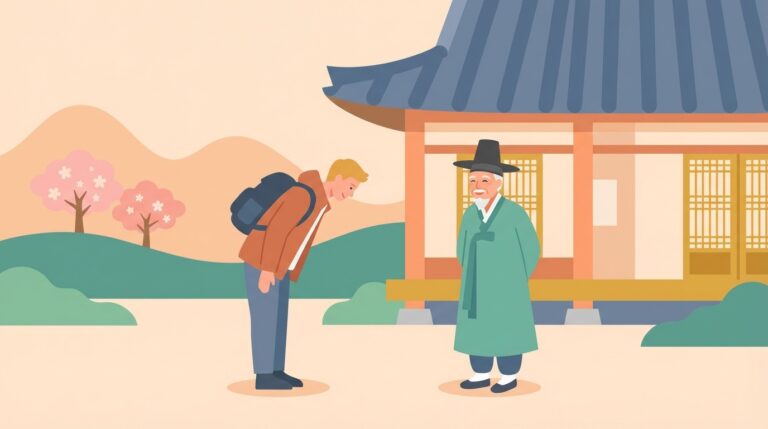
Picture this K-Drama scene: The rebellious, leather-jacket-wearing main character is shouting at his friends. Suddenly, the wooden sliding doors open, and his grandfather (the terrifying Chairman of a Chaebol) walks in. Instantly, the rebel stands up straight, bows 90 degrees, and his Korean completely changes. His sentences get longer, his voice gets softer, and he suddenly sounds like a historical drama actor.
As a Korean learner, you might wonder: Did he just switch to a different language?
Well, almost! Welcome to the world of Korean Honorifics (존댓말 – Jondaetmal). While you might know the basic ‘-yo’ (요) polite form, speaking to an elderly person—like a grandfather (할아버지 – Harabeoji)—requires a special ‘VIP upgrade’ of the Korean language.
If you use casual language with an elder, even by accident, it can lead to some very awkward stares. But if you get it right? You will instantly win their hearts and be praised as the “polite, well-mannered foreigner.” This guide is based on real struggles my beginner students face. Don’t worry, you don’t need to memorize a dictionary. Let’s master the essentials together!
Phase 2: Core Expressions Deep Dive
Let’s look at the 3 most important phrases you need when interacting with an elderly Korean man.
1. 할아버지 (Grandfather / Elderly Man)
- Pronunciation: [harabeoji] + [Hah-rah-buh-jee]
- Meaning: Grandfather (Literal) vs. Respectful term for any elderly man (Real nuance)
- K-Culture Moment: You are lost near a traditional market (like Gwangjang Market), and an old man helps you find the subway. You wouldn’t call him “Hey” or “Mister.” You call him “Harabeoji!”
- Editor’s Insight: In English, calling a stranger “Grandpa” might sound weird or overly familiar. In Korea, calling an elderly man “Harabeoji” (or ‘어르신 Eoreusin’ to be even more polite) shows respect for his age. It bridges the gap between strangers.
- Situation Spectrum:
- Close Friends (Casual): 🚫
- Co-workers (Semi-formal): 🚫
- Real Grandfather / Elderly strangers (Formal): ✅
- 🤔 Think About It: Why do Koreans use family terms (Grandfather, Older Brother, Aunt) for complete strangers? What does this tell us about the Korean sense of community?
2. 진지 드셨어요?
- Pronunciation: [jinji deushyeosseoyo?] + [Jeen-jee duh-shuh-sso-yo?]
- Meaning: Have you eaten a meal? (Literal) vs. How are you? / Have you been well? (Real nuance)
- K-Culture Moment: In family dramas, when the grandson visits the grandfather’s house, he doesn’t ask “How are you today?” He asks, “Jinji deushyeosseoyo?”
- Editor’s Insight: You probably learned “밥 먹었어요? (Bap meogeosseoyo?)” for “Did you eat?” But for elders, “Bap” (rice/meal) upgrades to the royal-sounding “Jinji”, and “meokda” (to eat) upgrades to “deushida”. It’s the ultimate polite greeting.
- Situation Spectrum:
- Close Friends (Casual): 🚫 (Too dramatic)
- Co-workers (Semi-formal): ⚠️ (A bit too formal for young colleagues)
- Grandparents / Elders (Formal): ✅
- 🤔 Think About It: Food is so important in Korea that asking if someone has eaten is equivalent to saying “Hello.” Does your culture have a unique greeting that isn’t just “How are you?”
3. 건강하세요!
- Pronunciation: [geonganghaseyo!] + [Guhn-gang-ha-se-yo!]
- Meaning: Be healthy! (Literal) vs. Please stay healthy / Take care (Real nuance)
- K-Culture Moment: Fan meetings! When K-Pop idols write letters to their older relatives or even to their fans on New Year’s Day, they almost always end with “건강하세요!”
- Editor’s Insight: Wishing for someone’s health is the most heartfelt way to say goodbye or express care to an older person. It carries much more warmth than a simple “Goodbye.”
- Situation Spectrum:
- Close Friends (Casual): ⚠️ (Use ‘건강해’ instead)
- Co-workers (Semi-formal): ✅
- Grandparents / Elders (Formal): ✅
- 🤔 Think About It: Wishing health is the highest form of blessing in Korea. How do you express your deepest well-wishes to elders in your home country?
Phase 3: Textbook vs. Real Korean
| Situation | 📖 Textbook Korean | 🗣️ Real Korean | 💡 Why is it different? |
|---|---|---|---|
| Greeting an elder | 안녕하십니까? (Annyeong-hasimnikka) | 식사하셨어요? / 진지 드셨어요? | Asking about meals shows affection and care, softening the stiff formal greeting. |
| Saying “Thank you” | 감사합니다. (Gamsahamnida) | 아이고, 감사합니다 어르신! (Aigo, gamsahamnida eoreusin!) | Adding “Aigo” (an exclamation of emotion) makes you sound like a true local! |
| Saying “Goodbye” | 안녕히 계십시오. (Annyeonghi gyesipsio) | 건강하세요! / 살펴 가세요! | Wishing them health or a safe trip home is much warmer than textbook farewells. |
Bottom Note for A2 Learners: You don’t need to memorize overly complicated grammar yet. Just swapping out a few key vocabulary words (like Bap -> Jinji) works like magic!
Phase 4: Cultural Context — K-Culture Deep Dive
4-1. The Non-Verbal “Honorifics” (Body Language)
Speaking respectfully is only 50% of the job. The other 50% is your body language.
– The Bow: When you say “안녕하세요” to a grandfather, you must bow. Not a quick head nod, but a genuine 45-to-90-degree bow.
– Two Hands Rule: If an elderly person hands you something (like a snack or your change at a market), ALWAYS receive it with both hands.
– Eye Contact (Nunchi): While looking someone in the eye shows confidence in Western cultures, staring directly into an elder’s eyes while they are speaking to you can be seen as challenging them. Look at their nose or chin area!
4-2. K-Drama & K-Travel Connections
- The Subway Rule: Have you seen scenes in K-Dramas where people are sleeping on the subway, but they immediately wake up and offer their seat when an elder boards? In Korea, there are designated “Priority Seats” (노약자석) for elders. If an elderly man (할아버지) gets on, offering your seat with a polite “여기 앉으세요 (Yeogi anjeuseyo – Please sit here)” is the ultimate cultural flex.
- The Reality Check: While dramas show young people using perfectly formal Korean with elders, in reality, younger Koreans sometimes use Aegyo (cute, affectionate behavior) with their actual grandparents, mixing polite forms with a soft, whiny tone to show closeness.
Phase 5: Real-Life Roleplay Scenario
Setting: A cozy Korean BBQ restaurant in Seoul. Friday night. You are having dinner with your Korean friend, Minho. Suddenly, an elderly man walks in. It’s Minho’s grandfather, who was passing by the neighborhood!
Characters:
– YOU: An A2 Korean learner, a bit nervous but eager to impress.
– Minho (28): Your supportive Korean friend.
– Harabeoji (75): Minho’s grandfather. Warm, but has a booming voice.
Dialogue:
Minho: 어? 할아버지! 여기서 뭐 하세요?
(eo? harabeoji! yeogiseo mwo haseyo?)
[Oh? Grandpa! What are you doing here?]
Harabeoji: 친구 만나고 가는 길이지. 네 친구인가?
(chingu mannago ganeun giriji. ne chingu-inga?)
[I’m on my way back from meeting a friend. Is this your friend?]
YOU: 앗, 할아버지, 안녕하세요!
(at, harabeoji, annyeonghaseyo!)
[Ah, Grandfather, hello!]
(🎭 Stage Direction: You stand up quickly and bow deeply)
Harabeoji: 오, 한국말을 할 줄 아네! 반가워요.
(o, hangungmareul hal jul ane! bangawoyo.)
[Oh, you can speak Korean! Nice to meet you.]
Minho: 제 외국인 친구예요. 한국말 진짜 열심히 공부해요.
(je oegugin chinguyeyo. hangungmal jinjja yeolsimhi gongbuhaeyo.)
[This is my foreign friend. They study Korean really hard.]
YOU: 아직 조금밖에 못 해요.
(ajik jogeumbakke mot haeyo.)
[I can only speak a little bit so far.]
Harabeoji: 허허, 아주 잘하네. 그래, 진지는 먹었어?
(heoheo, aju jalhane. geurae, jinjineun meogeosseo?)
[Haha, you speak very well. So, have you eaten (Jinji)?]
🔀 YOUR TURN! How should you respond to the Grandfather?
– A) “아니요, 너는요?” (No, and you?)
– B) “네, 먹었어요! 할아버지 진지 드셨어요?” (Yes, I ate! Have you eaten, Grandfather?)
– C) “응, 밥 먹었어.” (Yeah, I ate rice.)✅ Best Choice: B — You correctly answered politely and asked him back using the highest honorific “Jinji deushyeosseoyo?”.
⚠️ Why not A or C? “너 (You)” and “응 (Yeah)” are strictly for close friends of the same age or younger. Saying this to a grandfather is a huge cultural mistake!
YOU: 네, 먹었어요! 할아버지 진지 드셨어요?
(ne, meogeosseoyo! harabeoji jinji deushyeosseoyo?)
[Yes, I ate! Have you eaten, Grandfather?]
Harabeoji: 아이고, 기특하네. 나는 먹었어. 많이들 먹어!
(aigo, giteukhane. naneun meogeosseo. manhideul meogeo!)
[Aigo, how admirable. I ate. Eat up, you two!]
YOU: 감사합니다. 할아버지 건강하세요!
(gamsahamnida. harabeoji geonganghaseyo!)
[Thank you. Please stay healthy, Grandfather!]
Phase 6: 10-Second Shadowing Drill
Practice these sentences out loud. Pay attention to the pauses (/) and emotions!
- 😊 밝고 예의 바르게 (Bright & Polite):
할아버지! / 안녕하세요! (harabeoji! / annyeonghaseyo!) - 🥺 따뜻하게 배려하며 (Warm & Caring):
할아버지, / 진지 / 드셨어요? (harabeoji, / jinji / deushyeosseoyo?) - 😤 진심을 가득 담아 (Sincere & Respectful):
항상 / 건강하세요! (hangsang / geonganghaseyo!)
Phase 7: K-Culture Mini Dictionary
| Korean | Romanization | English | Cultural Context |
|---|---|---|---|
| 할아버지 | harabeoji | Grandfather | Can be your actual grandpa, or a respectful term for an elderly man. |
| 어르신 | eoreusin | Elder / Senior | A very respectful term used for an older stranger instead of ‘Harabeoji’. |
| 효도 | hyodo | Filial Piety | The Confucian concept of respecting and caring for one’s parents and elders. |
| 눈치 | nunchi | Social Awareness | The ability to read the room. Knowing when to bow and when to step back! |
Phase 8: Traveler Survival Kit (Elderly Encounter Edition)
Traveling in Korea means you will interact with elderly locals—whether it’s a taxi driver, a market vendor, or someone on a hiking trail.
🆘 Survival Phrases TOP 3
– 🇰🇷 “어르신, 이거 얼마예요?” (eoreusin, igeo eolmayeyo?)
– 🗣️ “Eo-reu-sheen, ee-geo uhl-mah-ye-yo?”
– 📍 Where to use: Traditional markets (Namdaemun, Gwangjang).
- 🇰🇷 “여기 앉으세요.” (yeogi anjeuseyo)
- 🗣️ “Yuh-gee ahn-juh-se-yo”
- 📍 Where to use: Offering your seat on the bus or subway.
🇰🇷 “도와주셔서 감사합니다.” (dowajusyeoseo gamsahamnida)
- 🗣️ “Doh-wa-ju-shuh-suh gam-sa-ham-ni-da”
- 📍 Where to use: When an older person helps you with directions.
📌 Editor’s Travel Note
– Cash is King in Markets: Elders in traditional markets prefer cash. Hand it over with two hands!
– Don’t tip your taxi driver: Korean taxi drivers (mostly elderly men) do not expect tips. A simple “감사합니다, 살펴 가세요!” is the best tip you can give.
Phase 9: Critical Thinking Corner — “A Step Deeper”
Language & Power: The Confucian Roots of Korean
🧠 Think Deeper:
Have you ever wondered why Korean has such a complex system of honorifics based on age? It traces back to Confucianism, which deeply influenced Korean society. In this philosophy, age brings wisdom, and respecting elders maintains social harmony. Therefore, language isn’t just about communicating facts; it’s a tool for showing where you stand in the social hierarchy. A simple verb change acts as a verbal bow.💬 Your Turn:
In your culture, does language change depending on the age of the person you are speaking to? Or do you show respect in other ways? Share your thoughts in the comments!
Phase 10: FAQ & Avoiding Mistakes
Q: I don’t know the exact age of the man. Can I still call him ‘Harabeoji’?
Yes, if he clearly looks to be in his 70s or older. However, if he looks to be in his 50s/60s, calling him “Grandpa” might offend him! In that case, use “사장님 (Sajangnim – Boss/Owner)” if he runs a shop, or “선생님 (Seonsaengnim – Teacher/Mr.)”.
Q: Can I use “안녕 (Annyeong)” if I bow deeply at the same time?
No! Mixing informal words with formal body language confuses Koreans. It’s like wearing a tuxedo jacket with gym shorts. Always match formal words (안녕하세요) with a formal bow.
❌ Common Mistake #1: Saying “당신 (Dangsin – You)” to an elder.
✅ Do This Instead: Korean actually drops the word “You” a lot. Instead of saying “Are you going?” say “(할아버지) 가세요? (Grandfather, going?)”. Using ‘Dangsin’ can actually sound aggressive and start a fight!
Phase 11: Summary & Action Items
One-Liner Summary: When speaking to a Korean grandfather, remember your 90-degree bow, two hands, and use special vocabulary like “진지 (Jinji)” instead of just adding “-yo”!
🔥 Action Mission 3-Step Challenge:
– 🥉 Bronze (Solo): Stand in front of a mirror and practice saying “할아버지, 진지 드셨어요?” while doing a proper Korean bow.
– 🥈 Silver (Online): Go to a K-Pop idol’s Weverse or Instagram and leave a comment saying “[Idol’s name], 밥 먹었어요? 건강하세요!” (Notice we used ‘Bap’ for idols, but kept the health wish!).
– 🥇 Gold (Real Life): Next time you are at a Korean restaurant run by an elderly person, hand them your credit card with two hands and say “감사합니다, 건강하세요!”
🎬 K-Culture Mission:
Watch one episode of a Korean family drama (like Reply 1988). Count how many times the younger characters use two hands when pouring a drink or handing something to the adults.
Editor’s Question: What is the hardest part about Korean honorifics for you? Let me know below!
Phase 12: Quiz — Interactive Challenge
1. Situational Judgment: You are riding the Seoul Metro. An elderly man boards and there are no seats. What is the BEST thing to say as you stand up?
A) 할아버지, 안녕! (Harabeoji, annyeong!)
B) 할아버지, 여기 앉으세요. (Harabeoji, yeogi anjeuseyo.)
C) 당신, 앉아! (Dangsin, anja!)
2. True or False – K-Culture Edition:
“It is polite to look an elderly Korean person directly and intensely in the eyes when they are giving you life advice.”
3. Fill in the Blank:
To ask an elder if they have eaten, you should upgrade the word for ‘meal’ (밥 – Bap) to _______.
Answers: 1. B (A is too casual, C is aggressive), 2. False (Look slightly downward at their chin/neck to show respect), 3. 진지 (Jinji).
Frequently Asked Questions (FAQ)
Q: What does "할아버지 (Grandfather / Elderly Man)" mean in Korean and how do you pronounce it?
A: In Korean, "할아버지 (Grandfather / Elderly Man)" is pronounced [harabeoji] and means: Grandfather (Literal) vs. Respectful term for any elderly man (Real nuance)
Q: What does "진지 드셨어요?" mean in Korean and how do you pronounce it?
A: In Korean, "진지 드셨어요?" is pronounced [jinji deushyeosseoyo?] and means: Have you eaten a meal? (Literal) vs. How are you? / Have you been well? (Real nuance)
Q: What does "건강하세요!" mean in Korean and how do you pronounce it?
A: In Korean, "건강하세요!" is pronounced [geonganghaseyo!] and means: Be healthy! (Literal) vs. Please stay healthy / Take care (Real nuance)







