

Phase 1: Empathy (Welcome to the K-Digital World!)
Hello there! This is your Daily Hangul Editor.
Imagine this: You are scrolling through Instagram late at night. You see a post from your favorite K-Pop idol, or maybe a stunning photo of a minimalist cafe in Seoul. The caption is short, maybe just an emoji, but below it… boom! A massive wall of Korean hashtags. You stare at them and wonder, “What does all this mean? Are there hidden messages here?”
Don’t worry, you are not alone! For many beginners, Korean SNS (Social Networking Service—what Koreans call social media) feels like a secret club with its own language. But here is the good news: knowing just a few key hashtags won’t only help you understand K-Culture better, but it will also help you find the absolute best food and travel spots when you visit Korea!
Let’s unlock the secrets of Korean SNS together. (All based on what trendy young Koreans are typing right now!)
Phase 2: Core Expressions Deep Dive
Let’s look at the top 3 most useful Korean hashtags. Even if you only know the alphabet (Hangul), you can start using these today!
1. #일상 (Daily Life)
- Pronunciation: [ilsang] Sounds like you are saying “ill sang” (like “I sang an ill song”).
- Meaning: Literal = Daily life / Real nuance = “Just my normal day (but make it look aesthetic).”
- K-Culture Moment: You see a photo of a half-eaten bagel, an iced Americano, and a laptop. The caption is just #일상. It’s the Korean equivalent of #daily or #life.
- Editor’s Insight: This isn’t for special events. It’s used to show the cozy, ordinary moments of life.
- Situation Spectrum:
- Casual (Your personal Insta): ✅
- Semi-formal (A cafe’s business account): ✅
- Formal (A corporate report): 🚫
- 🤔 Think About It: Why do you think people love sharing “ordinary” moments with strangers online? Does your culture have a hashtag for everyday life?
2. #맛집 (Must-Eat Restaurant)
- Pronunciation: [mat-jip] “mat” (like a door mat) + “jip” (like a jeep car).
- Meaning: Literal = Taste house / Real nuance = “This place has amazing food!”
- K-Culture Moment: K-Drama characters are always eating delicious food. In reality, Koreans don’t just walk into any restaurant; they search for a “matjip” first!
- Editor’s Insight: ‘Mat’ (맛) means taste, and ‘Jip’ (집) means house. This is the single most important word for your Korean travel survival.
- Situation Spectrum:
- Casual (Texting a friend): ✅
- Semi-formal (Searching online): ✅
- Formal (Talking to your boss): ✅ (Yes! Even bosses love a good matjip!)
- 🤔 Think About It: Food is a huge part of Korean identity. Why do Koreans combine the words “Taste” and “House” to describe a good restaurant?
3. #맞팔 (Follow for Follow)
- Pronunciation: [mat-pal] “mat” + “pal” (like your pal/friend).
- Meaning: Literal = Mutual follow / Real nuance = “Follow me, and I’ll follow you back!”
- K-Culture Moment: You leave a nice comment on a Korean creator’s post, and they reply with “#맞팔 해요!” (Let’s matpal!). They want to be mutuals!
- Editor’s Insight: ‘Mat’ (맞) means mutual/each other, and ‘Pal’ (팔) is short for Follow (팔로우). It’s a quick, cute way to make internet friends.
- Situation Spectrum:
- Casual (SNS comments): ✅
- Semi-formal: ⚠️ (Don’t use it on official brand accounts)
- Formal: 🚫
- 🤔 Think About It: Koreans love shortening English words (Follow -> Pal). Are there shortened English words used as slang in your country?
Phase 3: Textbook vs Real Korean
| Situation | 📖 Textbook Korean | 🗣️ Real SNS Korean | 💡 Why is it different? |
|---|---|---|---|
| Recommending food | 여기 식당 음식이 맛있어요. (The food here is delicious.) | 여기 완전 #맛집! (This place is a total #matjip!) | Social media requires short, impactful keywords rather than full sentences. |
| Asking for a follow | 서로 팔로우 할까요? (Shall we follow each other?) | #맞팔 환영! (#matpal welcome!) | Efficiency! Koreans love shortening words (줄임말) for faster typing. |
| Posting a cafe pic | 예쁜 카페에 왔어요. (I came to a pretty cafe.) | 주말 #카페투어 (Weekend #cafetour) | Turning actions into “tours” or “vibes” makes the post feel more like a lifestyle choice. |
Phase 4: Cultural Context — K-Culture Deep Dive
4-1. The “Nunchi” (눈치) of Hashtags
In Korea, there is an unspoken rule (nunchi) about hashtags. If you put 30 random hashtags on a post, people might think it looks a bit “spammy.” The trendy way is to use 3 to 5 highly specific tags.
4-2. K-Food & K-Travel Connection: The Ultimate Hack
Did you know? Koreans rarely use Google Maps to find good food. If you search “Best restaurants in Seoul” on Google, you’ll get tourist traps.
Instead, young Koreans open Instagram and type: #[Neighborhood] + 맛집.
– Going to Hongdae? Search: #홍대맛집 (Hongdae matjip)
– Going to Gangnam? Search: #강남맛집 (Gangnam matjip)
This is the ultimate insider secret to finding where the locals actually eat!
Phase 5: Real-Life Roleplay Scenario
Setting: A trendy, minimalist cafe in Seongsu-dong (성수동), the “Brooklyn of Seoul.” You just took a beautiful photo of your iced latte and a strawberry cake. You are sitting with Minji, a friendly Korean friend you met at a language exchange.
Characters:
– YOU: A beginner Korean learner, excited to post your first K-cafe photo.
– Minji (25): Your Korean friend. She practically lives on Instagram.
Minji: 우와, 사진 진짜 잘 찍었다! 인스타에 올릴 거야?
(Uwa, sajin jinjja jal jjigeotda! Inseuta-e ollil geoya?)
[Translation: Wow, you took that picture really well! Are you going to post it on Insta?]
(🎭 Stage Direction: Minji leans in to look at your phone screen)
YOU: 응! 근데 해시태그 뭐 쓸까?
(Eung! Geunde haesitaegeu mwo sseulkka?)
[Translation: Yeah! But what hashtag should I use?]
Minji: 음… 일단 #성수동카페 어때?
(Eum… ildan #seongsudong-kape eottae?)
[Translation: Hmm… first, how about #SeongsudongCafe?]
🔀 Your Turn! You want to connect with other cafe lovers online. What do you say?
– A) “#안녕하세요 쓸래!” (I’ll use #Hello!)
– B) “#맞팔 도 쓸까?” (Should I also use #Matpal?)
– C) “#한국식당 좋아!” (I like #KoreanRestaurant!)✅ Best Choice: B — By asking if you should use #맞팔 (Follow for follow), you show Minji you understand Korean SNS culture! It’s the perfect tag to grow your account.
⚠️ Choice A Analysis: People rarely search for #안녕하세요 on Instagram, so it won’t help you connect with anyone!
⚠️ Choice C Analysis: You are in a cafe, not a restaurant! A cafe is 카페 (kape), not 식당 (sikdang).
🎁 Bonus K-Culture Scenario: Idol Fan Cafe
You are on your favorite idol’s Weverse or Twitter. You want to show you are a supportive fan.
– Fan 1: 오늘 사진 너무 예뻐요! #소통 해요~
– YOU: 네! 우리 #맞팔 해요! (Yes! Let’s follow each other!)
Pro Tip: K-Pop fans use #맞팔 to build their fan networks!
Phase 6: 10-Second Shadowing Drill
Let’s practice saying these words out loud! Pay attention to the pauses (/) and emotions.
- 😊 밝게 (Brightly): 오늘 / 제 / #일상이에요!
(oneul / je / ilsang-ieyo!) = This is my daily life today! - 🤩 신나게 (Excitedly): 와! / 여기 진짜 / #맛집이다!
(wa! / yeogi jinjja / matjip-ida!) = Wow! This place is a real matjip! - 🥺 다정하게 (Friendly): 우리 / #맞팔 / 할까요?
(uri / matpal / halkkayo?) = Shall we follow each other?
Phase 7: K-Culture Mini Dictionary
| Korean | Romanization | English | Context |
|---|---|---|---|
| 인스타 감성 | insta-gamseong | Insta-vibe | The aesthetic, minimalist, or trendy look that is highly popular on Korean SNS. |
| 셀카 | selka | Selfie | Combined from “Self” and “Camera”. Very common daily vocabulary! |
| 인증샷 | injeung-syat | Proof shot | Taking a photo to “prove” you went somewhere trendy or bought something cool. |
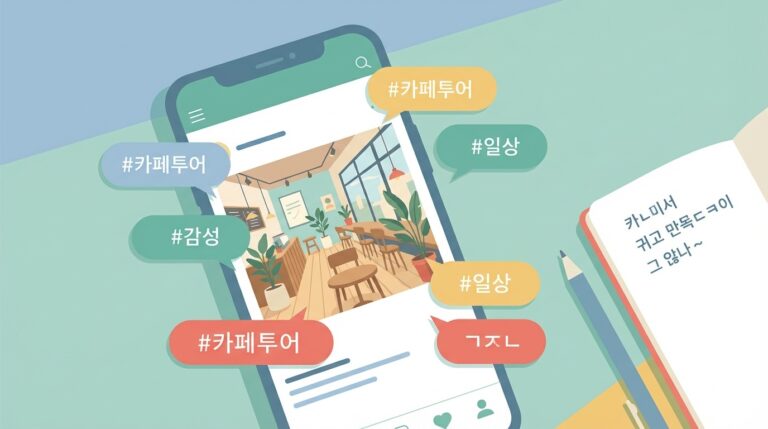
| 카페투어 | kape-tueo | Cafe tour | The popular hobby of visiting multiple aesthetic cafes in one day. |
Phase 8: Traveler Survival Kit 🧳
Even if you are A1 (absolute beginner), you can use hashtags to survive and thrive in Korea!
🆘 Survival Expression #1: Finding Food
– 🇰🇷 “[Neighborhood] + 맛집”
– 📍 Where to use: Instagram search bar or Naver search bar.
– 💡 Pro Tip: If you are in Myeongdong, just type “#명동맛집”. Look at the pictures, find a place that looks delicious, and show the photo to a local or use a map app to find it!
📌 Editor’s Travel Note
– Map Apps: Google Maps doesn’t work well for walking/driving in Korea. Download Naver Map or KakaoMap. You can search for “맛집” directly inside these map apps too!
– WiFi: Korea is heaven for internet users. Almost every cafe and restaurant has free WiFi. Just look at the receipt for the password!
Phase 9: Critical Thinking Corner — “Think Deeper”
Media vs Reality: The “Insta-Vibe” Culture
🧠 Think Deeper:
Korean society moves very fast (the famous “Palli-palli” culture). Because of this fast pace, visual communication on social media has become incredibly important. The hashtag #일상 (daily life) often doesn’t show a messy bedroom; it shows a perfectly clean desk and a stylish coffee cup. This “Insta-gamseong” (Insta-vibe) reflects a desire to curate a peaceful, beautiful version of reality amidst a busy, competitive society.💬 Your Turn: Does social media in your country focus more on “perfect aesthetics” or “raw, unedited reality”? Share your thoughts in the comments!
Phase 10: FAQ & Avoiding Mistakes
Q: Can I use #맞팔 on a famous actor’s or idol’s post?
A: You can, but they definitely won’t follow you back! 😅 It’s better to use it with other fans or regular people.
Q: Should I put spaces inside Korean hashtags?
A: No! Just like in English, spaces break the hashtag. Write #홍대맛집 (Correct) instead of #홍대 맛집 (Incorrect).
❌ Common Mistake #1: Typing Korean hashtags with English autocorrect on.
✅ Do this instead: Make sure your Korean keyboard is fully active. Sometimes phones try to “autocorrect” Korean into English letters, ruining your perfect hashtag!
Phase 11: Summary & Action Items
One-Liner Summary: Use #일상 for daily vibes, #맛집 to find the best food, and #맞팔 to make new Korean friends online!
Action Mission:
– 🥉 Bronze (Solo): Change your phone’s keyboard to Korean and practice typing #일상, #맛집, #맞팔.
– 🥈 Silver (Online): Go to Instagram right now, search #한국맛집 (Korean matjip), and like 3 photos that look delicious!
– 🥇 Gold (Real Life): Post a photo of your lunch today on your own SNS and use the hashtag #맛집!
K-Culture Mission:
Open Instagram, search for your favorite Korean celebrity or idol, and look at their latest post. Can you spot any Korean hashtags in their caption or the comments?
Did you complete today’s mission? Let me know in the comments below! 👇
Phase 12: Quiz — Interactive Challenge
1. You are traveling in Busan and you are super hungry. You want to find a good local restaurant. What should you search on Instagram?
– A) #부산여행 (Busan travel)
– B) #부산맛집 (Busan matjip)
– C) #부산일상 (Busan daily)
2. Fill in the blank!
“I really like your account! Let’s be friends. ______ 해요!” (Let’s follow each other!)
– A) 소통 (sotong)
– B) 맞팔 (matpal)
– C) 카페 (kape)
3. True or False: K-Culture Edition
“If you search for restaurants in Korea, Google Maps is the best app to use.” (T/F)
(Answers: 1. B, 2. B, 3. False – Use Naver Map or KakaoMap!)
Frequently Asked Questions (FAQ)
Q: What does "#일상 (Daily Life)" mean in Korean and how do you pronounce it?
A: In Korean, "#일상 (Daily Life)" is pronounced [ilsang] and means: Literal = Daily life / Real nuance = "Just my normal day (but make it look aesthetic)."
Q: What does "#맛집 (Must-Eat Restaurant)" mean in Korean and how do you pronounce it?
A: In Korean, "#맛집 (Must-Eat Restaurant)" is pronounced [mat-jip] and means: Literal = Taste house / Real nuance = "This place has amazing food!"
Q: What does "#맞팔 (Follow for Follow)" mean in Korean and how do you pronounce it?
A: In Korean, "#맞팔 (Follow for Follow)" is pronounced [mat-pal] and means: Literal = Mutual follow / Real nuance = "Follow me, and I'll follow you back!"






