

Phase 1: Empathy (The K-Culture Cold Open)
Hello! I’m your Daily Hangul Editor.
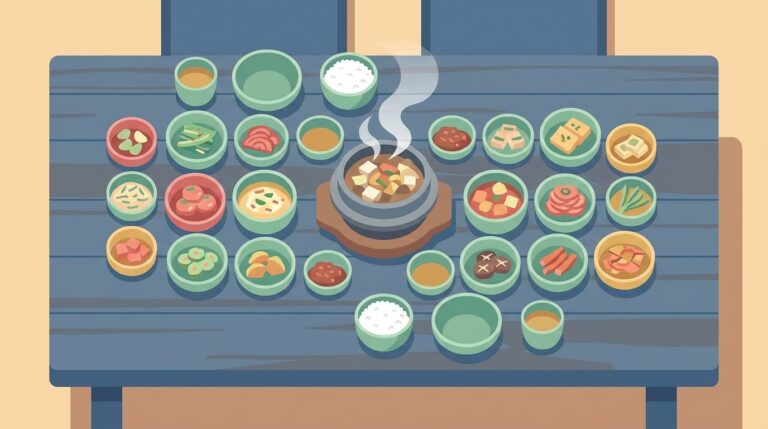
Imagine this: You’re watching a K-Travel variety show like 2 Days & 1 Night or Street Food Fighter. The cast arrives at a traditional restaurant in Jeolla Province (남도, Namdo). Suddenly, the waiters bring out plates. Not just one or two, but twenty, thirty different side dishes until the table is a mosaic of colors. The cast takes one bite of the fermented Kimchi, their eyes widen, and they exclaim, “크~ 깊은 맛이 나네!” (Ah~ it has such a deep flavor!).
As a C1-level Korean learner, you already know how to say “맛있어요” (It’s delicious). But when you’re traveling through the southern provinces—the undisputed culinary capital of Korea—”맛있어요” just doesn’t cut it. You need expressions that capture the overwhelming generosity, the complex fermented umami, and the cultural soul of a true Hanjeongsik (traditional Korean full-course meal).
If you use textbook Korean here, you’ll sound like a polite tourist. But if you use the expressions we’re about to cover, the restaurant owner might just bring you a secret, off-the-menu dish. Let’s dive deep into the real Korean used in a Namdo food tour!
Phase 2: Core Expressions Deep Dive
1. 상다리가 부러지겠다
- Pronunciation: sangdariga bureojigetda [sang-da-ri-ga boo-reo-jee-get-da]
- Meaning: Literal: “The table legs are going to break.” Real nuance: “There is an overwhelmingly generous amount of food on the table.”
- K-Culture Moment: You walk into a Hanjeongsik restaurant in Yeosu. The staff brings out a massive wooden board pre-loaded with 30 dishes and slides it onto your table. This is the exact moment you drop this phrase.
- Editor’s Insight: This isn’t just about weight; it’s the ultimate compliment to the host’s generosity (인심, Insim). It shows you recognize their effort to feed you well.
- Situation Spectrum:
- Casual (Friends): ✅ (상다리 부러지겠다!)
- Semi-formal (Colleagues): ✅ (상다리가 부러지겠어요.)
- Formal (Elders/Boss): ⚠️ (Use polite form: 상다리가 부러질 정도로 많이 차려주셨네요. / You prepared so much the table might break.)
- 🤔 Think About It: Why do Koreans express hospitality through the quantity and variety of dishes rather than just one large main course? How does this reflect the history of agriculture and community?
2. 완전 밥도둑이네요
- Pronunciation: wanjeon bapdodugineyo [wan-jeon bap-doh-doo-gee-ne-yo]
- Meaning: Literal: “It’s a complete rice thief.” Real nuance: “This side dish is so incredibly savory/salty-sweet that I’m eating way more rice than usual.”
- K-Culture Moment: You’re eating Ganjang Gejang (soy sauce marinated crab)—the most famous Namdo specialty. You mix rice into the crab shell, take a bite, and suddenly your bowl of rice is gone.
- Editor’s Insight: White rice is the canvas, and highly flavored dishes (like salted seafood or rich stews) are the paint. A “bap-doduk” is a compliment meaning the dish pairs so perfectly with rice that it “steals” it away.
- Situation Spectrum:
- Casual: ✅ (야, 이거 완전 밥도둑이다!)
- Semi-formal: ✅ (이 게장 진짜 밥도둑이네요.)
- Formal: ⚠️ (A bit colloquial. With very senior people, say: 반찬이 맛있어서 밥이 계속 넘어가네요.)
- 🤔 Think About It: In many Western cultures, bread is a side to the meat. In Korea, meat and stews are technically sides (반찬) to the rice (밥). How does the word “밥도둑” highlight the central role of rice in Korean identity?
3. 감칠맛이 장난 아니에요
- Pronunciation: gamchilmasi jangnan anieyo [gam-chil-ma-shee jang-nan a-nee-e-yo]
- Meaning: Literal: “The umami is no joke.” Real nuance: “The deep, savory, mouthwatering flavor is absolutely incredible.”
- K-Culture Moment: Namdo food heavily relies on Jeotgal (salted fermented seafood). When you taste a perfectly fermented Gat-kimchi (mustard leaf kimchi), the explosion of flavor isn’t just salty or spicy—it’s gamchilmat.
- Editor’s Insight: Gamchilmat is the Korean word for umami. “장난 아니다” (is no joke) is an advanced native-speaker way to say “is exceptionally good/intense.”
- Situation Spectrum:
- Casual: ✅
- Semi-formal: ✅
- Formal: 🚫 (Avoid “장난 아니다” with elders. Use: 감칠맛이 아주 뛰어나네요.)
- 🤔 Think About It: Does your native language have a specific word for the deep, lingering savory taste of fermented foods?
Phase 3: Textbook vs Real Korean
| Situation | 📖 Textbook Korean | 🗣️ Real Korean | 💡 Why the difference? |
|---|---|---|---|
| Complimenting a rich soup | 이 국은 정말 맛있습니다. | 와, 국물이 진짜 진국이네요. | “진국” implies a broth boiled for hours, showing you appreciate the culinary depth, not just the surface taste. |
| Being served a lot of food | 음식이 아주 많네요. | 상다리가 휘어지겠어요! | Koreans love hyperbole (exaggeration) to express gratitude for hospitality. |
| Wanting more of a side dish | 반찬을 더 주십시오. | 사장님~ 여기 게장 리필 되나요? | Using the English loanword “리필” (refill) is incredibly common in modern Korean dining. |
Phase 4: Cultural Context — K-Culture Deep Dive
4-1. The Non-Verbal “Nunchi” of a Hanjeongsik
When eating a massive Hanjeongsik, Nunchi (눈치) is crucial. Do not start eating the moment the first side dish touches the table. Wait until the main focal points (like the stew or the braised fish) are set down, and always wait for the oldest person at the table to lift their spoon first.
4-2. Food & Travel K-Connection: The Namdo Pride
If you watch K-Dramas like Mr. Sunshine or Reply 1994, you’ll notice characters from the Jeolla provinces take immense pride in their food. In Korea, traveling to places like Jeonju, Gwangju, or Yeosu specifically for a “맛집 투어” (restaurant tour) is a cultural staple.
When traveling there, remember: the food will be spicier, saltier, and much more fermented than the mild versions sold in Seoul. If a local restaurant owner (이모님 – “Auntie”) sees a foreigner digging into pungent fermented skate (홍어) or soy crab and calling it a “밥도둑,” you will instantly become their favorite customer.
Phase 5: Interactive Roleplay Scenario
Setting: Friday evening, 7 PM. You are at a famous traditional Hanjeongsik restaurant in Yeosu with your Korean business partner, Minsoo. The sliding door opens, and two waiters bring in a table literally covered with over 20 side dishes, a sizzling pot of Galbijjim, and soy sauce crabs.
Characters:
– YOU: A C1-level Korean learner, eager to impress with your deep cultural knowledge.
– Minsoo (38): Your Korean business partner. Friendly, but still maintains professional boundaries.
Dialogue:
Minsoo: 여수까지 오셨는데, 이 정도는 대접해야죠. 많이 드세요! 😊
(Yeosukkaji osyeonneunde, i jeongdoneun daejeophaeyajyo. Mani deuseyo!)
[Since you came all the way to Yeosu, I had to treat you to at least this much. Please, eat up!]
YOU: 와, 정말 상다리가 부러지겠어요! 너무 감사합니다.
(Wa, jeongmal sangdariga bureojigesseoyo! Neomu gamsahamnida.)
[Wow, the table legs are going to break! Thank you so much.]
Minsoo: 하하, 남도 한정식이 원래 반찬이 좀 많아요. 이 간장게장부터 한번 드셔보세요.
(Haha, Namdo hanjeongsigi wollae banchani jom manayo. I ganjanggejangbuteo hanbeon deusyeoboseyo.)
[Haha, Namdo Hanjeongsik naturally has a lot of side dishes. Try this soy sauce crab first.]
(🎭 Stage Direction: Minsoo places a piece of crab on your rice bowl.)
YOU: (Takes a bite and mixes it with rice) 음~! 감칠맛이 장난 아니네요.
(Eum~! Gamchilmasi jangnan anineyo.)
[Mmm~! The umami is incredible.]
Minsoo: 그렇죠? 비린내도 하나도 안 나고요.
(Geureochyo? Birinnaedo hanado an nagoyo.)
[Right? And there’s no fishy smell at all.]
🔀 Your Turn! How do you respond?
– A) “네, 맛있어요. 더 먹을게요.”
– B) “진짜 밥도둑이 따로 없네요. 공기밥 하나 더 시켜야겠어요!”
– C) “너무 짜서 건강에 안 좋을 것 같아요.”✅ Best Choice: B — “This is a total rice thief. I’m going to have to order another bowl of rice!” This shows native-level fluency, flatters the food, and perfectly matches the situation.
⚠️ Choice A Analysis: Grammatically perfect, but a bit dry for a C1 speaker experiencing Namdo food.
🚫 Choice C Analysis: Even if it’s salty, directly criticizing the healthiness of the local delicacy during a hosted meal breaks the social harmony (Nunchi) and ruins the mood.
Phase 6: 10-Second Shadowing Drill
Practice your flow, intonation, and pausing! (Repeat 3 times)
😲 와~ 사장님! / 상다리가 / 부러지겠어요! / 완전 / 밥도둑이네요!
(Wa~ sajangnim! / sangdariga / bureojigesseoyo! / wanjeon / bapdodugineyo!)
Emotion Tags: Start with a surprised gasp (😲), stretch the “상다리가”, and land on “밥도둑이네요” with deep satisfaction.
Phase 7: K-Culture Mini Dictionary
| Korean | Romanization | English | Context & Meaning |
|---|---|---|---|
| 남도 | namdo | Southern Provinces | Usually refers to Jeollanam-do. Famous for rich, flavorful, and abundant food culture. |
| 한정식 | hanjeongsik | Traditional Course Meal | A full-course Korean meal featuring an array of savory side dishes, soups, and rice. |
| 밥도둑 | bapdoduk | Rice Thief | A highly savory or salty dish (like Gejang) that makes you eat a lot of plain white rice. |
| 진국 | jinguk | Real Broth / The Real Deal | A thick, rich broth boiled for a long time. Also used metaphorically to describe a genuine, deep person. |
| 인심 | insim | Generosity / Heart | The generous spirit of locals, often shown through piling extra food on your plate. |
Phase 8: Traveler’s Survival Kit
Heading to Yeosu, Suncheon, or Jeonju for a food tour? You need these survival phrases specifically for local restaurants.
🆘 Survival Phrases for Namdo Restaurants
– 🇰🇷 “사장님, 반찬 리필 되나요?” (sajangnim, banchan ripil doenayo?)
– 🗣️ Meaning: “Boss, can we get a refill on the side dishes?”
– 📍 Note: Unlike Western restaurants, most banchan is free to refill! But always ask politely.
– 🇰🇷 “이거 어떻게 먹는 거예요?” (igeo eotteoke meongneun geoeyo?)
– 🗣️ Meaning: “How are you supposed to eat this?”
– 📍 Note: Namdo food often involves complex wrapping (ssam) or mixing. Let the locals teach you the best combinations!
– 🇰🇷 “덜 맵게 해 주실 수 있나요?” (deol maepge hae jusil su innayo?)
– 🗣️ Meaning: “Can you make it less spicy?”📌 Editor’s Travel Note
– Reservation Apps: For famous Hanjeongsik places in the south, use apps like ‘Catchtable’ (캐치테이블) as walk-ins might be rejected.
– Tipping: Korea has ZERO tipping culture. Do not leave money on the table; it will confuse the staff, and they might chase you down the street thinking you forgot your change!
Phase 9: Critical Thinking — “One Step Deeper”
🧠 Think Deeper: Food & Identity (Communal Eating)
Why is Hanjeongsik served all at once, covering the entire table, rather than in sequential courses like fine dining in the West? In Korean culture, food is the ultimate medium for community. The word for family is Sikgu (식구 – mouths that eat together). By sharing multiple side dishes from the center of the table, boundaries between individuals blur, and a collective identity is reinforced. Refusing to share or insisting on individual plating in a traditional setting can sometimes be perceived as maintaining an emotional distance.
💬 Your Turn: In your culture, does the way food is served emphasize individualism (your own plate) or collectivism (shared bowls)? How does that affect dinner conversations? Share your thoughts below!
Phase 10: FAQ & Avoiding Misunderstandings
Q: “Can I take the leftover banchan home in a doggy bag?”
No. While taking main dishes (like fried chicken or pizza) home is common, asking to pack up leftover banchan at a Hanjeongsik restaurant is generally not allowed due to food safety regulations and restaurant economics.
Q: “If the host keeps putting food on my plate, do I have to eat it all?”
This is the famous Korean Jeong (정). If you are completely full, it is perfectly acceptable to leave a little bit of food on your plate. Leaving a clean plate sometimes signals to a traditional Korean host that you are still hungry, prompting them to give you more!
❌ Common Mistake: Saying “배불러요” (I’m full) abruptly when the host offers more food.
✅ Do This Instead: Soften the refusal by praising the food first. “너무 맛있는데 배가 불러서 더 못 먹겠어요. 아쉽네요!” (It’s so delicious, but I’m so full I can’t eat anymore. It’s a shame!)
Phase 11: Summary & Action Items
One-Liner Summary: To truly appreciate a Namdo Hanjeongsik, move beyond “맛있어요” and praise the overwhelming generosity (상다리가 부러지다) and deep savory flavors (밥도둑, 감칠맛).
Action Mission:
– 🥉 Bronze (Solo): Look at a picture of a Korean feast and say aloud: “상다리가 부러지겠어요!”
– 🥈 Silver (Online): Find a YouTube video of a Namdo food tour (like Street Food Fighter) and leave a comment in Korean using “밥도둑”.
– 🥇 Gold (Real World): Visit a local Korean restaurant, order a stew, and tell the owner, “국물이 완전 진국이네요!”
🌍 K-Travel Mission: Open Google Maps or Naver Map, search for “여수 한정식” (Yeosu Hanjeongsik), look at the photo reviews, and count how many banchan are on a single table. Prepare to be amazed!
Phase 12: Quiz — Interactive Challenge
Q1. You are at a company dinner with your CEO at a high-end Hanjeongsik restaurant. The food arrives. Which is the MOST appropriate way to compliment the spread?
1) 사장님, 이거 완전 밥도둑이네요!
2) 상다리 부러지겠다, 대박!
3) 상다리가 부러질 정도로 푸짐하네요. 잘 먹겠습니다.
4) 감칠맛 장난 아니네요.
(Answer: 3. It uses the “상다리가 부러지다” idiom but in a polite, formal structure appropriate for a CEO.)
Q2. True or False: If you run out of Kimchi or basic side dishes at a traditional Korean restaurant, you have to pay extra to order more.
(Answer: False. Banchan refills are almost always free in Korea, reflecting the culture of ‘Jeong’ and ‘Insim’.)
Q3. Fill in the blank: Soy sauce marinated crab is so delicious that you eat too much rice. Koreans call this dish a “______”.
(Answer: 밥도둑 – Rice Thief)
Did you get them all right? See you in the next Daily Hangul post!
Frequently Asked Questions (FAQ)
Q: What does "상다리가 부러지겠다" mean in Korean and how do you pronounce it?
A: In Korean, "상다리가 부러지겠다" is pronounced [sangdariga bureojigetda [sang-da-ri-ga boo-reo-jee-get-da] and means: Literal: "The table legs are going to break." Real nuance: "There is an overwhelmingly generous amount of food on the table."
Q: What does "완전 밥도둑이네요" mean in Korean and how do you pronounce it?
A: In Korean, "완전 밥도둑이네요" is pronounced [wanjeon bapdodugineyo [wan-jeon bap-doh-doo-gee-ne-yo] and means: Literal: "It's a complete rice thief." Real nuance: "This side dish is so incredibly savory/salty-sweet that I'm eating way more rice than usual."
Q: What does "감칠맛이 장난 아니에요" mean in Korean and how do you pronounce it?
A: In Korean, "감칠맛이 장난 아니에요" is pronounced [gamchilmasi jangnan anieyo [gam-chil-ma-shee jang-nan a-nee-e-yo] and means: Literal: "The umami is no joke." Real nuance: "The deep, savory, mouthwatering flavor is absolutely incredible."







