

Phase 1: Empathy (The K-Drama Cold Open)
Hello! I’m the lead editor at Daily Hangul.
Picture this: You are watching your favorite K-Drama. The main character stood in the pouring rain waiting for their crush, and predictably, they’ve caught a terrible cold the next day. The romantic lead rushes over, not with chicken noodle soup, but with a steaming bowl of rice porridge (Juk). They hand over the bowl, look deeply into their eyes, and say a warm phrase. The subtitles simply read, “Get well soon.”
But wait… did they just translate four different Korean words into “Get well soon”?
If you have a Korean friend, colleague, or even a K-Pop idol who isn’t feeling well, you might want to send them a quick message. But if you type “I’m sorry you are sick” into a translator, you’ll end up saying “I apologize that you are sick” (미안해요) — which sounds like you caused their illness!
Don’t worry. As a veteran tutor who has seen students accidentally confess their sins to sick friends, I’ve got you covered. Let’s learn the real way to say “Get well soon” in Korean, straight from real-life situations.
Phase 2: Core Expressions Deep Dive
1. 빨리 나으세요
- Pronunciation: ppal-li na-eu-se-yo [ppal-lee nah-oo-say-yo]
- Tutor’s Tip: The ‘으 (eu)’ sounds like the disgusted grunt you make when you step in sticky gum!
- Meaning: (Literal) Heal quickly. / (Real) Get well soon.
- K-Culture Moment: This is the absolute golden standard. If your Korean coworker calls in sick or your language exchange partner has a sore throat, this is the text message you send.
- Editor’s Insight: It feels polite, caring, and bright. It’s the safest bet for almost anyone you know.
- Situation Spectrum:
- Friends (Casual): ⚠️ (Use the casual version: 빨리 나아!)
- Coworkers (Semi-formal): ✅
- Boss/Elders (Formal): 🚫 (A bit too direct for very senior people.)
- 🤔 Think About It: Koreans love the word “빨리” (ppal-li – quickly/fast). Do you think this “hurry up” culture even applies to healing?
2. 몸조리 잘하세요
- Pronunciation: mom-jo-ri jal-ha-se-yo [mom-joe-ree jal-hah-say-yo]
- Meaning: (Literal) Do body-care well. / (Real) Take good care of yourself / Rest up.
- K-Culture Moment: You’ll hear this a lot at hospitals when doctors say goodbye to patients, or when wishing someone a good recovery after they’ve been discharged.
- Editor’s Insight: This has a deeper, warmer feeling of “Please prioritize your rest and health.” It shows you really care about their wellbeing.
- Situation Spectrum:
- Friends (Casual): ⚠️ (Say: 몸조리 잘해!)
- Coworkers (Semi-formal): ✅
- Boss/Elders (Formal): ✅ (Often used as 몸조리 잘하십시오)
Phase 3: Textbook vs. Real Korean
| Situation | 📖 Textbook Korean | 🗣️ Real Korean | 💡 Why the difference? |
|---|---|---|---|
| Formal text/email to a sick boss | 빠른 쾌유를 빕니다 (I wish for your speedy recovery) | 푹 쉬시고 몸조리 잘하십시오 (Please rest well and take care) | The textbook version sounds like a formal hospital certificate. Real Korean focuses on advising them to “rest” (푹 쉬다). |
| To a close friend | 빨리 나으십시오 (Heal quickly) | 야, 약 먹었어? 빨리 나아 ㅠㅠ (Hey, did you take meds? Get well soon T_T) | Friends don’t use high formalities. Adding “Did you take medicine?” shows true affection. |
Phase 4: Cultural Context — K-Culture Deep Dive
4-1. Non-verbal Cue: Don’t go empty-handed!
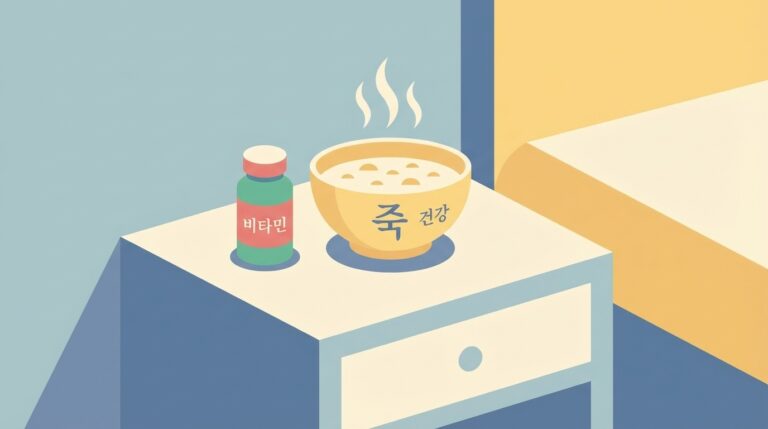
In Korea, words are great, but actions speak louder when someone is sick. If you are visiting a sick friend or greeting a coworker who just returned from sick leave, hand them a small brown glass bottle of Bacchus (박카스) or Vita500 (비타500). These are iconic Korean vitamin/energy drinks you can buy at any convenience store for about $1. Giving one with two hands while saying “빨리 나으세요” will instantly make you a K-Culture insider.
4-2. The “Juk” (Porridge) Phenomenon in K-Dramas
Have you noticed that sick K-Drama characters never eat chicken soup? In Korea, the ultimate sick-day food is Juk (죽) — rice porridge. It’s easy to digest and very comforting. If you want to melt a Korean friend’s heart, order them Jeonbokjuk (Abalone Porridge) from a delivery app when they have a cold. It’s the ultimate expression of Jeong (정 – deep affection/connection).
Phase 5: Real-Life Roleplay Scenario
Setting: Monday morning, 9:00 AM. The office breakroom. You are grabbing a coffee when your Korean coworker, Minji, walks in looking tired and wearing a mask.
Characters:
– YOU: An expat working your first month in Seoul.
– Minji (28): Your friendly coworker who helped you set up your desk last week.
Dialogue:
Minji: 콜록콜록… 좋은 아침이에요. 😷
(kollok-kollok… joeun achimieyo.)
[Cough cough… Good morning.]
YOU: 민지 씨, 괜찮아요? 감기 걸렸어요?
(minji ssi, gwaenchanayo? gamgi geollyeosseoyo?)
[Minji, are you okay? Did you catch a cold?]
Minji: 네, 주말에 비를 좀 맞았더니 감기 기운이 있네요.
(ne, jumare bireul jom majatdeoni gamgi giuni inneyo.)
[Yeah, I got caught in the rain over the weekend, so I feel a cold coming on.]
🔀 YOUR TURN! How do you respond?
– A) “미안해요…” (I’m sorry…)
– B) “헐! 대박!” (Whoa! Awesome/Crazy!)
– C) “따뜻한 물 많이 마시고, 빨리 나으세요!” (Drink lots of warm water, and get well soon!)✅ Best Choice: C — Giving a small piece of advice (like drinking warm water) followed by “빨리 나으세요” is incredibly natural and caring.
❌ Why not A? “미안해요” means “I apologize.” Minji will wonder if you made it rain on her!
⚠️ Why not B? “대박” is for surprising or cool things. Catching a cold is definitely not cool.
Phase 6: 10-Second Shadowing Drill
Let’s practice the perfect intonation. Follow the slashes for pauses!
🥺 민지 씨, / 감기 조심하고 / 빨리 나으세요!
(minji ssi, / gamgi josimhago / ppal-li na-eu-se-yo!)
[Minji, / be careful of the cold / and get well soon!]
Pro-tip: Say the last part with a soft, warm smile.
Phase 7: K-Culture Mini Dictionary
| Korean | Romanization | English | Context |
|---|---|---|---|
| 감기 | gamgi | Cold (Illness) | Usually paired with “걸리다” (to catch). 감기에 걸렸어요 = I caught a cold. |
| 죽 | juk | Rice Porridge | The holy grail of Korean sick food. Brand “Bonjuk” (본죽) is famous. |
| 약국 | yakguk | Pharmacy | Look for signs with the word “약” (Medicine). |
| 눈치 | nunchi | Social Awareness | If someone is sick, having good nunchi means offering them a hot drink or letting them rest. |
Phase 8: Traveler’s Survival Kit (Health Edition)
Getting sick while traveling in Korea is scary, but Korean pharmacies (Yakguk) are amazing and fast. Here are 3 survival phrases you must know as an A1 beginner.
🆘 Survival Phrase #1: I have a headache / stomachache
– 🇰🇷 “[머리 / 배]가 아파요.” ([meori / bae]-ga apayo.)
– 📍 Where to use: Pharmacy or Hospital.
– 💡 Pro Tip: Just point to where it hurts and say “아파요” (apayo – it hurts). The pharmacist will understand immediately.🆘 Survival Phrase #2: Please give me cold medicine
– 🇰🇷 “감기약 주세요.” (gamgiyak juseyo.)
– 📍 Where to use: Pharmacy.🆘 Survival Phrase #3: Where is the pharmacy?
– 🇰🇷 “약국이 어디에 있어요?” (yakgugi eodie isseoyo?)
– 📍 Where to use: Asking a hotel desk or people on the street.📌 Editor’s Travel Note:
– Language App: Download Papago. It has an excellent medical translation feature.
– Convenience Stores: If pharmacies are closed late at night, convenience stores (CU, GS25) sell basic emergency meds like Tylenol (타이레놀) and digestion pills (소화제) at the front counter!
Phase 9: Critical Thinking — “One Step Deeper”
Food & Identity: Sharing Pain Through Porridge
In many Western cultures, giving someone space is a sign of respect when they are sick. But in Korea, health and community are deeply intertwined through food. Asking “밥 먹었어?” (Did you eat?) is synonymous with “How are you?” Therefore, when someone is sick, the Korean instinct is not just to offer words, but to ensure the person is eating something nourishing like Juk. This stems from the concept of Jeong (정) — an invisible bond of collective care. It’s not just about the medicine; it’s about making sure you don’t feel alone while you are healing.
💬 Your Turn: How does your culture handle sick friends? Do you bring them a specific food, or do you prefer to leave them alone to rest? Let me know in the comments!
Phase 10: FAQ & Avoiding Misunderstandings
Q: Can I use “빨리 나으세요” on my favorite K-Pop idol’s live stream if they say they are sick?
Yes! Fans use this all the time. To add a bit of cute affection, fans often type: “오빠/언니 푹 쉬고 빨리 나으세요 ㅠㅠ” (Oppa/Unnie, rest well and get well soon T_T).
Q: Is it rude to wear a mask in Korea if I have a cold?
Actually, it’s the opposite! In Korea, wearing a mask when you are sick is considered basic manners to protect others. It shows great nunchi.
❌ Common Mistake: Translating “I feel bad for you” directly.
✅ Do this instead: Never say “미안해요” (I’m sorry) or “불쌍해요” (You are pitiful). Just stick to “빨리 나으세요” or “어떡해요ㅠㅠ” (Oh no, what should we do T_T).
Phase 11: Summary & Action Items
One-Liner Summary: Instead of saying “I’m sorry,” show your care by saying “빨리 나으세요” (Get well soon) and offering a warm drink.
Your Action Missions for Today:
– 🥉 Bronze (Solo): Stand in front of a mirror, look sympathetic, and say “빨리 나으세요” out loud 3 times.
– 🥈 Silver (Online): Find a K-Pop idol’s post or a friend’s social media where they mention feeling tired/sick, and leave “몸조리 잘하세요 💛” in the comments.
– 🥇 Gold (Real Life): Next time you pass a Korean convenience store, go inside, locate the Vita500 or Bacchus bottles, and imagine handing one to a friend while saying the phrase!
Phase 12: Quiz — Interactive Challenge
1. Situational Judgment: Your Korean language exchange partner texts you: “I can’t meet today. I caught a bad cold. 🤒” What is the best reply?
– A) 미안해요.
– B) 대박!
– C) 약 먹었어요? 빨리 나으세요!
2. True or False – K-Culture Edition:
If you get a headache at 1 AM in Seoul, you just have to suffer until the pharmacy opens the next morning.
– True or False?
(Answers below)
Click to reveal answers!
1. Answer: C. Asking if they took medicine and wishing them a fast recovery is the perfect Korean response. A means “I apologize” and B means “Awesome!”
2. Answer: False. You can buy basic over-the-counter medicines (like Tylenol) at any 24-hour convenience store in Korea!
Frequently Asked Questions (FAQ)
Q: What does "빨리 나으세요" mean in Korean and how do you pronounce it?
A: In Korean, "빨리 나으세요" is pronounced [ppal-li na-eu-se-yo [ppal-lee nah-oo-say-yo] and means: a key conversational Korean expression covered in this lesson.
Q: What does "몸조리 잘하세요" mean in Korean and how do you pronounce it?
A: In Korean, "몸조리 잘하세요" is pronounced [mom-jo-ri jal-ha-se-yo [mom-joe-ree jal-hah-say-yo] and means: (Literal) Do body-care well. / (Real) Take good care of yourself / Rest up.







