

Unboxing K-Culture: The Eco-Friendly Revolution in Korea’s Delivery Scene 📦
Phase 1: Empathy & The “Aha!” Moment
Hello! This is your Daily Hangul Editor.
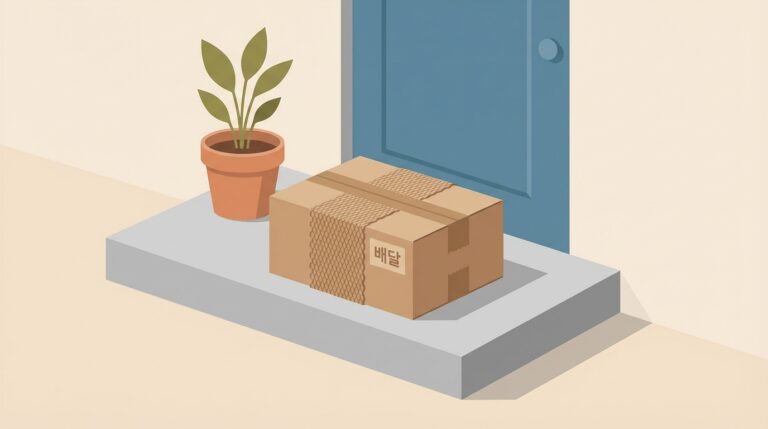
Picture this: You just ordered a massive haul of K-Beauty products on a Korean app. The very next morning, thanks to Korea’s famous 새벽배송 (sae-byeok-bae-song, Dawn Delivery), a box is waiting at your door. You grab a box cutter, expecting to painstakingly slice through layers of tight plastic tape and miles of plastic bubble wrap.
But wait. You look closer. The box is sealed with brown paper tape. Inside, your fragile glass serum bottles are wrapped in intricately cut honeycomb paper. No plastic. No sticky residue. You just rip the tape with your hands and toss the entire box straight into the paper recycling bin.
Welcome to the new era of Korean logistics! If you live in Korea, you already know that 분리수거 (bun-ri-su-geo, recycling) is practically a national sport. The recent shift to 친환경 포장재 (eco-friendly packaging), like paper tape and paper buffer materials, isn’t just a corporate trend—it’s a collective sigh of relief for everyone who dreaded peeling plastic tape off cardboard in the freezing Seoul winter.
At the C2 (Advanced) level, you need to go beyond just saying “It’s good for the environment.” Today, we’re diving deep into the sophisticated vocabulary and cultural nuances Koreans use to discuss sustainability, logistics, and consumer power.
Phase 2: Core Expressions Deep Dive
1. 과대포장을 줄이다
- Pronunciation: gwa-dae-po-jang-eul ju-ri-da
- Sound-alike guide: ‘gwa’ (like ‘Gua’ in Guatemala) – ‘dae’ (sounds like ‘day’) – ‘po’ – ‘jang’ / ‘eul’ (‘eu’ sounds like the disgusted sound you make when stepping in gum) – ‘ju’ – ‘ri’ – ‘da’
- Meaning: (Literal) To reduce overpackaging. / (Real Nuance) To cut down on excessive, wasteful packaging.
- K-Culture Moment: This phrase is everywhere in K-Pop right now. Fans are protesting against entertainment companies for 과대포장, demanding eco-friendly album options instead of giant boxes filled with unnecessary plastic just for one photocard.
- Editor’s Insight: This is a highly sophisticated, critical term. It shows you’re not just observing society, but analyzing it. It’s often used in news broadcasts or serious discussions about ESG management.
- Situation Spectrum:
[🚫 절대 금지] ———— [⚠️ 주의] ———— [✅ 자유롭게]
- Close Friends (Casual): ✅ (e.g., “야, 이거 완전 과대포장 아니냐?” – Hey, isn’t this total overpackaging?)
- Colleagues (Semi-formal): ✅
- Boss/Elders (Formal): ✅ (Perfect for professional business settings)
- 🤔 Think About It: Korea has a culture of elaborate gift-giving (like Chuseok fruit sets). How does the desire to present something “luxuriously” clash with the modern push against overpackaging?
2. 종이 완충재를 쓰니까 분리배출하기 편해요
- Pronunciation: jong-i wan-chung-jae-reul sseu-ni-kka bun-ri-bae-chul-ha-gi pyeon-hae-yo
- Sound-alike guide: ‘wan-chung-jae’ (sounds like ‘wan-choong-jay’) / ‘bun-ri’ (sounds like ‘bool-li’ due to Korean consonant assimilation)
- Meaning: (Literal) Because they use paper buffers, it’s easy to separately discharge. / (Real Nuance) Since it’s paper bubble wrap, recycling is a breeze!
- K-Culture Moment: You’re in the office pantry opening a package of office supplies. A coworker sees the brown honeycomb paper and says this. It’s a shared moment of relief because tearing plastic tape off cardboard boxes for office recycling is universally hated.
- Editor’s Insight: Note the word 분리배출 (bun-ri-bae-chul). While beginners learn 분리수거 (bun-ri-su-geo), native speakers and official guidelines use bun-ri-bae-chul (separately discharging waste) to describe our action of throwing it away, while bun-ri-su-geo technically refers to the garbage trucks collecting it.
- Situation Spectrum:
[🚫 절대 금지] ———— [⚠️ 주의] ———— [✅ 자유롭게]
- Close Friends (Casual): ✅ (Drop the ‘yo’: 편해)
- Colleagues (Semi-formal): ✅
- Boss/Elders (Formal): ✅
- 🤔 Think About It: Why is convenience in recycling such a hot topic in Korea? Think about the strict fines and the complex sorting categories in Korean apartment complexes.
3. 가치 소비를 실천하다
- Pronunciation: ga-chi so-bi-reul sil-cheon-ha-da
- Sound-alike guide: ‘ga-chi’ (sounds like ‘gotcha’ without the ‘a’ at the end + ‘ee’) – ‘so-bi’ (so-bee)
- Meaning: (Literal) To practice value consumption. / (Real Nuance) To vote with your wallet; ethical or eco-friendly shopping.
- K-Culture Moment: MZ generation Koreans love flexing their 가치 소비. Buying a slightly more expensive vegan cosmetic brand that uses 100% paper packaging and biodegradable tape isn’t just shopping—it’s a statement of identity often shared on Instagram stories.
- Editor’s Insight: This is a top-tier C2 phrase. Using it shows you understand current Korean socio-economic trends.
- Situation Spectrum:
[🚫 절대 금지] ———— [⚠️ 주의] ———— [✅ 자유롭게]
- Close Friends (Casual): ⚠️ (A bit too formal/academic for chatting over beer)
- Colleagues (Semi-formal): ✅
- Boss/Elders (Formal): ✅ (Great for presentations!)
- 🤔 Think About It: In your home country, is “ethical consumption” a mainstream trend or a niche market?
Phase 3: Textbook vs. Real Korean
| Situation | 📖 Textbook Korean | 🗣️ Real Korean | 💡 Why the difference? |
|---|---|---|---|
| Tearing the box | 테이프를 제거해야 합니다. (You must remove the tape.) | 테이프 안 뜯어도 돼서 개꿀! / 완전 편해! (It’s so sick/convenient that I don’t have to rip the tape off!) | Textbooks use formal instructions. Real life focuses on the emotional relief (개꿀 – slang for ‘very lucky/convenient’). |
| Complaining about packaging | 포장이 너무 많습니다. (There is too much packaging.) | 이거 완전 과대포장 아니에요? 쓰레기가 더 많아. (Isn’t this total overpackaging? There’s more trash than product.) | Koreans express dissatisfaction directly by pointing out the “trash ratio.” |
| Praising a brand | 이 회사는 환경을 사랑합니다. (This company loves the environment.) | 오, 여기 종이 테이프 쓰네? 개념 있다. (Oh, they use paper tape? They have good sense/values.) | ‘개념 있다’ (To have a concept/sense) is a high-level colloquialism praising someone’s ethical awareness. |
Bottom Note for C2: While “개꿀” (gae-kkul) is very common slang for “super convenient/lucky,” use it strictly with close friends. In a professional setting, stick to “정말 수월하네요” (It’s really hassle-free).
Phase 4: Cultural Context — K-Culture Deep Dive
4-1. The “Nunchi” of the Recycling Area (분리수거장 눈치)
In Korea, taking out the trash is a highly social and scrutinized event. Every apartment has a designated “Recycling Area” (분리수거장) run by eagle-eyed security guards or neighborhood elders. If you throw a cardboard box with plastic tape still attached into the paper bin, you will instantly feel the heavy, piercing gaze of 눈치 (Nunchi). You might even get scolded publicly! This strict social surveillance is exactly why eco-friendly paper tape—which can be recycled along with the box—became an instant sensation. It saves you from the Nunchi!
4-2. K-Pop’s Plastic Dilemma & The Photocard Economy
Let’s connect this to K-Pop. For years, the industry thrived on “Physical Album” sales. But fans don’t buy 50 albums for the CDs; they buy them for the randomized photocards (포카). This resulted in massive amounts of plastic wrap, glossy photobooks, and unrecyclable coated paper being dumped in the trash.
Recently, K-Pop fans have sparked an eco-friendly revolution. They began demanding 친환경 앨범 (Eco-friendly albums) and 가치 소비 (Value consumption). Now, major entertainment companies are releasing “Platform Albums” (a digital code with just a photocard) or using biodegradable paper packaging for their merchandise. When you watch an unboxing video on YouTube today, the use of paper tape and soy ink (콩기름 잉크) is often highlighted as a major selling point!
Phase 5: Real-Life Roleplay Scenario
Setting: Tuesday, 2:00 PM. The office lounge in a sleek Gangnam startup. You and your coworker Min-su are unboxing a delivery of new office supplies (notebooks, pens, coffee beans).
Characters:
– YOU: A foreign expat working in Seoul, highly observant of Korean office culture.
– Min-su (32): Your Korean coworker. Practical, a bit lazy when it comes to chores, but loves new trends.
Dialogue:
Min-su: 아, 드디어 택배 왔네요. 같이 좀 뜯을까요? 📦
(a, deu-di-eo taek-bae wat-ne-yo. ga-chi jom tteu-deul-kka-yo?)
[Ah, the delivery finally arrived. Shall we open it together?]
(🎭 Stage Direction: Min-su grabs a dangerously sharp box cutter.)
YOU: 네, 제가 도와드릴게요. 어? 이 박스 종이 테이프로 포장되어 있네요.
(ne, je-ga do-wa-deu-ril-ge-yo. eo? i bak-seu jong-i te-i-peu-ro po-jang-doe-eo it-ne-yo.)
[Yes, I’ll help you. Oh? This box is packed with paper tape.]
Min-su: 오, 진짜요? 대박. 칼 필요 없겠네. 그냥 손으로 뜯으세요.
(o, jin-jja-yo? dae-bak. kal pi-ryo eop-get-ne. geu-nyang so-neu-ro tteu-deu-se-yo.)
[Oh, really? Awesome. Guess we don’t need the knife. Just rip it with your hands.]
YOU: 쫙~ (테이프 뜯는 소리) 진짜 부드럽게 뜯기네요.
(jjwak~ jin-jja bu-deu-reop-ge tteut-gi-ne-yo.)
[Riiip~ (Sound of tape tearing) It tears really smoothly.]
Min-su: 요즘은 웬만한 기업들 다 친환경 포장재 쓰더라고요.
(yo-jeum-eun wen-man-han gi-eop-deul da chin-hwan-gyeong po-jang-jae sseu-deo-ra-go-yo.)
[These days, most decent companies use eco-friendly packaging materials.]
YOU: 맞아요. 비닐 뽁뽁이 대신에 종이 완충재 들어있는 거 보셨어요?
(ma-ja-yo. bi-nil ppok-ppok-i dae-si-ne jong-i wan-chung-jae deu-reo-it-neun geo bo-syeot-eo-yo?)
[Right. Have you seen the paper buffer materials instead of plastic bubble wrap?]
Min-su: 네, 근데 솔직히 종이 완충재는 부스러기 떨어져서 좀 귀찮지 않아요?
(ne, geun-de sol-jik-hi jong-i wan-chung-jae-neun bu-seu-reo-gi tteo-reo-jyeo-seo jom gwi-chan-chi an-a-yo?)
[Yeah, but honestly, isn’t the paper buffer a bit annoying because it drops crumbs?]
🔀 Your Turn! How will you respond?
– A) “그래도 환경을 보호해야 하니까 참아야죠.” (Textbook, a bit preachy)
– B) “그래도 나중에 분리배출할 때 테이프 안 뜯어도 돼서 훨씬 편하잖아요.”
– C) “먼지 날려서 짜증 나요. 그냥 비닐 썼으면 좋겠어요.” (A bit too negative for the office vibe)✅ Best Choice: B — Reason: You subtly agree with him but pivot to the ultimate practical benefit in Korean life: 분리배출 (recycling). You sound like a true Seoulite who knows the pain of recycling!
YOU: (Choosing B) 그래도 나중에 분리배출할 때 테이프 안 뜯어도 돼서 훨씬 편하잖아요.
(geu-rae-do na-jung-e bun-ri-bae-chul-hal ttae te-i-peu an tteu-deo-do dwoe-seo hwol-ssin pyeon-ha-jan-a-yo.)
[Still, it’s way more convenient later when we recycle because we don’t have to peel off the tape.]
Min-su: 아, 그건 인정! 저번에 비닐 테이프 떼다가 손톱 부러질 뻔했거든요. 😅
(a, geu-geon in-jeong! jeo-beon-e bi-nil te-i-peu tte-da-ga son-top bu-reo-jil ppeon-haet-geo-deun-yo.)
[Ah, I admit that! Last time I almost broke a nail trying to peel off plastic tape.]
YOU: 그쵸? 이런 게 진짜 가치 소비를 돕는 기업의 센스죠.
(geu-chyo? i-reon ge jin-jja ga-chi so-bi-reul dom-neun gi-eop-ui sen-seu-jyo.)
[Right? This is the kind of corporate sense that really supports value consumption.]
Phase 6: 10-Second Shadowing Drill
Ready to sound like a native? Practice the rhythm and pausing (/).
😌 요즘은 / 종이 테이프로 포장해 주는 곳이 / 호감이 가더라고요!
(yo-jeum-eun / jong-i te-i-peu-ro po-jang-hae ju-neun go-si / ho-gam-i ga-deo-ra-go-yo!)
[Translation: These days, I feel favorably towards places that pack things with paper tape!]
Focus: Put a slight emphasis on 종이 (jong-i/paper) to contrast it with plastic. The ending ~가더라고요 is a classic advanced grammar structure expressing a realization based on personal experience.
Phase 7: K-Culture Mini Dictionary
| 한국어 | Romanization | English | Contextual Explanation |
|---|---|---|---|
| 새벽배송 | sae-byeok-bae-song | Dawn Delivery | Order by midnight, get it by 7 AM. A staple of modern Korean life, heavily reliant on logistics and packaging. |
| 분리배출 | bun-ri-bae-chul | Separate discharge | The act of consumers sorting and throwing away recycling properly. Hardcore in Korea! |
| 뽁뽁이 | ppok-ppok-i | Bubble wrap | An onomatopoeic word for bubble wrap (the sound of popping). Now being replaced by jong-i wan-chung-jae (paper buffers). |
| 언박싱 | eon-bak-sing | Unboxing | A hugely popular YouTube/social media genre. The aesthetic of the packaging (and its eco-friendliness) is now heavily critiqued in these videos. |
| 탑꾸 | tap-kku | Top-loader decorating | Decorating the plastic cases for K-pop photocards. Fans are now seeking eco-friendly top-loaders to align with their ga-chi so-bi. |
Phase 8: Traveler Survival Kit 🧳
Even if you’re just visiting Korea for a week, you’ll encounter the strict recycling culture—especially when getting takeout or opening duty-free packages at your hotel.
🆘 Survival Expressions
– 🇰🇷 “이 박스, 그냥 종이류에 버리면 되나요?” (i bak-seu, geu-nyang jong-i-ryu-e beo-ri-myeon doe-na-yo?)
– 🗣️ English: Can I just throw this box into the paper recycling?
– 📍 Where to use: Hotel concierge, Airbnb hosts, convenience stores.
– 💡 Pro Tip: Look for the recycling symbols! Korean products have extremely detailed recycling icons (분리배출 마크) printed on them. If it says “종이” (Paper), it goes in the paper bin.📌 Editor’s Travel Note
– Convenience Store Trash: If you eat ramyeon at a CU or GS25, you CANNOT just throw everything into one bin. You must pour the leftover soup into a specific food waste bucket (음식물 쓰레기), throw the paper bowl in paper/mixed, and wooden chopsticks in general waste (일반쓰레기).
– Eco-Taxes: In Korea, you must pay for plastic bags at stores (around 50-100 KRW). Many places now only offer paper bags or reusable rent-a-bags!
Phase 9: Critical Thinking Corner — “One Step Deeper”
🧠 Think Deeper: Consumerism as Activism (글로벌 시대의 가치 소비)
In modern Korea, the term 가치 소비 (Value Consumption) represents a fascinating shift in power. Historically, chaebols (massive conglomerates) dictated market trends. However, the digitally hyper-connected MZ generation now uses mass boycotts (불매운동) or mass purchasing (돈쭐내다 – punishing a good business with money by buying everything) to enforce ESG standards.
When logistics companies introduced paper tape, it wasn’t purely out of the goodness of their hearts. It was survival. Korean consumers would literally take photos of excessive plastic packaging, post it on social media, tag the company, and shame them publicly. Language evolved alongside this: we moved from passive words like “자연 보호” (nature conservation) to active, consumer-driven words like “가치 소비” (value consumption). It shows that in Korea, your purchasing power is your political voice.
💬 Your Turn: In your culture, do consumers actively shame companies for overpackaging on social media? Or is convenience still prioritized over eco-friendliness? Let us know in the comments!
Phase 10: FAQ & Common Mistakes
Q: “Can I use ‘가치 소비’ when talking about buying something cheap?”
No. “가치 소비” refers to ethical, sustainable, or deeply personal values, not financial bargains. If you buy a cheap shirt, that’s “가성비” (Cost-effectiveness). If you buy a $50 shirt because 100% of profits go to protecting polar bears, that is “가치 소비”.
Q: “If a box has paper tape, do I really not need to peel it off?”
Usually, yes! Genuine water-activated paper tape (크라프트 테이프) melts down during the paper recycling process. However, if the tape is paper but has a shiny, glossy plastic coating, the Nunchi-masters at your apartment complex might still demand you peel it off.
❌ Common Mistake #1: Confusing 쓰레기 (Trash) with 재활용 (Recycling).
Foreigners often ask “재활용 어디에 버려요?” (Where do I throw the recycling?) but hold up general trash like dirty tissues.
✅ Do this instead: Learn the trinity: 일반 쓰레기 (General Waste – goes in paid municipal bags), 음식물 쓰레기 (Food Waste), and 재활용품 (Recyclables).
Phase 11: Summary & Action Items
One-Liner Summary: Korea’s shift to eco-friendly paper packaging isn’t just an environmental win; it’s a triumph for the MZ generation’s 가치 소비 (value consumption) and a massive relief for the daily chore of 분리배출 (recycling).
Action Mission:
– 🥉 Bronze (Solo): Look at a cardboard box in your room. Point to it and say, “이거 완전 과대포장이네!” (This is totally overpackaging!)
– 🥈 Silver (Online): Find a Korean unboxing video on YouTube. Leave a comment: “친환경 포장재를 쓰는 기업이라 호감이 가네요.” (I feel favorably toward this company because they use eco-friendly packaging.)
– 🥇 Gold (Real World): The next time you receive a package with paper tape, explain to a friend (in Korean or English) why this relates to Korean recycling culture!
K-Culture Mission:
Go to Weverse or YouTube and search “[Your favorite K-Pop group] 친환경 앨범” (eco-friendly album). See how the fans react to the new paper-based packaging vs. the traditional plastic ones!
Phase 12: Quiz — Interactive Challenge
1. Situational Judgment: Your boss hands you a beautifully wrapped Chuseok gift set. You open it, and it’s a tiny bottle of sesame oil surrounded by layers of silk, plastic molds, and huge boxes. What is the most appropriate C2-level thought to have in your head?
– A) 이건 가성비가 좋네요. (This has good cost-effectiveness.)
– B) 기업들이 과대포장을 좀 줄여야 할 텐데요. (Companies really need to reduce overpackaging.)
– C) 재활용하기 너무 편하겠어요! (It will be so easy to recycle!)
2. Fill in the blank:
“요즘 소비자들은 단순히 싼 물건을 찾는 게 아니라, 환경을 생각하는 기업의 제품을 사는 ______를 실천합니다.”
(Hint: Value consumption)
3. True or False – K-Culture Edition:
In Korea, it is perfectly acceptable to throw food waste, plastic, and paper into the same trash bag as long as you tie it tightly. (T/F)
(Scroll down for answers)
Answers:
1. B (A is wrong because it’s definitely not cost-effective. C is wrong because tearing apart all that plastic and silk will be a recycling nightmare.)
2. 가치 소비 (ga-chi so-bi)
3. False! If you do this in Korea, you will be heavily fined, and the security guard will definitely find you using CCTV. Everything must be strictly separated (분리배출)!
Frequently Asked Questions (FAQ)
Q: What does "과대포장을 줄이다" mean in Korean and how do you pronounce it?
A: In Korean, "과대포장을 줄이다" is pronounced [gwa-dae-po-jang-eul ju-ri-da] and means: (Literal) To reduce overpackaging. / (Real Nuance) To cut down on excessive, wasteful packaging.
Q: What does "종이 완충재를 쓰니까 분리배출하기 편해요" mean in Korean and how do you pronounce it?
A: In Korean, "종이 완충재를 쓰니까 분리배출하기 편해요" is pronounced [jong-i wan-chung-jae-reul sseu-ni-kka bun-ri-bae-chul-ha-gi pyeon-hae-yo] and means: (Literal) Because they use paper buffers, it's easy to separately discharge. / (Real Nuance) Since it's paper bubble wrap, recycling is a breeze!
Q: What does "가치 소비를 실천하다" mean in Korean and how do you pronounce it?
A: In Korean, "가치 소비를 실천하다" is pronounced [ga-chi so-bi-reul sil-cheon-ha-da] and means: (Literal) To practice value consumption. / (Real Nuance) To vote with your wallet; ethical or eco-friendly shopping.







