

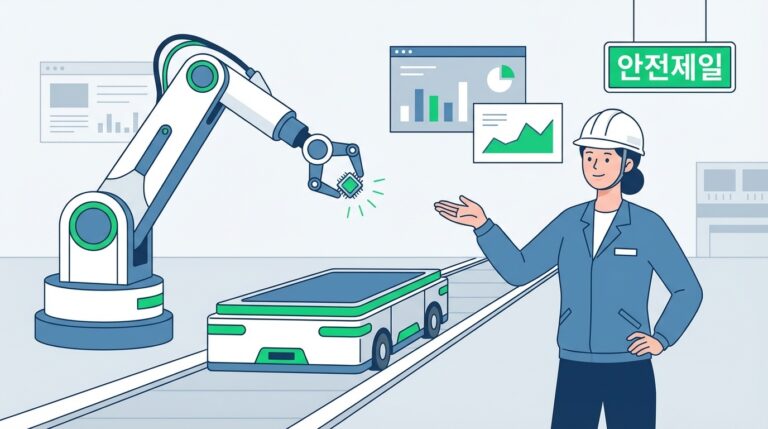
Phase 1: Empathy (The Cold Open)
Hello! I’m your Daily Hangul Editor, your resident veteran tutor and local culture navigator.
Imagine this: You’re on a business trip to a cutting-edge smart factory in Ulsan or Pangyo. It feels like stepping into a sci-fi K-Drama—sleek 협동 로봇 (cobots) are assembling parts, and 무인 운반차 (AGVs) are zipping across the floor. Suddenly, an alarm beeps, and a Korean engineer yells something across the noisy floor. Your textbook taught you to say, “Excuse me, the machine is moving,” but what you just heard sounded like a rapid-fire military command.
If you’re an engineering professional or a tech-tourist visiting Korea, mastering advanced conversational Korean for the industrial field isn’t just about sounding like an insider—it’s a matter of safety and professional trust. In high-stakes environments, the polite, lengthy sentences you learned in class are tossed out the window, replaced by hyper-efficient Sino-Korean jargon and sharp, direct commands.
Today, we’re diving deep into the C2-level vocabulary of intelligent robotics and safety protocols. I’ve compiled these insights from actual foreign engineers working on the ground in Korea. Let’s upgrade your language firmware!
Phase 2: Core Expressions Deep Dive
1. 안전거리 확보 (an-jeon-geo-ri hwak-bo)
- Pronunciation: [an-jeon-goh-ree hwak-boh] (‘Hwak’ sounds like a sharp exhale, ‘bo’ is short and crisp like ‘bow’)
- Meaning: Literal: “Secure safety distance.” / Real nuance: “Clear the area immediately / Step back from the machine.”
- K-Culture Moment: In K-Dramas featuring tech startups or construction sites (think Start-Up or Itaewon Class), you’ll hear the site manager shouting this while waving a glowing baton. It’s the ultimate “boss mode” phrase.
- Editor’s Insight: Engineers don’t say “Please move away.” They use the noun-verb combo 확보하다 (to secure). It sounds highly official, objective, and urgent.
- Situation Spectrum:
[🚫 절대 금지] ———— [⚠️ 주의] ———— [✅ 자유롭게]
- Casual with friends outside work: 🚫 (You’d sound like a robot yourself)
- Warning a colleague on the floor: ✅
- Official safety broadcast: ✅
- 🤔 Think About It: Notice how formal Korean relies heavily on Sino-Korean nouns (한자어) for technical actions? Why do you think institutional Korean favors nouns over verbs in official protocols? Does your native language do the same?
2. 로봇 오작동입니다 (ro-bot o-jak-dong-im-ni-da)
- Pronunciation: [ro-bot oh-jak-dong-im-nee-da]
- Meaning: Literal: “It is a robot malfunction.” / Real nuance: “The system is glitching/acting up.”
- K-Culture Moment: You’ll see this in thrilling sci-fi K-Dramas when the AI starts misbehaving. The prefix 오 (o – 誤) means ‘error’ or ‘mistake’.
- Editor’s Insight: While beginners might say “로봇이 고장났어요” (The robot is broken), C2 professionals say “오작동” (malfunction). It implies the machine isn’t physically broken, but its software or operational behavior is anomalous.
- Situation Spectrum:
[🚫 절대 금지] ———— [⚠️ 주의] ———— [✅ 자유롭게]
- Reporting to a Plant Manager (Formal): ✅
- Discussing technical specs in a meeting: ✅
- Explaining your broken phone to a friend: ⚠️ (A bit too dramatic)
- 🤔 Think About It: The concept of blame is delicate in Korean workplace culture. Saying “It’s malfunctioning” (오작동) rather than “Someone broke it” saves face and focuses on the system.
3. 동선이 겹칩니다 (dong-seon-i gyeop-chim-ni-da)
- Pronunciation: [dong-sun-ee gyup-chim-nee-da]
- Meaning: Literal: “The moving lines are overlapping.” / Real nuance: “Your path is crossing with the robot/AGV’s route (Watch out!).”
- K-Culture Moment: 동선 (movement path) is a ubiquitous word in Korea, used everywhere from pop idol choreography blocking to Covid-19 contact tracing, and here, smart factory logistics.
- Editor’s Insight: This is a brilliant example of spatial awareness in the Korean language. Instead of saying “You are in the way,” you say “The paths are overlapping,” removing personal fault and highlighting the logistical clash.
- Situation Spectrum:
[🚫 절대 금지] ———— [⚠️ 주의] ———— [✅ 자유롭게]
- Warning a visiting auditor: ✅
- Discussing floor layout: ✅
Phase 3: Textbook vs. Real Korean on the Factory Floor
| Situation | 📖 Textbook Korean | 🗣️ Real Korean (On-site) | 💡 Why the difference? |
|---|---|---|---|
| A robot is approaching | 기계가 다가오고 있습니다. 피하세요. (The machine is approaching. Please avoid it.) | 라인 돌아갑니다! 비키세요! (The line is running! Clear out!) | Efficiency and urgency. “라인” (Line) refers to the entire automated process. |
| Pressing the Emergency Stop | 비상 정지 버튼을 누르십시오. (Please press the emergency stop button.) | 스톱! E-Stop(이-스톱) 쳐! (Stop! Hit the E-Stop!) | In life-or-death milliseconds, Konglish (“E-Stop”) and short action verbs (“쳐” – strike/hit) are standard. |
| Checking safety gear | 안전모를 착용해 주시기 바랍니다. (Please wear your safety helmet.) | 하이바 쓰세요. (Put on your ‘haiba’.) | “하이바” is field-slang derived from a Japanese mispronunciation of “fiber” (fiberglass helmet). Common among veteran workers. |
Bottom Note for C2 Learners: While understanding slang like “하이바” helps you bond with veteran technicians, as an international expert, stick to standard terms like 안전모 (safety helmet) to maintain professional authority.
Phase 4: Cultural Context — K-Culture Deep Dive
4-1. Non-Verbal Dynamics: The ‘Nunchi’ of the Floor
In a bustling engineering environment, verbal communication is often drowned out by machinery. This is where 눈치 (Nunchi)—situational awareness—meets industrial safety. When a Korean manager points to a safety hazard, they rarely use a single index finger (which can seem accusatory or rude). Instead, they use an open palm facing upward or the whole hand to indicate the direction of the malfunctioning robot. Master this gesture, and you instantly project professional respect.
4-2. The K-Drama Workplace Hierarchy
If you’ve watched K-Dramas centered around tech companies, you’ve seen the strict reporting hierarchy (보고 체계). When an intelligent robot violates a safety parameter, you don’t just fix it and stay quiet. You must notify the chain of command. However, the tone shifts drastically depending on the urgency. A Junior Engineer might usually speak in the ultra-polite “-하십시오” form, but if a robotic arm swings dangerously, dropping honorifics to scream “반장님, 위험!!” (Foreman, danger!!) is not just accepted—it’s expected. Safety supersedes hierarchy.
Phase 5: Interactive Roleplay Scenario
Setting: 2:00 PM, Thursday. A semiconductor smart factory in Giheung. The constant hum of HVAC systems fills the air. You are inspecting the floor with Min-su, the Senior Plant Manager. An automated forklift (AGV) is quietly carrying a heavy pallet, but a new intern, wearing earphones, is walking right into its blind spot!
Characters:
– YOU: Lead Foreign Robotics Auditor. Sharp, observant, but culturally adaptable.
– Min-su (45): Senior Plant Manager (반장님). Strict about protocols, deeply respects expertise.
Dialogue:
Min-su: 이번에 도입된 협동 로봇 라인입니다. 센서 민감도가 아주 높죠.
(ibeone doipdoen hyeopdong robot rainimnida. senseo mingamdoga aju nopjyo.)
[English: This is the newly introduced cobot line. The sensor sensitivity is very high.]
(🎭 Stage Direction: Min-su gestures proudly at the robotic arms.)
YOU: 네, 안전 기준이 잘 적용된 것 같네요. 어? 저기 인턴 사원…
(ne, anjeon gijuni jal jeogyongdoen geot ganneyo. eo? jeogi inteon sawon…)
[English: Yes, the safety standards seem well applied. Oh? That intern over there…]
Min-su: 왜 그러십니까? 무슨 문제라도?
(wae geureosimnikka? museun munjerado?)
[English: What is it? Is there a problem?]
(🎭 Stage Direction: The AGV is just 5 meters away from the intern!)
🔀 Your Turn! How do you alert Min-su?
– A) “반장님! 인턴 사원에게 기계가 다가간다고 전해주세요!” (Too slow, too textbook.)
– B) “어이! 거기 조심해!” (Too informal to yell at someone else’s employee as a guest.)
– C) “반장님! AGV 동선 겹칩니다!! E-스톱!!”✅ Best Choice: C — Why? It immediately alerts the person in charge (Min-su) using his title, clearly identifies the technical issue (overlapping paths/동선 겹침), and issues an actionable command (E-Stop). It’s authoritative, professional, and culturally appropriate in an emergency.
Min-su: (Hits the emergency override on his tablet) 휴… 큰일 날 뻔했네요. 정확한 판단 감사합니다.
(hyu… keunil nal ppeonhaenneyo. jeonghwakan pandan gamsahamnida.)
[English: Phew… That was almost a disaster. Thank you for the accurate judgment.]
Bonus K-Travel Scenario: The Tech-Expo
You’re at COEX for the “Seoul International Robot Exhibition.” You want to test a robotic barista, but it suddenly stops moving.
You: “저기요, 이거 오작동인가요?” (Excuse me, is this malfunctioning?)
Staff: “아, 지금 쿨링 타임입니다. 5분 뒤에 재가동됩니다.” (Ah, it’s on a cooling break. It will restart in 5 minutes.)
Phase 6: 10-Second Shadowing Drill
Let’s practice the crucial warning phrase. Pay attention to the staccato pauses!
😤 반장님! / 지금 / AGV 동선이 / 겹칩니다! / 비키세요!
(ban-jang-nim! / ji-geum / AGV dong-seon-i / gyeop-chim-ni-da! / bi-ki-se-yo!)
[Foreman! Right now the AGV path is overlapping! Clear out!]
Phase 7: K-Culture Mini Dictionary (Tech Edition)
| 한국어 (Korean) | Romanization | English | Cultural Context |
|---|---|---|---|
| 안전 불감증 | anjeon bulgamjeung | Insensitivity to safety | A societal term used by media to criticize the lack of safety awareness in rushed projects. |
| 현장 | hyeonjang | The field / On-site | Carries a heavy nuance of “where the real work gets done” versus the office. |
| 매뉴얼 | maenyueol | Manual | “매뉴얼대로 해” (Do it by the manual) is the modern mantra replacing the old rushed ways. |
| 안전제일 | anjeon jeil | Safety First | You will see this written in green and white crosses on EVERY construction and factory site. |
Phase 8: Tech-Traveler Survival Kit
Visiting a Korean trade show, exhibition, or smart factory? Here are your elite survival phrases:
🆘 Survival Expression #1: Asking about restrictions
– 🇰🇷 “여기 사진 촬영 금지 구역인가요?” (yeogi sajin chwaryeong geumji guyeogingayo?)
– 🗣️ English Guide: Is this a restricted photography zone?
– 📍 Where to use: R&D centers, factory tours, tech expos.
– 💡 Pro Tip: Korea has strict corporate espionage laws. Always ask before snapping a photo of a cool robot arm!📌 Editor’s Travel Note
– Navigating Expos: Download Naver Map. Google Maps does not have full functionality in Korea due to national security laws.
– Business Cards (명함): When you meet a Korean engineer, present and receive business cards with both hands. It shows immense respect.
Phase 9: Critical Thinking — “One Step Deeper”
The ‘Palli-palli’ Paradox vs. Precision Robotics
Korea is globally famous for its 빨리빨리 (Palli-palli / Hurry up) culture. Historically, this socio-economic phenomenon drove the “Miracle on the Han River,” enabling hyper-fast industrialization. However, the advent of intelligent robotics creates a fascinating cultural friction. Smart factories require the exact opposite of Palli-palli: stringent, uncompromisable safety protocols (안전 수칙) and rigid adherence to manuals. When you hear an older manager complaining about automated safety locks slowing down the line, you are witnessing the generational shift in Korea—from a developing nation reliant on human speed to a fully automated society prioritizing flawless, systemic safety.
💬 Your Turn: Have you ever experienced a clash between “working fast” and “working safe” in your home country? How do engineers in your culture handle this balance? Let us know in the comments!
Phase 10: FAQ & Avoiding Common Mistakes
Q: “If there’s an emergency, do I still need to use formal language (존댓말) to my boss?”
A: MAYBE, but brevity wins. In a life-threatening moment involving heavy machinery, drop the complex grammar. Yelling “위험해!” (Danger!) or “피해!” (Avoid!) is completely acceptable. Survival dictates the tone.
❌ Common Mistake #1: Translating “Stop the robot” literally as “로봇을 멈추세요” (Robot-eul meom-chu-se-yo).
✅ Do this instead: Use technical terms. “로봇 정지!” (Robot jeong-ji!) or “E-스톱 눌러요!” (Press E-stop!).❌ Common Mistake #2: Calling everyone “당신” (You) or “~씨” (-ssi) on the floor.
✅ Do this instead: The factory floor is heavily titled. Use 반장님 (Foreman/Manager), 소장님 (Plant Director), or 기사님 (Technician/Engineer). Calling a veteran technician “Mr. Kim” (김씨) is highly offensive.
Phase 11: Summary & Action Items
- One-Liner Summary: In Korea’s automated industrial sites, mastering precise Sino-Korean nouns (like 확보, 오작동, 동선) ensures both your professional credibility and physical safety.
-
Action Mission:
- 🥉 Bronze: Say “로봇 오작동입니다. 안전거리 확보 바랍니다” out loud 3 times with a commanding tone.
- 🥈 Silver: Write a short comment below using the word 동선 (movement path) describing a time you bumped into someone.
- 🥇 Gold: The next time you visit a tech exhibition or use an automated kiosk/robot in Korea, practice looking for the 비상 정지 (Emergency Stop) label!
- K-Culture Mission: Watch a clip of a Korean tech or startup drama (like Start-Up). Listen closely when they are in the developer room or factory. Can you spot them using the word 오류 (Error) or 오작동 (Malfunction)?
Phase 12: Interactive Quiz Challenge
1. Situational Judgment: You are inspecting a cobot line. You notice a sensor is glitching, causing the arm to twitch. What is the most professional C2-level way to report this to the Plant Director?
– A) 소장님, 로봇이 이상해요. (Director, the robot is weird.)
– B) 소장님, 협동 로봇 오작동이 감지되었습니다. (Director, a cobot malfunction has been detected.)
– C) 소장님, 로봇이 고장났습니다. (Director, the robot is broken.)
(Hint: B is correct! ‘고장’ implies physical breakage, while ‘오작동’ perfectly describes a behavioral glitch.)
2. True or False – K-Culture Edition:
– In a Korean factory, pointing at a malfunctioning machine with one index finger is considered highly professional.
(Answer: False. Use an open palm to point, demonstrating ‘Nunchi’ and respect!)
3. Fill in the Blank:
“위험합니다! 로봇과 _____이 겹칩니다!” (Danger! The paths overlap with the robot!)
(Answer: 동선 – dong-seon)
Frequently Asked Questions (FAQ)
Q: What does "안전거리 확보 (an-jeon-geo-ri hwak-bo)" mean in Korean and how do you pronounce it?
A: In Korean, "안전거리 확보 (an-jeon-geo-ri hwak-bo)" is pronounced [an-jeon-goh-ree hwak-boh] and means: Literal: "Secure safety distance." / Real nuance: "Clear the area immediately / Step back from the machine."
Q: What does "로봇 오작동입니다 (ro-bot o-jak-dong-im-ni-da)" mean in Korean and how do you pronounce it?
A: In Korean, "로봇 오작동입니다 (ro-bot o-jak-dong-im-ni-da)" is pronounced [ro-bot oh-jak-dong-im-nee-da] and means: Literal: "It is a robot malfunction." / Real nuance: "The system is glitching/acting up."
Q: What does "동선이 겹칩니다 (dong-seon-i gyeop-chim-ni-da)" mean in Korean and how do you pronounce it?
A: In Korean, "동선이 겹칩니다 (dong-seon-i gyeop-chim-ni-da)" is pronounced [dong-sun-ee gyup-chim-nee-da] and means: Literal: "The moving lines are overlapping." / Real nuance: "Your path is crossing with the robot/AGV's route (Watch out!)."







