

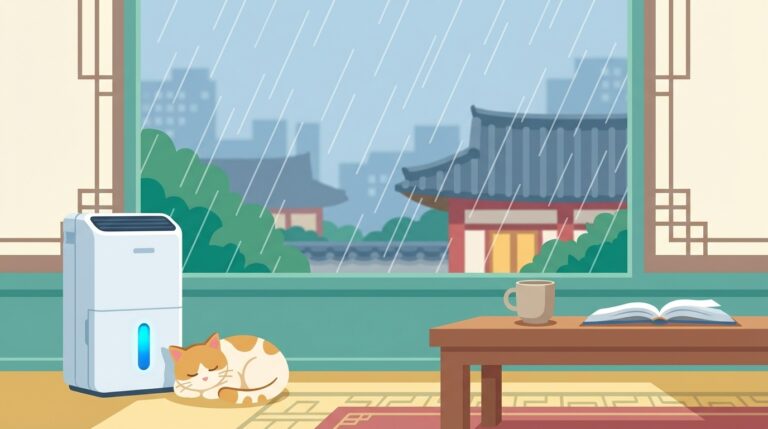
Phase 1: Empathy (The K-Culture Cold Open)
Hello! This is your Daily Hangul Editor.
Picture this: You just stepped out of Incheon Airport in mid-July. You were expecting a warm, sunny Korean summer, but instead, it feels like you’ve just walked into a giant bowl of hot, steaming Gukbap (soup with rice). You take three steps, and your shirt is already sticking to your back. Welcome to Jangma (장마)—the notorious Korean monsoon season.
You run into a nearby cafe to escape the muggy air. The moment you push the glass door open, you’re hit with a blast of crisp, cool, dry air. It’s not just the air conditioner; nestled in the corner is a sleek, quiet machine doing the heavy lifting. The magical Jeseupgi (제습기 – Dehumidifier).
In K-Dramas, the main leads always look flawlessly matte and breezy during summer. But in reality? We are all constantly scanning the room for a dehumidifier. Knowing how to talk about the humidity and casually asking someone to turn on the Jeseupgi won’t just keep you comfortable—it will earn you massive “Insider (인싸)” points from Koreans who will think, “Wow, they really know how we survive the summer!”
This guide is packed with real questions and survival stories from my students who successfully navigated the Korean summer without melting. Let’s dive in!
Phase 2: Deep Dive into Core Expressions
1. 너무 꿉꿉해요
- Pronunciation: neomu kkukkuphaeyo [Sound-alike: “Kkoop-kkoop-hay-yo” – Say ‘kkoop’ like ‘coop’ but tighten your throat for the double ‘ㄲ’ sound]
- Meaning: Literal = It’s very musty/damp. / Real nuance = I’m feeling sticky, gross, and uncomfortable because of the humidity.
- K-Culture Moment: You’ll hear this exactly 5 seconds after a group of friends steps out of an air-conditioned subway train into the July heat. Everyone starts waving their hands like fans and muttering, “아, 꿉꿉해 (Ah, kkukkuphae).”
- Editor’s Insight: This is the ultimate local word. Textbooks usually teach “습하다” (humid), but “꿉꿉하다” captures the emotional discomfort of the dampness. It’s the feeling of laundry that didn’t dry properly.
- Situation Spectrum:
[🚫 절대 금지] ———— [⚠️ 주의] ———— [✅ 자유롭게]
- Casual with friends: ✅
- Semi-formal with colleagues: ✅ (Great for small talk!)
- Formal with strict bosses: ⚠️ (Stick to “습하네요” to be safe)
- 🤔 Think About It: Why does Korean have so many highly specific sensory adjectives like “꿉꿉하다”? How does your native language describe the feeling of sticky humidity?
2. 제습기 좀 틀어주시겠어요?
- Pronunciation: jeseupgi jom teureojusigesseoyo? [Sound-alike: “Jeh-seup-gee johm too-ruh-joo-she-gess-uh-yo?”]
- Meaning: Literal = Would you kindly turn on the dehumidifier? / Real nuance = Could we get the dehumidifier going? It’s getting damp in here.
- K-Culture Moment: You’re at a cute indie cafe in Yeonnam-dong. The windows are getting foggy from the rain. You ask the barista this, and they instantly nod in deep understanding, rushing to hit the power button.
- Editor’s Insight: Pay attention to “틀다” (to turn on). We use “틀다” for ACs, heaters, and dehumidifiers, which originally meant “to twist/crank” (like an old dial).
- Situation Spectrum:
[🚫 절대 금지] ———— [⚠️ 주의] ———— [✅ 자유롭게]
- Casual with friends: ⚠️ (Say “제습기 좀 틀자!” instead)
- Semi-formal with colleagues/staff: ✅
- Formal with strict bosses: ✅
- 🤔 Think About It: Notice the “주시다” (to give) inside the verb? Koreans literally ask someone to “give the favor of turning it on.” How does this reflect the Korean culture of polite requests?
3. 뽀송뽀송해졌어요
- Pronunciation: pposongpposonghaejyeosseoyo [Sound-alike: “Ppo-song-ppo-song-hae-jyuss-uh-yo”]
- Meaning: Literal = It became soft and dry. / Real nuance = Ah, the room finally feels perfectly dry, crisp, and comfortable!
- K-Culture Moment: The dehumidifier has been running for 30 minutes. You stretch your arms, sink into the couch, and say this. It’s the ultimate sound of satisfaction. Also heavily used in K-Beauty commercials for matte face powders!
- Editor’s Insight: “뽀송뽀송” is an onomatopoeic word (mimetic word) that sounds exactly like what it means—fluffy, dry, and soft.
- Situation Spectrum:
[🚫 절대 금지] ———— [⚠️ 주의] ———— [✅ 자유롭게]
- Casual with friends: ✅
- Semi-formal with colleagues: ✅
- Formal with strict bosses: ⚠️ (A bit too cute/casual for a boardroom)
- 🤔 Think About It: Sound words (mimetic words) are everywhere in Korean. Do they make conversations feel more emotionally connected to you?
Phase 3: Textbook vs. Real Korean
| Situation | 📖 Textbook Korean | 🗣️ Real Korean | 💡 Why the difference? |
|---|---|---|---|
| Complaining about humidity | 오늘은 습도가 매우 높습니다. (Today the humidity is very high.) | 아, 오늘 진짜 꿉꿉해 죽겠다! (Ah, I’m dying of the dampness today!) | Koreans love adding “죽겠다” (I’m dying of…) to emphasize extreme physical or emotional states. |
| Asking to turn on the machine | 제습기를 켜 주십시오. (Please turn on the dehumidifier.) | 제습기 좀 틀어줄 수 있어요? (Can you turn on the dehumidifier a bit?) | Using “좀” (a little) softens the request, making it sound less bossy and more polite. |
| Feeling relieved from the dampness | 이제 건조해졌습니다. (It has become dry now.) | 와, 이제 좀 살 것 같다. (Wow, I feel like I can live now.) | Exaggerating relief is a cultural staple—moving from “dying” of heat to “living” again! |
Bottom Note for B1 Learners: You don’t need to memorize heavy slang. Just adding “좀” (a little) to your requests or using “살 것 같다” (feel like I can live) will make you sound incredibly natural.
Phase 4: Cultural Context — K-Culture Deep Dive
4-1. Non-verbal Nuances & Nunchi
When asking someone to turn on the AC or dehumidifier, Nunchi (눈치) is crucial. Instead of directly complaining, “It’s hot,” Koreans might implicitly show discomfort by fanning their faces with their hands, lightly pulling their collars, and letting out a soft sigh. A person with quick Nunchi will notice this and turn on the dehumidifier before you even have to ask!
4-2. The K-Food Connection: Rain, Humidity, and Sizzling Pancakes
Why do Koreans suddenly flock to traditional taverns when the Jangma rains start pouring and the humidity peaks? It’s all about Pajeon (Green Onion Pancake) and Makgeolli (Rice Wine).
When you’re stuck indoors because it’s too “꿉꿉해” (damp) outside, the sound of rain hitting the window perfectly matches the sizzling sound of frying a crispy Pajeon in oil. It’s a national coping mechanism for the monsoon season. So, if a Korean friend says, “비도 오고 꿉꿉한데… (It’s raining and damp, so…)”, get ready—they are 100% about to suggest eating Pajeon!
Phase 5: Real-life Roleplay Scenario
Setting: It’s late July, pouring rain outside. You are hanging out at your Korean friend Minji’s small studio apartment in Seoul. The air feels heavy, sticky, and you can practically see the moisture in the air. The AC is on, but it’s not cutting it.
Characters:
– YOU: A B1-level Korean learner, trying to stay comfortable without being rude.
– Minji (28): Your lovely Korean friend who is currently busy preparing snacks in the kitchen.
Dialogue:
Minji: 밖에 비 진짜 많이 오지? 안에는 좀 시원해?
(bakke bi jinjja mani oji? aneneun jom siwonhae?)
[It’s raining a lot outside, right? Is it a bit cool inside?]
(🎭 Stage Direction: Minji hands you a glass of iced barley tea)
YOU: 네, 에어컨 덕분에 시원한데… 오늘 날씨가 진짜 장난 아니네요.
(ne, eeokeon deokbune siwonhande… oneul nalssiga jinjja jangnan anineyo.)
[Yes, it’s cool thanks to the AC, but… today’s weather is really no joke.]
Minji: 맞아, 장마철이라서 그래. 불편한 거 있으면 말해!
(maja, jangmacheoriraseo geurae. bulpyeonhan geo isseumyeon malhae!)
[Right, it’s because it’s the monsoon season. Let me know if you’re uncomfortable!]
🔀 YOUR TURN! How do you smoothly ask for the dehumidifier?
– A) “방이 너무 습해요. 제습기를 켜세요.” (The room is too humid. Turn on the dehumidifier.)
– B) “비가 와서 좀 꿉꿉한데, 혹시 제습기 좀 틀어줄 수 있어?” (It’s a bit damp because of the rain, could you maybe turn on the dehumidifier?)
– C) “아, 꿉꿉해 죽겠어! 당장 제습기 틀자!” (Ah, I’m dying of the dampness! Let’s turn on the dehumidifier right now!)✅ Best Choice: B — Reason: It explains why you’re asking (rain) and uses the soft, natural request format “혹시 ~좀 틀어줄 수 있어?”.
⚠️ Choice A Analysis: Too robotic and direct. “켜세요” sounds like an order from a military general.
⚠️ Choice C Analysis: A bit dramatic. Only use this if Minji is your absolute best friend since childhood.
Minji (If you chose B): 아! 맞다. 내가 깜빡했네. 바로 틀게!
(a! matda. naega kkamppakhaenne. baro teulge!)
[Ah! Right. I completely forgot. I’ll turn it on right away!]
(🎭 Stage Direction: She presses a button, and the machine hums to life)
YOU: 고마워. 와, 이제 좀 뽀송뽀송해지는 것 같아. 살 것 같아!
(gomawo. wa, ije jom pposongpposonghaejineun geot gata. sal geot gata!)
[Thanks. Wow, it feels like it’s getting crisp/dry now. I feel like I can live!]
Phase 6: 10-Second Shadowing Drill
Follow the slashes (/) for pauses and match the emotional tags!
- 😩 오늘 날씨 / 진짜 / 꿉꿉하네요.
(oneul nalssi / jinjja / kkukkuphaneyo.)
[Today’s weather is really sticky.] -
🥺 혹시 / 제습기 좀 / 틀어주시겠어요?
(hoksi / jeseupgi jom / teureojusigesseoyo?)
[By any chance, could you turn on the dehumidifier?] -
😊 와~ / 이제 진짜 / 뽀송뽀송해요!
(wa~ / ije jinjja / pposongpposonghaeyo!)
[Wow~ now it’s really dry and soft!]
Phase 7: K-Culture Mini Dictionary
| Korean | Romanization | English | Cultural Context |
|---|---|---|---|
| 장마 | jangma | Monsoon season | Usually spans from late June to late July. High humidity, heavy rains, and gray skies. |
| 불쾌지수 | bulkwaejisu | Discomfort index | A weather metric broadcasted on TV. When it’s high, Koreans joke, “Don’t mess with me today.” |
| 에어컨병 | eeokeonbyeong | AC sickness | Catching a summer cold or feeling lethargic due to excessive AC use. |
| 뽀송뽀송 | pposongpposong | Dry and soft | The holy grail feeling during the Jangma season. Used for skin, laundry, and air. |
| 파전 | pajeon | Green onion pancake | The official comfort food of rainy days in Korea. |
Phase 8: Traveler’s Survival Kit
Are you staying at an Airbnb or visiting a cafe during your summer trip? Save these!
🆘 Survival Phrases: Beating the Heat & Humidity
– 🇰🇷 “에어컨 온도를 좀 낮춰주시겠어요?” (eeokeon ondoreul jom natchwojusigesseoyo?)
– 🗣️ Meaning: Could you lower the AC temperature a bit?
– 🇰🇷 “방이 좀 습한데, 제습기 있나요?” (bangi jom seuphande, jeseupgi innayo?)
– 🗣️ Meaning: The room is a bit humid, do you have a dehumidifier?
– 📍 Where to use: Airbnb messaging, hotel front desk, cafes.
– 💡 Pro Tip: In Korea, lowering the temperature (온도를 낮추다) means making it colder. Raising the temperature (온도를 높이다) means making it warmer. Don’t say “make the AC higher” (에어컨 높여주세요)—they might make the room hotter!📌 Editor’s Travel Note
Many modern Korean hotels and Airbnbs have built-in dehumidifying functions within the AC remote. Look for the button that says 제습 (Je-seup) or has a little water drop icon (💧). Pressing that will save your life!
Phase 9: Critical Thinking Corner — “One Step Deeper”
🧠 Think Deeper: Media vs. Reality – The Myth of the Perfect Summer
If you’ve watched summer romance K-Dramas like Our Beloved Summer, you might think Korean summers are all about riding bicycles under clear blue skies with slightly glowing, dewy skin.But reality is quite different. The pursuit of “glass skin (촉촉한 피부)” totally pauses during the Jangma season. Instead of dewy, people just look sweaty (꿉꿉하다). This creates a massive market for “matte” beauty products, portable hand fans, and, of course, dehumidifiers. The media sells the aesthetic of summer, but the language (with words like 불쾌지수 – discomfort index) reveals the survival aspect of it.
💬 Your Turn: Have you ever visited a country where the actual weather completely shocked you compared to what you saw in movies? Share your story in the comments!
Phase 10: FAQ & Common Mistakes
Q: Can I tell my boss “아, 꿉꿉해 죽겠어요!”?
No! Even if you are close, “~죽겠다” (dying of) is too casual for superiors. Stick to: “오늘 날씨가 많이 습하네요” (The weather is very humid today).
Q: Do Korean restaurants have dehumidifiers?
Usually, restaurants just blast the AC on the “Je-seup (Dehumidify)” mode. If it’s too damp or cold, you can ask the staff to adjust it.
❌ Common Mistake #1: Confusing 촉촉하다 and 꿉꿉하다
“촉촉하다” (chok-chok-ha-da) means moist/dewy in a good way (like a moist cake or hydrated skin). “꿉꿉하다” is damp/sticky in a bad way.
– Don’t say: “오늘 날씨가 너무 촉촉해요!” (Today’s weather is so wonderfully dewy!)
– Say: “오늘 날씨가 너무 꿉꿉해요!” (Today’s weather is so sticky/damp!)
Phase 11: Summary & Action Items
One-Liner Summary: To survive the sticky Korean Jangma, express your discomfort playfully with “꿉꿉해요” and politely ask for the “제습기” (dehumidifier)!
Your Mission for Today:
– 🥉 Bronze (Solo): Stand in front of a mirror and dramatically fan yourself while saying, “아, 오늘 꿉꿉하네요!”
– 🥈 Silver (Online): Go to your favorite K-Pop idol’s social media. If they post about the rain, comment: “비 와서 꿉꿉하죠? 제습기 꼭 틀어요!” (It’s damp because of the rain, right? Make sure to turn on the dehumidifier!)
– 🥇 Gold (Real Life): Next time you are in a humid room with a Korean speaker, casually ask, “혹시 제습기 좀 틀어줄 수 있어요?”
K-Culture Mission: Listen to the classic Korean rainy day song, “비가 오는 날엔 (On Rainy Days)” by BEAST. Imagine sitting in a cafe with the dehumidifier running perfectly while listening to it!
Phase 12: Quiz — Interactive Challenge
1. Situational Judgment: You are at a cafe in Seoul during July. You feel incredibly sticky and damp. What is the most natural thing to mumble to your friend?
– A) “이곳의 습도가 높습니다.”
– B) “아, 진짜 꿉꿉하다.”
– C) “날씨가 참 촉촉하네.”
2. True or False – K-Culture Edition:
– “When Koreans complain about the rain and humidity, there is a high chance they want to eat Pajeon (Green Onion Pancake).” (True / False)
3. Fill in the Blank:
– Friend: 방이 좀 습하지 않아?
– You: 네, 혹시 _____ 좀 틀어주시겠어요?
🗝️ Click here for Answers!
1. B (A is too textbook. C means the weather is pleasantly dewy/moist, which is weird).
2. True! Rain + Humidity = Pajeon and Makgeolli time.
3. 제습기 (jeseupgi)
Frequently Asked Questions (FAQ)
Q: What does "너무 꿉꿉해요" mean in Korean and how do you pronounce it?
A: In Korean, "너무 꿉꿉해요" is pronounced [neomu kkukkuphaeyo [Sound-alike: "Kkoop-kkoop-hay-yo" - Say 'kkoop' like 'coop' but tighten your throat for the double 'ㄲ' sound] and means: Literal = It's very musty/damp. / Real nuance = I'm feeling sticky, gross, and uncomfortable because of the humidity.
Q: What does "제습기 좀 틀어주시겠어요?" mean in Korean and how do you pronounce it?
A: In Korean, "제습기 좀 틀어주시겠어요?" is pronounced [jeseupgi jom teureojusigesseoyo? [Sound-alike: "Jeh-seup-gee johm too-ruh-joo-she-gess-uh-yo?"] and means: Literal = Would you kindly turn on the dehumidifier? / Real nuance = Could we get the dehumidifier going? It's getting damp in here.
Q: What does "뽀송뽀송해졌어요" mean in Korean and how do you pronounce it?
A: In Korean, "뽀송뽀송해졌어요" is pronounced [pposongpposonghaejyeosseoyo [Sound-alike: "Ppo-song-ppo-song-hae-jyuss-uh-yo"] and means: Literal = It became soft and dry. / Real nuance = Ah, the room finally feels perfectly dry, crisp, and comfortable!







