Phase 1: Empathy (The K-Drama Trash Bin Encounter)
Hello! I’m your Daily Hangul Editor.
Imagine this: You’re watching a cozy K-Drama. The lead character steps out of their apartment in a comfy tracksuit, hair tied up in a messy bun, carrying a mountain of empty boxes and water bottles. Down at the neighborhood recycling area (분리수거장), they accidentally drop a bottle, and bam! They lock eyes with their handsome neighbor. Romance blooms over a plastic bottle!
But let’s be real. If you’re a foreigner living in or visiting Korea, your experience at the recycling bins probably feels less like a rom-com and more like a high-stakes survival game. Korea has one of the strictest recycling systems in the world.
I’ve seen so many of my students panic at an Airbnb or after a K-pop concert, staring at five different colored bins, holding an empty iced Americano cup, thinking, “Where does this go?!”
Don’t worry. Today, I’m going to teach you the survival Korean you need to sort plastics like a true local. By the end of this guide, even the strictest Korean building manager (경비 아저씨) will give you a nod of approval. Let’s dive in!
Phase 2: Core Expressions Deep Dive
1. 플라스틱은 어디에 버려요?
- Pronunciation: [peullaseutigeun eodie beoryeoyo?] Sounds like: pull-ah-seu-teeg-eun uh-dee-eh buh-ryuh-yo?
- Meaning: Where do I throw away plastics?
- K-Culture Moment: You’re at a K-Pop concert venue or a massive cafe in Hongdae. You have an empty plastic fanlight case or drink cup, but you can’t find the right bin. You politely ask a staff member this exact question.
- Editor’s Insight: The verb 버리다 (beorida) means “to throw away.” Adding -어디에 (where) makes it the ultimate survival question for any type of trash.
- Situation Spectrum:
[🚫 Never] ———— [⚠️ Be Careful] ———— [✅ Freely]
- Close Friends (Casual): ⚠️ (Friends would use: 플라스틱 어디 버려?)
- Strangers/Staff (Semi-formal): ✅ (Perfect and polite!)
- Boss/Elders (Formal): ✅
- 🤔 Think About It: Why is it so important to ask where things go in Korea, rather than just finding the nearest trash can? How does your home country handle public trash?
2. 이거 플라스틱 맞아요?
- Pronunciation: [igeo peullaseutik majayo?] Sounds like: ee-guh pull-ah-seu-teeg mah-jah-yo?
- Meaning: Is this plastic? (Literally: Is it correct that this is plastic?)
- K-Culture Moment: You order a fancy K-Beauty skincare set online. It arrives in beautiful packaging, but you’re not sure if the inner tray is plastic or coated paper. You ask your Korean roommate while pointing at it.
- Editor’s Insight: Koreans love using “맞아요?” (Is it correct?) to confirm things. It sounds much more natural and humble than stating you don’t know something.
- Situation Spectrum:
[🚫 Never] ———— [⚠️ Be Careful] ———— [✅ Freely]
- Close Friends (Casual): ⚠️ (Drop the ‘yo’: 이거 플라스틱 맞아?)
- Co-workers (Semi-formal): ✅
- Store Clerk/Security Guard (Formal): ✅
- 🤔 Think About It: “맞다” (to be right/correct) is used constantly in Korean. Does this reflect a cultural desire to ensure harmony and avoid making mistakes in front of others?
3. 씻어서 버려주세요.
- Pronunciation: [ssiseoseo beoryeojuseyo.] Sounds like: she-suh-suh buh-ryuh-joo-seh-yo.
- Meaning: Please wash it before throwing it away.
- K-Culture Moment: You order spicy Tteokbokki via delivery. The plastic container is stained red. Your Korean friend tells you this phrase as they take the container to the sink. Yes, Koreans wash their trash!
- Editor’s Insight: This isn’t something you will say often, but it’s something you will hear or read all the time on Airbnb manuals and from neighbors. Unwashed plastic cannot be recycled in Korea!
- Situation Spectrum:
[🚫 Never] ———— [⚠️ Be Careful] ———— [✅ Freely]
- Friends (Casual): ⚠️ (씻어서 버려!)
- Airbnb Host to Guest (Formal): ✅
- 🤔 Think About It: Washing trash requires extra effort. What does this tell you about the Korean mindset regarding community spaces and the environment?
Phase 3: Textbook vs. Real Korean
| Situation | 📖 Textbook Korean | 🗣️ Real Korean | 💡 Why the difference? |
|---|---|---|---|
| Asking where plastic goes | 플라스틱을 어디에 버립니까? | 플라스틱 어디에 버려요? | The -니까 ending is too stiff for daily life. -요 is polite and natural. |
| Telling someone to take off the label | 상표를 제거하십시오. | 라벨 떼고 버리세요. | Koreans use the English word “Label” (라벨) in daily life, and “떼다” (take off) is shorter. |
| Asking if it’s general waste | 일반 쓰레기입니까? | 이거 그냥 버려도 돼요? | “Can I just throw this away?” implies asking if it can go into the general, non-recycled trash. |
Phase 4: Cultural Context — K-Culture Deep Dive
4-1. Non-verbal Communication: The Art of Nunchi at the Bins
When you are at the recycling area, pay attention to the security guard (경비 아저씨 – gyeongbi ajeossi). If he approaches you, don’t walk away! Make slight eye contact, bow your head slightly, and use the phrase you learned: “이거 플라스틱 맞아요?” Showing that you are trying to learn the rules will instantly melt away any strictness. This is a perfect example of 눈치 (Nunchi)—reading the room and acting politely before getting scolded.
4-2. The K-Drama & K-Travel Connection
If you stay at an Airbnb in Seoul, you will 100% receive a manual about 분리수거 (bunrisugeo – recycling). K-Dramas often use the neighborhood recycling spot as a crucial setting. Why? Because it’s the one place where everyone—from the wealthy CEO in secret sweatpants to the struggling college student—has to go. It’s the ultimate equalizer.
Pro Tip for Travelers: If you’re drinking a plastic bottle of water (페트병 – PET bottle), you must peel off the plastic label around it and throw the label in vinyl (비닐), the cap in small plastics, and the clear bottle in the PET bin. If you don’t? Prepare for a K-Drama style scolding!
Phase 5: Real-Life Roleplay Scenario
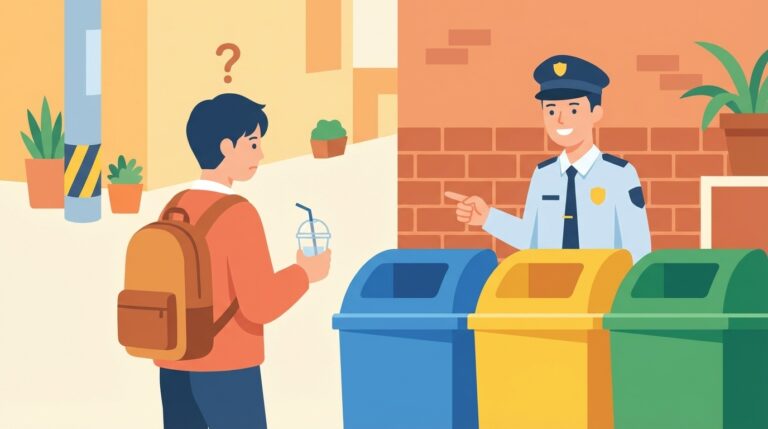
Setting: Tuesday night, 8:00 PM. You are staying at a lovely Airbnb in Hongdae. You just finished a delicious iced Americano from a local cafe. You take the empty plastic cup down to the building’s recycling area. The strict-looking building security guard, Mr. Kim (60s), is organizing boxes.
Characters:
– YOU: A foreigner who loves K-Culture but is terrified of Korean recycling rules.
– Mr. Kim (경비 아저씨): Building security guard. Looks grumpy, but actually very helpful if you show respect.
The Dialogue:
YOU: 안녕하세요!
(Annyeonghaseyo!)
[Hello!]
Mr. Kim: 네, 안녕하세요. 쓰레기 버리러 왔어요?
(Ne, annyeonghaseyo. Sseuregi beorireo wasseoyo?)
[Yes, hello. Did you come to throw away trash?]
YOU: 네. 아저씨, 이거 플라스틱은 어디에 버려요?
(Ne. Ajeossi, igeo peullaseutigeun eodie beoryeoyo?)
[Yes. Sir, where do I throw away this plastic?]
(🎭 Stage Direction: You hold up your plastic coffee cup with ice and syrup still inside)
Mr. Kim: 어구, 학생! 그거 그렇게 버리면 안 돼요!
(Eogu, haksaeng! Geugeo geureoke beorimyeon an dwaeyo!)
[Oh my, student! You can’t throw it away like that!]
YOU: 네? 왜요?
(Ne? Waeyo?)
[Pardon? Why?]
Mr. Kim: 안에 얼음 있잖아요. 내용물은 비우고 씻어서 버려주세요.
(Ane eoreum itjanayo. Naeyongmureun biugo ssiseoseo beoryeojuseyo.)
[There’s ice inside. Empty the contents and please wash it before throwing it away.]
🔀 YOUR TURN! How do you respond?
– A) “아, 귀찮아요. 그냥 버릴게요.” (Ah, that’s annoying. I’ll just throw it away.)
– B) “아! 죄송합니다. 다시 씻어 올게요!” (Ah! I’m sorry. I’ll go wash it and come back!)
– C) “영어 할 줄 아세요?” (Do you speak English?)✅ Best Choice: B — Korean recycling requires clean plastics. Apologizing playfully and fixing the mistake is the best way to win over the security guard!
⚠️ Choice C Analysis: While many Koreans speak English, older security guards usually don’t. Asking this defensively might make the situation awkward.
YOU: 아! 몰랐어요. 죄송합니다. 다시 씻어 올게요!
(A! Mollasseoyo. Joesonghamnida. Dasi ssiseo olgeyo!)
[Ah! I didn’t know. I’m sorry. I’ll go wash it and come back!]
Mr. Kim: 허허, 그래요. 물로 한 번 헹구면 돼요. 플라스틱은 저기 파란 통에 넣으세요.
(Heoheo, geuraeyo. Mullo han beon henggumeon dwaeyo. Peullaseutigeun jeogi paran tonge noeuseyo.)
[Haha, alright. Just rinsing it with water is fine. Put the plastic in that blue bin over there.]
YOU: 감사합니다!
(Gamsahamnida!)
[Thank you!]
🌟 Bonus K-Culture Scenario: Convenience Store
(You are buying a 2+1 drink at a GS25 convenience store and want to drink one immediately.)
– You: 계산해 주세요. (Please ring this up.)
– Clerk: 네, 3천 원입니다. (Yes, it’s 3,000 won.)
– You: (Finishing the drink) 사장님, 이 플라스틱 컵, 여기 버려도 돼요? (Boss, can I throw this plastic cup away here?)
– Clerk: 네, 문 옆에 쓰레기통 있어요. (Yes, there’s a trash can next to the door.)
Phase 6: 10-Second Shadowing Drill
Read these out loud! Pay attention to the pauses (/) and the emotion tags.
- 🥺 (Looking confused) 저기요… / 이거 / 플라스틱 맞아요?
(jeogiyo… / igeo / peullaseutik majayo?) - 😊 (Politely asking) 플라스틱은 / 어디에 / 버려요?
(peullaseutigeun / eodie / beoryeoyo?) - 😤 (Reminding yourself) 꼭! / 씻어서 / 버리자!
(kkok! / ssiseoseo / beorija!)
Phase 7: K-Culture Mini Dictionary
| Korean | Romanization | English | Context |
|---|---|---|---|
| 분리수거 | bunrisugeo | Recycling / Sorting Trash | The act of separating trash into paper, plastic, glass, etc. |
| 일반 쓰레기 | ilban sseuregi | General Waste | Trash that cannot be recycled (must go in a special paid bag!). |
| 종량제 봉투 | jongnyangje bongtu | Standard garbage bag | You MUST buy these at convenience stores for general waste. |
| 페트병 | peteubyeong | PET Bottle | Plastic water/soda bottles. They have their own strict rules. |
| 경비 아저씨 | gyeongbi ajeossi | Security Guard | The older men who manage apartment buildings. Treat them nicely! |
Phase 8: Traveler Survival Kit
If you are traveling in Korea, you will generate trash. Here is what you must know.
🆘 Survival Expression #1: “여기 버려도 돼요?”
– 🇰🇷 여기 버려도 돼요? (yeogi beoryeodo dwaeyo?)
– 🗣️ English Sound: yuh-gee buh-ryuh-doh dweh-yo?
– 📍 Where to use: Convenience stores, cafes, fast food restaurants.
– 💡 Pro Tip: Don’t leave your trash on the table at a cafe. Always take your tray to the return counter and ask this if you’re unsure where the plastic cup goes.📌 Editor’s Travel Note
– No Public Trash Cans: You will notice a shocking lack of public trash cans on Korean streets. Why? To prevent people from dumping household trash! Keep a small plastic bag in your backpack to carry your empty cups until you find a subway station or convenience store.
– Fines are Real: Throwing normal trash into a recycling bin at an Airbnb can actually result in your host being fined, and they might charge you for it. When in doubt, ask your host!
Phase 9: Critical Thinking Corner — “한 발 더 깊이”
Community & Identity: The “우리” (We) Mindset in Trash
🧠 Think Deeper:
Why is Korea so strict about washing plastics and separating bottle caps? It goes beyond environmentalism. Korea has a high population density and limited land. Historically, survival relied on village cooperation. This evolved into the modern “우리” (We/Our) mindset. Recycling isn’t just a personal choice in Korea; it is a civic duty. If you don’t rinse your plastic Tteokbokki container, it ruins the entire batch of recycled goods, harming the community. By participating in strict recycling, you are essentially showing respect to the Korean collective society.💬 Your Turn: How is recycling handled in your country? Is it seen as a personal choice or a community rule? Share in the comments!
Phase 10: FAQ & Common Mistakes
Q: Can I just throw my empty plastic coffee cup with the ice still inside into the bin?
A: NO! 🚫 You must empty the ice and leftover liquid into a sink or a special liquid disposal bin (often found in cafes), and then throw the plastic cup away.
Q: What if I really can’t figure out if something is plastic or general waste?
A: Look for the recycling symbol (분리배출 마크) printed on the packaging. Almost all Korean products have a symbol telling you exactly what bin it goes into (e.g., 플라스틱, 비닐류).
❌ Common Mistake #1: Throwing plastic wrap (Vinyl) into the Hard Plastic bin.
✅ How to fix it: Soft, crinkly plastics like snack bags and bubble wrap go into a separate bin called 비닐 (Vinyl). Hard plastics like shampoo bottles go into 플라스틱 (Plastic).
Phase 11: Summary & Action Items
One-Liner Summary: Always ask “플라스틱 어디에 버려요?” (Where do I throw away plastics?) and make sure your plastic is empty and clean before tossing it!
Your Action Missions for Today:
– 🥉 Bronze (Solo): Look at a plastic item on your desk right now and ask out loud, “이거 플라스틱 맞아요?” (Is this plastic?)
– 🥈 Silver (Online): Check a Korean product’s packaging online and try to find the “플라스틱” (Plastic) recycling symbol.
– 🥇 Gold (Real Life): Next time you finish a drink at a Korean cafe or convenience store, ask the staff: “여기 버려도 돼요?” (Can I throw it here?)
🎬 K-Culture Mission:
Watch one episode of a slice-of-life K-Drama (like Hospital Playlist or Reply 1988). Can you spot a scene where characters are interacting near the neighborhood recycling/trash area?
Phase 12: Interactive Quiz — Test Your Survival Skills!
1. You are holding an unwashed plastic takeout box covered in spicy red sauce. Which bin does it go into?
– A) Plastic (플라스틱)
– B) General Waste (일반 쓰레기)
– C) Vinyl (비닐)
(Toggle for Answer: B! If plastic is heavily stained with food and cannot be washed completely clean, it must go into the General Waste bag!)
2. True or False: It is polite to leave your empty plastic cup on the table at a Korean cafe.
(Toggle for Answer: False! Always return your tray and cup to the return counter, or throw it in the designated bins.)
3. Fill in the blank: Excuse me, where do I throw away the plastic?
저기요, 플라스틱은 ______에 버려요?
(Toggle for Answer: 어디 (eodi – where))
Good luck with your recycling adventures, and remember: taking off the label is the first step to becoming a Korean insider! See you in the next lesson! 😊
Frequently Asked Questions (FAQ)
Q: What does "플라스틱은 어디에 버려요?" mean in Korean and how do you pronounce it?
A: In Korean, "플라스틱은 어디에 버려요?" is pronounced [peullaseutigeun eodie beoryeoyo?] and means: Where do I throw away plastics?
Q: What does "이거 플라스틱 맞아요?" mean in Korean and how do you pronounce it?
A: In Korean, "이거 플라스틱 맞아요?" is pronounced [igeo peullaseutik majayo?] and means: Is this plastic? (Literally: Is it correct that this is plastic?)
Q: What does "씻어서 버려주세요." mean in Korean and how do you pronounce it?
A: In Korean, "씻어서 버려주세요." is pronounced [ssiseoseo beoryeojuseyo.] and means: Please wash it before throwing it away.