

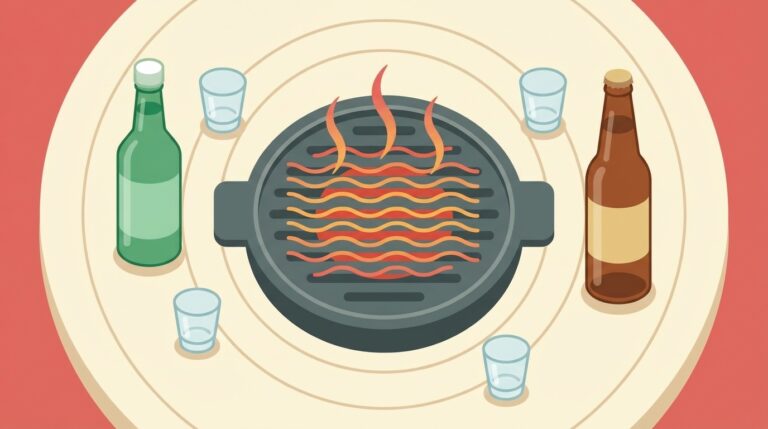
Hello! This is your Daily Hangul Editor. Have you ever watched a K-Drama where the main characters gather after a long, exhausting day? You know the scene: the sizzling sound of pork belly (Samgyeopsal) on the grill, the clinking of glasses, and suddenly, someone grabs a spoon, flicks their wrist, and pops open a beer bottle with a loud PONG! Then, they artfully balance a shot glass of Soju on two chopsticks over a pint of beer, slam their fist on the table, and—splash!—the famous Poktanju (bomb drink) is made.
While subtitles usually just say “Let’s drink!” or “Cheers!”, there is an entire unspoken language, a rigid hierarchy, and a lot of Nunchi (social awareness) happening at that table. If you ever find yourself at a Korean Hoesik (company dinner), knowing how to navigate this drinking culture won’t just save you from a massive hangover—it will instantly upgrade you to ‘Insider’ (Inssa) status among your Korean colleagues. Let’s dive into the fascinating, slightly intimidating, but incredibly fun world of Korean bomb drinks!
Phase 2: Deep Dive into Core Expressions
Here are the top three expressions you need to survive and thrive when Poktanju is being served.
1. 제가 한 잔 말아보겠습니다.
- Pronunciation: [Jega han jan marabogetseumnida] -> sounds like: jeh-gah hahn jahn mahl-ah-bo-get-seum-nee-dah
- Meaning: Literal: “I will try rolling a glass.” / Real Nuance: “Allow me to mix a bomb drink for us!”
- K-Culture Moment: The youngest employee or the self-proclaimed ‘drink master’ of the team stands up with a bottle of Soju in one hand and Cass (beer) in the other. Uttering this phrase instantly shifts the mood to ‘party mode’.
- Editor’s Insight: The verb 말다 (malda) usually means to “roll” (like rolling rice in seaweed to make Gimbap, or rice into soup). But in drinking slang, it means to mix alcohol, specifically Soju and beer (Somaek). It sounds active, confident, and very native!
- Situation Spectrum:
[🚫 Never] ———— [⚠️ Be Careful] ———— [✅ Go For It]
- Close Friends (Casual): ✅ (Use: “내가 한 잔 말아줄게!”)
- Co-workers (Semi-formal): ✅
- Boss/Elders (Formal): ⚠️ (Use polite form, but usually, superiors love it when juniors confidently offer to mix the drinks.)
- 🤔 Think About It: Why do Koreans use the word “roll” for mixing drinks? It reflects the physical swirling motion in the glass to perfectly blend the Soju and beer. Does your culture have a unique slang for mixing drinks?
2. 첫 잔은 원샷입니다!
- Pronunciation: [Cheot janeun wonsyasimnida] -> sounds like: chut jahn-eun won-syat-im-nee-dah
- Meaning: Literal: “The first glass is a one-shot!” / Real Nuance: “Bottoms up for the first round!”
- K-Culture Moment: Everyone has their newly minted Somaek in hand. The team leader gives a toast, and then shouts this phrase. You must drain the glass in one go.
- Editor’s Insight: “One-shot” is Konglish (Korean-English) for “bottoms up.” In Korean drinking culture, the first glass is almost always downed in one gulp to signify team unity and start the dinner with high energy.
- Situation Spectrum:
[🚫 Never] ———— [⚠️ Be Careful] ———— [✅ Go For It]
- Close Friends (Casual): ✅
- Co-workers (Semi-formal): ✅
- Boss/Elders (Formal): ⚠️ (Wait for the boss to say it first!)
- 🤔 Think About It: “One-shot” emphasizes collective action. Everyone drinks at the same time, at the same pace. How does this reflect Korea’s group-oriented culture (Woori culture)?
3. 저는 꺾어 마시겠습니다.
- Pronunciation: [Jeoneun kkeokkeo masigetseumnida] -> sounds like: juh-neun kkuh-kkuh mah-she-get-seum-nee-dah
- Meaning: Literal: “I will bend and drink.” / Real Nuance: “I’m going to take sips instead of downing it.”
- K-Culture Moment: You are three rounds deep. Your boss shouts “One-shot!” but your liver is begging for mercy. You politely smile, say this phrase, and take a modest sip.
- Editor’s Insight: 꺾다 (kkeokda) means to bend or break. Here, it implies “breaking” the drink into smaller sips. This is a brilliant survival phrase. It shows you know Korean slang while politely setting your boundaries.
- Situation Spectrum:
[🚫 Never] ———— [⚠️ Be Careful] ———— [✅ Go For It]
- Close Friends (Casual): ✅
- Co-workers (Semi-formal): ✅
- Boss/Elders (Formal): ✅ (Very useful for pacing yourself respectfully.)
- 🤔 Think About It: Koreans value harmony. Refusing a drink outright can sometimes kill the mood, so “bending” the drink is a clever compromise. How do you gracefully decline alcohol in your culture?
Phase 3: Textbook vs. Real Korean
Let’s see how language changes when the Soju starts flowing.
| Situation | 📖 Textbook Korean | 🗣️ Real Korean | 💡 Why the difference? |
|---|---|---|---|
| Mixing drinks | 맥주와 소주를 섞어 주세요. (Please mix beer and Soju.) | 소맥 한 잔 시원하게 말아주세요! (Mix up a cold glass of Somaek!) | ‘말다’ (to roll) is the universally accepted slang for making bomb drinks. |
| Bottoms up | 다 같이 마십시다. (Let’s all drink.) | 짠~ 원샷! (Cheers~ One-shot!) | Konglish like “원샷” is ingrained in modern Korean party culture. |
| Offering to pour | 술을 따라 드릴까요? (Shall I pour you alcohol?) | 한 잔 받으시죠! (Please receive a glass!) | “Receiving” a glass emphasizes the exchange of respect and affection. |
Bottom Note: At B2 level, using words like “말다” or “꺾어 마시다” will seriously impress native speakers because it shows you understand contextual slang, not just dictionary definitions.
Phase 4: Cultural Context — K-Culture Deep Dive
4-1. The Unspoken Rules (Non-Verbal Cues)
Knowing the words is only 50% of the battle. The other 50% is body language. When drinking with someone older or higher in rank:
1. Two Hands Always: When pouring, support your pouring arm with your free hand (touching your elbow or chest). When receiving, hold your glass with both hands.
2. The Head Turn: You must slightly turn your head and shoulders away from the senior person when you drink. Drinking while making direct eye contact with your boss is a major taboo!
4-2. K-Food Connection: The Golden Ratio
Somaek (Soju + Maekju/Beer) is the soulmate of Samgyeopsal (pork belly). Why? Korean pork BBQ is rich, fatty, and savory. The crisp, high-carbonation of Korean beer mixed with the sharp bite of Soju perfectly cleanses the palate. At a Hoesik, mastering the “Golden Ratio” (usually 3 parts Soju to 7 parts beer) is considered a highly respected skill. In fact, many beer glasses in Korea come with little measurements printed on the side just for making Somaek!
Phase 5: Real-Life Roleplay Scenario
Setting: Friday night, 7:30 PM. A smoky Samgyeopsal restaurant near Gangnam Station. The tables are covered in side dishes, and green Soju bottles are already multiplying. You are at a welcome dinner with your new Korean team.
Characters:
– YOU: A foreign employee on your first week in the Seoul office.
– Minsu (32): Your friendly, slightly energetic senior colleague who is the unofficial ‘MC’ of team dinners.
Dialogue:
Minsu: 자, 다들 잔 받으세요! 오늘 우리 새로운 팀원 환영회니까, 특별히 제가 제조하겠습니다!
(Ja, dadeul jan badeuseyo! Oneul uri saeroun timwon hwanyeonghoenikka, teukbyeolhi jega jejo-hagetseumnida!)
[English] Alright, everyone grab a glass! Since it’s a welcome party for our new team member today, I will personally craft the drinks!
(🎭 Stage Direction: Minsu grabs a Soju bottle, gives it a flashy shake, and hits the bottom with his elbow.)
YOU: 우와, 민수 대리님, 기술이 장난 아니신데요?
(Uwa, Minsu daerinim, gisuri jangnan anisindeyo?)
[English] Wow, Assistant Manager Minsu, your skills are no joke!
Minsu: 하하, 이 정도는 기본이죠. 자, 첫 잔은 원샷인 거 아시죠?
(Haha, i jeongdoneun gibonijyo. Ja, cheot janeun wonsyasin geo asijyo?)
[English] Haha, this is just the basics. Now, you know the first glass is a one-shot, right?
🔀 YOUR TURN! How do you respond?
– A) “저는 술 못 마십니다. 물 주세요.” (I can’t drink alcohol. Give me water.)
– B) “네! 원샷 하겠습니다!” (Yes! I’ll do a one-shot!)
– C) “아이고, 제가 술이 약해서… 꺾어 마시겠습니다.”✅ Best Choice: C — “Oh man, I’m a lightweight… I’ll take sips.”
Why? Option A is a bit too direct and might kill the mood (though it’s okay if you truly cannot drink for health/religious reasons, in which case asking for cider/cola is better). Option B is great if you can handle it! But Option C is the ultimate B2-level cultural flex. You acknowledge the mood, show you know the slang (“꺾어 마시다”), and protect your liver.
(Continuing with Choice C…)
Minsu: 오? ‘꺾어 마시다’라는 말도 알아요? 한국 사람 다 됐네요! 편하게 마셔요.
(O? ‘Kkeokkeo masida’raneun maldo arayo? Hanguk saram da dwaenneyo! Pyeonhage masyeoyo.)
[English] Oh? You even know the phrase ‘to sip/bend’? You’re practically Korean now! Drink comfortably.
Bonus Roleplay: The Refill (Jajak Taboo)
(🎭 Stage Direction: Your glass is empty. You reach for the Soju bottle to pour yourself a drink.)
Minsu: 앗! 잠깐만요! 한국에서는 자기 잔에 자기가 술을 따르면 안 돼요.
(At! Jamkkanmanyo! Hangugeseoneun jagi jane jagiga sureul ttareumyeon an dwaeyo.)
[English] Ah! Wait! In Korea, you shouldn’t pour alcohol into your own glass.
YOU: 아, 정말요? 몰랐어요.
(A, jeongmalyo? Mollasseoyo.)
[English] Oh, really? I didn’t know.
Minsu: 자작(pouring for yourself)하면 앞에 앉은 사람이 3년 동안 솔로가 된다는 농담이 있거든요. 제가 따라 드릴게요!
(Jajak-hamyeon ape anjeun sarami 3nyeon dongan solloga doendaneun nongdami itgeodeunyo. Jega ttara deurilgeyo!)
[English] There’s a joke that if you pour for yourself, the person sitting across from you will be single for 3 years. I’ll pour it for you!
Phase 6: 10-Second Shadowing Drill
Master the intonation to sound like a true Seoul office worker!
😊 부장님, / 제가 / 기가 막히게 / 한 잔 / 말아보겠습니다!
(Bujangnim, / jega / giga makige / han jan / marabogetseumnida!)
Boss, / I will / amazingly / one glass / mix! (I’ll mix a killer drink for us!)
Pro-tip: Put a strong, confident emphasis on 기가 막히게 (amazingly/mind-blowingly) to show your enthusiasm.
Phase 7: K-Culture Mini Dictionary
| Korean | Romanization | English | Contextual Meaning |
|---|---|---|---|
| 회식 | hoesik | Company Dinner | Not just eating, but a crucial extension of work where team bonding happens. |
| 소맥 | somaek | Soju + Beer | The ultimate Korean cocktail. Cheap, effective, and refreshing. |
| 건배사 | geonbaesa | Toast / Speech | A short speech made by a leader before everyone drinks. Can be stressful to prepare! |
| 눈치 | nunchi | Social intuition | Knowing when to pour an empty glass, when to laugh, and when to stop drinking. |
| 자작 | jajak | Pouring your own drink | Considered slightly sad or rude; you should pour for others and let them pour for you. |
Phase 8: Traveler Survival Kit
Even if you aren’t at a corporate Hoesik, you might visit a lively pub (Hof) or BBQ spot. Here are essential phrases:
🆘 Survival Expression #1
– 🇰🇷 “여기 카스 하나, 참이슬 하나 주세요!” (Yeogi kaseu hana, chamiseul hana juseyo!)
– 🗣️ yuh-gee cass ha-nah, cham-ee-seul ha-nah joo-seh-yo!
– 📍 Where to use: Any BBQ or Korean restaurant.
– 💡 Pro Tip: Naming the specific brand (Cass/Terra for beer, Chamisul/Jinro for Soju) sounds much more natural than just saying “beer and soju.”🆘 Survival Expression #2
– 🇰🇷 “앞접시 좀 주실 수 있나요?” (Apjeopsi jom jusil su innayo?)
– 🗣️ ahp-jeop-she jom joo-shil soo in-nah-yo?
– 📍 Where to use: When you want a small personal plate to share food from the main pot.📌 Editor’s Travel Note
– Call Buttons: Don’t wave your hands trying to catch a waiter’s eye! Look for the little bell (call button) on the table. Press it, and they will come running.
– Paying: You don’t ask for the check at the table. You bring the table number or the bill (usually left on your table) to the front counter to pay on your way out.
Phase 9: Critical Thinking Corner — “Going Deeper”
Language & Power in the Glass
Korean drinking culture is a fascinating microcosm of societal hierarchy. The rules of who pours, who receives with two hands, and who must turn their head to drink all stem from traditional Confucian respect for age and rank. However, the language of Poktanju (bomb drinks) acts as a great equalizer. When a junior employee confidently shouts, “제가 한 잔 말아보겠습니다!” (I will mix a glass!), the rigid corporate hierarchy temporarily melts away into a shared, collective experience. The alcohol itself becomes a tool to break down formal barriers, which is why Hoesik is seen as essential for building Jeong (deep emotional connection) in the workplace.
💬 Your Turn: In your culture, does drinking with your boss involve strict etiquette, or is it completely casual? Share your thoughts in the comments!
Phase 10: FAQ & Avoiding Mistakes
Q: “Can I completely refuse alcohol at a company dinner?”
Yes! Korea has changed a lot. While older generations might have pressured people, modern corporate culture is much stricter about not forcing drinks. You can politely say, “제가 술을 전혀 못 합니다” (I can’t drink at all), and ask for cider (Sprite) or cola. They will often pour your soda into a shot glass so you can still participate in the “Cheers!”
Q: “If my glass is half full, will someone top it up?”
Unlike Western wine culture, Koreans do not top up half-empty glasses (Cheomjan). You must wait until the glass is completely empty before someone pours you a new one.
❌ Common Mistake #1: Pouring alcohol into a glass that isn’t completely empty.
✅ Do This Instead: Wait until you see your colleague drink the last drop, then immediately grab the bottle and offer to pour!
Phase 11: Summary & Action Items
- One-Liner Summary: Surviving a Korean company dinner is all about the Golden Ratio of Somaek, reading the room (Nunchi), and knowing how to politely pace yourself!
Action Mission:
– 🥉 Bronze (Solo): Stand in front of a mirror, pretend to hold a Soju bottle, and confidently say, “제가 한 잔 말아보겠습니다!”
– 🥈 Silver (Online): Comment below with your favorite K-Drama drinking scene!
– 🥇 Gold (Real World): Next time you are at a Korean BBQ restaurant, order a Soju and a Beer, and try mixing a Somaek using a spoon to tap the bottom!
K-Culture Mission:
Watch an episode of My Mister or Itaewon Class. Pay close attention to the characters’ hands when they pour drinks for each other. Can you spot the ‘two-handed’ rule?
Phase 12: Quiz — Interactive Challenge
1. Situational Judgment: Your boss pours you a glass of Soju. What is the culturally correct way to drink it?
– A) Make strong eye contact, smile, and drink it with one hand.
– B) Hold the glass with two hands, turn your head to the side, and drink.
– C) Pour a drink for yourself immediately after.
2. Fill in the Blank:
“I can’t drink too much tonight, so I will ________ it.”
(오늘 너무 많이 못 마셔서, 저는 ______ 마시겠습니다.)
3. True or False: In Korea, it is considered polite to constantly top up your friend’s glass even if it’s still half full.
(Toggle for Answers)
- B (Turning your head is a key sign of respect!)
- 꺾어 (kkeokkeo – to sip/bend)
- False (Wait until the glass is completely empty before pouring!)
Frequently Asked Questions (FAQ)
Q: What does "제가 한 잔 말아보겠습니다." mean in Korean and how do you pronounce it?
A: In Korean, "제가 한 잔 말아보겠습니다." is pronounced [Jega han jan marabogetseumnida] and means: Literal: "I will try rolling a glass." / Real Nuance: "Allow me to mix a bomb drink for us!"
Q: What does "첫 잔은 원샷입니다!" mean in Korean and how do you pronounce it?
A: In Korean, "첫 잔은 원샷입니다!" is pronounced [Cheot janeun wonsyasimnida] and means: Literal: "The first glass is a one-shot!" / Real Nuance: "Bottoms up for the first round!"
Q: What does "저는 꺾어 마시겠습니다." mean in Korean and how do you pronounce it?
A: In Korean, "저는 꺾어 마시겠습니다." is pronounced [Jeoneun kkeokkeo masigetseumnida] and means: Literal: "I will bend and drink." / Real Nuance: "I'm going to take sips instead of downing it."







