The Hidden Reality Behind K-Drama Feasts: Navigating Korea’s ‘Um-sseu’ Survival Guide
Greeting! I am the Lead Editor of Daily Hangul.
Let’s set the scene: You are watching a historical K-Drama or a modern-day corporate dinner scene. The table is absolutely covered in banchan (side dishes), a massive seafood pancake (Haemul Pajeon), and endless bottles of traditional Makgeolli (rice wine). It looks glorious, generous, and infinitely delicious.
But as a veteran expat who has lived in Seoul for over a decade, a totally different thought crosses my mind when I see that mountain of leftover food: “Oh no… who is going to pay the environmental penalty fee for all that?”
Welcome to the C2-level reality of living and dining in South Korea. While Korean culture prides itself on incredible generosity and abundance when hosting guests, modern South Korea is also home to one of the world’s strictest and most technologically advanced food waste management systems (음식물 쓰레기 종량제).
If you’re an advanced learner planning to live in Korea, order delivery, or dine at authentic traditional restaurants, mastering the vocabulary and cultural nuances of food waste is an absolute survival skill. Let’s dive deep into the fascinating intersection of traditional Korean dining and cutting-edge eco-technology!
Phase 2: Core Expressions Deep Dive
At the C2 level, we move beyond “Where is the trash can?” and step into the realm of administrative terminology, societal norms, and advanced cultural nuances.
1. 음식물 쓰레기 종량제
- Pronunciation: [Eumsingmul sseuregi jongnyangje] / Think of it as: Eum-shing-mool seu-reh-gee jong-nyang-jeh
- Meaning: (Literal) Food waste volume-based fee system -> (Real nuance) The “Pay-As-You-Throw” (PAYT) system for food waste.
- K-Culture Moment: You move into a new apartment in Seoul. Instead of a standard trash can, the security guard hands you an RFID card. You must scan this card at a high-tech bin that literally weighs your leftover Kimchi-jjigae scraps and charges your monthly maintenance bill by the gram.
- Editor’s Insight: This isn’t just a vocabulary word; it’s a daily reality. The term 종량제 (Jongnyangje) means paying based on volume/weight. When you mention this word, Koreans will instantly know you are not just a tourist, but a true “local.”
- Situation Spectrum:
[🚫 절대 금지] ———— [⚠️ 주의] ———— [✅ 자유롭게]- Casual conversation with friends: ✅ (Usually shortened to just ‘음쓰’ – Um-sseu)
- Dealing with real estate agents / apartment guards: ✅ (Essential!)
- 🤔 Think About It: Why did Korea develop such an intense, high-tech system for food waste? Think about the geographical size of Korea, the high population density, and the naturally high moisture content of traditional Korean soups and fermented foods.
2. 드실 만큼만 덜어 가세요
- Pronunciation: [Deusil mangkeumman deoreo gaseyo] / Deu-shil man-keum-man duh-ruh gah-seh-yo
- Meaning: (Literal) Please take away only as much as you will eat -> (Real nuance) Don’t waste the food; take only what you can finish.
- K-Culture Moment: You are at a traditional Makgeolli bar or an all-you-can-eat Korean BBQ. The banchan is self-service. Above the kimchi and pickled radishes, there is a sternly written sign with this exact phrase, often accompanied by a threat of a 5,000 KRW fine.
- Editor’s Insight: Notice the use of the honorific 드시다 (to eat) instead of 먹다. Even when a restaurant is warning you not to be wasteful, they maintain a highly polite, customer-first tone. The verb 덜다 (to subtract/scoop out) is incredibly useful in Korean dining culture where sharing from a main pot is the norm.
- Situation Spectrum:
[🚫 절대 금지] ———— [⚠️ 주의] ———— [✅ 자유롭게]- Reading restaurant signs: ✅
- Host speaking to a guest: ✅
- Guest to guest: ⚠️ (Sounds a bit bossy unless used playfully)
3. 환경 부담금
- Pronunciation: [Hwangyeong budamgeum] / Hwan-gyung boo-dam-geum
- Meaning: (Literal) Environment burden money -> (Real nuance) Environmental penalty fee for leaving leftovers.
- K-Culture Moment: You confidently load up your plate with five different types of Jeon (Korean pancakes) at a traditional buffet, but you get full. The owner points to the sign: “환경 부담금 5,000원” (Environmental fee: 5,000 KRW).
- Editor’s Insight: “부담금” means a charge or levy. Restaurants use this term to shift the blame from “We want your money” to “We must protect the environment.” It’s a clever linguistic tool that appeals to civic duty rather than capitalist greed.
Phase 3: Textbook vs. Real Korean
| Situation | 📖 Textbook Korean | 🗣️ Real Korean | 💡 Why the difference? |
|---|---|---|---|
| Referring to food waste | 음식물 쓰레기 (Eumsingmul sseuregi) | 음쓰 (Um-sseu) | Koreans love 2-syllable abbreviations for everyday annoyances. It sounds casual and slightly dismissive of the chore. |
| Asking for a doggy bag | 남은 음식을 포장해 주시겠어요? (Could you pack the leftover food?) | 이거 포장돼요? / 싸주세요. (Can this be packed? / Wrap this up.) | Efficiency! Modern diners prefer fast, direct communication. ‘싸주세요’ implies wrapping it up quickly. |
| Throwing it away | 버려야 합니다. (You must throw it away.) | 음쓰통에 버려 / 종량제 봉투에 넣어. (Throw it in the Um-sseu bin / Put it in the Jongnyangje bag.) | Precision. In Korea, where you throw it is more important than the act of throwing itself. |
Bottom Note: At the C2 level, start using 음쓰 with your close Korean friends when complaining about house chores. They will be amazed by your native-like fluency!
Phase 4: Cultural Context — K-Culture Deep Dive
4-1. The ‘Nunchi’ of Waste Sorting
In Korea, taking out the trash is a highly visible social act. If you try to sneak a pork bone (돼지뼈) into the food waste bin, you will immediately feel the intense 눈치 (Nunchi – social pressure/gaze) of your neighbors or the apartment security guard.
Here is the golden rule of Korean food waste: “If a pig can’t eat it, it’s NOT food waste.”
Clam shells from your Jeonbokjuk (Abalone porridge)? General waste. Onion skins? General waste. Beef bones from Galbitang? General waste! Understanding this difference is the ultimate test of a true Korean local.
4-2. The Paradox of Traditional Dining vs. Eco-Tech
Historically, a Korean table setting (Bansang) was judged by the number of side dishes. A phrase like “상다리가 부러지게 차리다” (to set the table so heavily that its legs break) was the ultimate compliment for traditional hospitality.
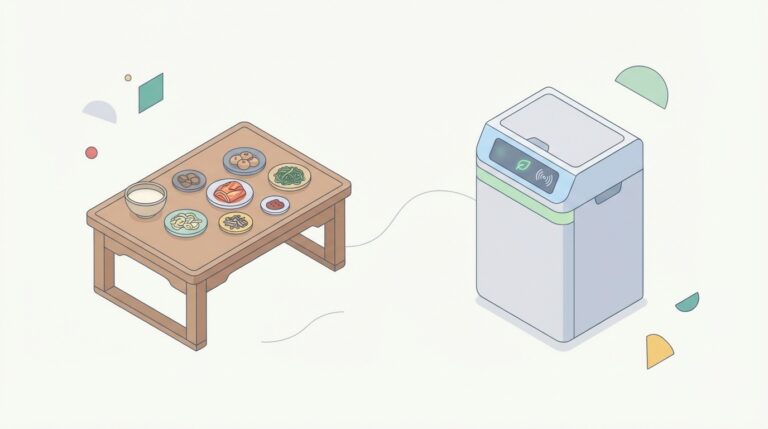
However, this cultural love for abundance directly clashed with modern environmental realities. To solve this, Korea introduced 감량화 기술 (Reduction Technologies). Now, many high-end traditional liquor bars and restaurants use smart dehydrators (음식물 처리기/감량기) in their kitchens to reduce the moisture and volume of leftovers before disposal. It’s a fascinating blend: consuming 500-year-old Makgeolli recipes while managing the waste with 21st-century RFID IoT technology!
Phase 5: Real-Life Roleplay Scenario
Setting: A rainy Friday night. You and your Korean coworkers are at a bustling, slightly noisy traditional Makgeolli tavern (Jumak) in Jongno. The table is already packed with half-eaten Dubu-kimchi and Dongdongju.
Characters:
* YOU (The Reader): An expat manager who has lived in Seoul for 3 years. You are eco-conscious and know the local rules.
* Min-su: Your enthusiastic Korean coworker who loves to show hospitality by over-ordering.
Dialogue:
민수: 비도 오는데, 우리 파전 하나 더 시킬까요? 막걸리가 남았잖아요! 🍶
(Bido oneunde, uri pajeon hana deo sikilkkayo? Makgeolliga namatjanayo!)
[Translation: It’s raining, should we order one more Pajeon (green onion pancake)? We still have Makgeolli left!]
YOU: 에이, 민수 씨. 우리 이미 너무 많이 시켰어요. 저기 남은 두부김치 좀 보세요.
(Ei, Min-su ssi. Uri imi neomu mani sikyeosseyo. Jeogi nameun dubugimchi jom boseyo.)
[Translation: Hey, Min-su. We’ve already ordered way too much. Look at the leftover Dubu-kimchi over there.]
민수: 원래 전집에 오면 상다리가 부러지게 먹는 거예요! 남으면 버리면 되죠.
(Wollae jeonjibe omyeon sangdariga bureojige meongneun geoyeyo! Nameumyeon beorimyeon doejo.)
[Translation: When you come to a pancake house, you’re supposed to eat until the table legs break! If there’s leftovers, we can just throw it away.]
🔀 Your Turn! How do you respond to Min-su? (Remember, you are a C2 speaker!)
- A) “안 돼요. 쓰레기 버리지 마세요.” (Too blunt, sounds like a textbook robot.)
- B) “요즘 식당들 음식 남기면 환경 부담금 내야 해요. 차라리 남은 걸 포장해서 내일 먹는 건 어때요?” (Sophisticated, polite, and culturally aware.)
- C) “헐, 대박 낭비. 음쓰 처리하기 귀찮잖아요!” (A bit too casual for a coworker setting, but very natural for close friends.)
✅ Best Choice: B. You smoothly bring up the ‘environmental fee’ (환경 부담금) to gently shut down the over-ordering without ruining the mood, and offer ‘packing it up’ (포장) as a practical alternative!
(🎭 Stage Direction: Min-su laughs, realizes you know Korean culture better than some locals, and calls the waiter to pack the food instead.)
민수: 와, 환경 부담금까지 알아요? 진짜 한국인 다 됐네요. 이모님! 여기 남은 것 좀 포장해 주세요!
(Wa, hwangyeong budamgeumkkaji arayo? Jinjja hangugin da dwaenneyo. Imonim! Yeogi nameun geot jom pojanghae juseyo!)
[Translation: Wow, you even know about the environmental fee? You’ve practically become fully Korean. Auntie (Waiter)! Please pack up the leftovers here!]
Phase 6: 10-Second Shadowing Drill
Let’s practice the rhythm and intonation of a sophisticated C2-level sentence. Pay attention to the pauses!
😤 단호하지만 부드럽게 (Firm but gentle):
음식물 쓰레기 / 줄이려면, / 처음부터 / 먹을 만큼만 / 덜어 먹는 게 / 중요해요.
(Eumsingmul sseuregi / juriryeomyeon, / cheoeumbuteo / meogeul mangkeumman / deoreo meongneun ge / jung-yohaeyo.)
[To reduce food waste, it’s important to take only what you can eat right from the start.]
Phase 7: K-Culture Mini Dictionary
| 한국어 | Romanization | English | Context & Nuance |
|---|---|---|---|
| 음쓰 | um-sseu | Food waste | Slang/abbreviation for 음식물 쓰레기. Used daily by locals complaining about chores. |
| 종량제 봉투 | jongnyangje bongtu | Standardized trash bag | The specific bags you must buy at convenience stores to throw away trash legally. |
| 상다리가 부러지다 | sangdariga bureojida | The table legs break | An idiom describing a table lavishly covered with an overwhelming amount of food. |
| 감량기 | gamnyanggi | Waste reducer/dehydrator | A popular high-tech home appliance in Korea that dries and grinds food waste to avoid the smell and weight fees. |
| 일반 쓰레기 | ilban sseuregi | General waste | Crucial distinction! Bones, shells, and tea bags go here, NOT in the food waste. |
Phase 8: Traveler Survival Kit
Even if you’re just visiting Korea and staying in an Airbnb, or eating out at traditional spots, you will encounter the food waste system.
🆘 Survival Phrases for Eco-Dining
* 🇰🇷 “이거 일반 쓰레기예요, 음식물 쓰레기예요?” (Igeo ilban sseuregiyeyo, eumsingmul sseuregiyeyo?)
* 🗣️ Sound guide: E-guh il-ban seu-reh-gee-yeh-yo, eum-shing-mool seu-reh-gee-yeh-yo?
* 📍 Where to use: Asking your Airbnb host or a convenience store worker where to throw away your Ramyeon leftovers.
* 🇰🇷 “반찬은 조금만 주세요.” (Banchan-eun jogeumman juseyo.)
* 🗣️ Sound guide: Ban-chan-eun jo-geum-man joo-seh-yo.
* 📍 Where to use: At a traditional restaurant when you know you can’t finish all the side dishes. It’s highly appreciated by restaurant owners today!📌 Editor’s Travel Note
* Where to buy bags: You cannot use regular plastic bags for trash in Korea. You must buy 종량제 봉투 at a local convenience store or supermarket.
* Specify your district: Trash bags are specific to the district (Gu). A bag bought in Gangnam cannot be used in Hongdae (Mapo-gu)!
Phase 9: Critical Thinking — “One Step Deeper”
🧠 Think Deeper: Food & Identity (음식과 정체성)
For decades, the core of Korean dining identity was Jeong (정) — affection expressed through overwhelming amounts of food. In the past, clearing your plate completely could actually signal to the host that they hadn’t provided enough, prompting them to refill your bowl. However, the introduction of the rigorous 음식물 쓰레기 종량제 (Volume-based fee system) in the early 2000s forced a massive cultural paradigm shift. Today, finishing everything perfectly or asking for “just a little bit” of banchan is no longer seen as rude; it is a sign of an educated, eco-conscious citizen. The language has shifted from “많이 드세요” (Eat a lot) to “먹을 만큼만 덜어 드세요” (Take only what you can eat). South Korea managed to hack its own cultural generosity using civic duty and advanced RFID technology.
💬 Your Turn: How does your home culture handle food waste? Is leaving food on the plate considered polite or wasteful? Share in the comments!
Phase 10: FAQ & Avoiding Misunderstandings
- Q: Can I ask the waiter to pack up leftover Banchan (side dishes)?
- A: NO. It is strictly against Korean etiquette to ask to pack up the free, refillable side dishes (banchan) because they are complimentary. You can only ask to pack up the main dish you paid for (like the leftover Pajeon or fried chicken).
- Q: Are chicken bones (치킨 뼈) food waste?
- A: NO. This is the #1 mistake foreigners make! Chicken bones, pork bones (from Gamjatang), and seafood shells are strictly 일반 쓰레기 (General Waste). Only soft things that animals can digest go into the ‘Um-sseu’.
- Q: Is it rude to decline a drink at a traditional liquor gathering?
- A: Maybe. In traditional company dinners, it used to be rude. But nowadays, it’s perfectly fine. Just say: “제가 술을 잘 못 해서요. 마음만 감사히 받겠습니다.” (I can’t drink well. But I gratefully accept your thought.)
❌ Common Mistake: Throwing away delivery food containers with soup still inside.
✅ Do this instead: You MUST pour the leftover soup down the sink (filtering the chunks into the food waste), rinse the plastic container, and recycle the plastic separately. Do not just throw the whole heavy container into the trash!
Phase 11: Summary & Action Items
One-Liner Summary: Surviving Korean dining means enjoying the traditional abundance of Jeong while strictly respecting the modern, high-tech Jongnyangje eco-rules.
Action Mission:
* 🥉 Bronze: Say “음식물 쓰레기 종량제” out loud 3 times without stumbling over the pronunciation.
* 🥈 Silver: Next time you eat at a Korean restaurant, practice saying “반찬은 조금만 주세요” (Please give me just a little banchan) to prevent waste.
* 🥇 Gold: Go to a Korean convenience store and successfully buy a 2-liter food waste bag: “가장 작은 음식물 쓰레기 봉투 하나 주세요!” (Please give me one of the smallest food waste bags!)
K-Culture Mission: Watch any modern K-Drama slice-of-life scene (like Hospital Playlist or Reply 1988). Notice how much time characters spend carefully separating their trash and food waste in the background. It’s a huge part of daily life!
Phase 12: Quiz — Interactive Challenge
1. Situational Judgment: You ordered a massive Gamjatang (Pork Bone Stew) for delivery. You finished the meat and broth. What do you do with the giant pork bones left in the bowl?
* A) Put them in the 음식물 쓰레기 (Food waste) bin. They came from food!
* B) Put them in the 일반 쓰레기 (General waste) bag.
* C) Flush them down the toilet.
2. Fill in the Blank:
“아, 쓰레기 버리러 가기 너무 귀찮아. 오늘 [ ] 당번은 누구야?”
(Ah, it’s so annoying to go throw away the trash. Who is on [ ] duty today?)
* Hint: The 2-syllable slang for food waste.
3. True or False — K-Culture Edition:
In Korea, leaving a little bit of food on your plate to show you are full is highly recommended to avoid the “Environmental Penalty Fee” (환경 부담금).
🚨 Click here for Answers!
- B is correct. Pork bones cannot be processed into animal feed, so they are legally classified as general waste. Putting them in food waste will earn you the anger of your neighbors!
- 음쓰 (Um-sseu). Very natural daily slang!
- False. Leaving food might actually cause you to pay the penalty fee at buffet-style places! It is best to take only what you can eat and leave a clean plate.
Frequently Asked Questions (FAQ)
Q: What does "음식물 쓰레기 종량제" mean in Korean and how do you pronounce it?
A: In Korean, "음식물 쓰레기 종량제" is pronounced [Eumsingmul sseuregi jongnyangje] and means: (Literal) Food waste volume-based fee system -> (Real nuance) The "Pay-As-You-Throw" (PAYT) system for food waste.
Q: What does "드실 만큼만 덜어 가세요" mean in Korean and how do you pronounce it?
A: In Korean, "드실 만큼만 덜어 가세요" is pronounced [Deusil mangkeumman deoreo gaseyo] and means: (Literal) Please take away only as much as you will eat -> (Real nuance) Don't waste the food; take only what you can finish.
Q: What does "환경 부담금" mean in Korean and how do you pronounce it?
A: In Korean, "환경 부담금" is pronounced [Hwangyeong budamgeum] and means: (Literal) Environment burden money -> (Real nuance) Environmental penalty fee for leaving leftovers.