

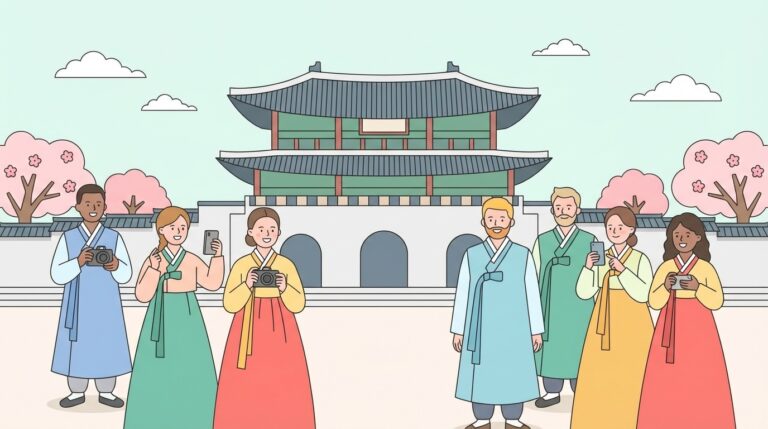
Renting a Hanbok in Korea: Speak Like a K-Drama Star!
Phase 1: Empathy (Welcome to the Scene)
Hello! I’m your Daily Hangul Editor. Imagine this: You’re walking toward Gyeongbokgung Palace on a crisp autumn day during Chuseok (Korean Thanksgiving). You see people gliding by in stunning, colorful traditional dresses. It looks exactly like a scene from Love in the Moonlight or The Red Sleeve!
You find a Hanbok rental shop, walk in, and… freeze. There are hundreds of skirts, ribbons, and hair accessories. The friendly shop owner (often called Imo, meaning auntie) is smiling at you, waiting for you to say something.
Sure, your textbook taught you how to say “Hello, I am American,” but how do you actually say, “Can I try this pink one?” or “Help me with my hair, please!”? Don’t worry. This guide is built from the real experiences of my students who successfully transformed into Joseon royalty. Let’s get you ready!
Phase 2: Core Expressions Deep Dive
Here are the top 3 phrases you need to survive and thrive in a Hanbok shop.
1. 이거 입어봐도 돼요? (Can I try this on?)
- Pronunciation: igeo ibeobwado dwaeyo? [Sounds like: ee-guh / ee-buh-bwa-do / dway-yo?]
- Meaning: Literal: Can I try wearing this? / Real nuance: I want to try this one on, is it okay?
- K-Culture Moment: In K-Dramas, this is the exact moment the protagonist picks out the most beautiful dress before the “makeover reveal” scene!
- Editor’s Insight: The ending
~아/어 봐도 돼요?is your magical “permission” key. You can use it anywhere in Korea—trying on clothes, tasting food, or taking a seat!- Situation Spectrum:
[🚫 Never] ———— [⚠️ Be Careful] ———— [✅ Freely]
- Close Friends (Casual): ⚠️ (Drop the ‘요’: 이거 입어봐도 돼?)
- Shop Owners/Clerks (Semi-formal): ✅
- Boss/Elders (Formal): 🚫 (Use: 입어봐도 될까요?)
- 🤔 Think About It: Why do Koreans ask for permission even when they are the paying customer? It reflects the culture of Nunchi (reading the room) and showing mutual respect.
2. 저한테 어울려요? (Does it look good on me?)
- Pronunciation: jeohante eoullyeoyo? [Sounds like: juh-han-te / uh-ool-lyuh-yo?]
- Meaning: Literal: Does it match me? / Real nuance: Does this look good on me?
- K-Culture Moment: Remember the K-Pop idol V-Live streams where they show off a new outfit and ask the fans, “Does it suit me?” This is that phrase!
- Editor’s Insight: Koreans love to give sincere feedback on style. Ask this to the shop owner, and she will immediately become your personal stylist.
- Situation Spectrum:
[🚫 Never] ———— [⚠️ Be Careful] ———— [✅ Freely]
- Friends (Casual): ⚠️ (Drop the ‘요’: 나한테 어울려?)
- Shop Owners (Semi-formal): ✅
- Formal: ⚠️
- 🤔 Think About It: In your culture, do you usually ask strangers for fashion advice? In Korea, shop owners are seen as enthusiastic experts eager to help you look your best.
3. 머리 예쁘게 해주세요! (Please do my hair beautifully!)
- Pronunciation: meori yeppeuge haejuseyo! [Sounds like: muh-ree / yep-pu-ge / hae-ju-se-yo!]
- Meaning: Literal: Please do my hair beautifully. / Real nuance: I’ll leave my hair styling in your expert hands!
- K-Culture Moment: Wearing a Hanbok isn’t complete without the Daenggi (traditional ribbon) and hair braiding. Say this with a bright smile, and the shop owner might give you extra hairpins for free!
- Editor’s Insight:
예쁘게(beautifully) +해주세요(please do it) is a cute, polite way to ask for a service. You can use it at hair salons and nail shops, too!- Situation Spectrum:
[🚫 Never] ———— [⚠️ Be Careful] ———— [✅ Freely]
- Friends (Casual): 🚫 (Too formal)
- Service Staff (Semi-formal): ✅ (Perfectly polite and sweet!)
- Boss/Elders (Formal): 🚫
- 🤔 Think About It: Does “Please make me pretty” sound a bit direct in English? In Korean, it’s a completely normal and friendly way to request a styling service.
Phase 3: Textbook vs. Real Korean
| Situation | 📖 Textbook Korean | 🗣️ Real Korean | 💡 Why the difference? |
|---|---|---|---|
| Choosing | “저는 이 한복을 대여하고 싶습니다.” (I want to rent this Hanbok.) | “이거 할게요.” (I’ll do this one.) | “~할게요” is the ultimate shortcut for “I’ll choose/buy/take this.” |
| Changing | “탈의실이 어디입니까?” (Where is the fitting room?) | “어디서 갈아입어요?” (Where do I change?) | People prefer active verbs over formal nouns in daily speech. |
| Price | “가격이 얼마입니까?” (What is the price?) | “두 시간에 얼마예요?” (How much for 2 hours?) | Practicality! Hanboks are usually rented by the hour. |
Bottom Note for A2 Learners: Don’t worry about memorizing long formal sentences. Short, polite phrases ending in ~요 are your best friends in Korea!
Phase 4: Cultural Context — K-Culture Deep Dive
4-1. The Non-Verbal “Nunchi” at the Shop
When you hand your shoes or clothes to the staff to put in a locker, try using two hands. It’s a small non-verbal gesture that screams, “I respect Korean culture!” The staff will immediately warm up to you.
4-2. The K-Travel Magic Trick: Free Palace Entry!
Did you know that if you wear a Hanbok, entry to Gyeongbokgung, Changdeokgung, and other grand palaces is 100% FREE? This is why you see so many tourists and locals wearing them during Korean holidays like Seollal (Lunar New Year) and Chuseok.
Critical View: While historical K-Dramas show strict rules about colors and classes (e.g., only the King wears red with gold dragons), modern Hanbok rentals offer “Fusion Hanboks” with glitter, lace, and neon colors. Some traditionalists dislike this, but it has undeniably made Hanbok fun and accessible globally!
Phase 5: Real-Life Roleplay Scenario
Setting: A bustling Hanbok rental shop in Bukchon Hanok Village. It’s a sunny Saturday morning.
Characters:
– YOU: An excited traveler wanting to visit the palace.
– 이모님 (Auntie/Shop Owner): A fast-moving, energetic Korean lady holding a tape measure.
이모님: 어서 오세요! 한복 보러 오셨어요?
(eoseo oseyo! hanbok boreo osyeosseoyo?)
[Welcome! Are you here to look at Hanboks?]
(🎭 Stage Direction: She quickly looks you up and down to guess your size.)
YOU: 네! 치마 먼저 골라도 돼요?
(ne! chima meonjeo gollado dwaeyo?)
[Yes! Can I pick the skirt first?]
이모님: 그럼요! 무슨 색 좋아해요? 핑크? 파란색?
(geureomyo! museun saek joahaeyo? pingkeu? paransaek?)
[Of course! What color do you like? Pink? Blue?]
YOU: 음… 이거 입어봐도 돼요?
(eum… igeo ibeobwado dwaeyo?)
[Hmm… Can I try this one on?]
이모님: 아이고, 예쁘네! 탈의실 저쪽이에요. 갈아입고 나오세요!
(aigo, yeppeune! taruisil jeojjogieyo. garaipgo naoseyo!)
[Oh my, it’s pretty! The fitting room is over there. Change and come out!]
(🎭 Stage Direction: You come out wearing the Hanbok. You look amazing!)
YOU: 저한테 어울려요?
(jeohante eoullyeoyo?)
[Does it look good on me?]
이모님: 대박! 완전 공주님이에요! 이리 와요, 머리 예쁘게 해줄게요.
(daebak! wanjeon gongjunimieyo! iri wayo, meori yeppeuge haejulgeyo.)
[Wow/Jackpot! You look exactly like a princess! Come here, I’ll do your hair beautifully.]
🔀 YOUR TURN! How do you reply?
– A) “얼마예요?” (How much is it?)
– B) “우와, 감사합니다! 머리 예쁘게 해주세요!” (Wow, thank you! Please do my hair beautifully!)
– C) “아니요, 괜찮아요.” (No, it’s okay.)✅ Best Choice: B — It matches her enthusiasm and politely accepts her offer!
⚠️ Choice A Analysis: Asking for the price right away ruins the magical “princess” moment. Ask for the price after the styling!
Phase 6: 10-Second Shadowing Drill
Let’s practice reading with the right feeling! ( / indicates a short pause)
- 🥺 (Looking hopeful) 저기요, / 이거 / 입어봐도 돼요?
(jeogiyo, / igeo / ibeobwado dwaeyo?) - 😊 (Excitedly) 우와! / 머리 / 예~~~~쁘게 해주세요!
(uwa! / meori / ye~~~~ppeuge haejuseyo!) - 🤩 (Striking a pose) 저한테 / 잘 어울려요?
(jeohante / jal eoullyeoyo?)
Phase 7: K-Culture Mini Dictionary
| Korean | Romanization | English | Context |
|---|---|---|---|
| 한복 | hanbok | Traditional Korean Clothes | Usually worn during holidays (Seollal, Chuseok) or weddings. |
| 저고리 | jeogori | Upper garment | The short jacket part of the Hanbok. |
| 치마 | chima | Skirt | The voluminous skirt worn by women. |
| 바지 | baji | Pants | The roomy pants worn by men. |
| 고궁 | gogung | Ancient Palaces | Places like Gyeongbokgung. Perfect photo spots! |
Phase 8: Traveler’s Survival Kit
🆘 Survival Phrases for the Rental Shop
– 🇰🇷 “짐 보관해 주세요.” (jim bogwanhae juseyo.)
– 🗣️ Meaning: Please keep my luggage/bag.
– 📍 Where to use: Before stepping out of the shop.
– 💡 Pro Tip: Most shops have free lockers for your personal clothes and bags while you rent the Hanbok!
- 🇰🇷 “두 시간에 얼마예요?” (du sigane eolmayeyo?)
- 🗣️ Meaning: How much is it for two hours?
- 📍 Where to use: At the checkout desk.
📌 Editor’s Travel Note
– Shoes: Bring comfortable walking shoes! Nobody will see them under the long skirt, and palace grounds are huge and sandy.
– Weather: In winter, wear thermal underwear (Heatech) under your Hanbok. It gets freezing!
Phase 9: Critical Thinking — “One Step Deeper”
Media vs. Reality: The Evolution of Hanbok
If you watch historical K-Dramas, Hanboks are strictly divided by social class. Silk for nobles, cotton for commoners. Today, however, renting a Hanbok near palaces has become a playful “theme park” activity. You’ll even see foreign guys wearing Queen’s dresses and local girls wearing King’s robes just for fun!
Some traditionalists argue that these shiny, lace-covered “Fusion Hanboks” distort Korean culture. But others argue that this trend has kept the Hanbok alive and globally loved in the 21st century.
💬 Your Turn: What do you think? Should traditional clothing be kept strict and authentic, or is it okay to modernize it for tourists to have fun? Share in the comments!
Phase 10: FAQ & Mistake Prevention
- Q: Can men wear skirts or women wear men’s clothing?
- A: YES! Cross-dressing in Hanbok is a huge trend in Korea right now. The shop owners will actually laugh and encourage you!
- Q: Do I have to pay extra for hair accessories?
- A: Maybe. Basic braiding is usually free, but fancy K-Drama-style hairpins might cost 2,000~5,000 won extra. Just ask: “이거 무료예요?” (Is this free?)
❌ Common Mistake: Dragging the skirt on the dirt floor.
✅ Do This Instead: When walking up stairs or over dirty puddles, gently lift the front of your skirt. The shop owners will appreciate you taking care of their beautiful clothes!
Phase 11: Summary & Action Items
One-Liner Summary: Use “이거 입어봐도 돼요?” to try on your dream Hanbok, and confidently ask “저한테 어울려요?” to get the best styling advice!
Action Mission 3 Steps:
– 🥉 Bronze (Solo): Look in the mirror and practice saying “머리 예쁘게 해주세요!” with a bright smile.
– 🥈 Silver (Online): Find a photo of your favorite K-Pop idol in a Hanbok and comment, “정말 잘 어울려요!” (It looks really good on you!).
– 🥇 Gold (Real Life): When you visit Korea, go to a rental shop and use these phrases exclusively without relying on a translation app!
K-Culture Mission:
Search “Hanbok Vlog” on YouTube and listen closely. Try to catch the moment the YouTuber asks to try something on!
Phase 12: Quiz — Interactive Challenge
Q1. Situational Judgment:
You picked a beautiful blue Hanbok. You want to ask the staff if you can try it on. What do you say?
1. 저한테 어울려요?
2. 이거 입어봐도 돼요?
3. 탈의실이 어디입니까?
Q2. True or False – K-Culture Edition:
If you wear a Hanbok, you must pay double to enter Gyeongbokgung Palace. (T/F)
Q3. Fill in the Blank:
You want the shop owner to style your hair nicely.
“머리 ( ______ ) 해주세요!”
(Answers: Q1-2, Q2-False [It’s FREE!], Q3-예쁘게)
Frequently Asked Questions (FAQ)
Q: What does "이거 입어봐도 돼요? (Can I try this on?)" mean in Korean and how do you pronounce it?
A: In Korean, "이거 입어봐도 돼요? (Can I try this on?)" is pronounced [igeo ibeobwado dwaeyo? [Sounds like: ee-guh / ee-buh-bwa-do / dway-yo?] and means: Literal: Can I try wearing this? / Real nuance: I want to try this one on, is it okay?
Q: What does "저한테 어울려요? (Does it look good on me?)" mean in Korean and how do you pronounce it?
A: In Korean, "저한테 어울려요? (Does it look good on me?)" is pronounced [jeohante eoullyeoyo? [Sounds like: juh-han-te / uh-ool-lyuh-yo?] and means: Literal: Does it match me? / Real nuance: Does this look good on me?
Q: What does "머리 예쁘게 해주세요! (Please do my hair beautifully!)" mean in Korean and how do you pronounce it?
A: In Korean, "머리 예쁘게 해주세요! (Please do my hair beautifully!)" is pronounced [meori yeppeuge haejuseyo! [Sounds like: muh-ree / yep-pu-ge / hae-ju-se-yo!] and means: Literal: Please do my hair beautifully. / Real nuance: I'll leave my hair styling in your expert hands!







